
Refinancing resets your loan term because it replaces your existing mortgage with an entirely new loan that carries its own repayment schedule and amortization structure. The term reset is a function of a new loan contract, not an automatic surrender to a 30-year timeline. You choose the new term during the application process, and that choice determines whether your debt extends, shortens, or stays roughly the same. Many homeowners assume refinancing automatically adds 30 years back to their mortgage. That misconception costs real money, and understanding the mechanics of how refinancing works puts you back in control.
Why refinancing resets the loan term: the mechanics explained
Refinancing technically resets the amortization clock because a new loan fully pays off the previous one, creating a fresh repayment schedule from day one. The Consumer Financial Protection Bureau (CFPB) classifies a refinance as a new credit transaction, which is why the term restarts rather than simply continuing where the old loan left off. Your original mortgage is closed. A new contract opens.
The most significant consequence of this reset involves amortization. Early payments on any mortgage are weighted heavily toward interest rather than principal. When you restart a 30-year loan after, say, 10 years of payments, you go back to paying mostly interest again. That means the equity you built through principal paydown slows considerably in the early years of the new loan.

The good news is that the term is entirely your decision. Borrowers can select terms of 15, 20, or 30 years, or request a custom term aligned with their remaining loan balance. A homeowner who has 18 years left on a 30-year mortgage can refinance into an 18-year loan and avoid any meaningful extension of their debt. The reset is real, but it does not have to work against you.
Pro Tip: Ask your lender for a custom loan term that matches your remaining payoff timeline. Most lenders can accommodate non-standard terms, and this single step prevents an unintended extension of your mortgage.
How does choosing a different loan term affect your mortgage?
The term you select at refinance shapes your monthly payment, total interest paid, and how quickly you build equity. Each option involves real trade-offs, and the right choice depends on your cash flow and long-term goals.
Shorter terms: pay less interest, pay more monthly
A shorter refinance term reduces the total interest you pay over the life of the loan and builds equity faster. The trade-off is a higher monthly payment. A homeowner refinancing a $350,000 balance from a 30-year into a 15-year fixed-rate mortgage will pay significantly more each month but save a substantial amount in interest over the loan’s life. This option suits homeowners with stable income who want to eliminate their mortgage sooner.
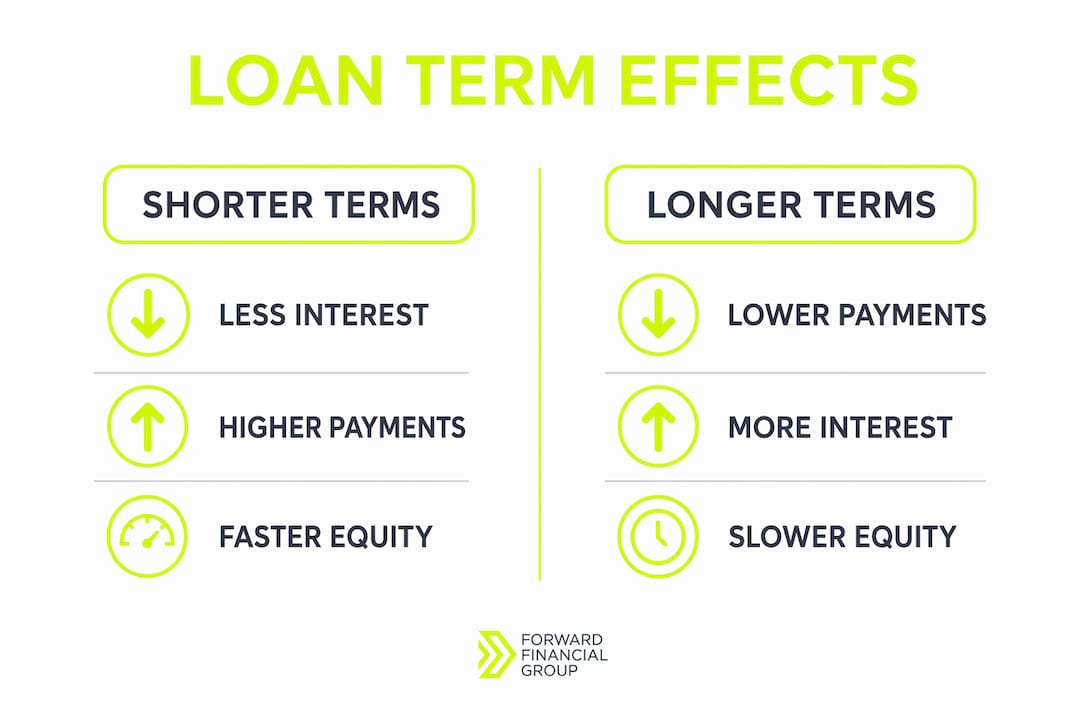
Longer terms: lower payments, more interest over time
Extending to a 30-year fixed-rate loan reduces monthly payments, which can provide real breathing room if your budget is tight. The cost is paying more interest over time, particularly because the amortization restarts from an interest-heavy position. Homeowners who refinance into a longer term after years of payments often end up paying more in total interest than they would have by staying with the original loan.
Keeping the same term to avoid resetting the clock
Matching the new loan term to your remaining balance period is the most overlooked option. If you have 22 years left, refinancing into a 22-year loan preserves your payoff timeline while still capturing a lower rate. This approach requires a lender willing to write a non-standard term, but it is the cleanest way to benefit from refinancing without extending your debt.
| Term choice | Monthly payment | Total interest | Payoff speed |
|---|---|---|---|
| Shorter (e.g., 15 years) | Higher | Lower | Faster |
| Same as remaining term | Unchanged | Moderate | Preserved |
| Longer (e.g., 30 years) | Lower | Higher | Slower |
Key considerations when choosing your term:
- Your current monthly budget and how much flexibility you have
- How many years remain on your existing mortgage
- Whether you plan to stay in the home long enough to benefit from the refinance
- Your equity goals and how quickly you want to own the home outright
What costs and timing factors determine if refinancing is worth it?
Refinancing is not free. Closing costs typically range from 2% to 6% of the total loan amount. On a $400,000 loan, that means $8,000 to $24,000 in upfront costs. Those costs must be recovered through monthly savings before refinancing delivers any real financial benefit.
The break-even point is the clearest measure of whether refinancing makes sense. Calculating your break-even means dividing total closing costs by your monthly savings. If closing costs are $10,000 and you save $250 per month, your break-even point is 40 months. Refinancing only benefits you if you stay in the home beyond that point.
The refinancing process itself takes time. Mortgage refinancing typically takes several weeks from application to closing, covering credit checks, rate shopping, underwriting, and final closing. Planning for that timeline prevents surprises and keeps the process moving.
Common mistakes homeowners make when refinancing:
- Refinancing for a rate drop of less than 0.75%, which rarely covers closing costs.
- Defaulting to a 30-year term without considering the amortization reset.
- Failing to calculate the break-even point before committing.
- Ignoring how long they plan to stay in the home.
- Overlooking appraisal fees, lender fees, and title costs in the total cost estimate.
Pro Tip: Run a break-even calculation before you apply. Divide your estimated closing costs by your projected monthly savings. If the result exceeds how long you plan to stay in the home, refinancing will cost you money rather than save it.
Refinancing becomes attractive when interest rates drop at least 0.75%, but that threshold alone does not guarantee savings. The full picture requires factoring in your remaining loan balance, your chosen term, and your total closing costs.
Practical strategies for managing your mortgage term when refinancing
Managing the impact of a loan term reset requires deliberate choices before and after closing. The following strategies help you maintain or reduce your overall mortgage duration even when refinancing extends the technical term.
- Match the term to your remaining balance period. If 19 years remain on your loan, request a 19-year or 20-year term. This preserves your payoff date while capturing a lower rate.
- Make extra principal payments after closing. Extra principal payments effectively shorten loan duration and reduce total interest paid. Even $100 to $200 per month above the required payment accelerates payoff meaningfully.
- Use a refinance calculator before you commit. Tools like the refinance calculator at David Mordue - Forward Financial Group let you model different term and rate combinations so you can see the real numbers before signing anything.
- Monitor your amortization schedule post-closing. Request an amortization table from your lender and track principal paydown each year. This keeps you aware of how the new loan is progressing and whether extra payments are having the intended effect.
- Combine a shorter term with affordability planning. If a 15-year payment feels tight, a 20-year term often provides a middle ground that reduces total interest without straining your monthly budget.
The goal is not simply to get a lower rate. The goal is to reduce total mortgage cost while keeping your payoff timeline aligned with your financial plan.
Key Takeaways
Refinancing resets your loan term because it creates a new loan contract with a new amortization schedule, but you control the term length and can avoid unnecessary debt extension.
| Point | Details |
|---|---|
| Term reset is a new contract | Refinancing closes your old loan and opens a new one with its own repayment schedule. |
| You choose the term length | Borrowers can select 15, 20, 30 years, or a custom term matching their remaining balance. |
| Amortization restarts | Early payments on the new loan are interest-heavy, slowing equity growth if the term extends. |
| Closing costs matter | Costs of 2%–6% of the loan amount must be recovered before refinancing delivers savings. |
| Extra payments offset extensions | Making additional principal payments after refinancing shortens loan duration and reduces interest. |
What I’ve learned from watching homeowners navigate term resets
The most common mistake I see is homeowners treating refinancing as a rate transaction and ignoring the term entirely. They focus on the lower monthly payment and sign a new 30-year loan without realizing they just added a decade or more back to their mortgage. The payment feels better. The total cost is much worse.
The second mistake is assuming the term is fixed at 30 years. Lenders can write custom terms, and most will accommodate a request for a non-standard payoff period. I have worked with homeowners who had 17 years left on their original loan and refinanced into a 17-year term at a lower rate. They kept their payoff date, reduced their monthly payment slightly, and saved thousands in interest. That outcome is available to most borrowers. Very few ask for it.
Closing costs deserve more attention than they typically get. A rate drop that looks attractive on paper can disappear entirely once you account for $12,000 to $18,000 in closing fees on a mid-sized loan. The break-even calculation is not optional. It is the single most important number in the refinancing decision.
My honest advice: do not refinance unless you have a clear answer to three questions. How long will you stay in this home? What term will you choose, and why? And have you calculated the exact month when your savings exceed your costs? If you cannot answer all three, you are not ready to refinance yet. Consulting a trusted mortgage advisor before you apply saves far more than any rate drop will.
— David Mordue
How David Mordue - Forward Financial Group can help you refinance with confidence
Refinancing is one of the most consequential financial decisions a homeowner makes. Getting the term right matters as much as getting the rate right.

David Mordue - Forward Financial Group offers personalized mortgage refinancing consultations, fully online applications, and funding in under 21 days. You can use the refinance calculator to model different term and rate scenarios before you commit. When you are ready to move forward, the mortgage refinance application connects you directly with expert guidance on term selection, closing cost analysis, and rate comparisons tailored to your financial goals. Clients consistently report significant monthly savings and a process that removes the guesswork from one of the biggest financial decisions they will make.
FAQ
Why does refinancing reset the loan term?
Refinancing replaces your existing mortgage with a new loan, which creates a new amortization schedule and repayment term from day one. The reset is a function of the new loan contract, not an automatic extension to 30 years.
Can I refinance without extending my loan term?
Yes. You can request a custom term that matches your remaining loan balance period, or choose a shorter standard term like 15 or 20 years. Most lenders accommodate non-standard terms when asked.
What are typical closing costs when refinancing?
Closing costs typically range from 2% to 6% of the total loan amount. These costs must be recovered through monthly savings before refinancing produces a net financial benefit.
How long does the refinancing process take?
The mortgage refinancing process typically takes several weeks from application to closing, covering credit checks, underwriting, and final settlement. Planning for this timeline prevents delays and keeps the process on track.
Does refinancing always increase total interest paid?
Not necessarily. Choosing a shorter term or making extra principal payments after closing can reduce total interest even after the amortization clock resets. The outcome depends on the term you select and how you manage payments after closing.