
Mortgage refinancing is the process of replacing your existing home loan with a new one, typically to secure a lower interest rate, reduce monthly payments, or change your loan term. Knowing when to refinance your mortgage can mean the difference between saving tens of thousands of dollars and paying more than you need to over the life of your loan. The decision depends on four core factors: current interest rates, your closing costs, your credit profile, and how long you plan to stay in the home. Get the timing right, and refinancing becomes one of the most effective financial moves a homeowner can make.
What financial factors determine the right time to refinance your mortgage?
The clearest signal that refinancing makes sense is a meaningful drop in interest rates. Industry guidelines suggest homeowners should consider refinancing when they can reduce their rate by 0.50% to 0.75% for long-term savings after costs. A 1% rate drop is a more definitive threshold for significant savings. The larger your loan balance, the more a rate reduction is worth in real dollars each month.
Closing costs are the other side of the equation. Refinancing costs often range from 3% to 6% of the loan principal. That means on a $300,000 loan, you could pay $9,000 to $18,000 upfront to refinance. Those costs must be recovered through monthly savings before refinancing delivers any real benefit.

How to calculate your break-even point
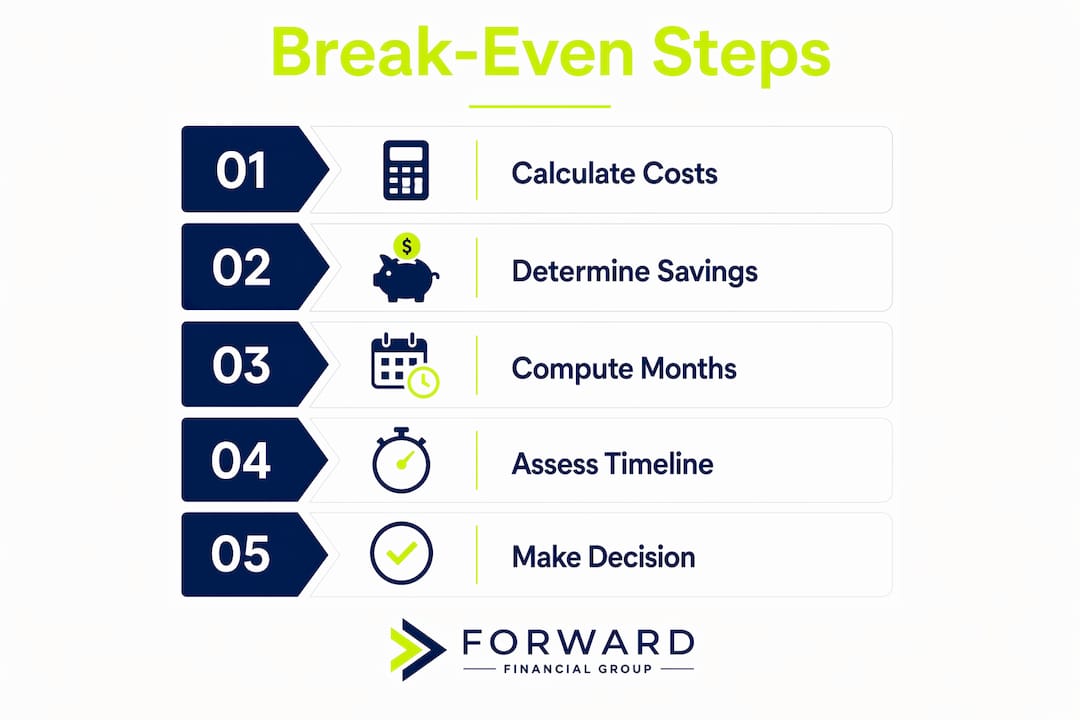
The break-even point is the number of months it takes for your monthly savings to cover your closing costs. The formula is simple: divide total closing costs by monthly savings.
Closing Costs | Monthly Savings | Break-Even Point |
|---|---|---|
$6,000 | $150 | 40 months (3.3 years) |
$12,000 | $200 | 60 months (5 years) |
$9,000 | $300 | 30 months (2.5 years) |
If your break-even point is 60 months and you plan to stay in the home for 7 years, refinancing makes clear financial sense. If you plan to move in 3 years, it does not.
A smaller loan balance produces smaller monthly savings, which pushes the break-even point further out
A larger rate reduction compresses the break-even period and accelerates total savings
Rolling closing costs into the new loan eliminates upfront expense but increases the loan balance and total interest paid
Pro Tip: Use the refinance calculator at Davidmordue to enter your current rate, new rate, and closing costs. The tool calculates your exact break-even timeline in minutes.
How does your personal timeline affect refinancing benefits?
Your planned time in the home is as important as the rate drop itself. Financial experts emphasize balancing interest rate savings against your planned time in the home, noting that short stay plans reduce refinance benefits significantly. If you plan to move within 1–2 years, refinancing costs often outweigh interest savings, making it generally unwise to proceed. Experts recommend staying put for at least 5 years to realize meaningful savings from a refinance.
Think of it this way: refinancing is a front-loaded cost with a back-loaded reward. You pay the closing costs today and collect the savings month by month over years. The longer you stay, the more you collect.
Credit score thresholds that affect your rate
Your credit score directly determines the interest rate a lender will offer you. Mortgage rates are best for borrowers with credit scores in the high 700s or above. Waiting a few months to improve your credit score before applying can reduce the interest rate you are offered, which compounds into significant savings over a 15 or 30-year term.
A score below 700 may still qualify you for refinancing, but the rate offered will be higher
Paying down revolving credit card balances is one of the fastest ways to lift your score
Avoiding new credit applications in the months before refinancing prevents unnecessary hard inquiries
Checking your credit report through AnnualCreditReport.com for errors before applying costs nothing and can catch score-damaging mistakes
Pro Tip: If your score is in the mid-600s, give yourself 3–6 months to pay down balances and dispute any errors before applying. The rate improvement you earn can outweigh the cost of waiting.
Comparing refinance types: which option fits your goal?
Not all refinances serve the same purpose. Understanding the type of refinance you need helps you evaluate whether the cost is justified.
No-cash-out refinance replaces your existing loan with a new one at a lower rate or shorter term, without pulling equity from the home. Freddie Mac notes that a no-cash-out refinance should be evaluated based on total lifetime interest, not just immediate monthly savings. A lower monthly payment that comes with a reset 30-year term can cost you more in total interest than your original loan.
Cash-out refinance lets you borrow more than you owe and receive the difference in cash. Homeowners use this to fund renovations, pay off high-interest debt, or cover major expenses. The tradeoff is a larger loan balance and potentially a higher rate than a no-cash-out refinance.
Term changes are a third lever. Refinancing to a longer term reduces monthly payments but increases total interest paid. Refinancing to a shorter term, such as moving from a 30-year to a 15-year fixed-rate mortgage, raises your monthly payment but saves a substantial amount in interest over time. Shorter loan terms also carry lower rates in most market conditions.
One underused benefit of refinancing is the ability to drop private mortgage insurance, or PMI. If your home has appreciated and your loan-to-value ratio has fallen below 80%, a new appraisal through the refinance process can eliminate PMI entirely. That savings alone can justify the cost of refinancing in some cases.
Typical fees involved in any refinance include:
Appraisal fee: generally $300–$600
Loan origination fee: often 0.5%–1% of the loan amount
Title search and insurance
Credit report fee
Prepaid interest and escrow setup
How to refinance your mortgage: a step-by-step process
Executing a refinance efficiently protects your credit score and gets you to closing faster.
Check your credit and finances. Pull your credit report, calculate your home equity, and confirm your debt-to-income ratio. Lenders generally want a debt-to-income ratio below 43%.
Set your goal. Decide whether you are refinancing for a lower rate, a shorter term, cash out, or to drop PMI. Your goal determines which loan product fits.
Shop multiple lenders within 14 days. Rate shopping within a 14-day window counts as a single hard credit inquiry, minimizing credit score impact while you compare offers. Get at least three Loan Estimates to compare rates, fees, and terms side by side.
Submit your application and documentation. Lenders require recent pay stubs, W-2s, tax returns, bank statements, and a copy of your homeowner's insurance. Self-employed borrowers typically need two years of business tax returns.
Receive your Loan Estimate. Federal law requires lenders to provide a Loan Estimate within 3 days of your application. Review it carefully for rate, APR, closing costs, and monthly payment.
Complete underwriting and appraisal. The refinancing process usually takes 2–4 weeks for underwriting and approval. An appraiser will visit your home to confirm its current market value.
Close and exercise your rights. At closing, review all documents before signing. Federal law grants a 3-day right of rescission for primary residence refinances, allowing you to cancel without penalty within that window.
Pro Tip: Avoid applying for new credit cards or auto loans between application and closing. New credit inquiries can delay underwriting and affect your final rate.
One critical mistake to avoid: refinancing resets the amortization schedule. Restarting a 30-year term after 10 years of payments reintroduces interest-heavy early payments and increases total interest paid. If you are 10 years into a 30-year loan, consider refinancing into a 20-year term instead of a new 30-year term to preserve your payoff progress.
Key takeaways
The best time to refinance your mortgage is when your rate savings exceed your closing costs before your planned move-out date, and your credit score qualifies you for the lowest available rate.
Point | Details |
|---|---|
Rate drop threshold | A 0.5%–1% rate reduction is the standard benchmark for refinancing to make financial sense. |
Break-even calculation | Divide total closing costs by monthly savings to find how many months until refinancing pays off. |
Stay duration matters | Plan to stay at least 5 years post-refinance to recoup closing costs and realize net savings. |
Credit score impact | Scores in the high 700s or above unlock the best refinance rates; improving credit before applying pays off. |
Amortization reset risk | Restarting a 30-year term late in your loan increases total interest paid, even with a lower rate. |
What I've learned from watching homeowners refinance at the wrong time
I have worked with hundreds of homeowners on refinancing decisions, and the most common mistake I see is acting on rate headlines without running the actual numbers. A 0.5% rate drop sounds meaningful, but on a $150,000 remaining balance, the monthly savings may be modest. After $8,000 in closing costs, the break-even point stretches past 5 years. If that homeowner plans to sell in 4 years, they lose money on the refinance.
The second pattern I see is homeowners who wait too long. They hold out for a rate that is 1% lower than what is available today, and in the meantime they pay thousands in unnecessary interest. The perfect rate rarely arrives. The right rate is the one that clears your break-even point before you move.
The third issue is ignoring the amortization reset. I have seen homeowners who are 12 years into a 30-year mortgage refinance into a new 30-year loan to lower their monthly payment. Their payment drops by $180 a month, but they add 12 years of payments back onto their loan. The total interest cost over the life of the loan increases significantly. A 20-year or 15-year refinance would have served them far better.
My honest advice: run three numbers before you call a lender. Know your break-even point, your planned stay duration, and your total interest cost under both scenarios. Those three figures tell you everything you need to know.
— David
Ready to find out if refinancing makes sense for you?
If you have been watching rates and wondering whether now is the right time to act, the answer starts with your personal numbers, not the headlines.

Davidmordue makes it straightforward to assess your refinancing options. Use the refinance savings calculator to enter your current loan details and see your break-even point in real time. When you are ready to move forward, Davidmordue's fully online application process can take you from application to funding in less than 21 days. Check current refinance rates and connect with a mortgage advisor who will compare options across lenders to find the terms that fit your financial goals. No pressure, no guesswork.
FAQ
What is the minimum rate drop that justifies refinancing?
Most financial guidelines recommend a rate reduction of at least 0.50% to 0.75% to justify refinancing after accounting for closing costs. A 1% drop is a stronger threshold that typically produces clear long-term savings.
How long does the refinancing process take?
The refinancing process typically takes 2–4 weeks from application through underwriting and approval. Your first payment on the new loan is generally due 30–60 days after closing.
Can I refinance with a credit score below 700?
You can refinance with a score below 700, but the rate offered will be higher than what borrowers in the high 700s receive. Improving your credit score before applying, even by a few months, can meaningfully reduce your rate and total interest cost.
What is the right of rescission in a refinance?
The right of rescission gives you 3 days to cancel a refinance on your primary residence after closing, without any penalty. This federal protection applies to most refinances and is worth knowing before you sign.
Does refinancing hurt my credit score?
Rate shopping with multiple lenders within a 14-day window counts as a single hard inquiry to credit scoring models, so comparing offers does not compound the impact on your score. The overall credit effect of refinancing is typically minor and temporary.