
When you need home financing quickly, the fastest routes are an existing HELOC draw (same-day to 48 hours), a personal loan (one to three days), hard-money lending (five to ten days), or a bridge or portfolio loan (two to three weeks). If you already have a mortgage and are struggling to make payments, the single most important first action is to contact your mortgage servicer immediately. Proactive outreach unlocks loss mitigation options, including forbearance and repayment plans, before any foreclosure process begins. For borrowers who need new financing fast, calling a mortgage broker or experienced loan officer is the equivalent first move.
Three documents to have ready before you make that call:
- Government-issued photo ID (driver’s license or passport)
- Two most recent pay stubs or proof of income
- Two most recent bank statements (all pages)
Your 24–hour action checklist:
- Contact your mortgage servicer (if behind on payments) or a licensed broker/loan officer (if seeking new financing)
- Pull your credit report at AnnualCreditReport.com and note your score
- Assemble the full document package listed in Section 5
- Identify which loan route fits your situation using the comparison table in Section 2
- Schedule a free consultation with a HUD-approved housing counselor if you are facing hardship
Table of Contents
- Which loan types exist and what makes each useful for urgent situations?
- How do loan terms and rate types affect speed and eligibility?
- What do lenders check, and which programs are easier to qualify for?
- What documents do you need, and how long will each route take?
- How can you get approved faster? A prioritized action plan
- What does an urgent home loan actually cost?
- How do you compare lenders quickly when time is short?
- What should you do right now? Your 24–72 hour action plan
- Key Takeaways
- When does using a mortgage broker actually speed things up?
- Fast pre-approval starts here with David Mordue - Forward Financial Group
- Useful sources and further reading
Which loan types exist and what makes each useful for urgent situations?
Understanding your options is the foundation of any solid urgent home loan options guide. Each program has a different speed profile, eligibility bar, and cost structure. Here is a clear breakdown.
Conventional mortgage
A conventional loan conforms to Fannie Mae or Freddie Mac guidelines and typically requires a credit score of 620 or higher, a down payment in a moderate to higher range, and several weeks to close with an experienced lender. It is the right choice for borrowers with solid credit who want the lowest long-term cost. The tradeoff: underwriting is thorough, and appraisal scheduling can add a week or more.
- Best for: Borrowers with good credit and stable income buying or refinancing a primary home
- Pros: Competitive rates, no upfront mortgage insurance with 20% down, widely available
- Cons: Stricter documentation, slower than portfolio or hard-money options
FHA loan
The FHA loan program, managed by the Federal Housing Administration under HUD, accepts credit scores as low as 580 with a 3.5% down payment, or as low as 500 with 10% down. Closing timelines run 30–45 days, similar to conventional, but the lower credit bar makes it one of the more accessible programs for borrowers who have had credit challenges. FHA loans carry an upfront mortgage insurance premium (MIP), plus an annual MIP.
- Best for: First-time buyers or borrowers with credit scores in the 580–620 range
- Pros: Low down payment, flexible credit requirements, government-backed eligibility
- Cons: MIP adds cost; property must meet FHA condition standards, which can slow appraisal
VA loan
VA loans are available to eligible veterans, active-duty service members, and surviving spouses. There is no down payment requirement and no private mortgage insurance. Credit expectations vary by lender but commonly sit around 620. Closing typically takes 30–45 days, though VA appraisals (called VA appraisals or “tidewater” reviews) can occasionally add time. For eligible borrowers, this is one of the most cost-effective fast-track options available. See the VA loan overview for eligibility details.
- Best for: Veterans and active-duty military who want zero down and no PMI
- Pros: No down payment, no PMI, competitive rates
- Cons: VA appraisal process can be slower; funding fee applies (waived for some veterans)
USDA loan
USDA loans are backed by the U.S. Department of Agriculture and are limited to eligible rural and suburban areas. They require no down payment and carry income limits. Credit expectations typically start around 640 for automated underwriting. Closing timelines run 30–45 days, but USDA loans require an additional review by the USDA Rural Development office, which can add one to three weeks. Speed is not this program’s strength.
- Best for: Low-to-moderate income buyers purchasing in eligible rural areas
- Pros: No down payment, below-market guarantee fee
- Cons: Geographic and income restrictions; slower due to USDA review layer
Jumbo loan
Jumbo loans exceed the conforming loan limits set by the Federal Housing Finance Agency and require stronger credit, larger reserves, and a higher down payment. Underwriting is more intensive, and timelines often run several weeks. For high-value properties where urgency is a factor, a jumbo loan is the right product, but it is rarely the fastest one.
- Best for: Buyers financing high-value properties above conforming limits
- Pros: Allows financing of luxury or high-cost-area homes
- Cons: Stricter credit and reserve requirements; slower underwriting
Portfolio loan
Portfolio loans are held by the lender rather than sold to Fannie Mae or Freddie Mac, allowing flexible underwriting rules and are valuable for certain borrowers. Timelines can be roughly a few weeks with an efficient lender. DSCR loans, a common portfolio product for investors, use rental income rather than personal income for qualification. Learn more about DSCR portfolio loans for investment scenarios.
- Best for: Self-employed borrowers, investors, or those with non-traditional income
- Pros: Flexible underwriting, faster than conventional in some cases
- Cons: Higher rates than conforming loans; terms vary widely by lender
Bridge loan
A bridge loan provides short-term financing to cover the gap between buying a new home and selling an existing one. Lenders usually require significant equity in the departing property. Funding can happen in a few weeks. The cost is higher than a conventional mortgage, with rates often several percentage points above prime.
- Best for: Homeowners who need to buy before their current home sells
- Pros: Removes contingency, speeds purchase timeline
- Cons: High interest rates, short repayment window, equity-dependent
Hard-money loan
Hard-money lenders are private investors or companies that lend based primarily on the property’s value rather than the borrower’s credit profile. Funding can happen in five to ten business days. Rates are significantly higher (often 10–15% or more), and terms are short (six to twenty-four months). Hard-money loans are a last resort for most owner-occupants but a practical tool for real estate investors or borrowers who need to close immediately and plan to refinance quickly.
- Best for: Investors, fix-and-flip buyers, or borrowers who cannot qualify elsewhere and need immediate funds
- Pros: Fastest funding available, minimal credit requirements
- Cons: High rates and fees, short terms, significant risk if exit strategy fails
HELOC
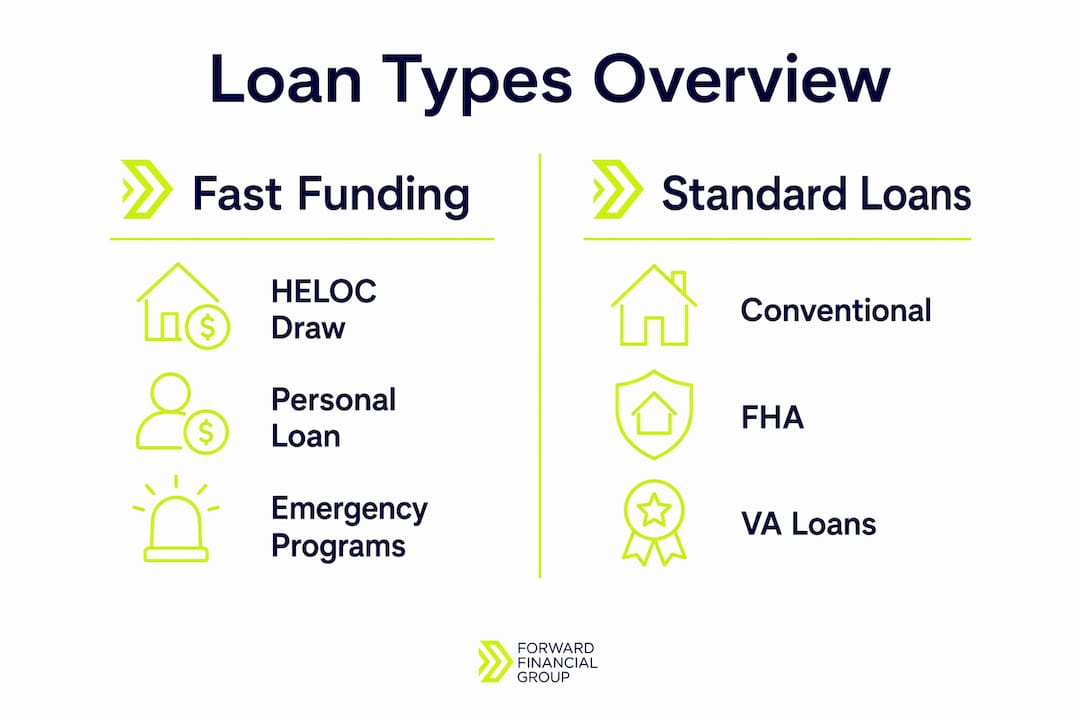
A home equity line of credit (HELOC) is the fastest option for homeowners who already have one open. Drawing on an existing HELOC can happen same-day to 48 hours. Opening a new HELOC typically takes several weeks. HELOCs carry variable interest rates and require sufficient home equity. For emergency home repairs or short-term cash needs, personal loans and HELOC draws consistently outpace mortgage-based products on speed because they skip the full mortgage appraisal and underwriting process.
- Best for: Homeowners with existing equity who need fast, flexible access to cash
- Pros: Fast draw if already open, interest-only payment options, revolving credit
- Cons: Variable rate risk, requires equity, new HELOC takes weeks to open
Loan type comparison
| Loan Type | Best For | Typical Credit Score | Typical Down Payment | Typical Timeline | Key Cost Note |
|---|---|---|---|---|---|
| Conventional | Good-credit buyers/refinancers | Higher credit | Moderate to high down payment | Several weeks | PMI may apply for lower down payments |
| FHA | Lower credit, first-time buyers | Lower credit accepted | Low down payment | Several weeks | MIP applies |
| VA | Eligible veterans/military | Credit requirements vary | No down payment | Several weeks | Funding fee may apply |
| USDA | Rural/suburban low-income buyers | Credit requirements vary | No down payment | Several weeks | Guarantee fee may apply |
| Jumbo | High-value property buyers | Higher credit required | Higher down payment | Several weeks | Higher reserves required |
| Portfolio | Self-employed, investors | Flexible credit | Varies down payment | A few weeks | Potentially higher rates |
| Bridge | Buying before selling | Credit requirements vary | Equity based | A few weeks | Higher short-term rates |
| Hard-money | Investors, urgent closings | Minimal credit | Higher down payment | About one to two weeks | Higher rates and fees |
| HELOC (existing) | Homeowners needing fast cash | Credit requirements vary | Equity based | Very fast funding | Variable rate |
How do loan terms and rate types affect speed and eligibility?
When urgency is the priority, the structure of your loan matters as much as the program you choose.

Fixed vs. adjustable rate: A fixed-rate mortgage locks your interest rate for the life of the loan, giving you predictable payments. An adjustable-rate mortgage (ARM) starts with a lower initial rate for a set period (commonly five or seven years) before adjusting annually. ARMs can sometimes help borrowers qualify for a larger loan amount because the initial payment is lower, which may reduce the debt-to-income (DTI) ratio enough to pass underwriting. For a borrower who plans to sell or refinance within five years, an ARM can be a cost-effective fast-track tool.
15-year vs. 30-year term: A 30-year fixed mortgage spreads payments over a longer period, lowering the monthly obligation and often making it easier to meet DTI requirements. A 15-year fixed mortgage carries a lower rate but a higher monthly payment, which can strain DTI for borrowers already stretched thin. For urgent situations where qualifying quickly is the goal, the 30-year term is usually the more accessible choice.
Key tradeoffs to weigh:
- An ARM’s lower initial rate can help you qualify faster, but rate adjustments after the fixed period add long-term uncertainty
- A shorter term saves significant interest over time but raises the monthly payment, potentially disqualifying you from some programs
- For hard-money or bridge loans, term length is less relevant because the exit strategy (sale or refinance) determines the real cost
- If you plan to refinance once your situation stabilizes, starting with an ARM or a higher-rate portfolio loan is a reasonable short-term decision
What do lenders check, and which programs are easier to qualify for?
Every lender, regardless of program, reviews the same core factors. Knowing where you stand on each one tells you which route is realistic right now.
Standard underwriting checks:
- Credit score: The primary gateway. FHA accepts 580+; conventional requires 620+; jumbo typically requires 700+; hard-money lenders often skip this entirely
- Income verification: Pay stubs, W-2s, 1099s, or bank statements (for bank statement loans)
- Employment history: Two years of consistent employment is the standard for conventional and FHA; portfolio lenders are more flexible
- Debt-to-income ratio (DTI): Most conventional programs cap DTI at 45–50%; FHA allows up to 57% in some cases with compensating factors
- Assets and reserves: Lenders want to see enough cash to cover closing costs plus one to six months of mortgage payments
- Title and property condition: The property must have clear title and meet minimum condition standards (FHA and VA are stricter here than conventional)
- Occupancy: Primary residence, second home, and investment property each carry different requirements and rates
Which programs are typically more forgiving:
- FHA is the most accessible government-backed program for borrowers with credit challenges or limited down payment funds
- VA offers the best terms for eligible veterans, with no down payment and no PMI, though the appraisal process can be strict
- Portfolio loans are the most flexible for self-employed borrowers or those with non-traditional income, since the lender sets its own rules
- Hard-money loans have the lowest qualification bar but the highest cost; they are practical only when speed is non-negotiable and an exit strategy is clear
Practical qualification checklist:
- [ ] Know your credit score before you apply
- [ ] Calculate your DTI (total monthly debt payments divided by gross monthly income)
- [ ] Confirm you have enough reserves for closing costs plus at least one month of payments
- [ ] Verify the property meets the condition standards of your target program
- [ ] Confirm your employment history is documentable for the past two years
- [ ] If self-employed, have two years of tax returns and year-to-date profit-and-loss statements ready
Fannie Mae’s relief options also outline refinance and loan modification paths for homeowners already in a Fannie-backed loan who need to restructure quickly.
What documents do you need, and how long will each route take?
Organized documentation is the single biggest variable you control in the approval timeline. Lenders who receive a complete package move faster. Those who have to chase missing items add days, sometimes weeks.
Full document checklist:
- Government-issued photo ID (driver’s license, passport)
- Two most recent pay stubs (or 60 days of bank statements if self-employed)
- W-2s or 1099s for the past two years
- Federal tax returns for the past two years (all pages, all schedules)
- Two to three months of bank statements (all pages, all accounts)
- Asset and investment account statements
- Proof of reserves (separate from down payment funds)
- Gift letter (if any portion of the down payment is a gift)
- Employer contact information for employment verification
- Homeowner’s insurance declaration page or binder
- Social Security number for credit authorization
Pro Tip: Use a lender that supports automated asset verification (such as Fannie Mae’s Day 1 Certainty program or similar bank-connection tools). Connecting your bank account directly can replace weeks of paper statement gathering with a same-day verification, shaving real time off underwriting.
Realistic timeline by funding route:
| Funding Route | Typical Timeline | Key Speed Factor | Notes |
|---|---|---|---|
| Existing HELOC draw | Same day–48 hours | No new underwriting needed | Requires open HELOC with available credit |
| Personal loan | 1–3 days | No appraisal or mortgage underwriting | Higher rate; fast funding option for repairs |
| Contractor financing | 1–5 days | Lender is the contractor’s partner | Limited to repair/renovation scope |
| Hard-money loan | 5–10 business days | Asset-based, minimal docs | High cost; short term |
| Bridge/portfolio loan | 14–21 days | Lender holds loan in-house | Flexible underwriting, higher rate |
| FHA/conventional (expedited) | 21–30 days | Experienced lender, complete docs | Standard appraisal adds 5–10 days |
| FHA/conventional (standard) | 30–45 days | Full underwriting cycle | Most common timeline |
| USDA loan | 45–60 days | USDA review adds 1–3 weeks | Not suitable for urgent closings |
State-level emergency programs can also provide relief. Connecticut’s Emergency Mortgage Assistance Program (EMAP) is one example, offering initial disbursements to bring delinquent homeowners current. Check your state’s housing finance agency for equivalent programs in your area.
How can you get approved faster? A prioritized action plan
The borrowers who close fastest share one trait: they treat the loan process like a project with a deadline, not a form to fill out when convenient. Fast approvals consistently correlate with early document preparation, improved credit, lower DTI, and avoiding financial changes during underwriting.
Highest-leverage moves, in order:
- Get pre-approved, not just prequalified. Pre-approval involves a hard credit pull and income verification. It carries far more weight with sellers and speeds the underwriting process because much of the work is already done.
- Lock in your appraisal immediately. Appraisal scheduling is often the longest single delay in a conventional or FHA close. Order it the day you go under contract, and ask whether a rush fee is available.
- Submit a complete document package on day one. Incomplete files sit in underwriting queues. A complete file moves to the front.
- Freeze your financial behavior. Do not open new credit accounts, make large deposits without documentation, change jobs, or take on new debt from the moment you apply until closing. Any of these triggers a condition that adds days.
- Respond to underwriter requests within hours, not days. Responsiveness is a major determinant of approval speed. Set a daily check-in with your loan officer.
Additional speed tactics:
- Pay down a credit card balance to below 30% utilization before applying; this can lift your score meaningfully within one billing cycle
- If your DTI is borderline, pay off a small installment loan in full before applying to remove that monthly obligation
- Choose a lender or broker with in-house underwriting and e-sign capability; paper-based processes add three to five days
- Ask specifically whether the lender offers express or priority underwriting and what the fee is
Pro Tip: Tell your loan officer upfront that speed is your top priority. Ask them to flag your file for priority processing and to communicate any conditions the same day they appear. Underwriters work multiple files simultaneously; a loan officer who advocates for your file internally makes a measurable difference.
Consider a scenario where a borrower assembles all documents before applying, pays down one credit card, and chooses a lender with in-house underwriting and automated asset verification. That combination can compress a standard 45-day conventional close to 21–28 days, without paying for any rush services.

What does an urgent home loan actually cost?
Speed often comes with a price premium. Understanding which fees are standard and which are optional accelerators helps you make an informed decision.
Standard closing costs to plan for:
- Origination fee: Typically 0.5–1% of the loan amount, paid to the lender for processing
- Appraisal fee: Typically $400–$700 for a standard residential appraisal
- Title search and insurance: Varies by state; commonly $500–$1,500
- Recording fees: Set by the county; typically $50–$250
- Escrow/settlement fee: Typically $300–$700
- Prepaid items: Homeowner’s insurance, property tax escrow, and prepaid interest (first month)
- Total closing costs: Commonly 2–5% of the loan amount for most conventional and FHA transactions
Program-specific costs:
- FHA MIP: 1.75% upfront (can be rolled into the loan) plus an annual premium of 0.45–1.05% depending on loan term and LTV
- PMI (conventional): Required when the down payment is below 20%; typically 0.2–2% of the loan amount annually
- VA funding fee: 1.25–3.3% of the loan amount, depending on down payment and whether it is a first use; waived for veterans with service-connected disabilities
- Hard-money fees: Origination points of 2–5% plus high interest rates; short-term cost can be substantial
Optional fees that can speed processing:
| Optional Fee | Typical Cost | What It Buys You |
|---|---|---|
| Appraisal rush fee | $100–$300 additional | Prioritized scheduling, 2–5 days faster |
| Overnight/courier fee | — | Faster delivery of physical documents |
| Priority underwriting | Varies by lender | File moved to front of queue |
| Seller concession for quick close | Negotiated | Seller covers some closing costs in exchange for a faster timeline |
The calculus is straightforward: if a delayed closing costs you a missed rate lock, a lost contract, or continued emergency repair damage, paying $200–$400 in rush fees is almost always worth it.
How do you compare lenders quickly when time is short?
Shopping multiple lenders is still worth doing even under time pressure. A difference of 0.25% in rate on a $400,000 loan adds up to thousands of dollars over the life of the loan. The key is knowing exactly what to ask so you can evaluate lenders in a single phone call or email.
What to compare across lenders:
- Speed of underwriting (ask for their average time from complete application to clear-to-close)
- Appraisal turn time in your area (some lenders have preferred appraiser networks that move faster)
- E-sign and digital document capability (paper-based lenders add days)
- Pre-approval fidelity (does their pre-approval hold up through underwriting, or do conditions frequently appear late?)
- Communication responsiveness (will you have a direct line to your loan officer and processor?)
- Rush or priority underwriting availability and cost
Exact questions to ask lenders:
- “What is your average time from complete application to clear-to-close right now?”
- “Do you have in-house underwriting, or do you outsource it?”
- “Can you order the appraisal the same day I go under contract?”
- “Do you offer priority or express underwriting, and what does it cost?”
- “Will I have a direct contact for my loan officer and processor throughout the process?”
- “What conditions most commonly delay closings, and how do you handle them?”
Broker vs. direct lender when speed matters:
A mortgage broker has access to multiple lenders simultaneously, which means they can match your profile to the lender most likely to approve and close quickly, rather than fitting you into one institution’s product set. For borrowers with non-standard profiles (self-employed, lower credit, unusual property), a broker often compresses the shopping and documentation process significantly. For borrowers with strong conventional profiles who already have a relationship with a bank or credit union, going direct can be equally fast. The CFPB’s loan shopping guidance recommends getting at least three Loan Estimates to compare rates and fees on equal terms.
What should you do right now? Your 24–72 hour action plan
- Contact your mortgage servicer or a licensed broker today. If you are behind on payments, call your servicer immediately and ask about forbearance, repayment plans, or loan modification. If you need new financing, call a broker or loan officer and describe your timeline.
- Assemble your complete document package. Use the checklist in Section 5. Have everything scanned and ready to upload before your first lender conversation.
- Pull your credit report and score. Identify any errors or high-utilization accounts you can address immediately. Dispute errors through AnnualCreditReport.com.
- Choose your fastest viable funding route. Use the timeline table in Section 5 and the loan type comparison in Section 2. If you need funds in under a week, your options are an existing HELOC draw, a personal loan, or hard-money lending. If two to three weeks is workable, portfolio or bridge loans are viable. If 21–30 days is acceptable, an expedited FHA or conventional loan with an experienced lender is the most cost-effective path.
- Schedule the appraisal as soon as you have a property address. Do not wait for underwriting to request it.
- Freeze all financial activity. No new credit, no large transfers, no job changes until after closing.
Decision heuristics:
- Need funds in 1–3 days? Personal loan or existing HELOC draw.
- Need funds in 5–10 days? Hard-money loan (if you have an exit strategy).
- Need funds in 14–21 days? Portfolio or bridge loan.
- Need funds in 21–30 days with the lowest long-term cost? Expedited FHA or conventional with a fast lender.
Higher-cost options (hard-money, personal loans) carry real risk if your exit strategy is unclear. If you are facing foreclosure or severe hardship, contact a HUD-approved housing counselor for free guidance before committing to a high-cost loan.
This article provides general information about U.S. home loan options and is not a substitute for advice from a licensed mortgage professional, attorney, or HUD-approved housing counselor. Confirm current program requirements and rates with your lender or a qualified professional before making any financing decision.
Key Takeaways
When speed is the priority, your fastest options are an existing HELOC draw or personal loan for immediate cash, and an expedited portfolio or FHA loan for mortgage-based financing within 14–30 days.
| Point | Details |
|---|---|
| Fastest funding routes | Existing HELOC draw (same day–48 hrs) and personal loans (1–3 days) beat all mortgage products on speed. |
| Contact servicer first | If you are behind on payments, call your servicer immediately to access forbearance or repayment options before default. |
| Document readiness wins | A complete document package submitted on day one is the single biggest factor you control in reducing approval time. |
| Cost vs. speed tradeoff | Hard-money and bridge loans close fastest among mortgage products but carry significantly higher rates and fees than conventional options. |
| David Mordue - Forward Financial Group | Offers a fully online application with funding possible in under 21 days, with personalized rate comparisons and expert guidance throughout. |
When does using a mortgage broker actually speed things up?
Brokers often compress the lender-shopping and documentation-coordination process in ways that a borrower working alone cannot easily replicate. Rather than submitting to one lender and waiting to learn whether it is a fit, a broker can simultaneously evaluate multiple lenders against your profile and direct your file to the one most likely to close on your timeline. That parallel process alone can save a week or more.
Two scenarios where a broker delivers a clear speed advantage: first, when your profile is non-standard (self-employed income, recent credit event, or an unusual property type) and you need a lender with flexible underwriting; second, when you are unfamiliar with the market and would otherwise spend days researching lenders before making a single call. A broker who works with a network of portfolio and hard-money lenders can also open doors that a borrower calling direct would not easily find.
One scenario where a direct lender or existing HELOC is preferable: when you already have a strong relationship with a bank or credit union that has your financial history on file. In that case, the institution can often move faster because the verification work is already partially done.
If you work with a broker, ask these questions before committing: How many lenders do you submit to simultaneously? Do you have access to portfolio and hard-money lenders for urgent situations? What is your average time from application to clear-to-close for a borrower with my profile? A broker who cannot answer those questions specifically is not the right partner for an urgent close.
Fast pre-approval starts here with David Mordue - Forward Financial Group
When timing matters, the quality of your lender matters just as much as the loan program you choose. David Mordue - Forward Financial Group offers a fully online application process designed to move quickly, with funding possible in under 21 days for qualified borrowers. You get personalized rate comparisons across multiple programs, direct access to an experienced loan officer, and a process built around your timeline, not a generic queue.
Getting started takes minutes. Submit your application online, upload your documents digitally, and receive a pre-approval decision with a clear picture of your options and rates. Whether you are purchasing, refinancing, or exploring your fastest path to financing, the team at David Mordue - Forward Financial Group is ready to help you move with confidence. Start your pre-approval today, or use the refinance calculator to estimate your options before you call.
Useful sources and further reading
The sources below are authoritative references for the programs, guidance, and options covered in this article.
- CFPB: If I can’t pay my mortgage, what are my options? — The Consumer Financial Protection Bureau’s primary guidance on contacting your servicer, forbearance, and HUD counseling. Start here if you are behind on payments.
- CFPB: Understanding different kinds of loans — Clear explanations of fixed vs. adjustable rate, loan terms, and government-backed vs. conventional programs.
- CFPB: How to shop for the best mortgage loan — Practical guidance on comparing Loan Estimates and evaluating lenders.
- USAGov: Government-backed home loans — Overview of FHA, VA, and USDA programs with eligibility summaries and links to apply.
- Fannie Mae: Options to stay in your home — Outlines refinance, forbearance, repayment plans, and loan modification for Fannie-backed loans.
- Freddie Mac: Forbearance programs — Details on forbearance eligibility and the up-to-12-month extension available under GSE guidelines.
- CHFA: Emergency Mortgage Assistance Program (EMAP) — Connecticut’s state-level emergency program; a model for what your state housing finance agency may offer. Search your state’s HFA for equivalent programs.
- CFPB: Fixed-rate vs. adjustable-rate mortgages — Straightforward explanation of how ARMs and fixed-rate loans differ and when each is appropriate.
- David Mordue - Forward Financial Group — Fast online pre-approval, rate comparisons, and expert loan officer guidance for borrowers who need to move quickly.