
First-time homebuyer loans are specialized mortgage products designed with lower down payments and more flexible credit requirements than standard loans. The five primary types of home loans first-time buyers use are FHA, VA, USDA, Conventional 97, and Good Neighbor Next Door. Each program targets a different buyer profile, and first-time buyers had a median down payment of 8% in 2025, though some programs now allow as little as 1% down. Choosing the wrong loan type costs you thousands over the life of the mortgage.
1. What are FHA loans and how do they benefit first-time buyers?
FHA loans are government-backed mortgages insured by the Federal Housing Administration, and they are the most widely used first-time buyer mortgage option in the country. They require just 3.5% down and a minimum credit score of 580. That combination makes them accessible to buyers who have not yet built strong credit histories.
Key FHA loan features:
Down payment: 3.5% with a 580+ credit score; 10% with a score between 500 and 579
Debt-to-income ratio: FHA allows higher ratios than most conventional loans
Mortgage Insurance Premium (MIP): Required for the life of the loan in most cases
Loan limits: Vary by county and are updated annually by the FHA
The MIP requirement is the most important cost factor to understand. FHA requires MIP for the loan's life, which means you pay insurance even after building significant equity. Buyers who plan to stay in the home long term should calculate whether refinancing into a conventional loan later makes financial sense.
Pro Tip: Use the FHA affordability calculator at David Mordue - Forward Financial Group to model your total monthly cost, including MIP, before committing to this loan type.
2. How do VA loans support eligible veterans and service members?
VA loans are zero-down-payment mortgages guaranteed by the U.S. Department of Veterans Affairs, and they are the strongest loan product available for eligible buyers. VA loans require no down payment and no mortgage insurance, which immediately reduces both upfront costs and monthly payments.
Eligibility requirements include:
Active-duty service members, veterans, and surviving spouses
Minimum service periods that vary by era and duty status
A Certificate of Eligibility (COE) issued by the VA
No official VA minimum credit score, though most lenders set their own thresholds
The absence of mortgage insurance is a significant long-term advantage. A conventional buyer putting 5% down pays PMI until reaching 20% equity. A VA buyer pays neither PMI nor a monthly insurance premium, which lowers the effective cost of the loan considerably. The VA does charge a one-time funding fee, but this fee can be rolled into the loan balance.
You can review full VA loan eligibility details at David Mordue - Forward Financial Group to confirm your qualification status before applying.
3. What options do USDA loans provide for rural and suburban buyers?
USDA loans are zero-down-payment mortgages backed by the U.S. Department of Agriculture, and they are available to buyers purchasing in eligible rural and suburban areas. The program targets low- to moderate-income households, and income limits vary by county and household size.
USDA loan highlights:
Down payment: 0% for eligible buyers in qualifying areas
Credit score: No official minimum, though most lenders prefer 640+
Geographic requirement: Property must be in a USDA-designated eligible area
Guarantee fee: An upfront fee plus an annual fee applies, similar in function to MIP
The geographic eligibility is broader than most buyers expect. Many suburban communities on the edges of metro areas qualify, not just remote rural locations. The USDA's online eligibility map is the fastest way to check whether a specific address qualifies. Use the USDA affordability calculator at David Mordue - Forward Financial Group to estimate your payment with the guarantee fee included.
4. What are Conventional 97 and specialized loan programs for first-time buyers?
Conventional 97 is a loan program backed by Fannie Mae and Freddie Mac that allows first-time buyers to put down just 3%. It requires a minimum 620 credit score and carries private mortgage insurance (PMI) until the borrower reaches 20% equity. Unlike FHA loans, PMI on a conventional loan cancels automatically once you hit that equity threshold.

The Good Neighbor Next Door program is a separate HUD initiative that offers eligible public servants, including teachers, law enforcement officers, firefighters, and emergency medical technicians, a 50% discount on the list price of homes in designated revitalization areas. This program is one of the most underused first-time buyer tools available.
Program | Min. Down Payment | Min. Credit Score | PMI/Insurance |
|---|---|---|---|
Conventional 97 | 3% | 620 | PMI until 20% equity |
Good Neighbor Next Door | Varies | Varies | Conventional terms apply |
FHA | 3.5% | 580 | MIP for loan life |
VA | 0% | Lender set | None |
USDA | 0% | 640 preferred | Annual guarantee fee |
State and local housing finance agencies offer down payment assistance programs that can be layered on top of Conventional 97, FHA, and USDA loans. These programs deliver grants or deferred loans that reduce the cash you need at closing. Thousands of these programs exist across the country, and many buyers never know to ask about them.
Pro Tip: Ask your lender specifically about down payment assistance programs in your state. A broker at David Mordue - Forward Financial Group can identify programs you qualify for and stack them with your primary loan.
5. How do fixed-rate and adjustable-rate mortgages differ for first-time buyers?
Fixed-rate and adjustable-rate mortgages (ARMs) describe how your interest rate behaves over time, and this choice applies across all the loan types above. Fixed-rate mortgages lock your rate for the entire loan term, meaning your principal and interest payment never changes. ARMs start with a fixed rate for an initial period, typically 5, 7, or 10 years, then adjust periodically based on a market index.
Fixed-rate advantages for first-time buyers:
Predictable monthly payments make budgeting straightforward
Protection against rising interest rates over time
Available in 15-year and 30-year terms
ARM considerations:
Initial rates are often lower than fixed-rate equivalents
Payment can increase significantly after the fixed period ends
Best suited for buyers who plan to sell or refinance before the adjustment period begins
A 15-year fixed-rate mortgage builds equity faster and carries a lower total interest cost than a 30-year term, but the monthly payment is higher. Most first-time buyers choose the 30-year fixed for its lower monthly obligation. Buyers who expect to move within seven years may benefit from an adjustable-rate mortgage if the initial rate savings outweigh the adjustment risk.
6. How does mortgage insurance affect total loan cost?
Mortgage insurance is a cost that appears across multiple loan types, and it has a larger impact on total loan cost than most buyers realize. Mortgage insurance on government loans can extend costs for many years, unlike conventional PMI, which cancels at 20% equity. On an FHA loan, MIP stays for the life of the loan unless you refinance into a conventional product.
The Consumer Financial Protection Bureau advises that comparing total APR gives a more accurate picture of loan cost than comparing base interest rates alone. APR folds in fees, mortgage insurance, and points, so it reflects what you actually pay. Two loans with identical interest rates can have meaningfully different APRs depending on their insurance and fee structures.
Buyers should calculate the total cost of each loan over their expected ownership period, not just the monthly payment. A loan with a lower rate but permanent MIP can cost more over ten years than a conventional loan with a slightly higher rate and cancellable PMI.
Key takeaways
The most affordable first-time buyer loan is the one with the lowest total APR over your expected ownership period, not the lowest advertised interest rate.
Point | Details |
|---|---|
FHA suits lower credit scores | FHA loans accept 580+ credit scores with 3.5% down, making them accessible for most buyers. |
VA is the strongest benefit for veterans | Zero down payment and no mortgage insurance make VA loans the lowest-cost option for eligible buyers. |
USDA covers more areas than expected | Many suburban properties qualify for USDA's zero-down program, not just remote rural locations. |
PMI cancels on conventional loans | Conventional 97 PMI removes automatically at 20% equity, unlike FHA MIP which lasts the loan's life. |
Layer assistance programs | State and local down payment assistance can be stacked with FHA, USDA, and Conventional 97 loans. |
What I tell every first-time buyer about choosing a loan
Most buyers walk in focused on the interest rate. I understand why. It is the number that gets advertised. But the rate alone tells you almost nothing about what the loan will actually cost you.
The first question I ask is how long you plan to stay in the home. If you are buying a starter home and expect to move in five to seven years, an ARM may save you real money. If you are buying your forever home, a fixed rate protects you from rate volatility over decades. That single variable changes the entire analysis.
The second thing I push every buyer on is mortgage insurance. FHA loans are excellent entry points, but the permanent MIP is a cost that compounds over time. I have seen buyers save more by qualifying for a Conventional 97 loan with cancellable PMI than by taking the easier FHA path. The difference is not always dramatic, but over ten years it adds up.
The third piece most articles skip is down payment assistance. Thousands of state and local programs exist, and the majority of buyers never ask about them. At David Mordue - Forward Financial Group, we check every client against available assistance programs before finalizing a loan recommendation. Leaving that money on the table is one of the most common and most avoidable mistakes first-time buyers make.
My honest advice: get at least three loan estimates, compare them by APR, and ask every lender what assistance programs you qualify for. The CFPB's loan comparison tool is a solid starting point for understanding what each number means.
— David Mordue
How David Mordue - Forward Financial Group helps you choose the right loan
Choosing between FHA, VA, USDA, and conventional programs is easier when you have the right tools and a broker who knows each program's details.
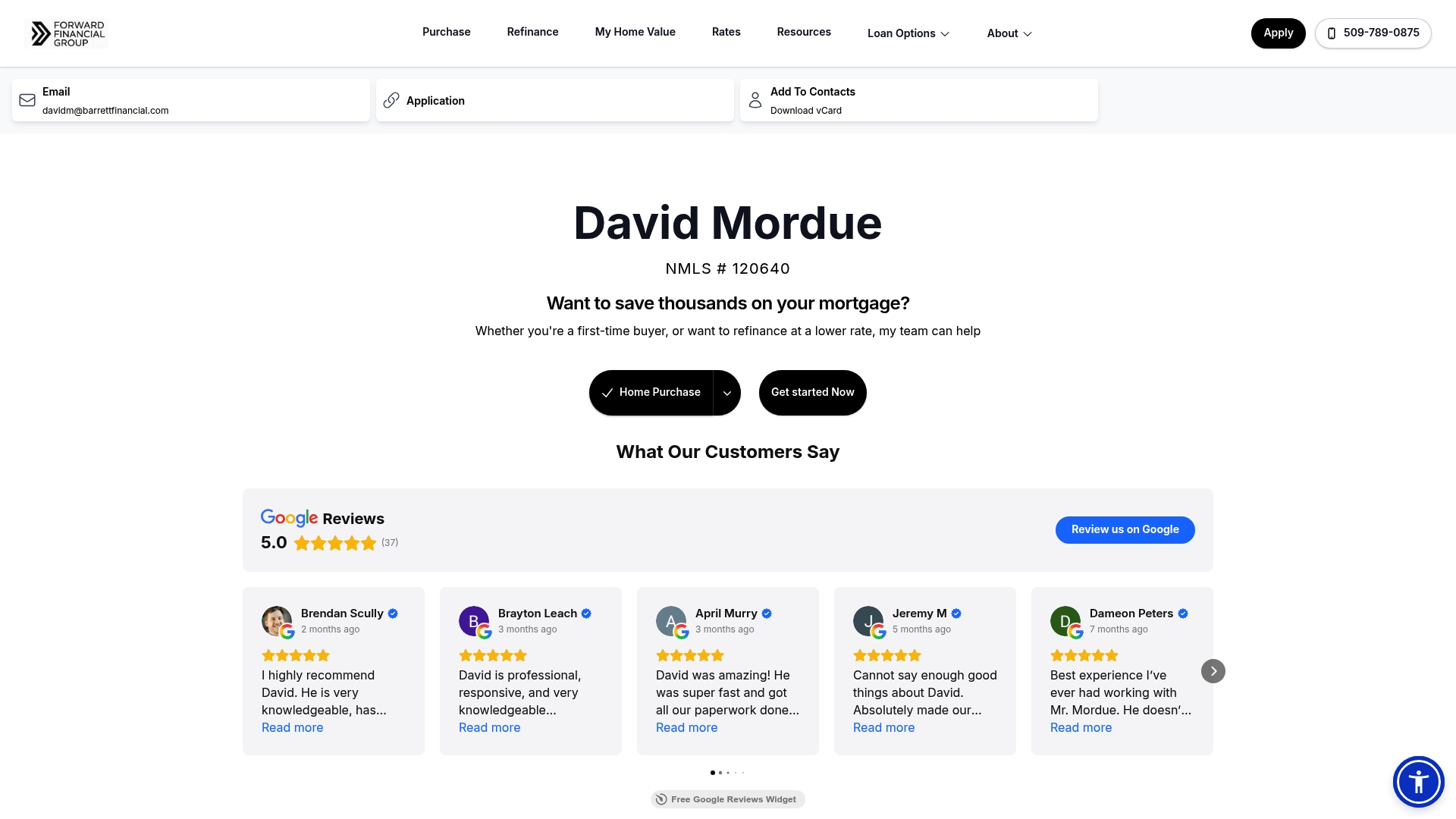
David Mordue - Forward Financial Group offers a fully online application process with funding possible in under 21 days. Use the rent vs. buy calculator to model your real costs before you apply, and the refinance calculator to plan your long-term equity strategy. When you are ready to move forward, get your mortgage pre-approval with personalized rate comparisons across every loan type available to you.
FAQ
What credit score do I need for a first-time buyer loan?
FHA loans accept credit scores as low as 580 with a 3.5% down payment. VA and USDA loans have no official minimum, though most lenders prefer 620 or higher.
Can I use down payment assistance with a government loan?
Yes. State and local down payment assistance programs can be layered with FHA, USDA, and Conventional 97 loans to reduce the cash you need at closing.
What is the difference between MIP and PMI?
MIP is mortgage insurance on FHA loans and typically lasts the life of the loan. PMI applies to conventional loans and cancels automatically once you reach 20% equity in your home.
Which loan type closes fastest for first-time buyers?
Conventional loans generally close faster than government-backed loans because they involve fewer federal requirements. Working with an experienced broker reduces closing time across all loan types.
Is a VA loan better than an FHA loan?
For eligible veterans and service members, a VA loan is almost always the better choice. It requires no down payment, carries no mortgage insurance, and typically results in a lower total loan cost than an FHA loan.