
True no-doc stated income loans no longer exist for owner-occupied home purchases in the U.S. What you’ll find instead are alternative-documentation programs, bank-statement loans, asset-depletion mortgages, DSCR loans for investors, and non-QM products such as a no-ratio mortgage, all of which verify your ability to repay through some other lens than a W-2. They cost more than a conventional loan, but they work. Before you call a lender, pull together 12 to 24 months of bank statements and a simple profit-and-loss statement.
TL;DR:
- No-doc stated income loans for owner-occupants are abolished; lenders now verify income through alternative documentation like bank statements or asset details.
- Alt-doc programs typically have higher interest rates, larger down payments, and stricter reserves compared to conventional loans, serving self-employed and asset-rich borrowers.
- Borrowers should prepare 12 to 24 months of bank statements, a profit-and-loss statement, and possibly tax returns, as underwriters scrutinize deposits and seasonal income patterns.
- DSCR, asset-depletion, and non-QM loans allow investors, retirees, and self-employed individuals to qualify without traditional income proof, but carry higher costs and potential refinancing hurdles.
- Future lending standards will likely stay aligned with existing regulations, with ongoing growth in non-QM options and slight guideline adjustments rather than major regulatory shifts.
Table of Contents
- What a Stated Income Loan Was and How the Product Evolved
- Why True Stated Income Loans Are No Longer Standard
- Modern Alternatives: Bank-Statement, Asset-Depletion, DSCR, Non-QM, and Hard Money
- How Lenders Qualify You Now: Documents and Numbers
- Costs, Risks, and Tradeoffs of Stated-Income Alternatives
- How to Choose a Lender or Broker and the Next Practical Steps
- Impact of Stated Income Loans on Credit Reports and Future Borrowing
- Regulatory Changes Anticipated or Recent Developments Affecting Stated Income Loan Products
- Risks and Benefits Specific to Borrowers When Opting for Stated Income or Its Modern Alternatives
- Typical Borrower Profiles or Scenarios Where Stated Income or Alternative Loan Types Are Most Suitable
- Publisher Perspective: How David Mordue Helps Self-Employed Borrowers Prepare and Apply
- Get Preapproved Without a Pay Stub in Sight
- Sources
What a Stated Income Loan Was and How the Product Evolved
A stated income loan let you write your income on the application without backing it up with pay stubs, W-2s, or tax returns. The lender took your word for it, verified your credit, and moved forward. That sounds risky because it was.
Self-employed borrowers, commissioned salespeople, and real-estate investors gravitated toward these loans because their tax returns rarely reflected their real cash flow. Deductions that lower a tax bill also lower the income a conventional underwriter sees, so a profitable business owner could look unqualified on paper even while covering a mortgage payment without strain.
The trouble came when the honor system broke down. Some borrowers, sometimes with encouragement from loan officers chasing commissions, inflated their stated income well past what they actually earned. These became known as “liar loans,” and they were a meaningful contributor to the wave of mortgage defaults that hit the market before 2008, according to Wikipedia’s account of the stated income loan’s history.
What made the original product attractive:
- No requirement to produce tax returns, pay stubs, or W-2s
- Fast underwriting because there was little to document
- Access for borrowers whose real income didn’t match their reported income
Why True Stated Income Loans Are No Longer Standard
Congress and federal regulators rewrote the rules after the crisis, and the rewrite was direct: verify that the borrower can actually repay the loan. The Ability-to-Repay and Qualified Mortgage rule from the CFPB requires lenders to check income, assets, debts, and credit history using reasonably reliable documentation before making most residential mortgages.
Statistic Callout: The federal Qualified Mortgage standard, defined in detail under 12 CFR § 1026.43, sets the documentation and underwriting bar most lenders now build their products around, whether or not the loan is technically a QM.
That single change did more to end no-doc lending than any marketing pushback ever could. A lender that ignores it faces legal liability if the loan later fails, so almost no one does.
A few carve-outs remain:
- Certain commercial and business-purpose loans fall outside residential ATR/QM rules entirely
- Some DSCR investor loans qualify off property cash flow rather than personal income, which sits in a different regulatory lane
- State licensing and disclosure rules add variation on top of the federal floor, so requirements shift somewhat by state
Modern Alternatives: Bank-Statement, Asset-Depletion, DSCR, Non-QM, and Hard Money
Lenders still serve self-employed home loans and alternative income loans borrowers. They just verify differently now. Here’s how each path actually works.
-
Bank-statement loans. Underwriters review 12 to 24 months of personal or business bank statements and average the deposits to estimate qualifying income, a method The Mortgage Reports confirms is now the standard workaround for freelancers and contractors whose tax returns understate their earnings. This fits a graphic designer, a consultant, or a contractor with strong deposits but heavy write-offs.
-
Asset-depletion loans. Instead of income, the lender divides your liquid assets by a set number of months (often 60 or 84) to produce an imputed monthly income figure. This suits a retiree or a recently sold-business owner sitting on savings but lacking a paycheck.
-
DSCR loans for investors. The debt-service coverage ratio compares a rental property’s income to its mortgage payment, sidestepping your personal income entirely, but comes with risks of ADU investment that landlords should consider. A ratio at or above 1.0 usually means the property pays for itself; many lenders prefer 1.2 or higher for the best pricing. DSCR loans for investors skip the personal-income documentation that trips up self-employed landlords, and Schedule E filings, per IRS guidance, often support the underwriting file.
-
Non-QM loans. These sit outside the Qualified Mortgage box but still comply with Ability-to-Repay rules through alternative documentation. Expect more flexible underwriting on credit events and income types, paired with higher rates and, often, larger down payments, since non-QM products function as the practical successor to old stated income loans.
-
Hard-money and bridge loans. Private lenders fund based mostly on the property’s value, not your income, at rates well above conventional financing and terms usually under 24 months. Real-estate investors use them to close fast on a flip or renovation, then exit through a sale or a refinance into a DSCR or conventional loan.
Pro Tip: If you’re a landlord weighing DSCR financing, run the numbers on the rent vs buy calculator first. It shows whether the property cash flow actually clears the 1.0 threshold before you apply.
How Lenders Qualify You Now: Documents and Numbers
Alt-doc underwriting still has a checklist. It’s just a different checklist than the one your W-2 neighbor fills out.
Expect to provide:
- 12 to 24 months of personal or business bank statements
- A CPA letter confirming self-employment and business ownership percentage
- A simple profit-and-loss statement covering the trailing 12 months
- Schedule C or full 1040 returns when the lender’s program calls for them
Credit score minimums for bank-statement and non-QM programs typically start higher than conventional loans, often in the 660 to 700 range, with the best pricing reserved for scores above 700. Reserve requirements run heavier too. Where a conventional loan might ask for a small number of months of reserves, an alt-doc file often requires several months of reserves.
Underwriters scrutinize deposits for anything that looks like a loan disguised as income, a large one-time transfer, or a seasonal spike that doesn’t repeat. Present seasonal income with supporting invoices and a short written explanation, and you cut down the back-and-forth that slows approval.
Costs, Risks, and Tradeoffs of Stated-Income Alternatives
None of this comes free. You trade documentation flexibility for a rate premium and tighter reserve rules.
Statistic Callout: Non-QM and bank-statement programs typically price higher than agency conventional loans, and The Mortgage Reports notes these products carry higher rates and often larger loan-to-value restrictions compared with full-documentation mortgages.
What to weigh before you commit:
- Higher interest rates and origination fees than a conventional 30-year fixed
- Larger down payments, often a substantial down payment depending on the program and property type
- Refinance friction later, since many borrowers use alt-doc loans as a bridge until their tax returns catch up with their real income
- Red flags: any lender promising no verification whatsoever, rates far below market, or pressure to inflate your bank-statement averages is signaling fraud risk, not opportunity
How to Choose a Lender or Broker and the Next Practical Steps
Not every loan officer works these files often, and that experience gap shows up in your closing timeline.
- Ask what documentation the lender actually accepts for your income type, and get it in writing before you apply.
- Ask about the rate premium and fees compared with a conventional quote, so you can weigh the real cost.
- Ask whether the lender holds the loan or sells it, since portfolio lenders sometimes offer more underwriting flexibility.
- Use a broker with non-QM relationships if your income is genuinely complex; a specialist can shop several alt-doc programs at once instead of forcing you into one lender’s box.
- Gather your bank statements and a one-page P&L now, then get preapproved and compare full APR and fees side by side.
Pro Tip: You can confirm any loan officer’s license through NMLS Consumer Access before you hand over financial documents.
Impact of Stated Income Loans on Credit Reports and Future Borrowing
An alt-doc loan reports to the credit bureaus the same way a conventional mortgage does. Your payment history, the loan balance, and the account age all show up identically on your credit report, and on-time payments build your score exactly like they would with a full-documentation loan. The loan type itself isn’t a visible flag to future lenders reading your credit file.
Where it does matter is in how future lenders read your file when you apply again. A bank-statement or non-QM loan often carries a higher rate, which means a higher monthly payment relative to your loan amount. That payment factors into your debt-to-income ratio the next time you apply for credit, whether it’s a car loan, a HELOC, or a second mortgage.
Refinancing out of an alt-doc loan into a conventional one, once your tax returns catch up with two years of stable self-employment income, is common and usually improves your rate. Lenders reviewing that refinance application look at your payment history on the original loan, not the documentation type you used to get it. Consistent, on-time payments on a bank-statement loan carry the same weight as consistent payments on any other mortgage. The bigger risk to future borrowing isn’t the loan category. It’s taking on a payment sized for a rate premium that strains your monthly budget for years.
Regulatory Changes Anticipated or Recent Developments Affecting Stated Income Loan Products
The Ability-to-Repay and Qualified Mortgage framework has held steady as the governing standard since its adoption, and there’s no indication regulators are rolling it back. The CFPB continues to enforce documentation requirements under that rule, and lenders build their non-QM and alt-doc programs to stay compliant with it rather than around it.
What has shifted is product innovation within that framework, not the framework itself. Bank-statement and DSCR programs have grown more standardized over the past several years as more lenders entered the non-QM space, giving self-employed home loans borrowers more competition among lenders and, in some cases, better pricing than existed a few years ago. Asset-depletion underwriting has also become more common as retirees and equity-rich borrowers look for ways to qualify without a traditional paycheck.
State-level licensing and disclosure requirements continue to add variation on top of the federal baseline, so a non-QM program available in one state may carry slightly different terms in another. Borrowers should expect this patchwork to persist rather than consolidate into one uniform national standard anytime soon.
Watch for continued growth in DSCR lending volume as more individual investors buy rental property, and expect non-QM underwriting guidelines to keep tightening or loosening modestly in step with broader mortgage market conditions rather than through any single dramatic regulatory event.
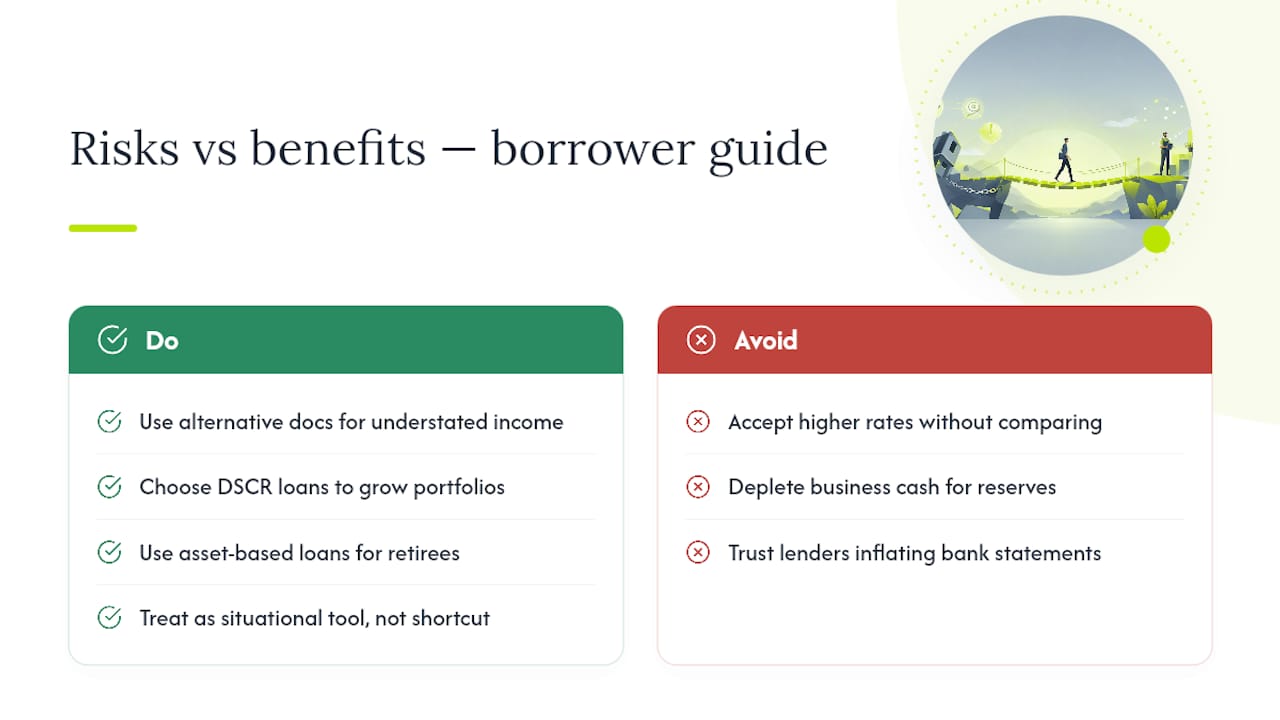
Risks and Benefits Specific to Borrowers When Opting for Stated Income or Its Modern Alternatives
The core benefit hasn’t changed since the original stated income products existed: access. A profitable self-employed home loans borrower whose tax returns show a modest number on paper, because of legitimate deductions, can still qualify for a mortgage that reflects their actual cash flow rather than their taxable income. Real-estate investors get to expand a portfolio using DSCR loans without their personal income capping how many properties they can finance. Retirees with substantial assets but no W-2 get a path to homeownership that a conventional lender would otherwise deny.
The risk side is just as real. Rate premiums on non-QM and bank-statement loans mean you pay more over the life of the loan, sometimes significantly more if you hold it for years without refinancing. Larger reserve and down payment requirements tie up cash that could otherwise go toward the business itself. And the documentation flexibility that makes these loans useful also makes them a target for predatory lenders who inflate bank-statement averages or steer borrowers into loans they can’t comfortably afford, the same dynamic that fueled the original stated income collapse.
The honest framing: alternative documentation loans solve a real underwriting gap for non-traditional income, but they’re a tool for a specific situation, not a shortcut around financial reality. A borrower who genuinely can’t support the payment shouldn’t take one just because a lender approves the application.
Typical Borrower Profiles or Scenarios Where Stated Income or Alternative Loan Types Are Most Suitable
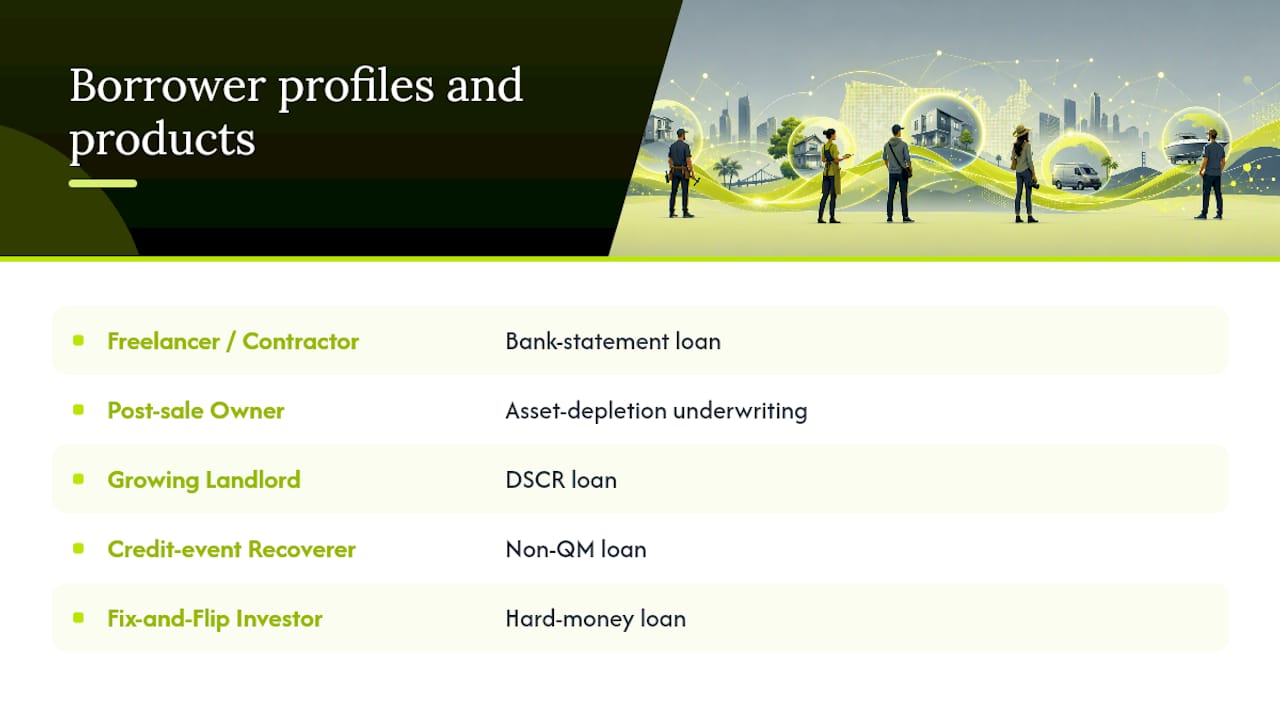
Certain borrower types show up again and again in alt-doc underwriting, and recognizing your own profile helps you pick the right product faster.
The established freelancer or contractor. Two or more years of consistent deposits, heavy Schedule C deductions, and a tax return that understates real cash flow. Bank-statement loans fit this profile well.
The small-business owner post-sale or windfall. Substantial liquid assets, little or no current W-2 income. Asset-depletion underwriting converts that balance sheet into qualifying income.
The growing landlord. Multiple rental properties where personal income can’t keep pace with portfolio growth under conventional DTI limits. DSCR loans let the properties qualify on their own cash flow.
The credit-event recoverer. A recent bankruptcy, foreclosure, or short sale that conventional and FHA guidelines won’t touch yet. Non-QM programs often allow shorter waiting periods with compensating factors like strong reserves.
The fix-and-flip or bridge investor. Needs to close in days, not weeks, and plans to sell or refinance within a year. Hard-money loans, despite the cost, match that timeline.
Matching your scenario to the right product before you apply saves you from wasted preapprovals and hard credit pulls on programs that were never going to fit your file.
Publisher Perspective: How David Mordue Helps Self-Employed Borrowers Prepare and Apply
Most self-employed borrowers don’t fail underwriting because their income is too low. They fail because their file is disorganized, and a rushed application gets flagged for the same one-off deposits and seasonal gaps that a well-prepared file explains upfront. Some brokers work with self-employed and alternative income loans clients specifically to build that file before it reaches an underwriter, comparing rates across lenders who specialize in bank-statement, DSCR, and non-QM programs so you’re not stuck with the first “yes” you get.
— David Mordue
Get Preapproved Without a Pay Stub in Sight
If your tax returns don’t tell your real income story, you don’t need to settle for whatever a single lender offers. Some brokers compare rates across lenders who actually work with bank-statement, DSCR, and non-QM files, so you see real pricing instead of a one-size-fits-all quote built for W-2 borrowers.
Some mortgage services offer a fully online application you can start from your phone or laptop, upload your bank statements and P-and-L, and get a personalized consultation on which alt-doc program fits your numbers, often with funding possible in about three weeks once your file is complete. Costs on these programs run higher than a conventional loan, and we’ll walk you through the real APR and fees before you commit to anything. If you’re a landlord, start with the rent vs buy calculator to check your numbers, or head straight to Davidmordue to start your preapproval and talk through which documentation path fits your income.
This article is general information, not a substitute for advice from a qualified financial advisor. Consult a qualified financial professional about your own circumstances before acting on anything here.
Sources
- Can you still get stated income loans? | The Mortgage Reports
- Ability-to-Repay and qualified mortgage (QM) rule — CFPB
- Stated income loan — Wikipedia
- 12 CFR § 1026.43 — The qualified mortgage definition