
Yes, you can get a mortgage when you’re self-employed. Lenders will finance you through two main paths: the conventional route using two years of tax returns, or bank-statement and non-QM programs when your tax returns understate what your business actually generates in cash flow.
Each path has a real tradeoff.
- Tax-return route: Lower rates and standard down payments, but your write-offs directly shrink your qualifying income.
- Bank-statement/non-QM route: Qualifies you on deposits instead of net income, but usually costs more in rate and requires a larger down payment.
The right choice depends on how your books look versus how your bank account looks. That distinction drives almost every decision below.
Key Takeaways
Self-employed borrowers qualify by choosing between tax-return-based conventional loans and bank-statement or non-QM programs, with the right fit depending on how deductions affect reported income.
| Point | Details |
|---|---|
| Two years is standard | Most lenders want two years of self-employment history, though one-year exceptions exist with prior W-2 experience. |
| Income gets rebuilt, not read | Lenders add back non-cash deductions and average two years, then divide by 24 for monthly qualifying income. |
| Documentation beats luck | A CPA-prepared P&L and expense-ratio letter often unlock more qualifying income than switching lenders. |
| Bank-statement loans cost more | Expect rates roughly 1 to 3 percentage points higher and larger down payments in exchange for skipping tax-return analysis. |
| Speed comes from preparation | David Mordue - Forward Financial Group coordinates CPA letters and lender selection to help self-employed files close in under 21 days. |
Table of Contents
- Self Employed Mortgage Requirements: The Underwriting Floor
- How Do Lenders Calculate Self Employed Income?
- What Documents Do You Need for a Self Employed Mortgage?
- Which Loan Type Fits a Self Employed Borrower?
- How to Improve Your Odds of Approval
- How Long Does a Self Employed Mortgage Take to Close?
- Why Working With a Specialist Matters
- What Most Advice Gets Wrong About Self Employed Mortgages
- Get a Self Employed Mortgage Pre-Approval Started Today
- Where to Verify These Self Employed Mortgage Rules
- Sources
Self Employed Mortgage Requirements: The Underwriting Floor
Lenders define “self-employed” as owning 25% or more of a business, and most conventional and government programs want two years of that history before they’ll count your income at face value. Credit and debt ratios follow familiar territory, but with less room to improvise.
- Two years of self-employment in the same field is the standard baseline most lenders apply.
- A credit score in the mid-600s or higher opens up conventional pricing; scores in the 700s unlock the best rates and the widest set of loan options.
- Debt-to-income ratios (DTI) typically need to stay within lender guidelines, often capped around 43 to 50%, though some non-QM lenders allow higher ratios with stronger reserves.
- Reserves generally hold greater importance for self-employed borrowers than for salaried ones due to potential fluctuations in income.
One exception worth knowing: some lenders will accept just one year of self-employment if you can show two years of prior W-2 work in the same industry, or relevant licensing and certifications that support the transition. It’s not the norm, but it’s not rare either. Fannie Mae outlines this as an underwriter judgment call, not an automatic approval.
How Do Lenders Calculate Self Employed Income?
This is where most self-employed borrowers get surprised, sometimes pleasantly, sometimes not. Lenders don’t look at your gross revenue. They start with your net taxable income and rebuild it into something closer to actual cash flow.
- Start with net income from Schedule C, K-1, or corporate returns, whichever applies to your business structure.
- Add back non-cash deductions like depreciation and amortization, since those reduce taxable income without reducing the cash actually in your pocket.
- Average two years of that adjusted figure, unless the trend is declining, in which case underwriters often use the lower year or investigate the drop.
- Divide by 24 to get a monthly qualifying income figure.
Fannie Mae’s underwriting guidance requires lenders to perform this written cash-flow analysis for every self-employed file, along with documentation of business stability. For S-corp owners, the math gets another layer: W-2 wages from the business are treated separately from K-1 distributions, and only consistent, documented distributions typically count toward income.
One number that changes everything: the two-year average calculation means a strong current year can’t fully offset a weak prior one. If your business grew sharply last year, expect the underwriter to average it down rather than count the newer, higher figure alone.
Bank-statement programs skip this analysis entirely and instead apply a flat expense ratio to your deposits, which is why a CPA-issued expense letter can shift your qualifying income meaningfully in either direction.
What Documents Do You Need for a Self Employed Mortgage?
Underwriters move fast when a file arrives complete and stall when it doesn’t. Build this list before you apply, not after a loan officer asks for it piece by piece.
- Two years of signed federal tax returns, including all schedules (C, E, K-1) and IRS transcripts when you can pull them.
- Year-to-date profit and loss statement and balance sheet, ideally prepared or reviewed by a CPA rather than assembled in a spreadsheet the night before.
- A CPA expense-ratio letter, required for most bank-statement programs to validate what portion of your deposits counts as business overhead versus income.
- 12 to 24 months of personal and business bank statements, depending on which loan program you’re pursuing.
- 1099s and signed client contracts, especially useful for freelancers whose income comes from a handful of recurring clients rather than steady payroll.
- Proof of funds for your down payment and reserves, sourced and seasoned according to the lender’s timeline.
Freddie Mac’s consumer guidance puts it plainly: the goal of every document on this list is showing consistent, ongoing income, not just a good year.
Pro Tip: Pull your IRS transcripts before you apply, not after your lender requests them. A same-day online request beats a paper-mail wait that can stretch a closing timeline by two weeks.
Which Loan Type Fits a Self Employed Borrower?
Not every self-employed profile fits the same box. Match your income pattern to the program built for it.
- Conventional loans offer the best pricing when your tax returns show enough qualifying income after the cash-flow analysis. This is the default path if your write-offs are modest.
- FHA loans carry more flexible credit and down-payment requirements, useful if your score sits below conventional thresholds or your reserves are thin. Explore FHA loan options if that describes your situation.
- VA loans work the same way for eligible veterans and service members, with self-employed income evaluated using a similar two-year framework. Details on VA loan eligibility are worth a look if you qualify.
- Bank-statement and non-QM loans solve the problem conventional loans create: heavy deductions that shrink your taxable income without shrinking your actual cash flow. Expect rates roughly 1 to 3 percentage points higher than conventional pricing, plus a larger down payment.
- 1099-only programs exist for contractors whose income is clean and verifiable through 1099 forms alone, without the complexity of a full business tax return.
- DSCR loans apply if you’re financing a rental property and want the loan qualified on the property’s cash flow instead of your personal income; see DSCR loan details if that’s your scenario.
Loans that don’t meet the qualified mortgage standards the CFPB defines, which covers most non-QM products, trade some consumer protections for underwriting flexibility. That’s a fair trade for many self-employed borrowers, but it’s worth understanding going in.
An adjustable-rate mortgage can also make sense if your income is growing but you want a lower initial rate while you build a longer track record, while a 30-year fixed or 15-year fixed suits borrowers whose income has already stabilized.

How to Improve Your Odds of Approval
Approval odds for self-employed borrowers come down to preparation more than luck. A few moves make a disproportionate difference.
- Get a CPA to prepare or review your year-to-date P&L, and request an expense-ratio letter if you’re pursuing a bank-statement loan. This single document often resolves the biggest income disputes before they start.
- Document recurring revenue through signed contracts or retainer agreements. Underwriters read consistency as lower risk.
- Hold off on aggressive write-offs in the two tax years before you apply. Every deduction that lowers your tax bill also lowers your qualifying income.
- Build 6 to 12 months of mortgage payment reserves. Variable income makes reserves carry more weight than they would for a salaried applicant.
Industry commentary consistently points to documentation, not a lack of loan programs, as the real obstacle self-employed borrowers face. Business Insider’s coverage of self-employed mortgage challenges backs this up: the paperwork burden, not the underwriting rules themselves, is what trips people up.
Pro Tip: Ask your CPA for a letter now, even before you’re ready to apply. Lenders often accept a letter dated within 60 days of closing, and having one on file saves a scramble later.

How Long Does a Self Employed Mortgage Take to Close?
Timelines vary more for self-employed borrowers than for W-2 applicants, mostly because of document collection, not underwriting speed itself.
- Pre-approval starts with your two years of returns, current P&L, and bank statements. The faster you supply these, the faster pre-approval moves.
- Conventional closings often run 30 to 45 days once a complete file is submitted.
- Bank-statement and non-QM closings can move faster since they skip the tax-return cash-flow analysis, sometimes closing in under 21 days when the file arrives complete.
- Common delays include incomplete P&Ls, missing signatures on returns, unverified business assets, and slow IRS transcript requests.
A broker who coordinates your CPA letter and lender selection upfront removes most of these bottlenecks before they cost you time.
Why Working With a Specialist Matters
David Mordue is a mortgage broker who works specifically with self-employed and refinance clients navigating tax-return complexity, bank-statement programs, and lender matching across multiple loan types. The practice runs a fully online application built for speed, with funding timelines that can land under 21 days once a file is complete, and direct coordination between borrowers, their CPAs, and the lenders best suited to their income profile.
What Most Advice Gets Wrong About Self Employed Mortgages
Most guides treat self-employed mortgage qualification as a documentation problem to solve once, then forget. That’s backwards. The real leverage point is a decision you make every tax season, long before you ever talk to a lender: how aggressively you write off expenses.
I’d argue the conventional wisdom, “just gather your documents and apply,” undersells how much the two-year averaging rule punishes borrowers who optimize for the lowest tax bill instead of the highest qualifying income. A business owner who nets $120,000 on paper but writes it down to $60,000 in deductions isn’t fooling the IRS. They’re fooling themselves out of buying power.
The borrowers who get approved fastest aren’t the ones with the cleanest businesses. They’re the ones who talked to a CPA about the mortgage application before filing that year’s return, not after. If you’re two years out from applying, that conversation matters more than your credit score. Bank-statement loans exist as a safety valve, not a strategy. Treat them as backup, not the plan.
Get a Self Employed Mortgage Pre-Approval Started Today
David Mordue - Forward Financial Group builds files around how self-employed income actually works, not around a generic checklist that ignores K-1s, write-offs, and irregular deposits. That means faster answers on whether your tax-return income qualifies you outright or whether a bank-statement route makes more sense.
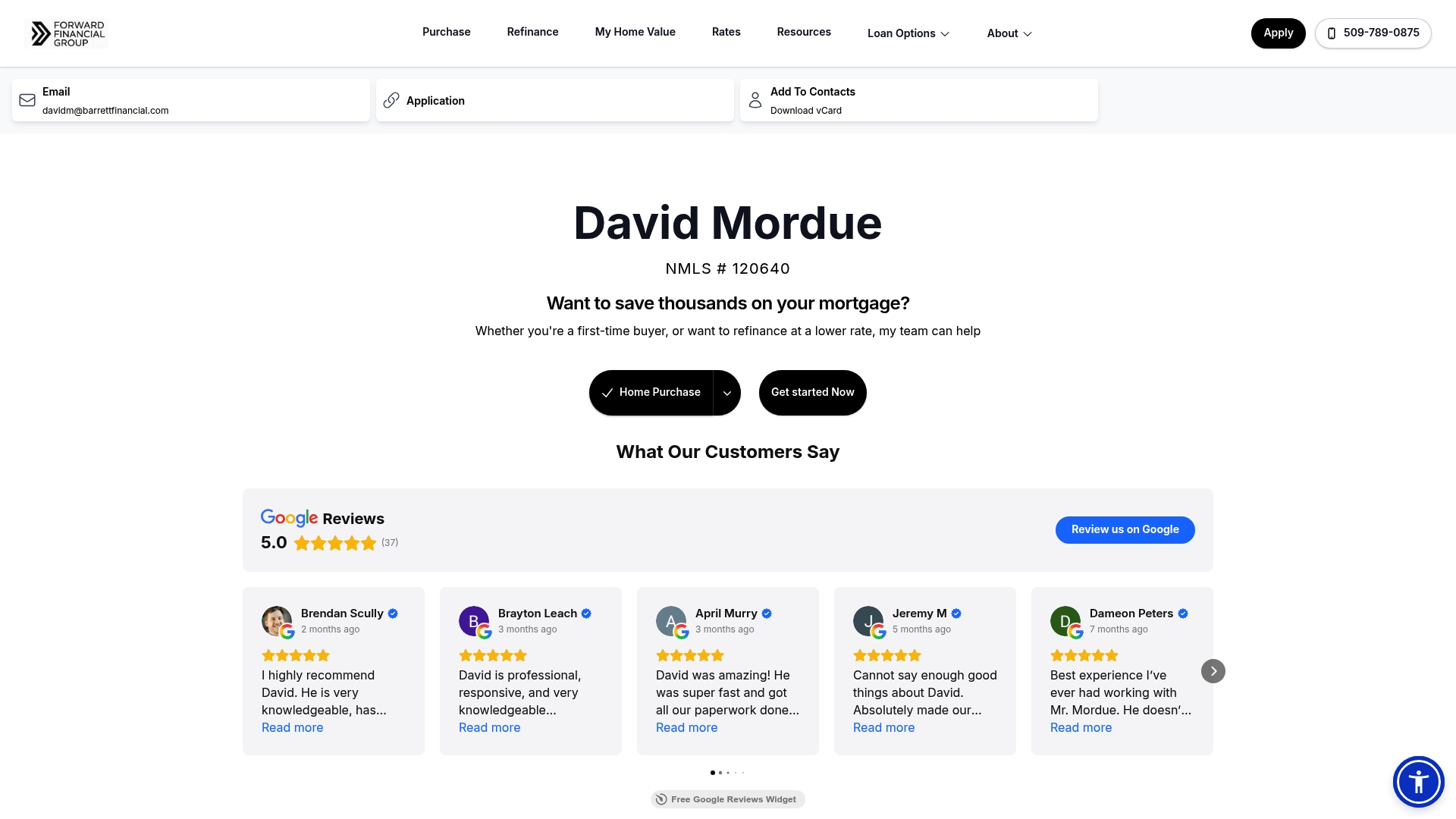
The process starts online, and CPA coordination happens alongside your loan officer rather than after a denial forces you to start over. Funding can land in under 21 days once your file is complete, a real advantage when a seller’s timeline won’t wait on paperwork. Before you apply, run your numbers through the conventional affordability calculator or the FHA affordability calculator to see where your income lands. Ready to move forward? Start your pre-approval and get matched with the loan program that fits your actual cash flow, not just your tax return.
Where to Verify These Self Employed Mortgage Rules
- Fannie Mae underwriting guidance covers income analysis and cash-flow rules.
- Freddie Mac consumer guidance explains accepted documents.
- CFPB defines qualified mortgage protections.
- IRS Self-Employed Tax Center covers recordkeeping requirements.