
For private reverse mortgages, you may qualify as early as age 55. For federally insured HECMs, you must be at least 62 years old. There is no maximum age. That single number is the gatekeeper for the most common reverse mortgage product in the United States, but it is far from the only requirement you will face.
Meeting the minimum age requirement gets you in the door. What happens next depends on a handful of other checks:
- HUD-approved counseling is mandatory before you can even submit a full application.
- Your lender will run a financial assessment to confirm you can keep up with taxes, insurance, and upkeep.
- You must live in the home as your primary residence, and that obligation continues for as long as the loan is active.
None of these caveats are designed to trip you up. They exist because a reverse mortgage is a lien against your biggest asset, and the Federal Trade Commission wants to be sure you understand the fees and interest that accrue against your equity before you sign anything.
Key Takeaways
The federal minimum age for a HECM reverse mortgage is 62, with no upper age limit, but approval hinges on equity, counseling, and the ability to cover ongoing property costs.
| Point | Details |
|---|---|
| Minimum age is fixed | You must be 62 by closing for a HECM; there’s no maximum age on the other end. |
| Youngest borrower sets the limit | On joint applications, the younger spouse’s age determines the principal limit calculation. |
| Counseling comes first | HUD-approved counseling is required before you can submit a full HECM application. |
| Financial assessment decides approval | Lenders review income, credit, and debt to confirm you can pay taxes and insurance long term. |
| A broker can compare your options | David Mordue - Forward Financial Group compares lenders and rates so you see your real principal limit before committing. |
Table of Contents
- Reverse Mortgage Eligibility Age and the Other Boxes You Need to Check
- How Your Age Shapes the Principal Limit You Can Borrow
- Can Homeowners Under 62 Get a Reverse Mortgage?
- When Does the Age Requirement Actually Apply?
- Financial Assessment, LESA, and Your Ongoing Obligations
- Denial Reasons and Red Flags Worth Fixing First
- What I Tell Clients About Timing and Alternatives
- How David Mordue - Forward Financial Group Makes This Easier
- Where to Verify These Rules Yourself
- Sources
Reverse Mortgage Eligibility Age and the Other Boxes You Need to Check
Age gets all the attention, but it’s only one line item on a longer checklist. Before you call a lender, walk through these four areas honestly.
- Occupancy and property type. The home must be your primary residence, not a vacation property or a rental. Eligible property types include single-family homes, FHA-approved condominiums, and 2 to 4 unit properties where you occupy one unit.
- Equity position. Most lenders want to see a home with significant equity, typically a substantial portion of the home’s value, though the exact figure shifts with your age, interest rates, and appraised value.
- HUD-approved counseling. This is a two-hour, HUD-approved session covering loan mechanics, costs, and alternatives, and it’s a required step before you apply. You can find an approved counselor through HUD’s counselor locator tool.
- Federal debt status. Delinquent federal debt, including unpaid federal income tax, can delay or block approval unless you resolve it or arrange an acceptable repayment plan first.
Pro Tip: Schedule your counseling session early, even before you’ve picked a lender. It gives you a neutral, third-party rundown of the numbers, and most lenders won’t move forward without the certificate anyway.
How Your Age Shapes the Principal Limit You Can Borrow
Age isn’t just a yes-or-no gate. It’s a direct input into how much money you can actually access. HUD’s formula for the Home Equity Conversion Mortgage calculates your principal limit using several factors together:
- The age of the youngest borrower (or eligible non-borrowing spouse) on the loan
- The home’s appraised value, up to the FHA lending limit
- Current interest rates
A 62-year-old borrower and an 82-year-old borrower with identical homes will not qualify for the same amount. Older borrowers generally unlock a higher percentage of their home’s value because actuarial tables expect a shorter loan term. On a married couple’s application, lenders always use the youngest spouse’s age for this calculation, even if the older spouse owns most of the equity. That single detail catches a lot of couples off guard when one partner is significantly younger than the other.
Can Homeowners Under 62 Get a Reverse Mortgage?

Not through a HECM, but proprietary and jumbo reverse mortgages fill part of that gap. Private lenders offer these products outside the federal insurance framework, and some set their minimum age as low as 55.
A few things to weigh before you go this route:
- Availability varies significantly by lender and by state, so a product offered in Florida might not exist in Ohio.
- Consumer protections differ from HECMs, which carry non-recourse guarantees and standardized federal oversight.
- Underwriting standards, cost structures, and loan limits are all set by the individual lender rather than by HUD, so terms can vary widely from one company to the next.
If you’re weighing a proprietary loan against waiting a few years for HECM eligibility, our refinance calculator can help you compare what cash-out refinancing might look like in the meantime.
When Does the Age Requirement Actually Apply?
Timing trips up more applicants than the age rule itself. Here’s what actually matters and when.
- Closing, not application, is the deadline. HUD generally requires the youngest borrower to be 62 by the time the loan closes, not necessarily on the day you submit paperwork, though individual lenders may set their own internal cutoffs.
- If your birthday falls during processing, talk to your loan officer about timing the closing date rather than rushing the application.
- Gather your documents early: a government-issued ID, proof of occupancy, and your title or deed all confirm both age and residence status.
Pro Tip: If you’re turning 62 within a few months, start the counseling session now. The certificate doesn’t expire quickly, and it removes one bottleneck from your timeline once your birthday arrives.
Financial Assessment, LESA, and Your Ongoing Obligations
Age qualifies you for the conversation. The financial assessment decides whether you actually get approved. Lenders review your income, assets, credit history, and any history of late payments on property charges to judge whether you can realistically keep paying taxes and insurance for the life of the loan.
When that review raises concerns, lenders don’t automatically deny you. Instead, they may require a Life Expectancy Set-Aside, or LESA. This sets aside a portion of your loan proceeds specifically to cover future property taxes and insurance, reducing the cash you receive upfront but protecting you from a tax-related default later.
Approval is only the beginning. As a reverse mortgage borrower, you remain on the hook for:
- Property taxes and homeowner’s insurance, paid on time every year
- Routine home maintenance that keeps the property in good condition
- HOA fees, where applicable
Falling behind on any of these isn’t a minor infraction. It’s the most common reason reverse mortgages end in foreclosure, according to AARP’s policy research on the product. The loan itself never requires monthly payments, but the underlying obligations of homeownership never go away.
Denial Reasons and Red Flags Worth Fixing First
Most denials trace back to a short list of fixable problems, not the age requirement itself. Insufficient home equity tops that list, followed closely by an inability to demonstrate you can cover ongoing taxes and insurance. Delinquent federal debt, particularly unpaid federal taxes, is another common blocker that can often be resolved with a payment plan before you reapply.
Watch for these warning signs as you shop for a lender:
- High-pressure sales tactics or promises that skip past HUD counseling entirely
- Any lender who discourages you from speaking with an independent counselor
- Offers that promise unusually large proceeds compared to what the standard HECM formula would produce
If your equity position feels thin right now, a HUD counselor or a broker’s pre-check can tell you where you stand before you invest time in a full application.
What I Tell Clients About Timing and Alternatives
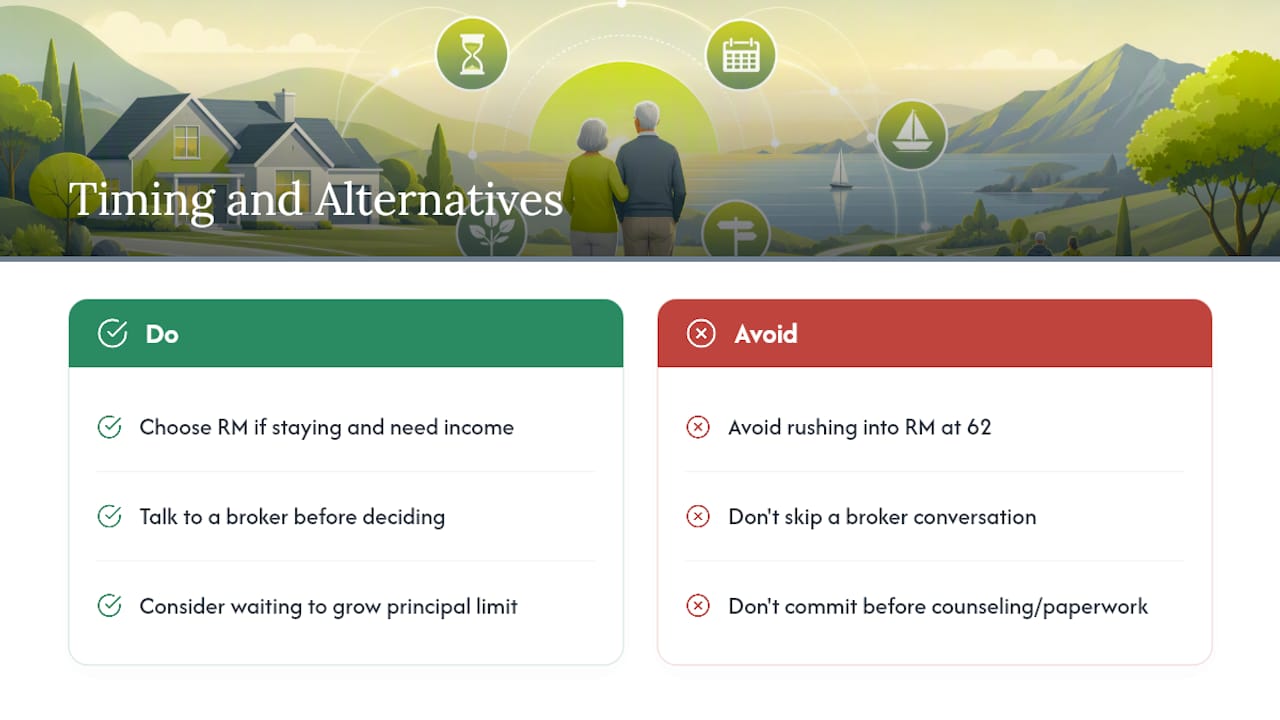
Sixty-two is a legal threshold, not a strategy. I’ve seen homeowners rush into a reverse mortgage the month they turn eligible when waiting three or four more years, letting equity build and rates settle, would have produced a meaningfully larger principal limit. Age qualifies you; it doesn’t tell you when to act.
A reverse mortgage makes sense when you plan to stay put and need to supplement retirement income without a monthly payment. If you’re still weighing whether to sell, downsize, or refinance instead, that’s a conversation worth having with a broker before you commit to counseling and paperwork.
— David Mordue
How David Mordue - Forward Financial Group Makes This Easier
David Mordue - Forward Financial Group gives you something most reverse mortgage lenders don’t: a broker who compares rates across multiple lenders instead of pitching you a single in-house product. That matters most right at the age threshold, when a few years of waiting or a different lender’s formula can change your principal limit significantly.
Our fully online application moves fast, with funding possible in under 21 days once you’re ready to close, and every client gets a personalized consultation to walk through counseling requirements, documentation, and how your age factors into your numbers. If you’re not sure whether a reverse mortgage or a refinance fits your situation better, run the numbers with our rent vs. buy calculator or start a consultation to get a broker’s read on your specific case.
Where to Verify These Rules Yourself
Confirm every detail here directly with the agencies that set the rules.
- HUD’s HECM program page for official program guidance and counselor listings.
- The CFPB for plain-language eligibility answers.
- The FTC for consumer warnings and how to report fraud.
- AARP’s policy book for borrower protections and advocacy positions.
This article is general information, not a substitute for advice from a qualified financial advisor. Consult a qualified financial professional about your own circumstances before acting on anything here.
Sources
- Can anyone take out a reverse mortgage loan? | Consumer Financial Protection Bureau
- Reversemortgage
- Reverse mortgages | FTC consumer advice