
A rate-and-term refinance replaces your current mortgage with a new loan that lowers your interest rate or changes your loan term, without putting any cash in your pocket. It’s sometimes called a no-cash-out refinance. The decision rule is simple: divide your closing costs by your monthly savings. If that break-even point lands before you plan to move, or well within your target horizon, the math works in your favor.
Key Takeaways
A rate-and-term refinance only pays off when your break-even point falls before you plan to sell or move, making that single calculation more important than the rate drop itself.
| Point | Details |
|---|---|
| Know your break-even | Divide closing costs by monthly savings to find how many months until the refinance pays for itself. |
| Watch the term, not just the rate | Extending your term can raise total interest paid even when your monthly payment drops. |
| Budget 2% to 5% for costs | Closing costs typically run 2% to 5% of your loan amount, covering origination, appraisal, and title fees. |
| Ask about streamline options | FHA and VA borrowers may skip the appraisal and cut documentation through streamline refinancing. |
| Compare lenders before locking | David Mordue - Forward Financial Group runs personalized rate comparisons and break-even math through its online refinance calculator. |
Table of Contents
- What Is a Rate-and-Term Refinance and How Does It Work?
- What Are the Financial Benefits of Refinancing Your Rate or Term?
- Rate-and-Term vs. Cash-Out Refinance: Which One Fits Your Goal?
- Do You Qualify for a Rate-and-Term Refinance?
- What Does a Rate-and-Term Refinance Actually Cost?
- When Does It Make Sense to Refinance?
- How Do You Complete a Rate-and-Term Refinance?
- Common Refinance Mistakes and Alternatives Worth Considering
- How David Mordue - Forward Financial Group Helps You Decide
- A Publisher’s Take on Refinance Timing
- Where to Verify Rates, Rules, and Lender Credentials
- Frequently Asked Questions
- Sources
What Is a Rate-and-Term Refinance and How Does It Work?
Think of it as swapping one mortgage for another. Your old loan gets paid off in full, the new loan funds, and the terms change. That could mean a lower rate, a shorter or longer repayment period, or a switch from an adjustable-rate loan to a fixed one. No money changes hands beyond covering the payoff and closing costs.
Lenders re-evaluate you almost as if you were applying fresh:
- Credit score and payment history
- Debt-to-income ratio and current income
- Home value, usually through a new appraisal
- Existing mortgage balance and payment history
You’ll typically supply pay stubs, W-2s or 1099s, bank statements, and your current mortgage statement.
Pro Tip: Some lenders waive the appraisal on FHA and VA streamline refinances, which speeds things up considerably. Conventional rate-and-term refinances almost always require one, since the lender needs to confirm your loan-to-value ratio before approving new terms.
What Are the Financial Benefits of Refinancing Your Rate or Term?
The most obvious win is a lower monthly payment. Drop your rate from 7% to 5.5% on a $350,000 balance, and you could save around $300 a month. But rate isn’t the only lever:
- Shorten your term — moving from a 30-year to a 15-year loan builds equity faster and can cut total interest paid dramatically, even if the monthly payment doesn’t drop much.
- Stabilize your payment — converting an adjustable-rate mortgage to a fixed-rate mortgage removes the risk of future rate resets.
- Drop mortgage insurance — refinancing an FHA loan into a conventional one once you have enough equity can eliminate monthly mortgage insurance premiums entirely.
Each of these serves a different goal. Someone chasing lifetime interest savings wants a shorter term; someone chasing monthly cash flow wants the lowest possible rate on a familiar term.
Rate-and-Term vs. Cash-Out Refinance: Which One Fits Your Goal?
These two products solve different problems, and mixing them up is where borrowers get into trouble.
| Factor | Rate-and-Term | Cash-Out |
|---|---|---|
| Purpose | Lower rate or change term | Access home equity as cash |
| Effect on principal | Balance stays roughly the same | Balance increases |
| Typical rate premium | None | Typically higher |
Choose rate-and-term when you want a lower rate, need to shorten or extend your term, or want to shed private mortgage insurance. Choose cash-out when you need funds for renovations, debt consolidation, or a major expense and are willing to accept a higher balance and usually a slightly higher rate.
Do You Qualify for a Rate-and-Term Refinance?
Lenders look for a credit score in the mid-600s or higher for conventional loans, though the best pricing usually goes to borrowers above 740.
You’ll need:
- Two recent pay stubs and two years of W-2s or tax returns
- Two to three months of bank statements
- Your current mortgage statement and homeowners insurance information
FHA and VA borrowers may qualify for a streamline refinance, which often skips the appraisal and requires far less income documentation. It’s a genuine shortcut, but only available if your current loan is already FHA or VA insured.
What Does a Rate-and-Term Refinance Actually Cost?
Closing costs typically run 2% to 5% of your loan amount, covering origination fees, title insurance, appraisal costs, and recording fees.
Break-even formula: closing costs ÷ monthly savings = months to break even.
Here’s how it plays out on a $350,000 balance. Say you refinance from 7% to 5.75% on a 30-year term, and your new monthly payment drops by $250. Stay in the home longer than three years, and the refinance saves you real money. Sell or move before then, and you’ve lost ground.

Rolling closing costs into the loan instead of paying them at closing raises your balance and stretches your break-even timeline, since you’re financing the fees over the life of the loan rather than absorbing them upfront. It’s convenient if cash is tight, but it delays the point where you’re actually ahead.
When Does It Make Sense to Refinance?
There’s no universal rate-drop threshold, but a useful guideline is looking for at least a 0.5% to 2% reduction, depending on your remaining term and how long you plan to stay put.
- Compare your break-even period against how long you realistically plan to stay in the home.
- Watch mortgage application trends and rate movement, since lender pricing shifts with market demand.
- Get quotes from at least three lenders before locking a rate. Pricing on the same day can vary more than borrowers expect.
How Do You Complete a Rate-and-Term Refinance?
The process runs faster than most people assume, especially with an online application.
- Shop lenders and request Loan Estimates from at least three.
- Apply with your chosen lender and submit income and asset documents.
- Lock your rate once you’re comfortable with the pricing.
- Appraisal and underwriting verify your home’s value and confirm your financial details.
- Closing finalizes the new loan and pays off the old one.
Most rate-and-term refinances close in 30 to 45 days, though FHA and VA streamline options can move faster since they skip steps like the appraisal. Before you commit, compare each lender’s APR (not just the headline rate) and read the Closing Disclosure carefully. It lists your final rate, monthly payment, and closing costs, and you’re entitled to review it before signing.
Common Refinance Mistakes and Alternatives Worth Considering
The single biggest mistake is fixating on the rate while ignoring the term. Refinancing a loan you’ve already paid down for ten years into a fresh 30-year term can lower your payment while quietly increasing your total interest, because you’re restarting the amortization clock.
Other pitfalls and alternatives worth weighing:
- Skipping the total-interest math — a lower payment can mask a higher lifetime cost.
- Overlooking a recast — if you have a lump sum, recasting your existing loan lowers your payment without new closing costs or a new rate.
- Ignoring a HELOC or home equity loan if you actually need cash, rather than forcing a cash-out refinance you don’t need.
Pro Tip: Before signing anything, run the numbers on keeping your current term versus shortening it. If your real goal is paying less interest over time, a shorter term almost always beats a lower payment on a longer one.
How David Mordue - Forward Financial Group Helps You Decide
Running break-even math on your own is doable, but comparing real rate offers across multiple lenders takes time most homeowners don’t have. David Mordue - Forward Financial Group builds that comparison for you, pulling live pricing across lender partners and mapping it against your actual break-even timeline instead of a generic estimate.

The process runs fully online, with personalized consultations to talk through whether a shorter term or a lower rate fits your plans better, and funding in as little as 21 days once you’re ready to move. Start by running your numbers on the refinance calculator to see your estimated break-even point, then head to Davidmordue to begin your application and get matched with rate options built around your actual timeline.
A Publisher’s Take on Refinance Timing
Too many homeowners chase headline rates without checking their own math first. The break-even calculation should decide everything, not the rate alone. That’s why we built our calculators around your specific numbers, and why we fund in as little as 21 days once you’re ready. Run your figures before you commit to anything.
Where to Verify Rates, Rules, and Lender Credentials
Check current benchmark rates on Experian’s refinance rate tracker, review your Closing Disclosure rights through the CFPB, and confirm any lender’s license through NMLS Consumer Access. Then run your own numbers on the refinance calculator or start a pre-approval at Davidmordue.
Frequently Asked Questions
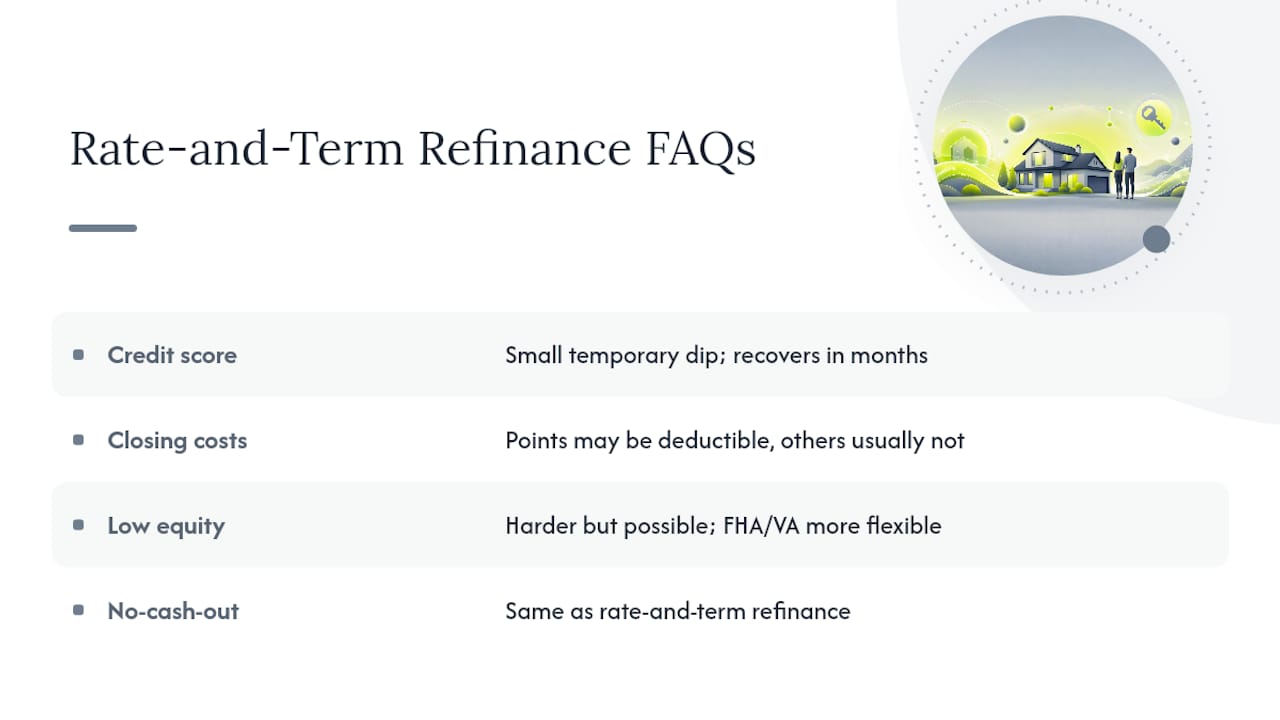
Does a rate-and-term refinance hurt my credit score?
Expect a small, temporary dip from the hard credit inquiry and the new account showing on your report. Most homeowners recover those points within a few months of consistent, on-time payments.
Are refinance closing costs tax-deductible?
Points paid to lower your rate may be deductible, often spread over the life of the loan rather than all at once, while most other closing costs generally aren’t. A tax professional can confirm how your specific costs apply.
Can I refinance if I have little equity?
It’s harder, but not impossible. FHA and VA streamline programs often have more flexible equity requirements than conventional rate-and-term refinances, which typically want at least some equity cushion.
How is a rate-and-term refinance different from no-cash-out refinancing?
They’re the same thing. “No-cash-out” and “rate-and-term” both describe a refinance that changes your rate or term without disbursing cash to you.
This article is general information, not a substitute for advice from a qualified financial advisor. Consult a qualified financial professional about your own circumstances before acting on anything here.
Sources
- Refinance rates today | Bankrate
- What is a rate-and-term refinance? | Experian
- Rate-and-Term Refinance Explained | Investopedia
- Consumerfinance
- Mortgage applications decrease in latest MBA weekly survey | MBA