
Before you commit to any loan, ask these questions and get the answers in writing. That single habit separates borrowers who close with confidence from those who discover surprise fees on closing day. Nearly half of mortgage borrowers don’t shop around when buying a home, which means most people accept the first offer they receive. You don’t have to.
Here is your ready-to-use checklist. Bring it to your first broker meeting, read the questions aloud, and don’t leave without written answers to the starred items.
Top questions to ask a mortgage broker at your first meeting:
- What is your NMLS ID, and may I verify it now? ⭐
- How are you paid, and who pays you? ⭐
- What is the interest rate, and what is the APR? ⭐
- Can I see a written Loan Estimate? ⭐
- What loan types are you recommending, and why?
- Is the rate locked? For how long, and what does the lock cost?
- How many lenders are on your panel?
- What are all the fees, including origination and broker fees?
- Are there prepayment penalties?
- What is the expected timeline from application to closing?
- Can you provide two references from recent closings?
- Who will I contact day-to-day if I have questions?
Immediate actions at the meeting:
- Request the NMLS ID and verify it on NMLS Consumer Access before proceeding.
- Ask how the broker is compensated and whether the lender or you pay the fee.
- Demand a written Loan Estimate before making any rate or fee decision.
- Ask for at least two references from clients with a similar loan scenario.
Quick dealmaker vs. red flag guide:
- Dealmaker: Broker provides NMLS ID immediately and welcomes verification.
- Red flag: Broker hesitates, deflects, or refuses to give a written Loan Estimate.
- Dealmaker: Broker explains all fees in dollar amounts, not just percentages.
- Red flag: Broker promises guaranteed approval or pressures you to misstate income.
Pro Tip: Print this checklist and check off each item during the meeting. Any question the broker refuses to answer in writing is a signal to pause and reconsider.
Key Takeaways
Asking the right questions before you commit to a mortgage broker protects you from hidden fees, licensing gaps, and offers that look competitive until you read the fine print.
| Point | Details |
|---|---|
| Verify NMLS ID first | Search the broker’s NMLS ID on NMLS Consumer Access before sharing any documents. |
| Demand a written Loan Estimate | A verbal quote is not binding; the Loan Estimate is the only document that locks in disclosed fees. |
| Compare at least two offers | Most borrowers don’t shop around, but comparing APR and fees across two Loan Estimates can materially reduce total cost. |
| Confirm broker compensation in dollars | Ask the broker to show their fee as a dollar amount on the Loan Estimate, not just a percentage. |
| David Mordue - Forward Financial Group | Provides written Loan Estimates, transparent fee disclosure, and a fully online application across multiple loan types. |
Table of Contents
- Questions to ask a mortgage broker about licensing and experience
- Loan-level questions that let you compare offers fairly
- What to get in writing: fees, closing costs, and key documents
- What the timeline looks like and what documents to bring
- How brokers are paid and how to verify their disclosures
- Red flags to watch for and what not to say prematurely
- How to compare multiple offers and negotiate better terms
- Your first-meeting documents checklist and short scripts
- Why these questions protect you more than any rate comparison tool
- Work with a broker who answers every question on this list
- Sources
Questions to ask a mortgage broker about licensing and experience
A broker’s credentials are the foundation of the relationship. Licensing is not optional in the U.S., and every mortgage broker must hold a valid NMLS ID issued under the Secure and Fair Enforcement for Mortgage Licensing Act (SAFE Act). You can verify a broker’s license and disciplinary history on NMLS Consumer Access by searching the broker’s name or NMLS number. Disciplinary records, license suspensions, and complaints are all visible there.
Beyond the license, ask these vetting questions:
- “What is your NMLS ID?” Write it down and check it before the meeting ends.
- “Have you had any disciplinary actions, complaints, or license suspensions?” A clean record is expected; evasion is not.
- “How many lenders are on your panel, and are any loan types I might need excluded?” Some brokers have limited panels that exclude certain direct-lender programs or government-backed products. Confirm your loan type is available.
- “How long have you worked with borrowers in my situation?” First-time buyers, self-employed borrowers, and investors each have different documentation needs. Experience with your specific profile matters.
- “Can you provide two references from clients who closed a loan similar to mine in the last six months?” Recent references reveal current service quality, not just historical reputation.
- “Who will I work with day-to-day: you directly, or a processing team?” Knowing your point of contact prevents communication gaps during underwriting.
- “What is your typical response time for emails and calls?” A broker who takes three days to answer a question during the interview will likely take longer during underwriting.
Pro Tip: When you pull up NMLS Consumer Access during the meeting, show the broker the screen. A trustworthy broker will lean in and help you read it. One who gets uncomfortable has told you something important.
Loan-level questions that let you compare offers fairly
Rate comparisons only work when you’re comparing the same inputs. Two brokers can quote the same interest rate and deliver very different total costs, depending on points, fees, and loan structure. These questions force an apples-to-apples comparison.

1. What is the interest rate, and what is the APR?
The interest rate is the base cost of borrowing. The APR (Annual Percentage Rate) includes most fees and gives you a truer picture of total cost. Ask exactly which fees are included in the APR calculation, because lenders vary in what they fold in.
2. Is the rate locked, and what are the lock terms?
A rate quote means nothing if it expires before closing. Ask whether the rate is locked, how long the lock lasts, what it costs to extend the lock, and what happens if the loan doesn’t close before the lock expires.
3. How many points are you quoting, and what do they buy?
One point equals 1% of the loan amount paid upfront to reduce the interest rate. Ask how many points are included in the quote, what rate reduction each point buys, and whether points are refundable if the loan is denied. Brokers are often paid in points that you may pay at closing or that get added to the interest rate, so clarity here is non-negotiable.
4. Why are you recommending this specific loan type?
Whether the broker recommends a 30-year fixed, a 15-year fixed, an adjustable-rate mortgage, FHA, VA, USDA, or jumbo product, you deserve a clear explanation. Ask what other loan types were considered and ruled out, and whether the broker will document that comparison in writing.
5. Are there prepayment penalties or restrictions on extra payments?
Some loan products penalize early payoff or cap how much extra principal you can pay each year. Ask directly, and get the answer in writing.
6. What are the escrow requirements?
Most conventional loans require an escrow account for property taxes and homeowners insurance. Ask whether escrow is mandatory for your loan type and what the monthly escrow estimate is.
Statistic to keep in mind: Nearly half of mortgage borrowers don’t compare offers when buying a home. Getting loan-specific answers in writing from at least two brokers is the single most reliable way to know whether the offer in front of you is competitive.
What to get in writing: fees, closing costs, and key documents
Verbal fee quotes are not binding. The only number that matters is the one on a signed, written document. Two documents protect you by law: the Loan Estimate and the Closing Disclosure.
The Loan Estimate must be provided within three business days of submitting a complete application. It breaks down your interest rate, monthly payment, closing costs, and loan terms on a standardized form. The Closing Disclosure arrives at least three business days before closing and reflects the final, locked figures. Compare the two line by line.
Key line items to check on both documents:
- Origination charges: The lender’s fee for processing the loan, listed in Section A.
- Broker fee: Disclosed separately; ask whether it’s a flat fee, a percentage of the loan, or lender-paid.
- Third-party fees: Appraisal, title search, title insurance, and settlement services in Section B and C.
- Prepaid items: Homeowners insurance, property taxes, and prepaid interest in Section F.
- Cash to close: The total you’ll need at the table, including down payment and all closing costs.
Mortgage brokers typically earn about 1%–2% of the loan amount and must disclose fees in writing. Broker fees can sometimes be rolled into the loan rather than paid at closing. Ask which option applies to your scenario and whether rolling fees into the loan changes the interest rate.
Also ask: “Do you charge a fee if the loan is denied or doesn’t close?” Some brokers do; most don’t. Know before you apply.
Concrete action: Request a written cost summary at the first meeting, even before a formal application. Then request a Loan Estimate from at least two lenders or brokers and compare them side by side.
What the timeline looks like and what documents to bring
Most borrowers underestimate how document-intensive the mortgage process is. Arriving at your first meeting prepared cuts days off the timeline and signals to the broker that you’re a serious applicant.
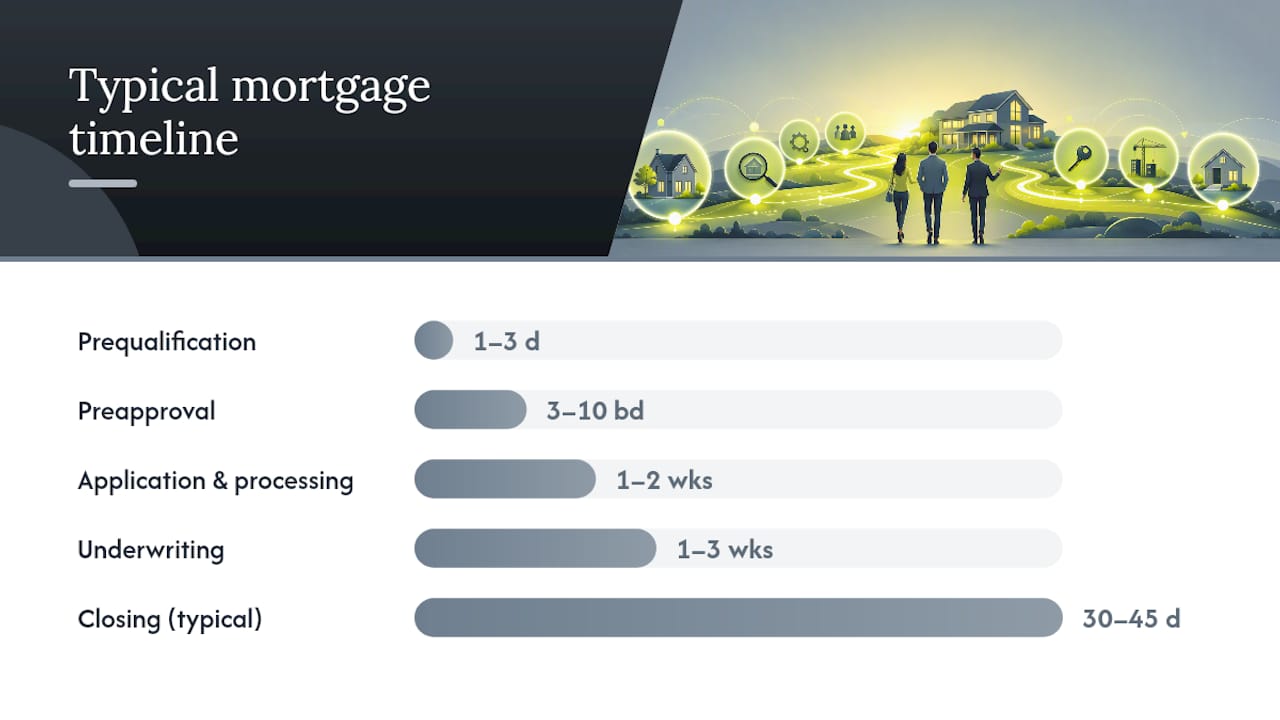
Typical milestones and time ranges:
- Prequalification: 1–3 days. A soft credit check and income estimate; not a commitment from the lender.
- Preapproval: 3–10 business days. A hard credit pull, full document review, and conditional approval letter. This is what sellers want to see.
- Formal application and processing: 1–2 weeks after an accepted offer.
- Underwriting: 1–3 weeks. The lender verifies every document and may issue conditions requiring additional paperwork.
- Appraisal: Typically ordered during underwriting; results take 1–2 weeks.
- Clear to close: Issued when all conditions are satisfied.
- Closing: Usually 30–45 days from application for a standard purchase; David Mordue - Forward Financial Group’s fully online process can target funding in under 21 days.
Ask the broker for a written timeline specific to your loan type and property. A broker who can’t give you a rough schedule has not done this enough times to know their own process.
Documents to bring to your first meeting:
- Government-issued photo ID (driver’s license or passport)
- Social Security number
- Last two pay stubs (or most recent 60 days of income documentation)
- Last two years of W-2s or 1099s
- Last two years of federal tax returns (required for self-employed borrowers)
- Last two to three months of bank statements for all accounts
- List of current assets (investment accounts, retirement accounts) and debts
- Signed purchase contract, if you’re already under contract
Pro Tip: Check and correct your credit reports before your first broker meeting. Errors on a credit report can lower your score and cost you a better rate. Pull reports from all three bureaus at AnnualCreditReport.com and dispute inaccuracies before you apply.
How brokers are paid and how to verify their disclosures
Understanding broker compensation removes one of the biggest sources of confusion in the mortgage process. Brokers earn money in a few distinct ways, and each has implications for the offer you receive.
Common compensation structures:
- Borrower-paid fee: You pay the broker directly, typically as a percentage of the loan amount at closing.
- Lender-paid commission: The lender pays the broker after closing, funded through a slightly higher interest rate. You don’t write a check, but you pay over time through the rate.
- Points: Upfront fees paid to the lender (or broker) to buy down the interest rate. One point equals 1% of the loan amount.
Federal regulations prohibit a broker from being paid by both the lender and the borrower for the same compensation item on the same loan. That means if the lender is paying the broker, the broker cannot also charge you a separate origination fee for the same service.
Ask the broker to estimate their total compensation in dollars based on your loan amount and show it on the Loan Estimate. This is the clearest way to see what you’re paying and to whom. Broker fees can sometimes be rolled into the loan, which changes your cash-to-close but increases the loan balance and total interest paid.
To verify licensing and check for complaints, go to NMLS Consumer Access and search by the broker’s name or NMLS ID. The record shows license status, state authorizations, and any disciplinary actions. Do this before you hand over any documents.
The FTC is direct on this point: don’t assume a mortgage broker automatically gets you the best deal. Compare loan terms and costs yourself and verify all broker disclosures in writing. A broker’s access to multiple lenders is an advantage only if you can see and compare what each lender actually offered.
Pro Tip: Ask the broker: “Can you show me the lender’s rate sheet for today?” Not all brokers will share it, but those who do are demonstrating transparency. The rate sheet shows the base rate the lender offers; the difference between that and your quoted rate is part of the broker’s compensation.
Red flags to watch for and what not to say prematurely
Some warning signs are obvious. Others show up only when you push for written documentation. Know both categories before you sit down.
Red flags that should end the meeting:
- Refusal to provide an NMLS ID or resistance to you verifying it.
- Unwillingness to give a written Loan Estimate before you commit.
- Pressure to misstate income, assets, or employment status on the application. This is mortgage fraud, and it exposes you, not just the broker.
- Promises of guaranteed approval. No broker can guarantee approval; only the lender’s underwriter makes that decision.
- Evasive or inconsistent answers about who pays the broker’s commission.
- Requests for upfront fees before any loan documents are issued.
What not to volunteer before preapproval:
Timing matters. Certain disclosures made too early can complicate underwriting:
- Don’t mention a planned job change or resignation before the loan closes. Employment verification happens at closing, and a job change can void your approval.
- Don’t disclose plans to convert a primary residence to a rental immediately after closing. Occupancy fraud is a federal offense.
- Don’t mention large upcoming purchases (car, furniture) before closing. New debt changes your debt-to-income ratio.
If a broker pressures you to move faster than you’re comfortable with, use this phrase: “I’d like to see that in writing before I decide.” A legitimate broker will not object. One who pushes back is showing you exactly how the rest of the process will feel.
Pro Tip: Insist on a written Loan Estimate before making any rate or fee decision. Verbal quotes are not binding. The Loan Estimate is a standardized federal form, and a broker who won’t provide one is either not ready to submit your application or is avoiding a commitment.
How to compare multiple offers and negotiate better terms
Getting two or three Loan Estimates is the most effective thing you can do to lower your total mortgage cost. You are allowed to negotiate fees and terms at closing, and most borrowers don’t realize how much leverage they have before signing.
Step-by-step comparison method:
- Collect Loan Estimates from at least two brokers or lenders on the same day, for the same loan amount and type.
- Compare Section A (origination charges) line by line. This is where broker fees and lender fees live.
- Compare the APR, not just the interest rate. A lower rate with higher fees often costs more over five years.
- Check points: one offer may quote a lower rate but require you to buy it down with points. Calculate the break-even period.
- Confirm rate lock terms: same rate, same lock period, same lock cost.
- Total the cash-to-close on each estimate and compare.
Negotiation questions that actually work:
- “Lender B quoted me [X rate] with [Y points]. Can you match or beat that?”
- “Can you waive the application fee or reduce the origination charge?”
- “What is the true cost of this loan over five years, including all fees?”
- “If I accept a slightly higher rate, can you reduce the closing costs?”
- “Is there a fee credit available if I close within 30 days?”
When a broker lowers a rate, check that fees didn’t rise to compensate. A lower rate paired with higher origination charges can cost more over the life of the loan than the original quote.
Offer comparison criteria:
| Criteria | What to compare |
|---|---|
| Interest rate | Base rate quoted, assuming same loan amount and term |
| APR | Total cost including fees; use for cross-offer comparison |
| Points | Number of points and rate reduction per point |
| Origination fee | Dollar amount in Section A of the Loan Estimate |
| Broker fee | Disclosed separately; confirm who pays it |
| Rate lock period | Length, cost to extend, and expiration date |
| Cash to close | Total funds needed at closing |
| Prepayment penalty | Yes or no; if yes, terms and duration |
Your first-meeting documents checklist and short scripts
Documents to bring or send securely before the meeting:
- Government-issued photo ID
- Social Security number
- Last two pay stubs
- Last two years of W-2s or 1099s
- Last two years of federal tax returns (self-employed borrowers)
- Two to three months of bank statements (all accounts)
- Asset statements: investment, retirement, and savings accounts
- List of current monthly debts (car loans, student loans, credit cards)
- Signed purchase contract, if available
Ask whether the broker uses an encrypted document portal for uploads. If they accept documents by unencrypted email, that’s a security concern worth raising. Request a confirmation receipt for every document you send.
Script 1: Verifying licensing and compensation
“Before we go further, can I get your NMLS ID? I’d like to pull it up on NMLS Consumer Access now. Also, can you walk me through exactly how you’re paid on this loan, in dollar terms, and whether that fee comes from me or the lender?”
Script 2: Requesting a Loan Estimate and timeline
“Once I submit my application, how long before I receive a written Loan Estimate? And can you give me a written timeline from application to closing for this loan type and property?”
Both scripts are short, direct, and non-confrontational. A broker who answers both questions clearly and without hesitation has passed the most important part of the interview.
Why these questions protect you more than any rate comparison tool
Most borrowers focus on the interest rate and miss the bigger picture. The rate is one variable. The broker’s transparency, the fee structure, the lender panel, and the communication model together determine whether your loan closes on time, at the cost you expected, without surprises.
The questions in this guide are designed to surface exactly those variables. Asking for an NMLS ID is not bureaucratic box-checking. It’s the fastest way to confirm you’re working with a licensed professional who has a clean record. Asking for a written Loan Estimate is not distrust. It’s the only way to hold a broker accountable to the numbers they quoted.
What most borrowers underestimate is how much the broker relationship affects the closing experience. The affordability calculators and refinance calculators on this site let you test any offer against your actual budget before you commit.
Work with a broker who answers every question on this list
David Mordue - Forward Financial Group was built around exactly the kind of transparency this checklist demands. The fully online application process delivers a written Loan Estimate fast, and the team handles purchase loans, refinancing, FHA, VA, ARM, and jumbo products, so you’re not limited by a narrow lender panel.
For borrowers who want to compare rates before committing, the preapproval and rate comparison page shows current options across loan types. If you’re still deciding whether buying makes sense right now, the rent vs. buy calculator gives you a clear financial picture in minutes. And if refinancing is on the table, the refinance calculator estimates your monthly savings against your current loan.
The next step is straightforward: bring this checklist to your first broker conversation, or start your application at Davidmordue and see how the process works when fee disclosure and clear communication are the baseline, not the exception.
Sources
These are the primary U.S. resources used to build this checklist. Each one is free, authoritative, and specific to the American mortgage market.
- Shopping for a mortgage FAQs | FTC
- Mortgage Brokers: What They Are and How to Find One - NerdWallet
- Nearly half of mortgage borrowers don’t shop around when they buy a home | CFPB blog
- NMLS Consumer Access — Main Search
All six resources are U.S.-specific and reflect federal consumer protection standards. They are the primary sources behind the questions, fee disclosures, and verification steps in this guide.
This article is general information, not a substitute for advice from a qualified financial advisor. Consult a qualified financial professional about your own circumstances before acting on anything here.