
True no‑doc mortgages for primary residences are effectively gone. What survives under that name today is a set of stricter, more expensive alternatives: bank‑statement loans, asset‑based programs, and DSCR loans for investors, all underwritten through the non‑QM market. The Ability‑to‑Repay rule requires lenders to verify some form of repayment capacity, so a lender who promises “no verification, no problem” on a home you plan to live in should raise your guard immediately.
TL;DR:
- True no‑doc mortgages are nearly extinct for owner‑occupied homes, replaced by stricter, costlier alternatives that verify income through nonstandard methods.
- Common current options include bank‑statement loans, asset‑based loans, and DSCR loans, each suited to different income and asset profiles.
- Borrowers typically need a credit score of around 700+ and a substantial down payment, often exceeding 30%, to qualify for these higher‑cost loans.
- Alternative‑doc loans carry higher interest rate premiums, often 1 to 5 percentage points above conventional loans, and lack some consumer protections.
- Using a knowledgeable broker can improve chances of matching with the right lender and obtaining better terms, especially for self‑employed or investor borrowers.
Table of Contents
- What a No‑Doc Mortgage Meant Before 2008, and Why the Rules Changed
- The Products You’ll Actually Encounter Today
- Who Actually Qualifies, and What It Costs
- Weighing the Real Benefits Against the Real Risks
- Finding a Legitimate Lender and Preparing Your Documents
- How a Broker Evaluates an Alternative‑Doc Application
- Why I Steer Self‑Employed Borrowers Toward Alternatives First
- Get Matched With the Right Alternative‑Doc Lender
- Where to Read More on Alternative‑Doc Lending
- Sources
What a No‑Doc Mortgage Meant Before 2008, and Why the Rules Changed
A no‑doc mortgage, in its original form, let a borrower state their income and assets without submitting pay stubs, tax returns, or bank statements to back up the number. Lenders took the applicant’s word for it, priced the risk into the rate, and moved on. That model earned the nickname “liar loans” for a reason, and by the mid‑2000s it had a cousin even looser than a plain no‑doc: the NINJA loan, short for No Income, No Job, No Assets.
Those products didn’t stay a fringe curiosity. Stated‑income lending fed directly into the mortgage defaults that triggered the 2008 financial crisis, and Washington responded with the Dodd‑Frank Act and, eventually, the Consumer Financial Protection Bureau’s Ability‑to‑Repay and Qualified Mortgage rules. The CFPB’s compliance guide spells out the core requirement plainly: a lender has to make a reasonable, good‑faith determination that you can actually repay the loan before they originate it.
That single requirement rewired the industry. Lenders couldn’t simply take your word anymore, so many of the old no‑doc and low‑doc products got restructured into what regulators call “alternative documentation” loans, according to Investopedia’s history of low/no‑doc lending. The name softened, but the substance changed too: some proof is still mandatory, just not the standard W‑2 and pay stub package that a conventional underwriter expects.
Here’s the distinction that trips up most borrowers searching for a no doc mortgage today:
- True no‑doc (pre‑2008 style): no income statement of any kind, priced purely on credit and collateral. Essentially extinct for owner‑occupied homes.
- Alternative documentation / non‑QM: income is verified through nonstandard sources like bank deposits, assets, or rental cash flow instead of tax returns.
- No‑income‑verification marketing language: often used loosely by lenders to describe alternative‑doc products, which can confuse borrowers into expecting something looser than what’s actually offered.
The Products You’ll Actually Encounter Today
If you’re self‑employed, a freelancer, or an investor, the products marketed as no-doc mortgage alternatives fall into a handful of recognizable categories. Knowing which one fits your income pattern saves you from applying to the wrong lender twice.
- Bank‑statement loans. Underwriters review 12 to 24 months of personal or business bank statements and convert your average monthly deposits into a qualifying income figure, sometimes averaging deposits and sometimes applying an expense ratio to business accounts. Lenders vary widely on whether they count transfers between your own accounts, so ask directly before you submit statements.
- Asset‑based loans (NIVA, no income verification asset). Instead of income, the lender verifies your liquid assets, checking accounts, brokerage holdings, retirement funds, and calculates a hypothetical monthly income by dividing your asset total over a set loan term. This path suits retirees and high‑net‑worth borrowers sitting on savings but light on recent tax filings.
- SIVA and SISA loans. Stated Income/Verified Assets (SIVA) requires proof of assets but takes your stated income at face value; Stated Income/Stated Assets (SISA) is the loosest version still marketed and is now largely confined to investor and portfolio lending rather than primary residences.
- DSCR loans. Debt Service Coverage Ratio loans qualify the property, not the person. Underwriters compare the home’s projected rental income against its mortgage payment, and if the ratio clears the lender’s threshold, your personal income barely enters the conversation. LendingTree’s analysis notes DSCR loans have become the primary vehicle for investors chasing no‑income‑verification style financing. Our DSCR loan page walks through the qualifying math in more detail.
Each of these sits under the non‑QM umbrella, meaning they fall outside the standard Fannie Mae and Freddie Mac box and get priced, and underwritten, accordingly.
Who Actually Qualifies, and What It Costs
Lenders compensate for reduced income documentation by tightening every other lever they control. That trade‑off shows up in three numbers borrowers consistently underestimate.
Pro Tip: Pull your credit report before you shop for an alternative‑doc lender. A 640 score might clear a conventional loan, but it will knock you out of most bank‑statement and asset‑based programs before a human even reviews your file.
- Credit score: Expect a floor around 700, sometimes higher depending on the lender and loan type, since credit history becomes the primary risk signal when income documentation is thin.
- Down payment: Many programs ask for a substantial down payment or more. Bankrate’s overview of no‑doc mortgages confirms that a 30%+ down payment paired with a 700+ credit score is a common baseline for these products.
- Rate premium: Budget for meaningfully higher interest costs than a conventional loan carries.
Alternative‑doc and no‑income‑verification loans typically run 1 to 5 percentage points above conventional mortgage rates, depending on the lender, loan type, and how thin your documentation actually is.
That spread matters. On a $400,000 loan, even a 2‑point rate premium adds hundreds of dollars to your monthly payment and tens of thousands over the life of the loan. Borrowers with genuinely strong liquid assets, think a retiree with a seven‑figure brokerage account, or an investor buying a fourth rental property, tend to absorb that premium more comfortably than a first‑time buyer stretching for a starter home. If your only advantage is “I don’t have tax returns,” the math usually favors documenting your income properly instead.
Weighing the Real Benefits Against the Real Risks
Alternative‑doc loans exist because they solve a genuine problem: a profitable self‑employed borrower whose tax returns show minimal income after deductions can look unqualified on paper while sitting on strong cash flow. For that borrower, and for investors buying property based on rental math rather than personal salary, these products open a door conventional underwriting slams shut.
The costs are just as real. Higher rates and larger down payments are the visible price, but the fine print carries less obvious risk too. Non‑QM loans generally come with fewer of the consumer protections built into qualified mortgages, and the pool of lenders offering them is far smaller, which limits your ability to shop around for better terms.
Watch for these warning signs before you sign anything:
- Any lender charging a large upfront fee before pulling your credit or reviewing a single document.
- Guaranteed approval language, since no legitimate underwriter promises an outcome before reviewing your file.
- Pressure to close quickly without a clear explanation of the rate, term, and prepayment penalties in writing.
- A lender who can’t clearly explain how they satisfy Ability‑to‑Repay requirements when you ask directly.
Pro Tip: Before you apply anywhere, run your numbers through a refinance calculator or affordability tool first. Seeing the real monthly cost of a rate premium in dollars, not just percentage points, makes the decision far less abstract.
Finding a Legitimate Lender and Preparing Your Documents
Start by verifying anyone you’re considering through NMLS Consumer Access, the public registry that confirms a mortgage company or loan originator is actually licensed. Skipping this step is how borrowers end up with lenders who disappear mid‑transaction or charge fees no licensed originator would attempt.
Documentation, even for “alternative” programs, still matters. Gathering it in advance speeds up underwriting and widens your options:
- 12 to 24 months of personal and business bank statements
- Profit and loss statements, ideally prepared or reviewed by an accountant
- 1099s if you contract rather than freelance informally
- Asset statements covering checking, savings, brokerage, and retirement accounts
Before committing to any lender, ask directly how they satisfy Ability‑to‑Repay requirements, which specific documents they’ll accept in place of tax returns, and whether they count business account transfers as qualifying deposits. Also compare the alternative‑doc route against a fully documented one: an FHA loan or a high‑down‑payment conventional loan can sometimes beat a non‑QM rate once you factor in the total cost over five to seven years.
How a Broker Evaluates an Alternative‑Doc Application
A broker’s job on a file like this is matching, not guessing. The process generally runs in four stages: an initial online review of your income pattern and goals, a tailored document checklist based on what you actually have available, matching you to lenders whose overlays fit your profile, then negotiating rate and terms once an offer is on the table.
- Initial review: income type, credit profile, target property, and timeline
- Document checklist: built around your specific situation, not a generic form
- Lender matching: non‑QM investors keep varying credit overlays and seasoning rules, and a broker who knows those differences can steer you away from a lender likely to decline you
- Rate and term negotiation: comparing offers across lenders rather than accepting the first quote
“Brokers can often negotiate better terms by matching borrower profiles to niche lenders” is the practical edge alternative‑doc borrowers get from working with someone who tracks lender overlays daily rather than shopping cold.
David Mordue - Forward Financial Group runs its application fully online, with funding possible in under 21 days for borrowers who come prepared with the right documents. One recent bank‑statement approval involved a self‑employed contractor whose tax returns understated actual cash flow; 18 months of business deposits told a very different story to the right lender.
Why I Steer Self‑Employed Borrowers Toward Alternatives First
I usually recommend documented paths before anything marketed as no‑doc, because the total cost gap is rarely small. If you have two years of consistent bank deposits, a bank‑statement loan or even a well‑prepared conventional application often beats a true alternative‑doc rate outright. Keep clean records for a year before you buy, and you may not need the premium at all. For most self‑employed borrowers, the smartest pathway is documenting income properly, then letting a broker find the lender who reads a P&L statement the way your business actually earns.
— David Mordue
Get Matched With the Right Alternative‑Doc Lender
You’ve seen the tradeoffs: bank‑statement, asset‑based, and DSCR programs all work, but only when they’re matched to the right lender and priced against your actual documentation. That matching is exactly what David Mordue - Forward Financial Group does for self‑employed borrowers, investors, and anyone whose income doesn’t fit a standard W‑2 box.
Rather than applying blind to lenders advertising vague “no income verification” promises, you start with a fully online application, get matched against lenders whose overlays actually fit your profile, and receive real rate comparisons instead of guesswork. Investors exploring rental‑income qualification can review the DSCR loan program directly, while anyone weighing a higher‑cost alternative loan against staying put should run the numbers first on the rent vs. buy calculator. When you’re ready to see real terms, start your application and get a document checklist built around your specific income, not a generic form.
Where to Read More on Alternative‑Doc Lending
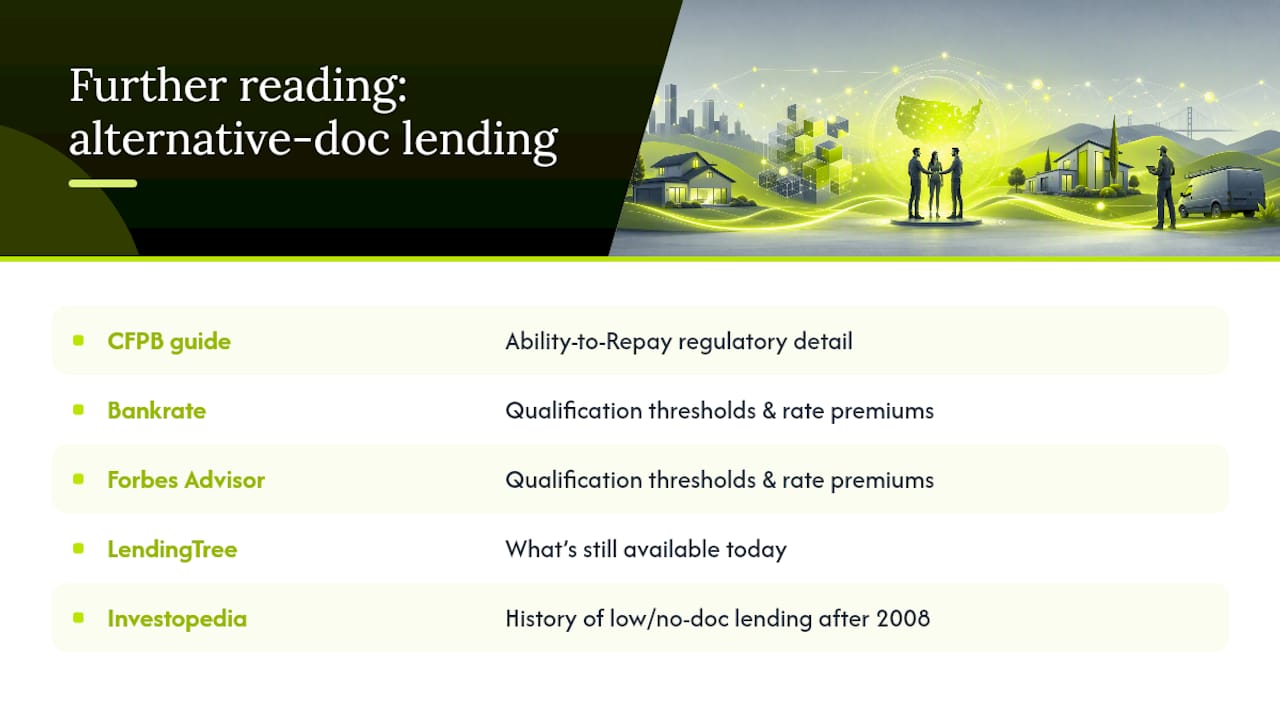
For regulatory detail on Ability‑to‑Repay requirements, go straight to the CFPB’s compliance guide. Bankrate and Forbes Advisor both break down current qualification thresholds and rate premiums, LendingTree covers what’s still available today, and Investopedia offers the clearest history of how low/no‑doc lending evolved after 2008.
This article is general information, not a substitute for advice from a qualified financial advisor. Consult a qualified financial professional about your own circumstances before acting on anything here.
Sources
- What Is A No-Doc Mortgage? | Bankrate
- No-Doc Mortgages: Are They Still Available? | LendingTree
- Low/No Documentation Loan: Meaning, Origins | Investopedia
- CFPB compliance guide: Ability-to-repay and qualified mortgage rule
- Can You Still Get A No-Doc Mortgage? | Forbes Advisor