
Buying mortgage points is worth it when your break-even timeline falls comfortably within your planned stay in the home and you still have healthy cash reserves after closing. For most buyers and refinancers, that test is the only calculation that truly matters.
Three quick rules of thumb before you run the numbers:
- You plan to stay long enough. Average U.S. homeowners stay in a home about 12 years, so a break-even of 4–5 years is often manageable; a break-even of 9 years is a much tighter call.
- You have cash to spare after closing. Paying for points should never drain your emergency fund. Experts advise against buying points if doing so removes your financial cushion.
- You are unlikely to refinance soon. If rates drop and you refinance within two years, you lose the upfront cost before recovering it.
The break-even test is simple: divide the cost of the points by the monthly payment reduction they produce. The result is the number of months you must keep the loan for the purchase to pay off.
Key Takeaways
Mortgage points are worth buying when your break-even timeline falls well within your planned hold time and you retain adequate cash reserves after closing.
| Point | Details |
|---|---|
| Break-even is the core test | Divide point cost by monthly savings; a result under half your planned stay generally favors buying. |
| One point costs 1% of the loan | On a $400,000 loan, one point costs $4,000 and typically reduces the rate by about 0.25%. |
| Cash reserves must stay intact | Buying points should never deplete your emergency fund; experts advise against it if reserves are tight. |
| Seller concessions can cover points | On a purchase, negotiating seller-paid points gives you a lower rate without spending your own cash. |
| David Mordue - Forward Financial Group | Provides custom break-even runs, multi-lender rate comparisons, and online calculators to model your exact scenario. |
Table of Contents
- Are mortgage points worth it? Discount vs. origination points explained
- How buying points changes your monthly payment and total interest
- Step-by-step break-even calculation you can run in minutes
- Checklist: when mortgage points are likely a good idea
- Common pitfalls and scenarios when points are not worth it
- Buying points on a purchase loan vs. buying points when you refinance
- Tax, APR, and loan-cost items to check with your lender or tax advisor
- How a mortgage broker evaluates points before making a recommendation
- A broker’s practical rule of thumb on buying points
- Get a tailored break-even analysis from David Mordue - Forward Financial Group
- Sources
Are mortgage points worth it? Discount vs. origination points explained
Mortgage discount points are prepaid interest. You pay a lump sum at closing in exchange for a permanently lower interest rate on your loan.
The CFPB describes points as a direct trade-off: you pay more upfront to get a lower rate and lower monthly payments over the life of the loan. Lender credits work in reverse — the lender covers some closing costs in exchange for a higher rate. Both options must appear on your Loan Estimate and Closing Disclosure, so you can always verify what you are paying.
Discount points vs. origination points are not the same thing, and conflating them is a common mistake. Origination points are fees the lender charges to process your loan. They do not reduce your rate. Discount points are the rate-buy-down tool. When you ask “should I pay points,” you are almost always asking about discount points.
One point typically reduces your rate by about 0.25 percentage points, though the actual reduction varies by lender, loan program, and current market conditions. Government loan programs such as FHA and VA may price points differently than conventional loans, which is one reason experts recommend shopping multiple lenders and always requesting a zero-point quote for comparison.
How buying points changes your monthly payment and total interest
A lower rate reduces your principal-and-interest payment every month and cuts the total interest you pay over the life of the loan. The longer you hold the loan, the more those monthly savings add up over time.
Here are two worked examples that show the mechanics clearly.
Example 1: Purchase loan, $400,000, 30-year fixed
On a $400,000 loan, one point costs $4,000 and a 0.25% rate reduction may lower the monthly payment by about $66, producing a break-even near 61 months. That is roughly five years. If you stay 10 years, the net savings after recovering the point cost is approximately $3,960.
Example 2: Refinance loan, $250,000, 30-year fixed
On a $250,000 refinance, one point costs $2,500. Break-even: $2,500 ÷ $42 = approximately 60 months. Use the refinance calculator at David Mordue to model your specific numbers.
| Scenario | Loan Amount | Point Cost | Rate Drop | Monthly Savings | Break-Even |
|---|---|---|---|---|---|
| Purchase (30-yr fixed) | $400,000 | $4,000 | 0.25% | ~$66/mo | ~61 months |
| Refinance (30-yr fixed) | $250,000 | $2,500 | 0.25% | ~$42/mo | ~60 months |
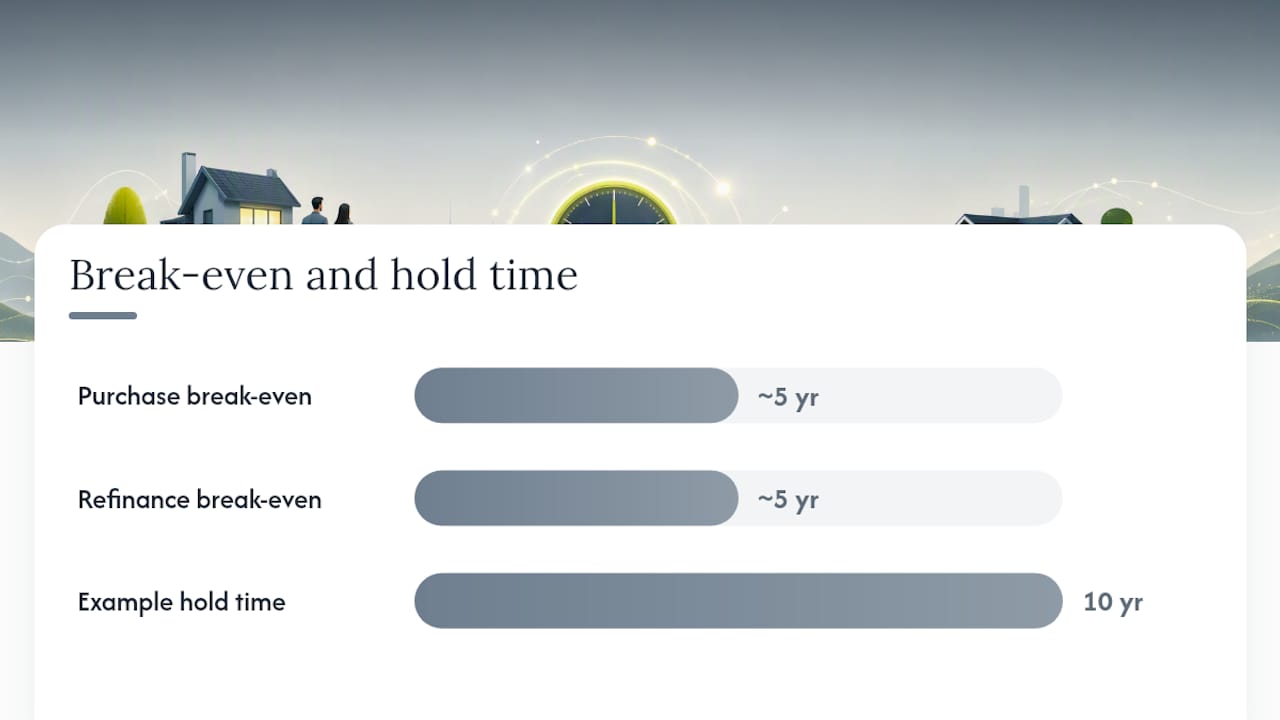
Both examples land near five years. That figure is not a coincidence — it reflects the typical pricing structure lenders use. Your actual numbers will differ based on your rate, loan size, and the specific buy-down your lender offers.
Step-by-step break-even calculation you can run in minutes
The break-even formula is straightforward: cost of points ÷ monthly payment reduction = months to break even. Here is how to compute it for your loan.
- Get your loan amount and both rate quotes. Ask your lender for the rate with zero points and the rate with one or two points. The difference is your rate delta.
- Calculate the monthly payment at each rate. Use the conventional affordability calculator or any standard mortgage calculator. Plug in the same loan amount and term at each rate.
- Subtract to find monthly savings. Payment at zero-point rate minus payment at discounted rate = your monthly savings from buying points.
- Divide the point cost by monthly savings. That quotient is your break-even in months. Divide by 12 for years.
- Compare to your planned hold time. If your break-even is 48 months and you plan to stay at least 7 years, the math favors buying points. If you are unsure how long you will stay, the rent vs. buy calculator can help you think through the hold-time question.
A note on financed points. On a refinance, some borrowers roll the point cost into the loan balance rather than paying cash at closing. This changes the math because you are now paying interest on the point cost itself. Your monthly savings shrink slightly, and your break-even extends. Always run the calculation both ways before deciding.
Checklist: when mortgage points are likely a good idea
Use this checklist before you commit. The more boxes you check, the stronger the case for buying points.
- You plan to stay in the home well past break-even. A five-year break-even with a seven-year planned stay is marginal. A five-year break-even with a twelve-year planned stay is solid.
- You have sufficient cash after closing. Points should come from surplus funds, not from reserves you would need for repairs, job loss, or emergencies.
- Rates are relatively high and unlikely to fall sharply. In a high-rate environment, a locked-in lower rate is more valuable because refinancing becomes less attractive later.
- Seller concessions are available. If the seller agrees to pay closing costs, those funds can cover point purchases without touching your cash.
- You are near a DTI ceiling. Buying points lowers your monthly payment, which can reduce your debt-to-income ratio and help you qualify for the loan.
- You are taking a shorter-term loan. On a 15-year fixed mortgage, break-even arrives faster relative to the loan term, and you pay less total interest either way.
- Your credit score is strong. Better credit already earns you a lower base rate; points then buy down from a more favorable starting position.
Red flags that suggest skipping points:
- You expect to sell or refinance within three years.
- Buying points would leave you with less than two to three months of living expenses in savings.
- Rates are trending downward and a refinance in 12–18 months seems likely.
- You are on an FHA loan and a larger down payment would eliminate mortgage insurance instead.
A quick sanity check: always ask your lender for the zero-point rate alongside any point-inclusive quote. Without that comparison, you cannot tell whether the rate reduction is priced fairly.
Common pitfalls and scenarios when points are not worth it
The most common mistake is buying points on a loan you end up not keeping. Sell the home or refinance before break-even and you lose the entire upfront cost with no recovery. On a $400,000 loan, that is $4,000 or more gone.

Cash depletion is the second risk. Paying $6,000–$8,000 for two points on a $300,000–$400,000 loan feels manageable on paper, but that money is gone from your liquid reserves the moment you close. If a major repair hits in year one, you may wish you had kept it.

Falling market rates create a specific trap. At that point, you have paid $4,000 for a rate you no longer hold. The point cost is unrecoverable.
Financed points on a refinance deserve extra scrutiny. Rolling the cost into the loan balance means you pay interest on the point cost for the life of the loan. The monthly savings are real, but the effective break-even is longer than the simple formula suggests. Model it explicitly before deciding.
One more comparison worth making: mortgage points do not build equity. A larger down payment reduces your principal balance and may eliminate private mortgage insurance, both of which deliver financial benefits that points cannot. If you are choosing between buying points and increasing your down payment, run both scenarios side by side.
Buying points on a purchase loan vs. buying points when you refinance
The mechanics differ in a few important ways depending on whether you are purchasing or refinancing.
On a purchase loan:
- Points are paid at closing alongside your down payment and other closing costs.
- The IRS generally allows you to deduct discount points in the year of purchase on a primary residence, subject to the $750,000 mortgage interest deduction limit for loans originated after December 15, 2017. Confirm your specific situation with a tax professional before counting on this benefit.
- Seller-paid points are a powerful option here. Using seller concessions to cover point costs gives you a lower rate without spending your own cash, and in some markets it can be more impactful than negotiating a lower purchase price.
On a refinance:
- You can pay points in cash at closing or roll them into the new loan balance.
- The IRS typically requires you to deduct points on a refinance over the life of the loan rather than in a single year, which reduces the immediate tax benefit.
- The break-even calculation must account for both the point cost and the closing costs of the refinance itself. A broker can model this for you using a side-by-side Loan Estimate comparison.
APR vs. nominal rate: when comparing offers, always look at the Annual Percentage Rate alongside the stated interest rate. A lender quoting a low nominal rate with heavy points may carry a higher APR than a competitor quoting a slightly higher rate with fewer points. The APR captures the total cost of the loan, including points, and gives you a more accurate comparison.
Tax, APR, and loan-cost items to check with your lender or tax advisor
APR is the most practical tool for comparing point-inclusive offers across lenders. The nominal rate tells you what your monthly payment will be; the APR tells you what the loan actually costs when you include points and fees.
On the tax side, discount points on a purchase mortgage are generally deductible as mortgage interest in the year paid, provided the loan is for your primary residence and meets IRS criteria. The deduction phases out above the $750,000 mortgage limit for loans originated after December 15, 2017. Points on a refinance are typically deducted ratably over the loan term. These rules have conditions and exceptions, so confirm your eligibility with a tax professional before factoring the deduction into your break-even math.
Lender questions to ask before closing:
- “Can you give me a Loan Estimate showing the rate at zero points and at one and two points?”
- “Where are the points shown on the Loan Estimate?” (They appear in Section A of the Loan Costs on page 2.)
- “How does the APR change between the zero-point and point-inclusive offers?”
- “Are these origination points, discount points, or both?”
Getting written answers to these questions before you commit protects you from paying for points that are actually lender fees in disguise.
How a mortgage broker evaluates points before making a recommendation
A broker’s job is to run the scenarios you would not think to run yourself. Here is the checklist a professional would work through before recommending points on your loan.
- Request zero-point and point-inclusive Loan Estimates from multiple lenders. Brokers routinely ask lenders for both options so they can compare the effective price of the rate buy-down across competing offers.
- Compute break-even for each scenario. Cost of points ÷ monthly savings = months to break even. Compare that figure to your stated hold-time intention.
- Check DTI impact. If you are near a lender’s DTI ceiling, buying points lowers the monthly payment, which may be the deciding factor in loan approval. This is a tactical use of points that goes beyond simple interest savings.
- Model the refinance sensitivity. If rates drop 0.75% within two years, would you refinance? If yes, the point purchase may not survive that scenario.
- Evaluate seller concession potential. On a purchase, can the seller cover point costs? That changes the cash-flow math entirely.
- Compare points versus larger down payment. Especially on FHA loans, where mortgage insurance adds to monthly costs, a larger down payment may outperform points on a total-cost basis.
Edge case: rolling points into a financed refinance. When a borrower has limited cash but wants a lower rate, a broker may model rolling one point into the refinance balance. The monthly savings are smaller because the loan balance is higher, but the upfront cash requirement drops to zero. This works best when the borrower has significant equity and a long planned hold time.
Pro Tip: Ask your lender for a full amortization schedule and a Loan Estimate that isolates the point cost as a separate line item. That document lets you compare offers from different lenders on an identical basis and verify that the rate reduction you are paying for is actually priced into the loan.
A broker’s practical rule of thumb on buying points
The simplest rule for most clients: buy points if the break-even falls within the first half of your planned stay and you will still have three or more months of living expenses in reserve after closing.
For purchase loans, a break-even of three to five years is generally comfortable for buyers who plan to stay seven or more years. For refinances, a tighter threshold applies — aim for a break-even under three years, because refinance economics can shift quickly if market rates move.
The action to take right now: run your numbers using the refinance calculator or the conventional affordability calculator, then request a zero-point Loan Estimate from your lender so you have a real comparison to work from.
Get a tailored break-even analysis from David Mordue - Forward Financial Group
Knowing the formula is one thing. Getting the actual lender quotes to plug into it is another. David Mordue - Forward Financial Group gives you both: a fully online application process, expert rate comparisons across multiple lenders, and personalized consultations that walk through the exact point-cost scenarios relevant to your loan.

The brokerage runs the numbers you need before you commit:
- Custom break-even analysis comparing zero-point and point-inclusive Loan Estimates
- Lender shopping across multiple programs (conventional, FHA, VA, jumbo) to find the best point pricing
- Seller-concession negotiation support on purchase transactions
- Refinance and purchase calculators available directly on the site
Ready to see whether buying points makes sense for your specific loan? Request your free rate comparison or use the refinance calculator to model your break-even in minutes.
Sources
Use these resources to verify definitions, run scenarios, and compare lender offers:
- Are mortgage points worth buying right now? Here’s what 3 experts think.
- How should I use lender credits and points (also called discount points)? | Consumer Financial Protection Bureau
- Everything You Need to Know About Mortgage Discount Points
- Are Discount Points Worth It? Run the Break-Even
- How Mortgage Points Work and When to Pay for Them
This article provides general information about mortgage discount points and is not a substitute for personalized financial or tax advice. Confirm current IRS rules, lender pricing, and eligibility requirements with a qualified mortgage professional or tax advisor before making any loan decision.