
The best low down payment mortgages for first-time buyers in the U.S. fall into five clear categories: VA loans (0% down for eligible service members and veterans), USDA loans (0% down for qualifying rural and suburban properties), FHA loans (3.5% down with flexible credit guidelines), and 3% conventional options including Fannie Mae HomeReady and Freddie Mac Home Possible. Each program targets a different buyer profile, and the right choice depends on your service history, location, income, and credit score.
At a glance: VA and USDA loans require no down payment. FHA loans require a small down payment with appropriate credit scores. HomeReady and Home Possible allow low down payments. Stack a state or local down payment assistance grant on top of any of these, and your net out-of-pocket can drop significantly.
Veterans and surviving spouses who qualify for VA benefits have access to the strongest program in this list. Rural and suburban buyers who meet USDA income limits get the same zero-down advantage without a military requirement. Everyone else is choosing between FHA’s flexible credit standards and the conventional 3% programs, which offer better long-term mortgage insurance terms for buyers with solid credit.
Table of Contents
- What are the best zero-down mortgage options?
- How do FHA, HomeReady, and Home Possible compare?
- How does down payment assistance reduce your out-of-pocket costs?
- What are the real out-of-pocket costs on a low down payment loan?
- Do you meet the eligibility requirements for these programs?
- How do you choose the right low-down-payment loan for your situation?
- What does the timeline look like from application to closing?
- How does a mortgage broker help you find the best low-down strategy?
- Key Takeaways
- What most buyers get wrong about low down payment loans
- Ready to find your best low-down-payment option?
- Authoritative program resources
What are the best zero-down mortgage options?
Two programs offer a genuine 0% down payment: VA loans and USDA loans. Both are government-backed, but they serve entirely different buyer profiles and come with distinct eligibility rules.
VA loans: the strongest zero-down option for veterans
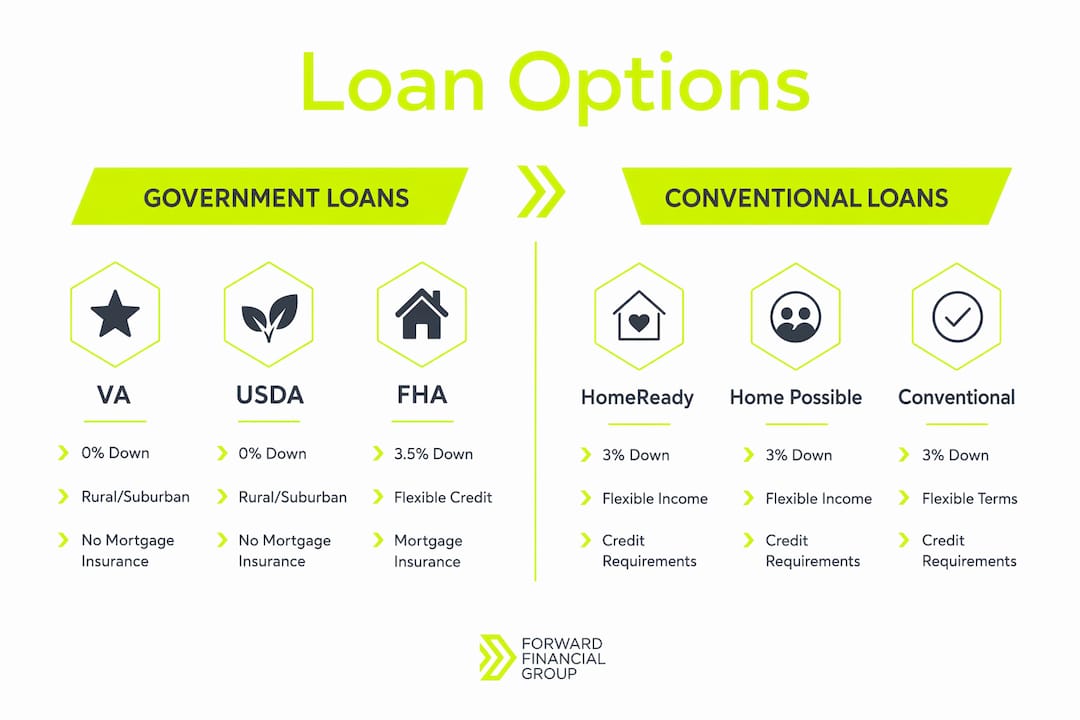
VA loans are available to active-duty service members, veterans, and eligible surviving spouses. There is no minimum down payment required, no private mortgage insurance, and the program allows competitive interest rates. The main cost to understand is the VA funding fee, a one-time upfront charge that varies based on your service type, down payment amount, and whether you’ve used the benefit before. First-time users putting 0% down typically pay a VA funding fee, though this fee is waived entirely for veterans with a service-connected disability.
You can review the VA funding fee schedule directly on the VA’s website before you apply. The fee can be rolled into the loan, so it doesn’t have to come out of pocket at closing.
Eligibility checklist for VA loans:
- Minimum 90 days of active-duty service during wartime, or 181 days during peacetime
- Six years of service in the National Guard or Reserves (or 90 days under Title 32 orders)
- Surviving spouse of a service member who died in the line of duty or from a service-connected disability
- Certificate of Eligibility (COE), obtainable through your lender or the VA’s eBenefits portal
- The property must be your primary residence
Pro Tip: Complete your COE before you start shopping for homes. Lenders can pull it electronically in most cases, but delays in entitlement processing can slow pre-approval. Having it ready puts you in the same position as a cash-ready conventional buyer.
USDA loans: zero down for rural and suburban buyers
USDA loans are backed by the U.S. Department of Agriculture and require no down payment for properties in designated rural and suburban areas. Income limits apply, generally tied to 115% of the area median income for your household size. The property must be located in a USDA-eligible area, which you can verify using the USDA’s online eligibility map.
Pros and cons of zero-down programs:
- VA pros: No PMI, competitive rates, no down payment, funding fee waived for disabled veterans
- VA cons: Requires military service history, funding fee adds upfront cost, primary residence only
- USDA pros: No down payment, lower mortgage insurance costs than FHA, available to non-veterans
- USDA cons: Geographic restrictions, income limits, property must meet USDA condition standards, longer approval timelines due to USDA eligibility checks
Zero-down loans are the right move when you have stable income and good credit but limited savings. The long-term cost of carrying a slightly higher loan balance is often smaller than the opportunity cost of waiting years to save a larger down payment.

How do FHA, HomeReady, and Home Possible compare?
For buyers who don’t qualify for VA or USDA, the choice narrows to FHA loans at 3.5% down and conventional options at 3% down. The differences matter more than the half-point gap in down payment suggests.
Side-by-side comparison
| Feature | FHA (3.5% down) | HomeReady (3% down) | Home Possible (3% down) |
|---|---|---|---|
| Minimum down payment | 3.5% (580+ credit score) | 3% | 3% |
| Who is eligible | Most borrowers; flexible credit | Low-to-moderate income; income limits apply | Income at or below 80% AMI |
| Credit score expectation | 580+ for 3.5% | Typically 620+ | — |
| Mortgage insurance | Upfront MIP + annual MIP (life of loan if <10% down) | Conventional PMI (cancelable at 20% equity) | Reduced MI; cancelable at 20% equity |
| Property restrictions | 1–4 units, primary residence | 1–4 units, primary residence | 1–4 units, primary residence |
| Gift funds allowed | Yes | Yes, including Community Seconds® | Yes |
| Homebuyer education | Not required | Required for first-time buyers | Required for first-time buyers |
The single biggest practical difference between FHA and the conventional 3% programs is mortgage insurance. FHA charges an upfront mortgage insurance premium (MIP) of 1.75% of the loan amount, plus an annual MIP that typically runs 0.55% per year on a 30-year loan with less than 10% down. That annual MIP stays for the life of the loan unless you refinance. Conventional PMI, by contrast, cancels automatically once your loan-to-value ratio reaches 80%.
HomeReady accepts rental income from a boarder or accessory dwelling unit toward qualifying income, which is a genuine advantage for buyers in multi-generational households. Home Possible caps income eligibility at 80% of area median income and offers reduced mortgage insurance compared with standard conventional loans.
Worked example: $300,000 purchase price
FHA at 3.5% down:
- Down payment: $10,500
- Upfront MIP (1.75%): $5,076 (typically rolled into loan)
- Estimated closing costs: $6,000–$9,000
- Cash needed at closing (excluding upfront MIP): approximately $16,500–$19,500
HomeReady at 3% down:
- Down payment: $9,000
- No upfront MIP
- Estimated closing costs: $6,000–$9,000
- Cash needed at closing: approximately $15,000–$18,000
The conventional option saves roughly $1,500–$1,800 upfront and avoids the life-of-loan MIP burden, but it requires a stronger credit profile. Use the FHA affordability calculator to run your own numbers before deciding.
Additional program notes:
- Gift funds from family members are accepted by FHA, HomeReady, and Home Possible
- Community Seconds® (subordinate financing from approved sources) can cover the down payment or closing costs on HomeReady loans
- Homebuyer education is required for first-time buyers using HomeReady or HomeOne; completing it early prevents underwriting delays
How does down payment assistance reduce your out-of-pocket costs?
Down payment assistance (DPA) is the most underused affordability tool available to first-time buyers. Stacking a DPA grant or forgivable second mortgage on top of a primary low-down loan can reduce your net cash at closing to near zero, even on a conventional or FHA loan.
Types of DPA programs
- Grants: Free money that doesn’t need to be repaid, typically offered by state housing finance agencies or municipalities. Amounts vary widely by state and county.
- Forgivable second mortgages: A second loan that is forgiven after you stay in the home for a set period (often 3–10 years). If you sell or refinance before the forgiveness period ends, a portion may be recaptured.
- Deferred-payment seconds: A second mortgage with no monthly payment; the balance is due when you sell, refinance, or pay off the first mortgage.
- Low-interest second mortgages: A second loan at a below-market rate, repaid monthly alongside the primary loan.
- Employer assistance programs: Some employers offer housing grants or forgivable loans as a benefit, particularly in healthcare, education, and government sectors.
Stacking DPA with a primary loan
A common stacking scenario: a first-time buyer in a qualifying state uses a HomeReady loan at 3% down on a $300,000 home ($9,000 required). Their state housing finance agency offers a $10,000 forgivable second mortgage for first-time buyers at or below 80% AMI. The DPA covers the entire down payment and a portion of closing costs, leaving the buyer responsible only for remaining closing costs and prepaid items.
Pro Tip: Search your state’s housing finance agency website first, then check HUD’s local homebuying programs finder. Many buyers miss grants that are available in their county simply because they didn’t know to ask. A mortgage broker can run this search as part of your pre-approval process.
Finding DPA in your area
- HUD’s approved housing counselor network: Counselors can identify local DPA programs at no cost to you
- State housing finance agencies: Every state has one; most maintain a searchable database of current programs
- Municipal and county programs: Many cities offer targeted grants for buyers purchasing in specific neighborhoods or income brackets
- Lender-specific programs: Some lenders maintain their own DPA funds or have preferred relationships with local agencies
Red flags to watch for
- Recapture clauses: Some DPA programs require repayment if you sell within a certain period, even if the loan was described as “forgivable.” Read the full agreement.
- Incompatible program restrictions: Not every DPA program is compatible with every primary loan type. Confirm compatibility before you apply.
- Documentation timing: DPA approval often requires its own underwriting timeline. Starting the DPA application late can delay your closing.
- Higher interest rates tied to DPA: Some lenders offer DPA but offset the cost with a higher rate on the primary loan. Compare the all-in cost, not just the upfront savings.
State programs can also change the mortgage insurance picture. Massachusetts’ ONE Mortgage program, for example, eliminates private mortgage insurance entirely for qualifying low- and moderate-income first-time buyers, which can save hundreds of dollars per month compared with a standard conventional loan.
What are the real out-of-pocket costs on a low down payment loan?
The down payment percentage is only one part of what you’ll pay at closing. Mortgage insurance, closing costs, and upfront fees all affect your true cash requirement.

Cost comparison by program type
| Cost Item | VA (0% down) | USDA (0% down) | HomeReady/Home Possible (3% down) | FHA (3.5% down) |
|---|---|---|---|---|
| Down payment | $0 | $0 | $9,000 | $10,500 |
| Upfront mortgage insurance | VA funding fee (amount varies; see VA table) | USDA guarantee fee (1% of loan) | None | FHA upfront MIP (1.75% of loan) |
| Annual mortgage insurance | None | — | Conventional PMI (cancelable at 20% equity) | FHA annual MIP (~0.55%, life of loan) |
| Estimated closing costs | $6,000–$10,000 | $6,000–$9,000 | $6,000–$9,000 | $6,000–$9,000 |
| Upfront fee (rolled in) | Yes, funding fee | Yes, guarantee fee | No | Yes, upfront MIP |
All dollar figures based on a $300,000 purchase price. Closing cost ranges are estimates; actual costs vary by lender, state, and transaction specifics.
How seller credits and lender credits change the picture
Seller concessions allow the seller to contribute toward your closing costs, reducing your cash at closing. FHA allows seller concessions up to 6% of the purchase price. Conventional loans allow 3% with less than 10% down. VA allows up to 4% in seller concessions plus reasonable closing costs.
Lender credits work differently: the lender covers some or all of your closing costs in exchange for a slightly higher interest rate. This can make sense when you’re cash-constrained at closing but plan to refinance or sell within a few years. Use the conventional affordability calculator to model how a lender credit affects your monthly payment versus your upfront savings.
Step-by-step cash-at-closing estimate
- Multiply the purchase price by your down payment percentage ($300,000 × 3% = $9,000)
- Add estimated closing costs (typically 2%–5% of the loan amount, or $6,000–$15,000 on a $300,000 loan)
- Add any upfront mortgage insurance not rolled into the loan
- Subtract seller concessions, DPA grants, and gift funds
- The result is your estimated cash needed at closing
A low down payment increases your loan balance, which means more interest paid over the life of the loan. A clear borrowing capacity assessment can help you model whether putting more down now makes financial sense versus preserving liquidity for reserves or other goals.
Do you meet the eligibility requirements for these programs?
Each program has its own credit score floor, debt-to-income (DTI) expectations, and documentation requirements. Here’s what lenders typically look for.
Credit score expectations by program
- VA loans: Lenders often require a credit score in the mid-to-high 500s or above
- USDA loans: Generally require a credit score considered good, though exceptions exist
- FHA loans: Require credit scores at or above thresholds for low down payment options
- HomeReady: Typically requires moderate credit scores
- Home Possible: Generally requires moderate to good credit scores, depending on lender overlays
DTI and income considerations
Most conventional low-down programs allow a back-end DTI (all monthly debt payments divided by gross monthly income) up to 45%, with some automated approvals reaching 50% for strong files. FHA is more flexible, sometimes approving DTIs up to 57% with compensating factors. VA has no hard DTI cap but uses a residual income test that ensures you have enough left over after all obligations.
Income limits apply to HomeReady and Home Possible. HomeReady caps qualifying income at 80% of area median income for most census tracts (with exceptions in low-income areas). Home Possible uses the same 80% AMI threshold. USDA limits household income to 115% of area median income.
Documentation checklist
- Income verification: Two years of W-2s or tax returns; recent pay stubs (30 days); profit-and-loss statement if self-employed
- Employment verification: Employer contact information; two-year employment history
- Asset verification: Two months of bank statements; documentation of gift funds (gift letter + donor bank statement)
- Credit: Lender pulls your credit report; you don’t need to provide it separately
- VA-specific: Certificate of Eligibility (COE); DD-214 for veterans
- USDA-specific: Property eligibility confirmation; household income documentation for all members
- DPA-specific: Program application, income certification, and homebuyer education certificate if required
Homebuyer education is a firm requirement for first-time buyers using HomeReady or HomeOne. Fannie Mae’s Framework course and HUD-approved counseling both satisfy the requirement. Completing it before you start lender shopping prevents a last-minute delay in underwriting.
How do you choose the right low-down-payment loan for your situation?
The right program depends on four factors: your eligibility, your credit profile, how long you plan to stay in the home, and how much cash you can bring to closing.
Decision framework:
- You’re a veteran or active-duty service member: Start with VA. The absence of PMI and the competitive rates make it the strongest long-term option for eligible buyers.
- You’re buying in a rural or suburban area and meet income limits: USDA is your zero-down alternative to VA.
- Your credit score is below 620: FHA is likely your most accessible path. The flexible credit guidelines and FHA loan structure are designed for exactly this profile.
- Your credit score is 620 or above and your income qualifies: HomeReady or Home Possible will cost you less over time than FHA because PMI is cancelable.
- You have very limited savings: Stack a DPA grant with your primary loan before assuming you need to wait.
Questions to ask every lender before you commit
- What is your lender overlay on the minimum credit score for this program?
- Can this loan be paired with my state’s DPA program?
- At what equity threshold does PMI cancel, and is it automatic or do I need to request it?
- What seller concession limits apply to this loan type?
- Can the upfront fee (funding fee or MIP) be rolled into the loan?
Common red flags
Watch for lenders who push lender-paid mortgage insurance (LPMI) without explaining that it’s built into a permanently higher rate. Unlike borrower-paid PMI, LPMI can’t be canceled when you reach 20% equity. Also be cautious of DPA programs where the recapture terms aren’t disclosed in writing before you sign.
Pro Tip: If you’re using DPA, lock your rate as soon as the DPA approval is confirmed. DPA programs can run out of funding mid-cycle, and rate locks protect you if the DPA process takes longer than expected. Ask your broker to coordinate the timing of both approvals simultaneously.
What does the timeline look like from application to closing?
Low-down-payment loans follow the same general timeline as conventional mortgages, with a few program-specific additions.
Typical stages and timeframes:
- Pre-approval: 1–3 business days for a fully documented application; same-day in many cases with an online lender or broker
- Home search and offer: Variable; once under contract, the clock starts
- Appraisal: Ordered after contract; typically completed within 7–14 days
- Underwriting: 7–21 days for most conventional and FHA loans; USDA adds a second review layer that can extend this by 1–3 weeks
- Clear to close: Issued when all conditions are satisfied; typically 1–3 days before closing
- Closing: Final signing and funding; same day or next business day
Program-specific timing notes:
- USDA: Requires a USDA Rural Development eligibility check in addition to lender underwriting. Budget an extra 2–4 weeks compared with a conventional loan.
- VA: Entitlement processing is usually fast when your COE is already in hand. VA appraisals (called VA appraisals, conducted by VA-approved appraisers) can take slightly longer in some markets.
- DPA: The DPA approval runs on its own timeline. Some programs require a separate application, income certification, and homebuyer education completion before they issue a commitment letter. Start the DPA process at the same time as your mortgage application, not after.
Documents to prepare before you apply:
- Last two years of federal tax returns and W-2s
- One month of recent pay stubs
- Two months of bank statements (all accounts)
- Photo ID and Social Security number
- Landlord contact information for rental history (if applicable)
- COE for VA; proof of property location for USDA
David Mordue - Forward Financial Group’s fully online application process is designed to move from pre-approval to funding in under 21 days for well-documented files, which matters when you’re competing in a market where sellers favor buyers who can close quickly.
How does a mortgage broker help you find the best low-down strategy?
A mortgage broker does more than submit your application to a single lender. The core value is access: brokers work with multiple wholesale lenders, which means they can shop your file across programs and underwriting standards that a single bank can’t offer.
What a broker does for a low-down buyer:
- Eligibility check across programs: A broker reviews your credit, income, and location against VA, USDA, FHA, HomeReady, and Home Possible criteria simultaneously, so you know all your options before you choose.
- DPA search: Brokers familiar with your local market know which state and county DPA programs are currently funded and compatible with your primary loan type.
- Lender shopping: Because lenders apply overlays on top of agency guidelines, the same borrower can get approved at one lender and declined at another. A broker identifies which wholesale investors are most favorable for your specific file.
- Apples-to-apples cost comparison: A broker can produce a side-by-side loan estimate showing the true cost of FHA vs. HomeReady vs. a DPA-stacked conventional loan, including PMI/MIP, rate, and closing costs.
- Closing coordination: When DPA is involved, the broker coordinates the timing of both the primary loan and the DPA commitment to prevent delays.
Lender overlays are one of the most underappreciated obstacles for low-down buyers. An agency guideline may allow a 580 credit score, but a lender’s overlay may require 620. Shopping with a broker who has access to multiple investors means your file goes to the lender whose overlay fits your profile, not the one who happens to be convenient.
David Mordue - Forward Financial Group specializes in exactly this kind of program matching for first-time buyers, including VA, FHA, and conventional low-down products with DPA coordination. The platform’s online application and rate comparison tools give you transparency at every step.
Key Takeaways
The most effective low-down-payment strategy for first-time buyers combines the right primary loan program with available DPA, turning a low required down payment into near-zero net out-of-pocket cash at closing.
| Point | Details |
|---|---|
| Zero-down options exist | VA (veterans/service members) and USDA (rural/suburban, income limits) require no down payment. |
| 3% conventional beats FHA long-term | HomeReady and Home Possible PMI cancels at 20% equity; FHA MIP typically stays for the life of the loan. |
| DPA stacking is the strongest affordability move | A state or local grant on top of a conventional loan can reduce net cash at closing to near zero. |
| Lender overlays change your options | The same borrower can be approved at one lender and declined at another; broker shopping matters. |
| David Mordue - Forward Financial Group | Offers program matching across VA, FHA, and conventional low-down loans with DPA coordination and a sub-21-day funding timeline. |
What most buyers get wrong about low down payment loans
The conventional wisdom says “save more, put more down.” For many first-time buyers, that advice costs them years of equity-building while they wait to accumulate a 20% down payment that the market no longer requires.
What buyers consistently underestimate is the mortgage insurance math. FHA’s life-of-loan MIP is a real long-term cost, but it’s also a solvable problem: once you’ve built 20% equity, a refinance into a conventional loan removes it. The question isn’t whether to accept MIP, it’s whether the cost of carrying it for 3–5 years is less than the cost of waiting 3–5 more years to buy. In most markets, buying earlier wins.
The other underestimated factor is DPA. Most buyers assume they need to cover the down payment from personal savings. In reality, many state and local programs are funded specifically to help buyers who meet income thresholds, and the money goes unclaimed every year because buyers didn’t know to ask. A broker who actively searches DPA programs as part of the pre-approval process can change the entire affordability picture.
One more thing worth saying plainly: a low down payment does increase your lifetime interest cost. That’s a real tradeoff, not a technicality. But for buyers with stable income and a long-term ownership plan, the equity you build from day one of ownership typically outweighs the incremental interest cost of a slightly larger loan balance. Run the numbers for your specific situation before you decide.
Ready to find your best low-down-payment option?
Sorting through VA, USDA, FHA, HomeReady, and DPA programs on your own is possible, but the combinations and lender overlays make it easy to leave money on the table. David Mordue - Forward Financial Group handles the program matching, DPA search, and lender comparison for you, with a fully online process that can move from pre-approval to funding in under 21 days.
Whether you’re a first-time buyer trying to minimize upfront cash or a veteran ready to use your VA benefit, the next step is a pre-approval that shows you exactly what you qualify for and what it will cost. Use the rent vs. buy calculator to see how ownership compares to your current situation, then start your pre-approval to get a personalized program comparison with real rate quotes. If you’d prefer to run the numbers first, the FHA affordability calculator and conventional affordability calculator are available at no cost.
This article is general information, not professional financial or legal advice. Confirm current program eligibility, rates, and requirements with a licensed mortgage professional or the relevant program authority for your specific situation.
Authoritative program resources
Use these primary sources to verify eligibility rules, current loan limits, and program details directly:
- VA home loans: U.S. Department of Veterans Affairs — eligibility, COE, funding fee schedule, and approved lenders
- USDA Rural Development: USDA Single Family Housing — property eligibility map, income limits, and guaranteed loan program details
- FHA loans: HUD.gov — FHA loan basics, MIP rates, lender search, and handbook
- Fannie Mae HomeReady: HomeReady program page — income limits, education requirements, and approved lenders
- Freddie Mac Home Possible: Home Possible program page — income limits, MI details, and lender resources
- State and local DPA: HUD local homebuying programs — state housing finance agency directory and approved housing counselors
- Massachusetts ONE Mortgage (state program example): Mass.gov ONE Mortgage — 3% down, no PMI, for low-to-moderate income first-time buyers in Massachusetts