
Yes, you can refinance your primary residence through an online mortgage broker today, and the process can move faster than most homeowners expect. David Mordue - Forward Financial Group handles the full application online, with funding possible in less than 21 days. Start with the Refinance Calculator to model your savings in minutes, or schedule a personalized consultation directly at Davidmordue.
A quick scope note: this guide covers primary-residence refinances only, both rate-and-term and cash-out for owner-occupied homes. It does not cover investment or rental property loans.
What you get when you work with a licensed, NMLS-registered broker:
- One application submitted to multiple lenders, not just one
- Access to lender programs not widely advertised to the public
- Personalized guidance through underwriting, documentation, and rate lock decisions
- A single point of contact from application to funding
Key Takeaways
Refinancing your primary residence through a licensed online mortgage broker gives you rate competition, personalized guidance, and a realistic path to funding in under 21 days.
| Point | Details |
|---|---|
| Break-even is the deciding metric | Divide total closing costs by monthly savings to confirm you’ll stay long enough to recoup them. |
| Cash-out requires 20% equity | Lenders typically cap cash-out refinances at 80% LTV; Fannie Mae also requires 12-month seasoning in most cases. |
| Closing costs run 2%–5% | Budget this range against your loan balance before committing to any refinance offer. |
| Compare Loan Estimates, not rates | APR, cash-to-close, and break-even months tell you more than the nominal interest rate alone. |
| David Mordue - Forward Financial Group | One application, multiple lenders, personalized consultation, and a funding target of under 21 days for primary-residence refinances. |
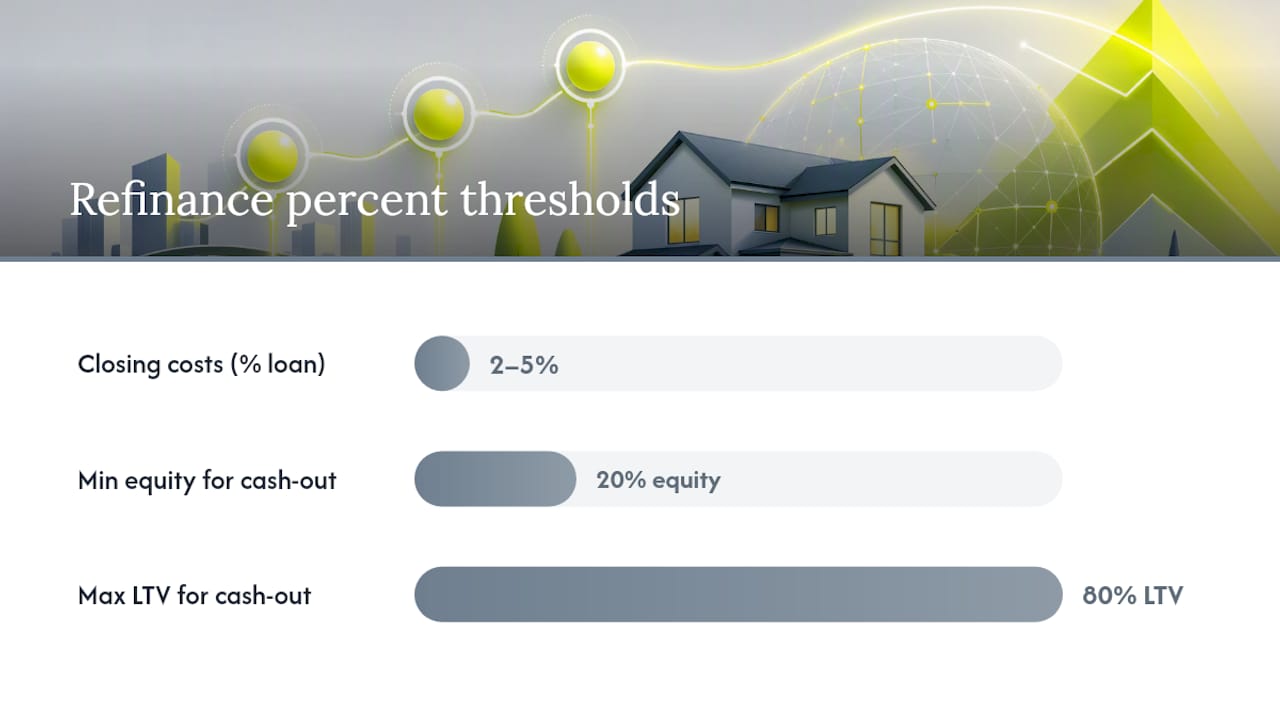
Table of Contents
- Why an online mortgage broker beats applying to one lender
- Which refinance type fits your primary residence?
- What lenders check before approving your refinance
- How to calculate your refinance savings and break-even point
- What the application process looks like, step by step
- What David Mordue - Forward Financial Group does for you in a refinance
- When refinancing your primary residence may not make sense
- Start your refinance with David Mordue - Forward Financial Group
- A perspective on when a brokered online refinance is the right call
- Sources
Why an online mortgage broker beats applying to one lender
Applying directly to a single bank means accepting whatever that institution offers. A mortgage broker compares multiple lenders from one application, often surfacing programs and rates that aren’t publicly listed. That difference matters most when your financial profile has any complexity: self-employment income, recent job changes, or a debt-to-income ratio that sits near a lender’s cutoff.
The concrete benefits of a brokered refinance:
- One application, multiple lenders. Your credit is pulled once; the broker shops the results across its lender panel.
- Personalized underwriting guidance. A broker’s core value isn’t just the lowest headline rate. It’s matching your specific income, credit, and equity profile to the lender most likely to approve you on favorable terms.
- Negotiation of lender credits. Brokers can sometimes negotiate credits that offset closing costs, reducing your out-of-pocket at closing.
- Access to niche programs. VA, jumbo, and non-QM options may be available through a broker’s panel that a single bank won’t offer.
- Transparency on fees. Brokers are required to disclose compensation, so you know exactly what the service costs.
Pro Tip: During your first consultation, ask four specific questions: Which lenders are on your panel? How is your compensation structured? Can you guarantee a rate lock timeline? What is a realistic funding date given current appraisal scheduling in my area?
Which refinance type fits your primary residence?
Two paths cover most homeowners: rate-and-term refinance and cash-out refinance. Choosing the wrong one costs money.
Fannie Mae’s cash-out guidelines specify seasoning requirements, acceptable uses of proceeds, and LTV/CLTV limits that directly affect eligibility and pricing. In many cases, your existing first mortgage must be seasoned at least 12 months before a cash-out refinance is permitted. Freddie Mac also allows rolling closing costs and prepaids into certain cash-out loans, which can reduce what you bring to closing.
Choose rate-and-term if: your goal is a lower monthly payment or a shorter loan term, and you don’t need cash from equity.
What lenders check before approving your refinance
Underwriters evaluate five core areas. Knowing them before you apply lets you fix problems in advance.
- Credit score. Most conventional lenders want a minimum of 620; better rates typically require 740 or above.
- Loan-to-value ratio. Calculate yours: divide your current loan balance by your home’s estimated value. Rate-and-term refinances allow higher LTVs than cash-out.
- Debt-to-income ratio (DTI). Most lenders cap total DTI at 43%–45%, though some programs allow higher with compensating factors.
- Seasoning. Cash-out refinances generally require 12 months of on-time payments on the existing mortgage per Fannie Mae’s selling guide.
- Appraisal. Cash-out transactions almost always require a full appraisal; some rate-and-term refinances qualify for an appraisal waiver.
- Documentation. Pay stubs (30 days), W-2s or 1099s (two years), most recent mortgage statement, bank statements (two months), homeowners insurance declarations page, and government-issued ID.
How to calculate your refinance savings and break-even point
Refinancing typically costs 2%–5% of the loan amount in closing costs. The break-even formula is straightforward:
Break-even months = Total closing costs ÷ Monthly payment savings
If you plan to stay in the home longer than 42 months, the refinance pays off. If you’re likely to move in three years, the math doesn’t work.
Typical closing-cost line items to budget for:
- Origination fee (0.5%–1% of loan amount)
- Appraisal ($400–$700)
- Title search and insurance
- Escrow and settlement fees
- Recording fees
- Prepaid interest and insurance
Use the Refinance Calculator to input your current loan balance, interest rate, expected new rate, estimated closing costs, and planned time in the home. The calculator produces your monthly savings and break-even timeline instantly.
What the application process looks like, step by step
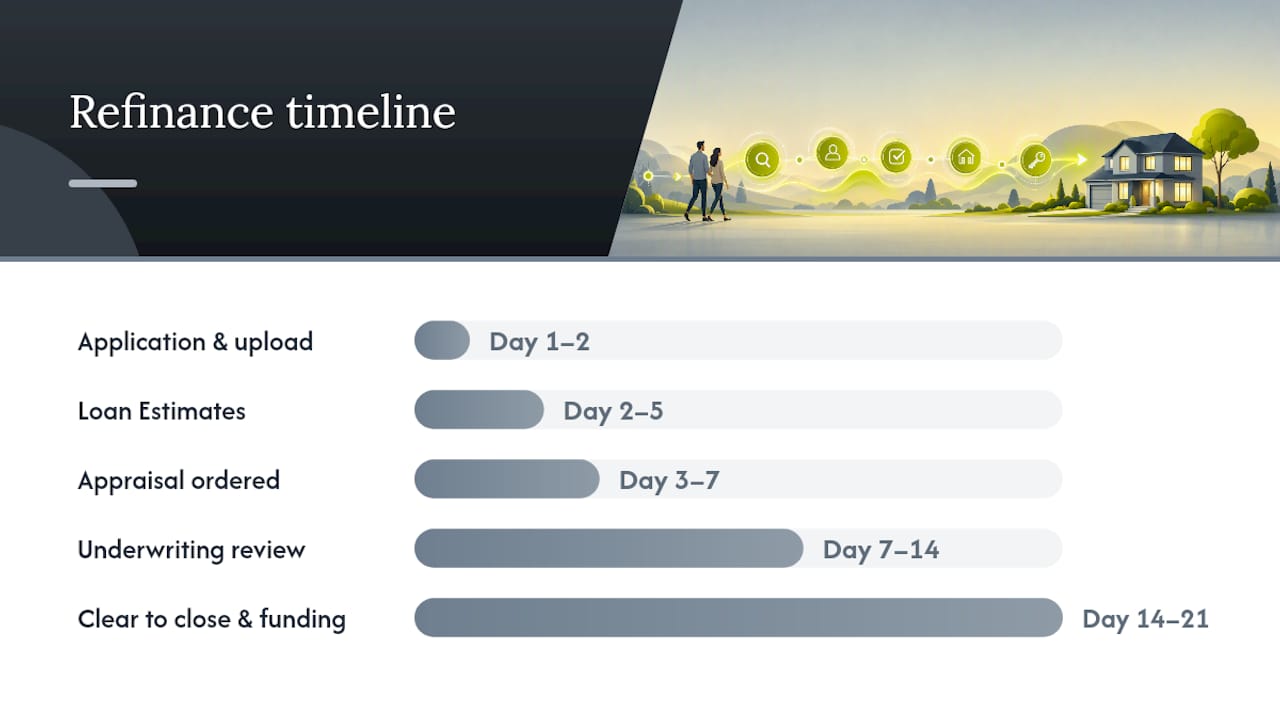
A brokered online refinance follows a predictable sequence. Here’s a realistic timeline:
- Day 1–2: Application and document upload. Complete the online application and upload your core documents. The broker submits to multiple lenders simultaneously.
- Day 2–5: Loan Estimates received. Lenders are required to deliver a Loan Estimate within three business days. Compare APR, cash-to-close, and break-even months across at least three offers before choosing.
- Day 3–7: Appraisal ordered. Schedule the appraisal as early as possible. Provide the appraiser with recent comparable sales in your neighborhood to support your estimated value.
- Day 7–14: Underwriting review. The lender’s underwriter reviews your file. Respond to any conditions within 24 hours to avoid delays.
- Day 14–18: Clear to close. Once all conditions are satisfied, you receive a Closing Disclosure at least three business days before closing.
- Day 18–21: Funding. Sign closing documents and receive funding.
Pro Tip: Choose electronic title services where available. They cut the title search and insurance turnaround from several days to 24–48 hours in many markets, which is one of the most reliable ways to shorten the overall timeline.
The broker controls the comparison, application submission, and documentation coordination. Appraisal scheduling and underwriting speed depend on the lender and third-party providers. David Mordue - Forward Financial Group’s online process is built to minimize delays on the brokerage side.
What David Mordue - Forward Financial Group does for you in a refinance
David Mordue - Forward Financial Group manages the full refinance process from a single online platform. You submit one application, and the brokerage shops it across its lender panel to find the most competitive rate and terms for your specific profile. Every client receives a personalized consultation, not a generic rate quote.
The service includes documentation review, underwriting guidance, and direct communication with the lender on your behalf. For borrowers with self-employment income, recent credit events, or complex asset structures, that personalized underwriting support is where the real value shows up.
David Mordue - Forward Financial Group is a licensed mortgage broker with NMLS registration. Use the Refinance Calculator as your first step to model scenarios before the consultation.
When refinancing your primary residence may not make sense
Not every refinance is worth doing. These situations call for caution:
- You already have a historically low rate. Trading a 3% or 3.5% rate for today’s rates increases your monthly payment and total interest paid.
- You plan to move within three years. If you won’t reach break-even before selling, closing costs outweigh the savings.
- Your equity is below 20% for a cash-out refinance. Lenders commonly limit cash-out to roughly 80% LTV, and going below that threshold adds private mortgage insurance costs.
- A credit event is imminent. Applying for a refinance shortly before a major credit change, such as a new car loan or job change, can affect your approval terms.
Alternatives worth considering:
A HELOC (home equity line of credit) lets you draw cash as needed without replacing your first mortgage, preserving a low existing rate. A home equity loan provides a lump sum at a fixed rate, also without touching your first mortgage. If your goal is simply a lower payment and you have minimal equity, a no-closing-cost refinance rolls fees into the rate, which makes sense when you’re uncertain about your timeline.
On broker-specific risks: ask for a full fee disclosure upfront, confirm how many lenders are on the panel, and review the Loan Estimate carefully for any origination charges before you commit.
Start your refinance with David Mordue - Forward Financial Group
David Mordue - Forward Financial Group gives you a faster path to a funded refinance than applying to a single lender. One online application reaches multiple lenders, a licensed broker guides you through every underwriting decision, and the process targets funding in under 21 days.

Here’s what happens after you submit your information: within 24–48 hours, you receive a personalized consultation and competing Loan Estimates to compare. No guesswork on which lender fits your profile. No waiting weeks for a single bank’s decision.
What the service includes:
- Personalized consultation with a licensed, NMLS-registered mortgage broker
- Rate comparisons across multiple lenders from one application
- Full documentation and underwriting support
- Funding target: under 21 days
Schedule your consultation or start the Refinance Calculator today. If you’re evaluating a 15-year vs. 30-year term as part of your refinance, the calculator models both scenarios side by side.
A perspective on when a brokered online refinance is the right call
The homeowners who benefit most from an online brokered refinance are those who want speed and certainty without sacrificing rate quality. Applying to a single lender is faster to start, but it leaves money on the table if that lender’s pricing isn’t competitive for your profile. A broker’s panel solves that problem without adding complexity for you.
The primary-residence scope matters here. This guide, and David Mordue - Forward Financial Group’s refinance service is built for owner-occupied homes, with underwriting standards, LTV limits, and rate expectations different from those for investor or rental property loans.
Sources
Use these authoritative resources alongside the David Mordue - Forward Financial Group calculators to research your options and verify current guidelines.
- Mortgage Broker vs. Bank - NerdWallet
- B2-1.3-03, Cash-Out Refinance Transactions - Fannie Mae Selling Guide
- Cash-out refinance - Freddie Mac Single-Family
This article provides general information about mortgage refinancing and is not a substitute for professional financial or legal advice. Confirm current guidelines and eligibility requirements with a licensed mortgage professional or the relevant regulatory authority before making any financing decision.