
An interest-only mortgage lets you pay only the interest on your loan for a set period, usually 5 to 10 years, while your principal balance stays exactly where it started. Your monthly payment drops significantly during that window, which is the main appeal. The trade-off is real: once the interest-only period ends, your payment resets to cover principal too, often jumping hundreds of dollars a month, and you have not built a dollar of equity through your payments alone.
TL;DR:
- Interest-only loans often require higher credit scores, lower debt-to-income ratios, and larger down payments due to their underwriting standards.
- The typical interest-only period lasts 5 to 10 years, with monthly payments covering only interest, which do not reduce the principal balance.
- After the interest-only phase, payments jump significantly because the remaining balance must be amortized over the remaining loan term, often leading to larger monthly obligations.
- Total interest paid over the life of an interest-only mortgage tends to be higher than with a fully amortizing loan, especially if home values decline.
- These loans are best suited for borrowers with predictable income, short-term ownership plans, or investors managing cash flow, rather than long-term homeowners.
Table of Contents
- How Does an Interest-Only Mortgage Work?
- What Are the Pros and Cons of an Interest-Only Loan?
- Who Qualifies for an Interest-Only Mortgage?
- What Are the Real Risks, and What Should You Ask Before Signing?
- How Do You Calculate an Interest-Only Payment?
- A Broker’s Take on When Interest-Only Loans Actually Make Sense
- Compare Interest-Only Options With a Broker Who Shops the Whole Market
- Sources
- FAQ
How Does an Interest-Only Mortgage Work?
Every interest-only loan runs on two clocks. The first is the interest-only phase, when your payment covers just the interest charged on your outstanding balance. The Consumer Financial Protection Bureau confirms that your principal does not shrink at all during this stretch, no matter how many payments you make. The second phase is amortization, sometimes called a recast, when the lender recalculates your payment to pay off the full remaining balance over whatever term is left.
Term structures vary, but a few patterns show up again and again:
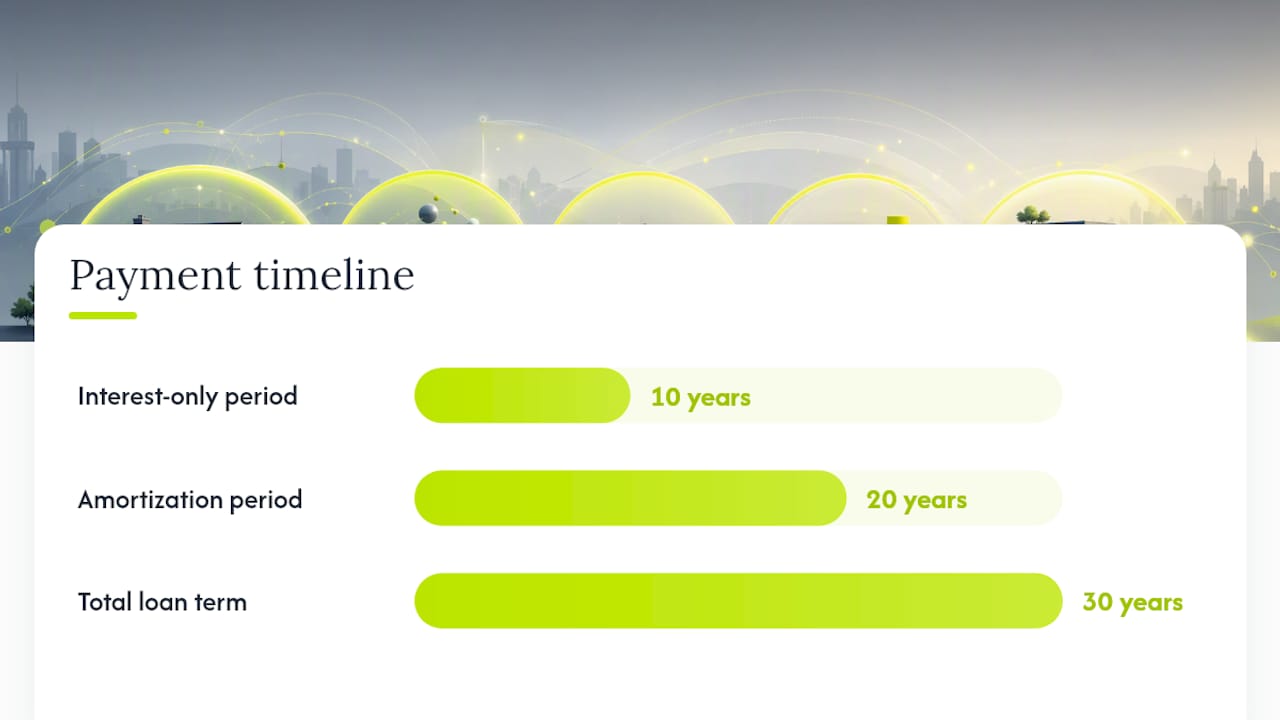
- A 10-year interest-only period on a 30-year loan, leaving 20 years to amortize the full balance afterward.
- A 5-year or 7-year interest-only window, frequently paired with an adjustable-rate mortgage such as a 7/1 ARM.
- A true interest-only loan, where the payment never dips below the interest owed, versus a payment-option ARM, where a minimum payment can fall short of interest and add unpaid interest back onto your balance, a process known as negative amortization.
That last distinction matters more than most borrowers realize. Investopedia notes that interest-only structures are frequently built on an ARM chassis, which means your rate, index, margin, and caps deserve as much attention as the interest-only feature itself. Shortening the remaining amortization window without a rate change is enough on its own to push your future payment up substantially, since the same balance now needs to be repaid faster.
What Are the Pros and Cons of an Interest-Only Loan?
The appeal is straightforward: your monthly obligation during the interest-only phase can run considerably lower than a comparable fixed-rate or fully amortizing loan, freeing up cash for other goals. Some borrowers also point to the mortgage interest deduction, which currently applies to interest on up to $750,000 of mortgage debt for most homeowners, though your own tax situation should guide that decision, not a general rule of thumb.
The downsides carry real weight, and they compound over time.
- No principal reduction happens unless you voluntarily prepay, meaning you build zero equity through your regular payment.
- Total interest paid over the life of the loan tends to run higher than a standard amortizing mortgage, since the balance stays elevated longer.
- If home values fall, refinancing or selling to escape a payment increase becomes difficult or impossible, since you may owe more than the home is worth.
Pro Tip: Run the math on total interest paid over 30 years, not just the monthly savings today. A lower payment now can mean tens of thousands more paid to the lender over time.
Interest-only loans tend to fit specific situations best: someone who plans to own the home for only a few years, an investor managing cash flow across a portfolio, or a borrower with a documented, predictable jump in future income, like a bonus structure or a scheduled promotion.
Who Qualifies for an Interest-Only Mortgage?
Qualified Mortgage rules, established under the ability-to-repay framework, generally exclude interest-only features entirely. That single fact explains why these loans are harder to find than they were before the 2008 crisis. The CFPB confirms that lenders offering interest-only products are typically underwriting outside the standard QM channel, which means tighter scrutiny across the board.
Expect lenders to look for:
- A higher credit score than a standard fixed-rate applicant would need.
- Lower debt-to-income ratios, since the payment jump after the interest-only period gets factored into affordability.
- A larger down payment or equity cushion, along with verified liquid reserves, a pattern Experian confirms is standard across interest-only underwriting.
Pro Tip: A mortgage broker who shops multiple lenders can surface interest-only programs that never appear on a single bank’s website, since many of these products are offered through intermediary channels rather than direct retail lending.
What Are the Real Risks, and What Should You Ask Before Signing?
Payment shock is the risk that catches borrowers off guard most often. Your interest-only payment stays flat for 10 years. Once amortization begins, that same balance now needs to be repaid over the remaining 20 years instead of 30, which pushes your payment up substantially, even if your rate never moves. If rates have also risen since closing, the increase compounds further.
The CFPB and the OCC both caution against assuming a future sale or refinance will bail you out of that jump. Home values can fall, credit scores can slip, and lending standards can tighten, any of which can close that exit door. Underwriting guidance recommends stress-testing your ability to repay at the fully indexed or maximum contractual rate, not the introductory rate you start with.
Before signing anything, request:
- A Loan Estimate that spells out the interest-only period, the recast trigger, and projected payments after amortization begins.
- The promissory note, so you can confirm there is no negative amortization clause hiding in the fine print.
- A written projected payment schedule showing your payment before and after recast, plus any rate caps or balloon provisions.
How Do You Calculate an Interest-Only Payment?
The formula is simple: monthly interest-only payment equals your loan amount multiplied by the annual interest rate, divided by 12. Multiply $360,000 by 0.075 to get $27,000, then divide by 12, and you land on a $2,250 monthly payment, a figure confirmed by Bankrate’s interest-only mortgage calculator.
Once amortization kicks in, that $2,250 payment climbs because the full balance now needs to be repaid over a shorter window. Before you commit to a loan like this, run through a short checklist:
- Calculate your interest-only payment using the formula above.
- Calculate the post-recast amortized payment using your remaining loan term.
- Compare the two figures side by side, then stress-test the higher one against your actual budget, not your projected future income.
A Broker’s Take on When Interest-Only Loans Actually Make Sense
Most articles on this topic stop at “know the risks.” That advice is true but incomplete. What separates a borrower who uses an interest-only loan well from one who gets burned is documentation, not optimism.
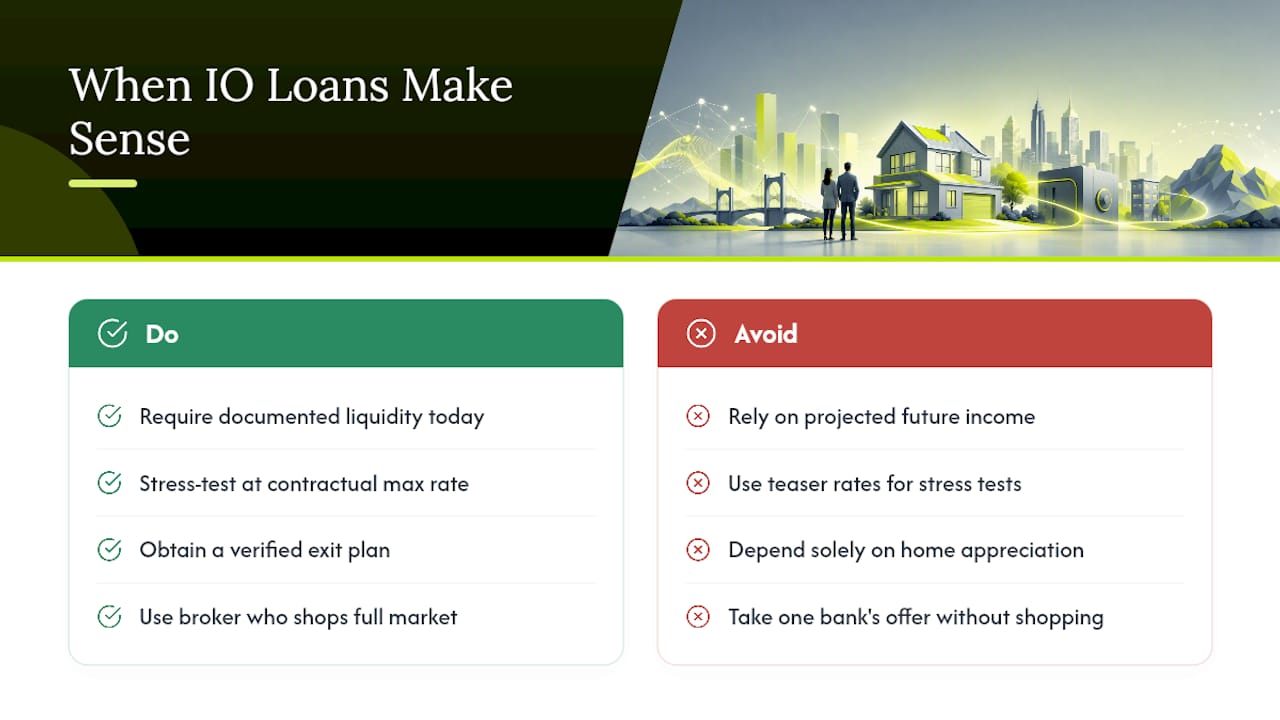
Before I recommend this structure to anyone, I want to see documented liquidity that covers the post-recast payment today, not a projection of what income might look like in five years. I want a stress test run at the maximum contractual rate, not the teaser rate. And I want a verified exit plan that does not depend entirely on home appreciation, because markets do not always cooperate on your timeline.
Where this structure earns its place is when a borrower’s income path is genuinely predictable, or when short-term ownership is the actual plan, not a hope. Working with a broker who shops the full market, rather than a single lender’s shelf of products, tends to surface options that fit that reality more precisely than walking into one bank and taking whatever they offer.
— David Mordue
Compare Interest-Only Options With a Broker Who Shops the Whole Market
Some mortgage brokers provide access to rate comparisons across multiple lenders, run through a fully online application that can lead to funding in under 21 days.

If an interest-only structure is genuinely the right fit for your situation, a personalized consultation is the fastest way to find out, rather than guessing from a calculator alone. You can also model what a 30-year fixed-rate mortgage or an adjustable-rate mortgage would cost side by side with an interest-only structure before you decide anything. When you are ready to see actual numbers, compare current rates and start your application, or reach out for a consultation through David Mordue - Forward Financial Group to walk through your specific income timeline and exit strategy together.
This article is general information, not a substitute for advice from a qualified financial advisor. Consult a qualified financial professional about your own circumstances before acting on anything here.
Sources
- What is an “interest-only” loan? | Consumer Financial Protection Bureau
- Interest Only Mortgage Calculator - Calculate Payment | Bankrate
- Interest-Only Mortgages Explained: Benefits and Risks | Investopedia
FAQ
Which Banks Offer Interest-Only Mortgages?
Interest-only mortgages are not standard offerings at most retail banks, since Qualified Mortgage rules generally exclude the feature from conventional lending. They are more commonly found through portfolio lenders and mortgage brokers who work outside the standard QM channel, which is why working with a broker who shops multiple lenders tends to surface more options than a single bank visit.
How Much Is an Interest-Only Mortgage on $100,000?
Using the standard formula of loan amount multiplied by annual rate divided by 12, the monthly interest-only payment is calculated by that method, as Bankrate also illustrates. Your actual rate will depend on your credit profile, loan structure, and current market conditions.
Is It Difficult to Get an Interest-Only Mortgage?
Yes, relative to a standard fixed-rate mortgage, because these loans typically require a higher credit score, lower debt-to-income ratio, and larger verified reserves, as Experian confirms. Since most interest-only loans fall outside the Qualified Mortgage framework, lenders also apply stricter underwriting than they would to a conventional loan.
How Much Would I Pay Monthly on a 30-Year Interest-Only Mortgage?
Your monthly payment during the interest-only phase depends only on your loan amount and rate, not the total loan term, since no principal is included.