
You can remove FHA MIP two ways: it cancels automatically if your loan qualifies, or you refinance into a conventional loan to eliminate it entirely. Check your origination date, original down payment, and current loan-to-value before doing anything else.
TL;DR:
- Automatic FHA MIP cancellation applies only to loans originated on or after June 3, 2013, with a down payment of at least 10%, after 11 years.
- Borrowers with less than 10% down payment pay MIP for the life of the loan, regardless of home value appreciation or loan payoff progress.
- Refinancing to a conventional loan requires about 20% equity, high credit scores, and manageable debt-to-income ratios, but does not eliminate existing UFMIP refunds.
- FHA-to-FHA refinancing can offer a partial UFMIP refund within HUD’s specified window, but does not remove monthly MIP payments entirely.
- Confirming your eligibility for automatic MIP cancellation depends on your origination date and current loan-to-value, with servicer action determining actual termination.
Table of Contents
- How FHA MIP Removal Differs From Canceling Conventional PMI
- Do You Qualify for Automatic FHA MIP Cancellation?
- Refinancing to Remove FHA MIP: What Actually Qualifies
- Does FHA MIP Refund When You Refinance?
- How to Check Your MIP Status With Your Servicer
- When Refinancing to Kill MIP Isn’t Worth It
- What Happens if You Keep Paying MIP Past Eligibility
- Are There Alternatives to Refinancing for MIP Removal?
- What I’d Prioritize First if I Were in Your Shoes
- Ready to Refinance and Stop Paying FHA MIP?
- Where to Verify These FHA MIP Rules Yourself
- Sources
- FAQ
How FHA MIP Removal Differs From Canceling Conventional PMI
FHA loans carry two separate insurance charges: an upfront mortgage insurance premium (UFMIP), paid at closing or rolled into the loan, and an annual MIP, billed monthly. Almost every FHA borrower pays both, regardless of how much they put down. That is the first thing that trips people up when they go looking for FHA MIP removal, because they are comparing it to a completely different system.
Conventional loans use private mortgage insurance (PMI), which you can request to cancel once your balance drops to 80% of the home’s original value, and which federal consumer guidance confirms lenders must automatically cancel once you hit 78%. FHA doesn’t work that way. Its rules come from HUD policy, not a borrower-initiated request, and your servicer is the one who tracks eligibility and submits the paperwork.
Two things decide your situation:
- Your loan’s origination date determines which rule set applies, since HUD changed the cancellation framework effective June 3, 2013.
- Your servicer’s action determines whether cancellation actually happens, since HUD notes that termination can be based on the servicer’s own amortization reporting, especially after a loan modification.
That servicer dependency is the part most FHA MIP refund process guides skip, and it matters more than any equity calculation.
Do You Qualify for Automatic FHA MIP Cancellation?
Your case number’s assignment date splits FHA loans into two very different worlds.
Put down less than 10%, and you’re paying MIP for the life of the loan, full stop, according to HUD’s own guidance. No amount of home value appreciation changes that.
| Origination window | Down payment | MIP cancellation rule |
|---|---|---|
| On or after June 3, 2013 | 10% or more | Automatic after 11 years |
| On or after June 3, 2013 | Less than 10% | Life of loan (no automatic cancellation) |
| — | Any | Cancels at 78% LTV, after minimum 5 years paid |
| — | Any | Governed by older HUD rules; check case-specific terms |
Current LTV is your remaining loan balance divided by your home’s current appraised value, not the original purchase price. Servicers typically require a formal appraisal or an approved automated valuation before they’ll act on that number.
Your FHA case number and origination date sit on your closing disclosure and original loan documents. Pull those before calling anyone.
Refinancing to Remove FHA MIP: What Actually Qualifies
If you don’t meet the automatic cancellation criteria, refinancing into a conventional loan is the standard route, and it’s the one most FHA MIP eligibility criteria checklists point to when the calendar math doesn’t work in your favor.
Conventional refinances generally require:
- Around 20% equity to avoid PMI entirely, or less equity if you’re willing to carry PMI temporarily
- A credit score in the high 600s or better for the most competitive rates, though approval is possible lower
- A debt-to-income ratio lenders find comfortable, typically under 43% to 45%
Refinancing FHA-to-FHA is a different animal. It does not remove your monthly MIP. You’ll still owe periodic premiums under the new loan’s terms, though timing the switch correctly can net you a partial UFMIP credit, covered next. If you’re a veteran or in an eligible rural area, a VA or USDA refinance can also eliminate monthly mortgage insurance entirely, often with better terms than either FHA or conventional.
Here’s the actual sequence to follow:
- Calculate your current LTV using a recent valuation, not your purchase price.
- Collect refinance quotes from multiple lenders to compare rate and fee structures.
- Run a break-even analysis: divide total closing costs by your monthly savings to find the payback period.
- If you’re staying FHA rather than going conventional, check whether you fall inside the UFMIP credit window before locking anything in.
Pro Tip: If your FHA case number is close to a UFMIP refund threshold, moving fast on an FHA-to-FHA refinance can save you real money that evaporates the longer you wait. But if you’re going conventional and rates are trending down, it’s often worth waiting a few weeks for a better lock rather than rushing into a marginal deal.
Does FHA MIP Refund When You Refinance?
Only in one specific scenario: refinancing from an existing FHA loan into a new FHA loan, and only within HUD’s allowed window.
- HUD’s Chapter 7 refund rules apply a declining percentage refund of your original UFMIP based on how many months have passed since your original closing.
- That refund isn’t cash back to you. It’s applied as a credit against the new loan’s upfront MIP, according to RefiGuide’s breakdown of FHA-to-FHA refinances.
- Refinancing FHA-to-conventional gets you zero UFMIP refund, no exceptions.
The core tradeoff: going conventional forfeits any leftover UFMIP credit, but it’s the only move that actually stops your monthly MIP for good. Staying FHA might save you a few hundred dollars in credit today while leaving you on the hook for premiums indefinitely.
Exact refund percentages and window lengths have shifted with policy updates over the years, so confirm the current schedule with HUD or your lender rather than assuming an older number still applies.
How to Check Your MIP Status With Your Servicer
Don’t call your servicer without a plan. Here’s what actually gets results:
- Locate your FHA case number and original closing date on your mortgage documents.
- Ask your servicer directly: is my loan eligible for automatic termination, and has that request been submitted to HUD?
- Ask how they calculate your current LTV, and whether they require a new appraisal or accept an automated valuation.
- Request a written timeline for when cancellation would take effect if you qualify.
Have your most recent mortgage statement, any recent appraisal or valuation report, and proof of on-time payments ready before you call. If the servicer stalls or gives vague answers, ask for a supervisor and get any commitment in writing.
If the answer comes back that you don’t qualify for cancellation, that’s your cue to start collecting refinance quotes rather than waiting.
When Refinancing to Kill MIP Isn’t Worth It
Refinancing has real costs: closing fees, appraisal charges, title insurance, and often two to three months of overlapping payments during the transition. All of that has to be weighed against what you’d actually save.
- Closing costs typically run 2% to 5% of the loan amount
- If your credit score has dropped since your original FHA loan, conventional PMI pricing could rival or exceed your current MIP
- A lower rate doesn’t always offset a longer amortization schedule if you’re resetting your loan term
Quick example: say refinancing saves you $150 a month but costs $6,000 in closing fees. Your break-even point is 40 months. If you’re planning to sell or refinance again before then, you lose money on the deal.
The rule is simple: only refinance when your monthly savings, measured against realistic time in the home, clearly outweigh closing costs and any extension of your loan term.
What Happens if You Keep Paying MIP Past Eligibility
Missing your cancellation window isn’t rare, and it’s rarely intentional.
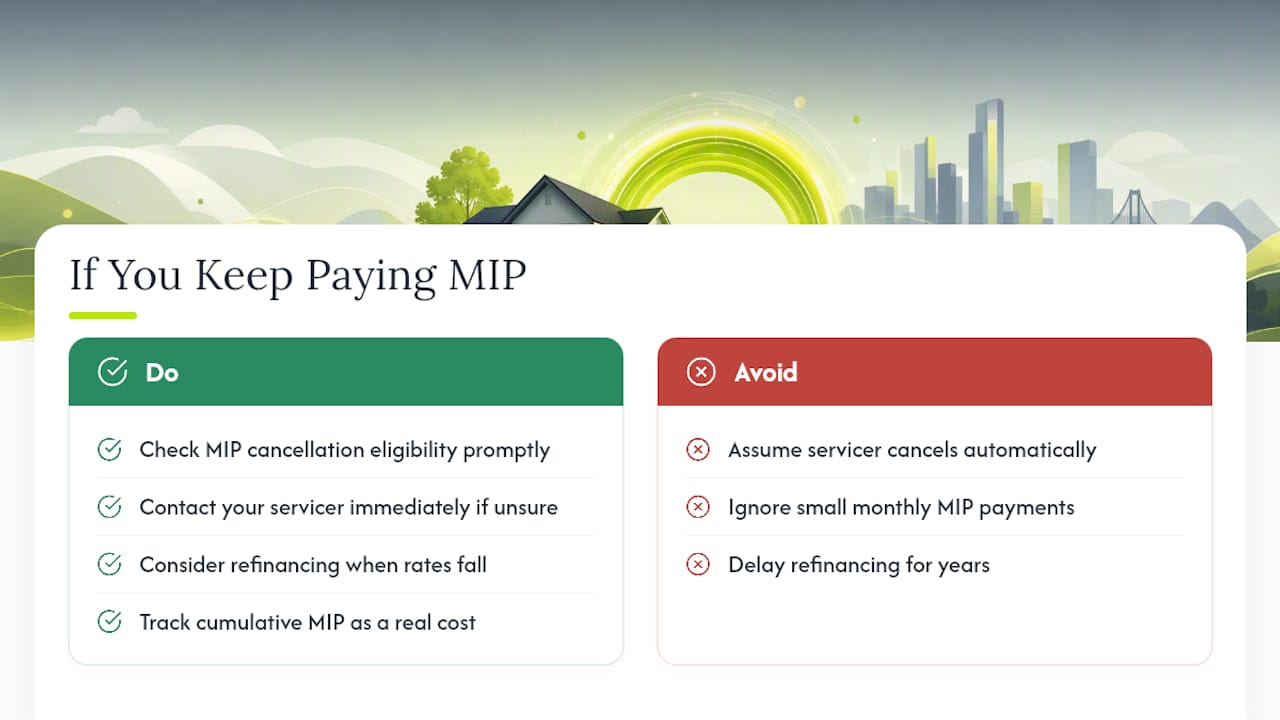
The direct cost is straightforward: every month you overpay adds up. On a typical FHA loan, annual MIP runs a fraction of a percent of your loan balance, split into monthly payments. That might sound small in isolation, but stretched across years of an eligibility window you never claimed, it becomes a real drain on your budget, money that could have gone toward principal, savings, or literally anything else.
There’s a compounding effect too. If you’re paying MIP unnecessarily while also carrying a higher interest rate than what’s currently available, you’re layering two avoidable costs on top of each other. That combination is exactly what pushes many FHA borrowers toward refinancing sooner rather than later, once they realize automatic cancellation either isn’t coming or already should have happened.
There’s also an opportunity cost tied to timing. Rates fluctuate, and waiting years to address unnecessary MIP payments means missing windows when refinancing might have made even more financial sense. If you suspect you’ve crossed a cancellation threshold and your servicer hasn’t acted, that’s worth raising immediately rather than assuming it will happen on its own. HUD’s framework puts the reporting responsibility on the servicer, but that doesn’t mean it happens without a nudge from you.
Are There Alternatives to Refinancing for MIP Removal?
Not really, and that’s worth being direct about.
A few adjacent moves can help indirectly, even though they don’t remove MIP itself:
- Extra principal payments speed up equity growth, which matters if you’re on the 78% LTV track from an older loan, but they do nothing for life-of-loan MIP on newer originations.
- A loan modification could, in rare cases, trigger a servicer’s amortization recalculation, but it’s not a strategy anyone should pursue purely to escape MIP.
- Waiting out the 11-year clock, if you put down at least 10%, is technically an alternative to refinancing, though it means paying premiums for over a decade first.
For most borrowers stuck with life-of-loan MIP, refinancing into a conventional loan (or VA/USDA if eligible) remains the only mechanism that actually ends the payments rather than just reducing their sting.
What I’d Prioritize First if I Were in Your Shoes
Start with your origination date and down payment, not your interest rate. That’s the first thing I’d check, because it tells you in about five minutes whether you’re chasing an automatic cancellation that’s already earned, or whether you’re wasting time waiting on a life-of-loan MIP that will never go away on its own.
Too many homeowners assume MIP works like PMI and wait for a letter that’s never coming. Once you know refinancing is your actual path, speed starts to matter, particularly if there’s a UFMIP credit window closing or rates are moving. A quick online process that can return refinance quotes and funding in under 21 days matters here, because a slow shopping process can cost you more than the MIP you’re trying to eliminate.
— David Mordue
Ready to Refinance and Stop Paying FHA MIP?
If your servicer confirms you’re stuck on life-of-loan MIP, refinancing into a conventional loan is the fastest way to actually stop the bleeding, and speed matters more than most homeowners realize once a UFMIP credit window or a favorable rate is on the line. A fully online application can compare rates across multiple lenders and aim to get you funded quickly, instead of the weeks-long back-and-forth typical of a single-bank refinance.

Start by running your numbers through the refinance calculator to see your realistic break-even point before you commit to anything. If the math works, or if you just want a second opinion on what a conventional refinance would actually cost you in fees versus what it saves you monthly, get your refinance quote directly. If you’re still early in deciding whether FHA fits your situation at all, the FHA loans overview page is a useful next stop.
Where to Verify These FHA MIP Rules Yourself
For the official rulebook, HUD’s 4155.2 Chapter 7 covers UFMIP refund schedules and cancellation triggers directly from the source. The HUD Answers page confirms the 11-year and life-of-loan distinction. For consumer-friendly breakdowns, Bankrate’s refinance guide and RefiGuide’s refund explainer are both solid starting points.
This article is general information, not a substitute for advice from a qualified financial advisor. Consult a qualified financial professional about your own circumstances before acting on anything here.
Sources
- Chapter 7. Mortgage Insurance Premiums (MIP) - HUD 4155.2
- How long is MIP collected for case numbers assigned on or after June 3, 2013? - HUD Answers
- How To Remove Mortgage Insurance On FHA Loan | Bankrate
- Do You Get an FHA MIP Refund When You Refinance? - RefiGuide
FAQ
Is It Possible to Remove MIP From an FHA Loan?
Yes, either through automatic cancellation if your loan meets HUD’s origination-date and down payment criteria, or by refinancing into a conventional, VA, or USDA loan if it doesn’t.
Is MIP Required on FHA Loans No Matter What?
Yes, nearly all FHA loans require both upfront and annual MIP regardless of down payment size, unlike conventional PMI, which conventional lenders can waive with enough equity upfront.
What Factors Determine FHA MIP in 2026?
Your loan’s origination date, original down payment percentage, current loan-to-value ratio, and loan term all determine both your MIP rate and whether cancellation applies, per HUD’s official policy.
Can David Mordue Help Me Refinance Out of FHA MIP?
Yes. The refinance application compares rates across lenders and aims to fund quickly once refinancing makes financial sense.