
A home loan deposit, commonly called a down payment in the United States, is the portion of a home’s purchase price you pay upfront in cash at closing. It reduces the amount you need to borrow and directly determines your starting equity in the property. The size of your deposit affects your loan eligibility, your monthly payment, and whether you’ll pay Private Mortgage Insurance (PMI).
Three things to know right away:
- Typical U.S. ranges vary by loan type. Down payment minimums run from 0% for eligible VA and USDA borrowers to 3%–3.5% for conventional and FHA loans, up to 10%–30% for jumbo loans.
- Your deposit size affects your monthly cost. A smaller deposit means a larger loan balance, often a higher interest rate, and usually PMI on top of your principal and interest payment.
- Loan type sets the minimum, not a universal rule. FHA, VA, and USDA programs each have their own requirements and trade-offs, and a mortgage broker can match you to the program that fits your financial situation.
Table of Contents
- What a home loan deposit actually is, with a real dollar example
- Deposit vs. down payment vs. earnest money: what’s the difference?
- Typical down payment amounts by U.S. loan type
- Why the size of your deposit matters: LTV, PMI, and your monthly payment
- Programs and tactics that let you buy with less than 20% down
- When and how your deposit is paid: earnest money, escrow, and closing
- How to budget for a deposit: closing costs, reserves, and a savings framework
- A worked example: comparing 3%, 3.5%, and 20% down on a $300,000 home
- Clear next steps: save, get pre-approved, and talk to a broker
- Key Takeaways
- What most buyers get wrong about the 20% rule
- Ready to put your deposit to work? Here’s how we can help.
- Useful sources for verifying program details
What a home loan deposit actually is, with a real dollar example
Your down payment is the cash contribution you make toward the purchase price of a home, reducing the amount you need to borrow. That contribution becomes your immediate equity in the property from day one.
To make the percentages concrete: small percentages of a typical home price translate to thousands of dollars in down payment amounts. Those numbers represent the cash you need at the closing table, separate from closing costs, which typically add another 2%–5% of the purchase price on top.
One term worth clarifying early: earnest money is not the same as your down payment. Earnest money is a smaller deposit you pay when you make an offer to show the seller you’re serious. It’s held in escrow and usually applied toward your down payment at closing. The full down payment itself is settled at the closing table.
| Concept | What it is |
|---|---|
| Down payment | Your upfront cash contribution to the purchase price at closing |
| Immediate equity | The ownership stake you hold from day one |
| Closing costs | Separate fees (2%–5% of purchase price) paid at closing |
| Earnest money | A smaller deposit paid at offer; applied to down payment at closing |
Deposit vs. down payment vs. earnest money: what’s the difference?
These three terms often get used interchangeably, but they refer to different payments at different stages of the transaction.
- Earnest money is paid when you submit your offer, typically 1%–3% of the purchase price. It’s held in escrow by a neutral third party and signals to the seller that you’re committed. If the sale closes, it’s applied toward your down payment. If you back out without a contingency, you may forfeit it.
- Down payment is the larger sum paid at closing. It’s the difference between the purchase price and your loan amount.
- Deposit is sometimes used loosely to mean either earnest money or the down payment, depending on context. In U.S. mortgage conversations, “deposit” and “down payment” are often used to mean the same thing.
The transaction timeline looks like this:
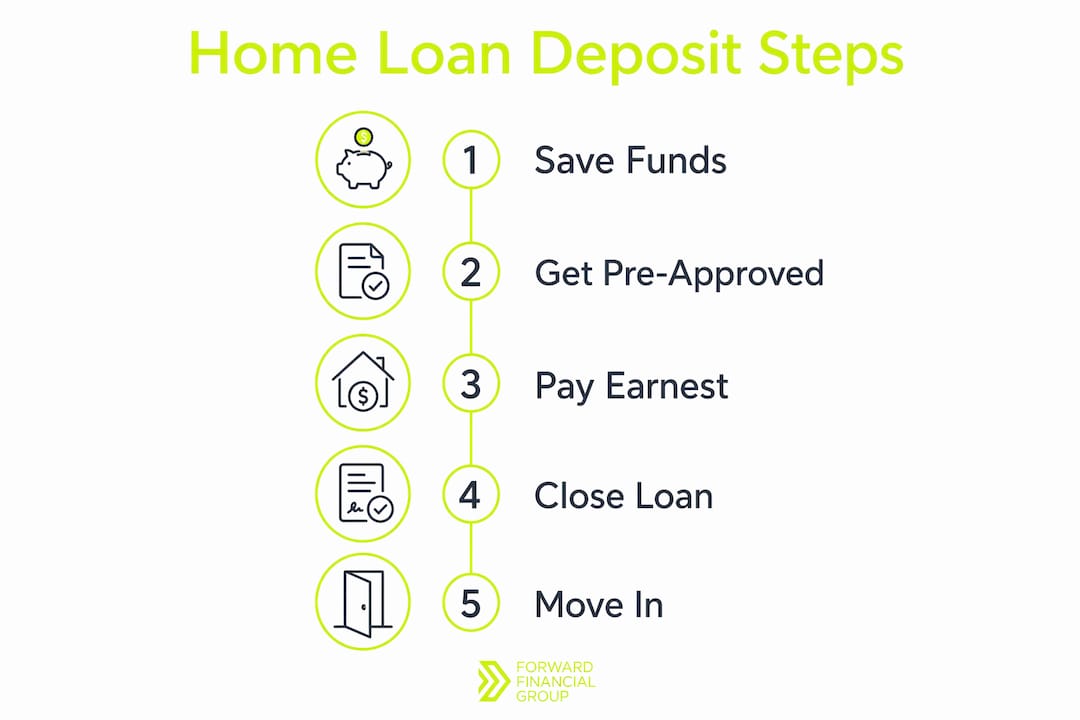
- You make an offer and submit earnest money (held in escrow).
- Your lender verifies your assets and approves the loan.
- At closing, your down payment is paid, earnest money is applied, and the title transfers to you.
Understanding this sequence matters because lenders will scrutinize where every dollar comes from, and the timing of fund transfers can affect your approval.
Typical down payment amounts by U.S. loan type
Not all loan programs require the same upfront cash. Here’s how the major U.S. loan types compare, along with what each minimum actually means in dollars on a $300,000 purchase.

| Loan Type | Typical Minimum | PMI / Mortgage Insurance |
|---|---|---|
| Conventional | 3%–5% (certain programs) | PMI required below 20% down |
| FHA | 3.5% minimum | Mortgage insurance premiums required |
| VA | 0% for eligible borrowers | No PMI; funding fee may apply |
| USDA | 0% for eligible borrowers | Guarantee fee applies |
| Jumbo | 10%–30% | Varies by lender |
The CFPB reports that first-time buyers put down an average of about 9%. Jumbo loans, used for higher-priced properties, carry their own set of lender requirements and are worth reviewing separately if your target price exceeds conforming loan limits.
One practical detail: lenders often evaluate deposits in 5% increments. Putting down 8% may not produce better loan pricing than 5%, because the next meaningful threshold is 10%. Aiming for a round increment, such as 10% or 20%, tends to produce better rate outcomes than splitting the difference.
Why the size of your deposit matters: LTV, PMI, and your monthly payment
Your deposit directly determines your loan-to-value ratio (LTV), which is the loan amount divided by the home’s appraised value. A 10% down payment produces a 90% LTV; a 20% down payment produces an 80% LTV. Lenders use LTV as a primary risk indicator.
Three downstream effects of a smaller deposit:
- PMI. On conventional loans, putting down less than 20% typically triggers Private Mortgage Insurance, an additional monthly premium that protects the lender, not you. PMI is removed once you reach 20% equity through payments or appreciation.
- Interest rate. A higher down payment can unlock lower interest rates because it reduces lender risk. Even a quarter-point rate difference compounds significantly over a 30-year term.
- Monthly payment. A smaller loan balance means a lower principal-and-interest payment each month, independent of any rate difference.
What this means in practice: On a $300,000 home at a 7% interest rate, a 3% down payment ($9,000) leaves a $291,000 loan balance. A 20% down payment ($60,000) leaves a $240,000 balance. The monthly principal-and-interest difference between those two scenarios is roughly $340 per month, before factoring in PMI on the lower-down option.
FHA borrowers should note that mortgage insurance premiums work differently. Even after reaching 20% equity, FHA mortgage insurance often continues for the life of the loan depending on when the loan originated and the initial down payment amount. That’s one trade-off worth weighing against the lower entry cost.
Programs and tactics that let you buy with less than 20% down
Saving 20% before buying is not a requirement, and for many first-time buyers it’s not realistic. Several programs and strategies can reduce the upfront cash you need.
FHA loans
FHA loans require a minimum 3.5% down payment for borrowers with a credit score of 580 or higher. The program is backed by the Federal Housing Administration and is one of the most accessible paths for buyers with limited savings or a shorter credit history. The trade-off is mandatory mortgage insurance: an upfront premium at closing plus an annual premium built into your monthly payment.
VA and USDA loans
VA loans, guaranteed by the U.S. Department of Veterans Affairs, allow eligible active-duty service members, veterans, and surviving spouses to purchase with 0% down. No PMI applies, though a one-time funding fee is typically charged. USDA loans, backed by the U.S. Department of Agriculture, also offer 0% down for eligible buyers in qualifying rural and suburban areas. Both programs have income and eligibility requirements that a broker can help you verify quickly.
Gift funds and down payment assistance
Some programs and lenders accept down payment funds from family members as a gift. If you use gift money, your lender will require a signed gift letter confirming the funds are not a loan, along with documentation of the transfer. Many states and local housing agencies also offer down payment assistance programs, which can provide grants or low-interest second loans to cover part of the upfront cost. Eligibility and amounts vary by location, so checking with a local broker is the fastest way to find what’s available in your area.
Pro Tip: Document any gift funds at least 90 days before your closing date. Lenders typically require a 90-day transaction history for accounts holding down payment funds. If a large deposit appears in your account shortly before closing without a clear paper trail, it can delay or derail your approval.
When and how your deposit is paid: earnest money, escrow, and closing
The down payment doesn’t move as a single transfer on day one. It comes together in stages, and understanding the sequence helps you avoid surprises.
- Offer accepted. You submit earnest money, typically 1%–3% of the purchase price, to an escrow account held by a neutral third party (title company or escrow agent). This is separate from your down payment.
- Loan processing. Your lender reviews your financials, orders an appraisal, and verifies your assets. They’ll request documentation showing where your down payment funds are held and their source.
- Closing disclosure. Three business days before closing, you receive a Closing Disclosure listing the exact cash you need to bring to closing, including the down payment minus earnest money already in escrow, plus closing costs.
- Closing day. You wire the remaining funds (or bring a cashier’s check). Earnest money is applied to the down payment, the loan funds, and the title transfers to you.
Lenders typically request 90-day bank statements for accounts holding down payment funds, along with a gift letter if any portion was received as a gift and proof of any large transfers. If you’re selling a previous home and using those proceeds, documentation of that transaction will also be required.
One important note: if the sale falls through due to a contingency you exercised (financing, inspection, or appraisal), earnest money is typically returned to you. If you simply change your mind without a valid contingency, the seller may keep it.
How to budget for a deposit: closing costs, reserves, and a savings framework
The CFPB recommends a specific approach to calculating how much you can comfortably put down: start with your total available savings, then subtract your estimated closing costs and a three-to-six month emergency cushion before deciding on a down payment amount. What’s left is your realistic deposit ceiling.
A practical savings framework to work from:
- Down payment: Your target percentage of the purchase price (3%–20% depending on loan type).
- Closing costs: Budget 2%–5% of the purchase price separately. On a $300,000 home, that’s $6,000–$15,000.
- Moving and immediate repairs: A modest buffer for move-in costs and any urgent repairs the inspection surfaces.
- Emergency reserve: Three to six months of living expenses, kept separate from your home purchase funds.
The total picture for a $300,000 home at 3.5% down looks like this: $10,500 down payment, plus up to $15,000 in closing costs, plus a three-month emergency reserve. That’s a meaningful savings target, and it’s why starting early and using a calculator to model your specific scenario is worth the time.
The FHA Affordability Calculator and the Conventional Affordability Calculator can help you run these numbers for your income and target price before you sit down with a broker. Bring those results to your first consultation so the conversation starts from your actual numbers, not generic estimates.
A worked example: comparing 3%, 3.5%, and 20% down on a $300,000 home
Assumptions: Purchase price $300,000, 30-year fixed mortgage, illustrative 7% interest rate, PMI estimated at 0.5%–1% annually on the loan balance where applicable. These are illustrative figures; your actual rate and PMI cost will vary.
| Scenario | Down Payment | Loan Amount | Est. Monthly P&I | Est. Monthly PMI | Approx. Total Monthly |
|---|---|---|---|---|---|
| 3% down (Conventional) | $9,000 | $291,000 | — | — | — |
| 3.5% down (FHA) | $10,500 | — | — | — | — |
| 20% down (Conventional) | $60,000 | $240,000 | — | $0 | — |
The monthly difference between 3% down and 20% down is roughly $460 per month before accounting for FHA mortgage insurance premiums or property taxes and homeowner’s insurance. Over five years, that gap totals more than $27,000 in additional payments.
The 20% scenario produces a meaningfully lower monthly payment and no PMI, but it requires $51,000 more in upfront cash compared to the 3% option. For many first-time buyers, the right answer is not to wait until they’ve saved 20%. Getting into a home sooner with an FHA or low-down conventional loan, then refinancing once equity builds, can be the more practical path. The calculus depends on your local market, your income trajectory, and how long you plan to stay in the home.
Clear next steps: save, get pre-approved, and talk to a broker
Knowing what a down payment is and how it works is the foundation. Here’s how to move from understanding to action.
- Run your numbers first. Use an affordability calculator to model your target purchase price, estimated down payment, and monthly payment before you start shopping. The rent vs. buy calculator is a useful starting point if you’re still weighing whether now is the right time to buy.
- Assemble your documents. Gather 90 days of bank statements for all accounts holding down payment funds, recent pay stubs, two years of tax returns, and any gift letters if applicable. Having these ready speeds up the pre-approval process considerably.
- Get pre-approved or consult a broker. Pre-approval gives you a verified budget and makes your offer more competitive. A mortgage broker, like the team at David Mordue - Forward Financial Group, can compare programs across multiple lenders, identify which loan type fits your deposit size and credit profile, and walk you through the documentation requirements before you apply.
A broker’s value at this stage is specific: they can tell you whether you’re better served by an FHA loan, a conventional 3% program, or a VA or USDA option if you qualify, and they can show you the rate and cost differences side by side. That comparison is difficult to do on your own without access to multiple lenders’ current pricing.
For buyers managing existing debt while saving for a deposit, reviewing personal finance strategies for accelerating savings can also be a productive step before applying.
Key Takeaways
A home loan deposit is the upfront cash you contribute toward a home’s purchase price, and its size directly determines your loan amount, PMI obligation, interest rate, and monthly payment.
| Point | Details |
|---|---|
| Definition and role | Your down payment reduces the loan amount and creates immediate equity; it’s separate from closing costs and earnest money. |
| Typical U.S. percentages | Minimums range from 0% (VA/USDA) to 3%–5% (conventional) to 3.5% (FHA) to 10%–30% (jumbo), with first-time buyers averaging about 9%. |
| PMI and rate impact | Putting down less than 20% on a conventional loan triggers PMI; a larger deposit can also unlock a lower interest rate. |
| Budget beyond the deposit | Reserve 2%–5% of the purchase price for closing costs and keep a 3–6 month emergency cushion separate from your down payment funds. |
| David Mordue - Forward Financial Group | Offers program matching, rate comparisons, and a fully online pre-approval process that can move from application to funding in under 21 days. |
What most buyers get wrong about the 20% rule
The 20% down payment has become so embedded in homebuying culture that many first-time buyers treat it as a legal requirement rather than a conventional threshold. It’s not. It’s the point at which PMI drops off on conventional loans, and it’s a useful target if you can reach it without depleting your emergency savings. But waiting years to hit 20% while renting often costs more in total than buying sooner with a lower down payment and paying PMI for a few years.
The more overlooked mistake is treating the down payment as the only number that matters. Buyers who stretch to hit 20% and arrive at closing with no cash reserve are in a genuinely fragile position. One unexpected repair, one month of reduced income, and the financial cushion is gone. The CFPB’s guidance to subtract closing costs and a three-to-six month reserve before deciding on a down payment amount exists for exactly this reason.
The other thing buyers underestimate is the value of the 5% increment rule. If you have 8% saved, you’re not in a meaningfully better position than someone with 5%. The next threshold that actually changes your pricing is 10%, and after that, 20%. Knowing this can help you decide whether to buy now at 5% down or wait a few more months to reach 10%, rather than buying at 8% and getting no pricing benefit for the extra savings.
Ready to put your deposit to work? Here’s how we can help.
Saving for a down payment is one part of the equation. Matching that deposit to the right loan program, at the best available rate, is where the real difference gets made. David Mordue - Forward Financial Group offers a fully online mortgage application with funding possible in under 21 days, program matching across conventional, FHA, VA, USDA, and jumbo loans, and personalized rate comparisons so you know exactly what each option costs before you commit.
Whether you’re still calculating how much to save or you’re ready to get pre-approved today, the process starts with a conversation. Use the rent vs. buy calculator to confirm buying makes sense for your situation right now, then schedule your pre-approval consultation to get a clear picture of your loan options, your deposit requirements, and your realistic monthly payment. No guesswork, no pressure.
Useful sources for verifying program details
These official U.S. government and regulatory sources are the most reliable places to confirm current program rules, eligibility requirements, and documentation standards.
- Consumer Financial Protection Bureau (CFPB) — Down payment guidance, budgeting tools, and explanations of how deposit size affects loan costs. Start here for a clear, unbiased overview.
- HUD / FHA (U.S. Department of Housing and Urban Development) — Official FHA loan program rules, minimum credit score requirements, and mortgage insurance premium schedules. Visit hud.gov for current program details.
- U.S. Department of Veterans Affairs (VA) — Eligibility criteria for VA home loans, the funding fee schedule, and how to obtain a Certificate of Eligibility. Visit va.gov/housing-assistance.
- U.S. Department of Agriculture (USDA) — Rural Development loan program eligibility maps, income limits, and application guidance. Visit rd.usda.gov.
Program rules, income limits, and eligibility thresholds change periodically. A mortgage broker can help you verify current requirements and identify which programs you qualify for based on your specific financial profile.
This article is general information, not professional financial or legal advice. Confirm current program rules and eligibility with the official sources above or a qualified mortgage professional before making any financial decisions.