
A First Home Scheme is a government-backed program that helps first-time buyers access homeownership either through a direct price discount or by taking a shared equity stake in the property. If you’re a U.S. buyer who’s encountered this term, it maps most closely to state down-payment assistance programs, community land trusts, or shared-equity nonprofits at the local level — not to FHA, VA, or USDA loans, which are insured mortgage products rather than ownership-stake arrangements.
Here’s what you need to know at a glance:
- Two core models: discounted sale (government or developer reduces the purchase price) and shared equity (a public agency co-owns a percentage and is repaid on sale or redemption)
- U.S. equivalents: state Housing Finance Agency (HFA) down-payment assistance, community land trusts (CLTs), and municipal new-build discount programs
- Key signals to watch for: income caps, resale price restrictions, occupancy requirements, and eligibility certificates
- Separate from FHA/VA/USDA: those are insured mortgage products; First Home Schemes are ownership-structure arrangements layered on top of a mortgage
Table of Contents
- What does a first home scheme actually mean?
- How these programs work from application to resale
- U.S. programs that achieve the same goals
- Do you qualify? Common eligibility rules to check
- Benefits and drawbacks worth weighing carefully
- How to find and apply for a program: a step-by-step checklist
- What the numbers look like: a worked example
- When should you consult a mortgage broker?
- Key Takeaways
- The resale cap problem most buyers don’t see coming
- Ready to find the right mortgage for your first home?
- Useful sources and official program pages
What does a first home scheme actually mean?
The label “First Home Scheme” covers at least three distinct program types, and confusing them leads to real financial surprises later.
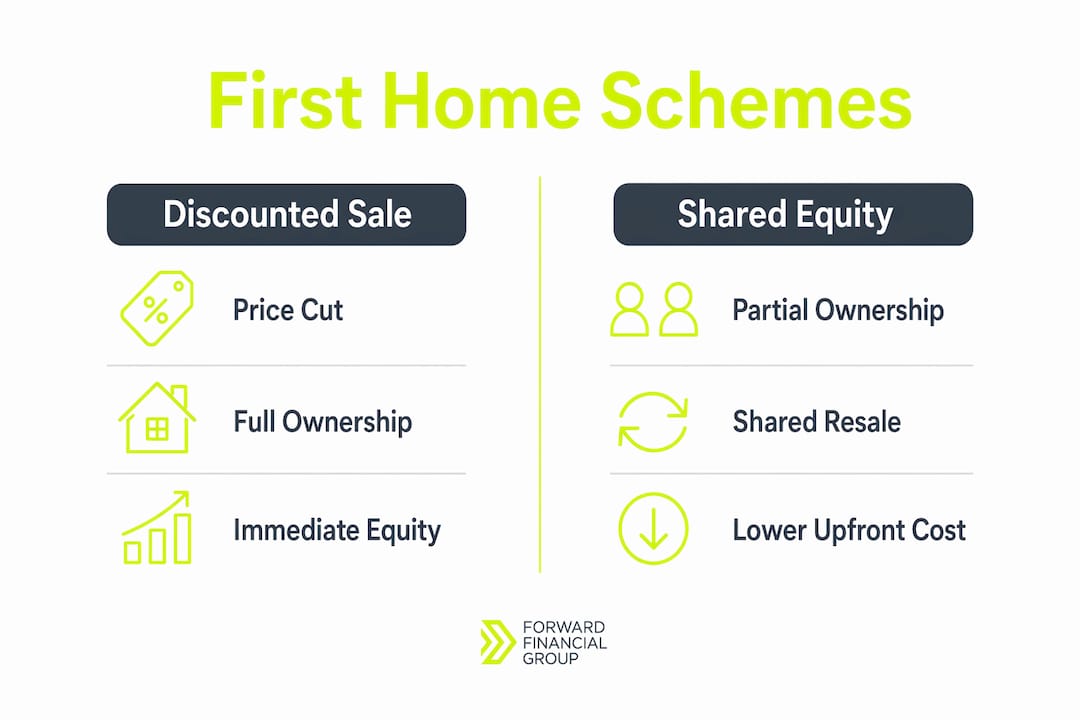
Discounted-sale programs reduce the purchase price outright. England’s First Homes scheme offers a 30%–50% discount on new-build homes for eligible first-time buyers, with income caps of £80,000 nationally and £90,000 in London, and post-discount price caps of £250,000 (or £420,000 in London). The buyer takes full ownership at purchase. No ongoing rent, no co-ownership claim.
Shared-equity programs work differently. Ireland’s First Home Scheme provides up to 30% of the purchase or build cost in exchange for an equivalent equity stake (reduced to 20% if Help to Buy is also used). The buyer takes a smaller mortgage, but the scheme holds a legal ownership interest that must be redeemed or settled when the property is sold or transferred.
Shared ownership is a third model, common in the UK, where buyers purchase a 10%–75% share of a property and pay rent on the remainder, with the option to buy additional shares over time through a process called staircasing. This is a leasehold arrangement and carries ongoing ground rent and service charges that discounted-sale buyers don’t face.
- Discounted sale: full ownership at purchase, lower price, resale restrictions
- Shared equity: co-ownership stake, smaller mortgage, future repayment obligation
- Shared ownership: part-buy, part-rent, leasehold, staircasing option
- Down-payment assistance (U.S.): grants or forgivable loans toward the deposit, no equity stake
- FHA/VA/USDA: insured or guaranteed mortgages, not ownership-structure programs
The policy goal behind all of them is consistent: broaden access to homeownership for buyers priced out of the private market while managing housing inventory through targeted eligibility and resale rules.
How these programs work from application to resale
Understanding the mechanics protects you from surprises at closing and years down the road.
- Pre-qualification and preliminary certificate. In Ireland’s FHS, buyers first obtain a Preliminary Certificate, which lets them explore properties and lenders without locking in a formal application. This step is underused but valuable — it functions as an affordability probe that reduces wasted effort later.
- Eligibility certificate. Once a specific property is identified, a formal Eligibility Certificate confirms the scheme’s contribution amount and the buyer’s qualification. Lenders require this before issuing a mortgage offer.
- Mortgage offer. The buyer secures a mortgage on the post-discount or post-equity-share price. For England’s First Homes scheme, the mortgage must cover at least 50% of the discounted purchase price.
- Independent valuation. Official UK guidance requires an independent valuation to confirm market value before the discount is applied. This protects both the buyer and public funds.
- Completion and fund release. Scheme funds are released at closing. For shared-equity programs, the equity stake is recorded in the title documents at this point.
- Post-purchase obligations. You must occupy the home as your primary residence. Letting the property is typically restricted or prohibited. Improvements may require scheme administrator approval in some programs.
- Resale or redemption. On a discounted-sale property, the resale price is capped to preserve affordability for the next buyer. On a shared-equity property, the scheme receives its proportional share of the sale proceeds, including any appreciation.
Resale restrictions are not a minor footnote. They are legally binding contract terms that directly affect how much you walk away with when you sell. A 30% equity stake held by a scheme on a home that appreciates by $100,000 means $30,000 goes back to the program, not to you. Evaluate that trade-off before you sign.
Pro Tip: Ask the program administrator for the exact resale formula in writing before making an offer. Some programs cap the resale price; others take a share of appreciation. These are fundamentally different outcomes for your long-term wealth.
U.S. programs that achieve the same goals
American first-time buyers won’t find a program called a “First Home Scheme,” but the underlying models exist across federal, state, and local levels.

| Type of Help | Who Provides It | Typical Eligibility | Main Restriction | How to Apply |
|---|---|---|---|---|
| FHA insured mortgage | Federal (HUD) | — | Mortgage insurance premium | Through an FHA-approved lender |
| VA guaranteed loan | Federal (VA) | Military service requirement | Primary residence only | Through a VA-approved lender |
| USDA guaranteed loan | Federal (USDA) | Rural area, income limits | Property location cap | Through USDA-approved lender |
| State/local down-payment assistance | State HFA or municipality | First-time buyer, income caps | Forgivable after occupancy period | State HFA website or HUD directory |
| Shared-equity / CLT program | Nonprofit CLT or local government | Income-qualified, first-time buyer | Resale price cap, right of first refusal | Local CLT or housing authority |
| Developer discount program | Private developer + local government | First-time buyer, income limits | Occupancy requirement, resale cap | Developer sales office + lender |
Where to search for U.S. programs:
- HUD’s homebuyer assistance directory lists state and local programs by ZIP code
- Your state’s Housing Finance Agency (HFA) maintains a program directory; every state has one
- The National Community Land Trust Network connects buyers with local CLT programs
- Local government housing departments often list municipal new-build discount opportunities
A mortgage broker can confirm which programs your income and credit profile qualify for, then match you with a lender who will underwrite the mortgage on the post-discount or post-assistance price. Some lenders treat the discounted purchase price as the loan-to-value basis; others require additional documentation. Confirming this early prevents delays at closing.
Do you qualify? Common eligibility rules to check
Most first home buyer programs share a core set of eligibility requirements, though the specific thresholds vary by program and location.
Standard eligibility criteria:
- First-time buyer status: You (and any co-buyer) must not have previously owned a home. Some programs apply a “Fresh Start” exception for people who are separated, divorced, or have completed insolvency proceedings with no current ownership interest.
- Minimum age: Typically 18 years old.
- Income caps: England’s First Homes scheme caps household income at £80,000 nationally (£90,000 in London), with post-discount property price caps of £250,000 nationally and £420,000 in London. U.S. state HFA programs typically set income limits at 80%–120% of Area Median Income (AMI), varying by county.
- Mortgage minimum: Some programs require the buyer’s mortgage to cover a minimum percentage of the purchase price.
- Occupancy requirement: You must move in within a set period (commonly 12 months) and live there as your primary residence.
| Eligibility Factor | England First Homes | Ireland FHS | Typical U.S. State DPA |
|---|---|---|---|
| First-time buyer required | Yes | Yes (Fresh Start exception) | Yes (some allow 3-year gap) |
| Income cap | £80,000 nationally / £90,000 in London | Regional price ceilings apply | 80%–120% AMI (varies by county) |
| Property price cap | £250,000 nationally / £420,000 in London | Regional ceilings | Varies by program and county |
| Mortgage minimum | 50% of discounted price | Program-specific | Lender-determined |
| Occupancy requirement | Primary residence | Primary residence | Primary residence |
Practical red flags to check early:
- Whether the program excludes buyers who have used other public housing schemes
- Restrictions on renting out any part of the property
- Whether your lender will accept the scheme’s valuation methodology
Benefits and drawbacks worth weighing carefully
The benefits are real and significant:
- Lower entry cost means a smaller deposit and a smaller monthly mortgage payment
- Access to new-build homes or neighborhoods that would otherwise be out of reach
- Shared-equity programs reduce the loan amount, which can improve debt-to-income ratios and mortgage approval odds
- Discounted-sale programs give you full ownership from day one with no ongoing rent or co-ownership obligation
The drawbacks are equally real:
- Resale price caps limit your upside when the market rises
- Shared-equity repayment means a portion of any appreciation goes back to the scheme
- Restrictions on letting reduce your flexibility if your circumstances change
- Leasehold shared-ownership properties carry ongoing ground rent and service charges
- Legal fees, independent valuation costs, and potential scheme administration fees add to closing costs
- Finding eligible properties in competitive markets can be difficult
The hidden cost most buyers underestimate is opportunity cost. A resale cap that preserves affordability for the next buyer is a direct transfer of future wealth away from you. That trade-off is worth making for many buyers — but it should be a conscious decision, not a surprise discovered when you go to sell.
The legal contracts and resale rules in these programs materially affect future proceeds and rights. Read them before you commit, not after.
How to find and apply for a program: a step-by-step checklist
Where to look:
- Developer advertisements for new-build discount programs in your target area
- Your state HFA’s program directory (search “[your state] Housing Finance Agency first-time buyer”)
- HUD’s local homebuying programs page at hud.gov
- Local government housing department websites
- Nonprofit CLT organizations in your city or county
Application steps for U.S. buyers:
- Pre-qualify with a lender. Get a mortgage pre-approval that reflects your actual income, credit, and debt. This tells you your realistic price range before you layer in any assistance.
- Identify eligible programs. Use your state HFA directory and HUD resources to find programs you qualify for based on income, location, and first-time buyer status.
- Request a preliminary certificate or eligibility confirmation. Where offered (as in Ireland’s FHS), this step lets you test your eligibility without a full application commitment.
- Collect required documents. Government-issued ID, two years of tax returns, recent pay stubs, bank statements, and proof of any other income sources.
- Secure your mortgage offer. Your lender issues a formal mortgage offer based on the post-assistance purchase price.
- Submit the program application. Complete the program’s formal application with your eligibility certificate, mortgage offer letter, and property details.
- Coordinate closing. Confirm with your lender and program administrator that scheme funds will be released at the same time as your mortgage funds.
Documents you’ll typically need:
- Government-issued photo ID
- Two years of federal tax returns (W-2s and/or 1099s)
- Recent pay stubs (last 30 days)
- Bank statements (last 2–3 months)
- Signed purchase contract
- Mortgage pre-approval or offer letter
For a broader look at first-time mortgage options, comparing lender features before you apply can save time and money.
What the numbers look like: a worked example
Typical costs to budget for:
- Down payment (your share after assistance)
- Closing costs: lender fees, title insurance, recording taxes
- Independent valuation fee (required for some programs)
- Legal or attorney fees
- Scheme administration fees (where applicable)
Worked example: 30% discounted-sale program
| Item | Without Scheme | With 30% Discount |
|---|---|---|
| Market value | $400,000 | $400,000 |
| Purchase price | $400,000 | — |
| Resale price cap | None | Capped at discounted value + limited appreciation |
Worked example: 20% shared-equity program
| Item | Without Scheme | With 20% Equity Share |
|---|---|---|
| Market value | $400,000 | $400,000 |
| Scheme contribution | — | $80,000 |
| — | Buyer keeps full gain | Scheme receives $100,000 (20% of $500,000); buyer keeps $400,000 |
Key milestones timeline:
- Week 1–2: Mortgage pre-approval and program eligibility check
- Week 3–4: Preliminary certificate (where applicable) and property search
- Week 5–8: Formal application, independent valuation, mortgage offer
- Week 9–12: Exchange of contracts, scheme funds confirmed
- Week 12–16: Closing and fund release
- Post-closing: Notify scheme administrator of any sale, transfer, or letting request
When should you consult a mortgage broker?
A mortgage broker adds specific, concrete value at several points in the process that most buyers don’t anticipate.

First, not every lender will underwrite a mortgage on a discounted purchase price using the scheme’s valuation methodology. Some U.S. lenders treat the post-discount price as the loan-to-value basis; others require additional documentation or apply different underwriting standards. A broker identifies which lenders will work with your specific program before you waste time on applications.
Second, brokers coordinate the timing of your mortgage offer with the scheme’s fund release. A mismatch in timing can delay or derail closing. This is especially relevant for shared-equity programs where the scheme’s funds must arrive simultaneously with the mortgage advance.
Third, a broker can interpret eligibility rules that aren’t always clear in program documentation, including income calculation methods, co-buyer rules, and how prior ownership of property in another country is treated.
Pro Tip: Before your first broker meeting, ask the program administrator for the scheme’s mortgage requirements in writing, specifically the minimum mortgage percentage and the accepted valuation methodology. Bringing that document to your broker consultation cuts the lender-matching process significantly.
The pre-approval process follows a similar logic regardless of jurisdiction: the earlier you confirm your mortgage capacity, the more efficiently you can use a preliminary certificate or eligibility check to target the right properties.
Key Takeaways
A First Home Scheme reduces the upfront cost of buying through either a direct price discount or a shared equity stake, and U.S. buyers should map those models to state HFA programs, CLTs, or FHA-backed mortgages before applying.
| Point | Details |
|---|---|
| Two models to recognize | Discounted sale gives full ownership at purchase; shared equity creates a co-ownership stake requiring future repayment. |
| Eligibility checks matter early | Confirm income caps, first-time buyer status, and property price limits before you make an offer. |
| Resale rules affect long-term wealth | Price caps and shared appreciation formulas directly reduce your future sale proceeds; evaluate them before signing. |
| U.S. equivalents exist at state and local level | State HFA down-payment assistance, community land trusts, and FHA/VA/USDA loans each address different parts of the affordability gap. |
| David Mordue - Forward Financial Group | Offers pre-approval support, lender matching for discounted and shared-equity deals, and affordability calculators to confirm your mortgage fit. |
The resale cap problem most buyers don’t see coming
Most buyers focus on what a First Home Scheme saves them at purchase. That’s the right instinct for getting into a home. But the programs that have the most generous discounts tend to carry the most restrictive resale rules, and those rules can significantly change the financial outcome years later.
A 30% discount on a $400,000 home saves you $120,000 at purchase. If that same property appreciates to $550,000 over seven years and the resale cap limits you to the original discounted value plus a modest inflation adjustment, you may walk away with far less than a buyer who purchased at full market price. The scheme’s policy goal is to keep that home affordable for the next buyer, which is a legitimate public interest. But it comes at a direct cost to your equity accumulation.
The question buyers should ask before signing is not just “how much does this save me today?” but “what does this cost me when I sell?” A broker who understands both the program mechanics and the local market can help you model both scenarios before you commit.
Ready to find the right mortgage for your first home?
Navigating first-time homebuyer assistance programs is straightforward when you have the right support. David Mordue - Forward Financial Group specializes in exactly this: matching first-time buyers with lenders who will underwrite their specific program, whether that’s a state HFA down-payment grant, a shared-equity arrangement, or a conventional purchase with an FHA-backed loan.
The fully online application process means you can get pre-approved in days, not weeks, and the team coordinates directly with program administrators to confirm fund release timing at closing. Use the rent vs. buy calculator to model how a discount or equity contribution changes your monthly payment, then start your pre-approval to confirm which programs and lenders you qualify for today.
Useful sources and official program pages
Program rules, income caps, and price thresholds change regularly. Always verify current figures directly with the program administrator before applying.
U.S. resources:
- HUD Homebuying Programs — national directory of state and local assistance programs
- Your state’s Housing Finance Agency (HFA) — search “[your state] HFA first-time buyer programs”
- National Community Land Trust Network — directory of local CLT shared-equity programs
UK and Ireland reference programs (used for comparative explanation in this article):
- England’s First Homes scheme — GOV.UK official guidance
- Ireland’s First Home Scheme — official program site with Preliminary Certificate application
- GOV.UK affordable homeownership schemes — overview of all UK programs including Shared Ownership
- Ireland Department of Housing First Home Scheme — policy overview and eligibility summary
This article is general information, not financial or legal advice. Program rules, income caps, and eligibility requirements vary by location and change over time. Confirm current thresholds with the relevant program administrator or a qualified mortgage professional before making any financial decisions.