
A VA seller concession is any item of value a seller or builder provides to a veteran buyer at no cost to the buyer, beyond what the seller would customarily pay. VA guidance caps these concessions at no more than 4% of the home’s established reasonable value, which is set by the VA Notice of Value (NOV), not the contract price. That distinction matters in practice: if the NOV comes in below what you agreed to pay, your concession room shrinks accordingly.
Here is how VA separates the two categories you need to understand before negotiating:
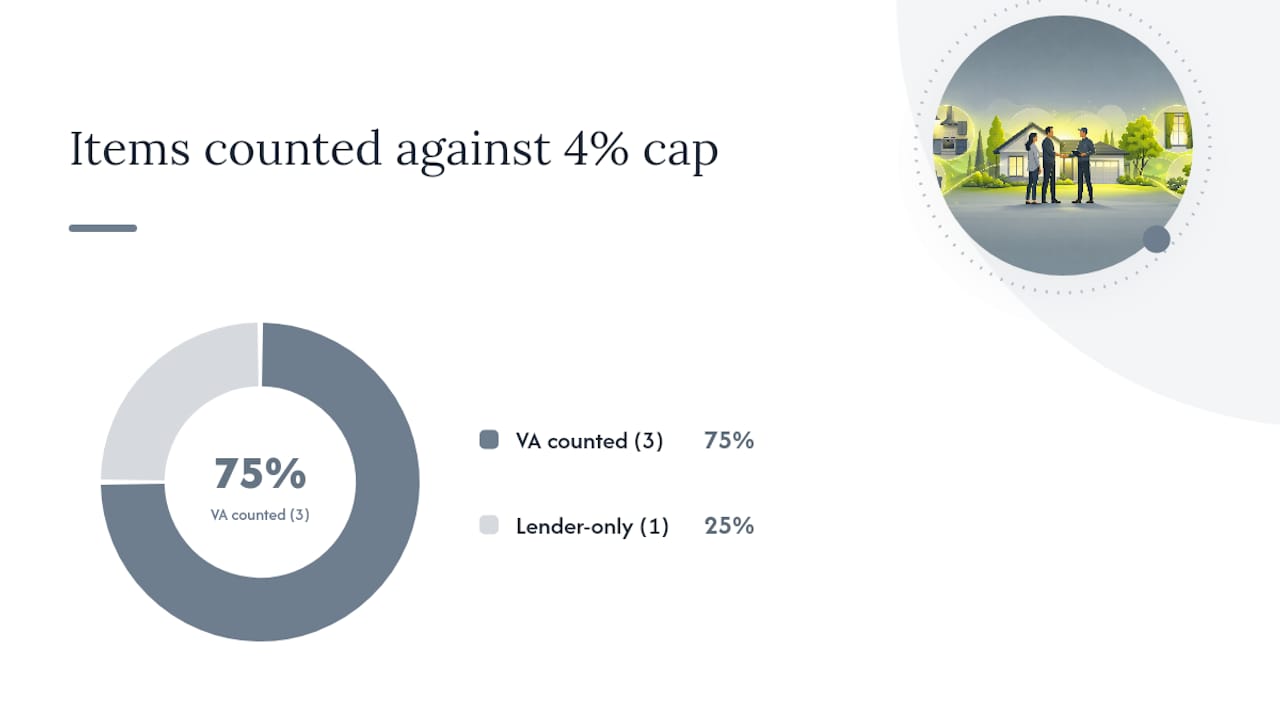
- Seller concessions (subject to the 4% cap): Items such as payment of your VA funding fee, prepaid taxes and insurance, payoff of buyer credit balances or judgments, rate buydowns beyond market-appropriate points, and gifts of personal property.
- Seller-paid closing costs (not counted against the 4% cap): Standard buyer closing costs the seller agrees to cover, including origination fees, appraisal fees, title insurance, and recording fees. VA treats these separately from concessions.
- Practical consequence: Always base your concession calculations on the NOV, not the sales price. A seller can pay your typical closing costs AND still offer up to 4% of the NOV in concessions, giving you two separate levers to reduce out-of-pocket costs.
VA.gov is the primary authority on these rules. Confirm the specific treatment of any item with your lender before finalizing an offer.
Key Takeaways
| Point | Details |
|---|---|
| 4% cap uses the NOV | Always calculate concession limits from the VA Notice of Value, not the sales price. |
| Closing costs are separate | Seller-paid standard closing costs do not count against the 4% concession cap under VA rules. |
| Common concession items | Funding fee, rate buydowns, debt payoffs, prepaids, and personal property gifts all count toward the cap. |
| Confirm lender overlays | Many lenders apply a blanket 4% limit to all seller-paid items; verify policy before signing a contract. |
| Get everything in writing | Document concession amounts in a signed contract addendum and disclose them to your lender at pre-approval. |
Table of Contents
- What VA seller concessions are and how they compare to other loan types
- How the VA 4% cap works and how to calculate it correctly
- What seller concessions VA explicitly allows
- What seller concessions cannot cover or are typically excluded
- How seller concessions affect your negotiation and the seller’s bottom line
- Two worked examples for calculating the 4% concession cap
- How lender overlays and NOV timing can affect your concessions
- When to work with a VA-savvy broker or loan officer
- A broker’s perspective on negotiating VA seller concessions
- Ready to put your VA benefits to work?
- Sources
What VA seller concessions are and how they compare to other loan types
The VA Lender’s Handbook (VA Pamphlet 26-7) defines a seller concession as “anything of value added by the seller or builder for which the buyer pays nothing and which the seller is not customarily expected to pay.” That last phrase is the key. Paying your title insurance is customary for a seller in many markets, so it does not count as a concession. Paying off your credit card balance is not customary, so it does.
VA’s approach differs from other loan programs. FHA loans cap seller contributions at 6% of the sales price, and conventional loans set limits based on loan-to-value ratios, typically ranging from 3% to 9%.
If the same seller pays your title insurance (a standard closing cost), that does not. Both reduce your cash at closing, but only one eats into your concession allowance.
How the VA 4% cap works and how to calculate it correctly
When the NOV equals the contract price, the math is straightforward. When the NOV comes in lower, the lower number controls.
The NOV is issued after the VA appraisal is completed. You will find it in your loan file, typically delivered by your lender after the appraiser submits the report to the VA. Your lender is required to provide it to you, and VA’s home loan pages explain the appraisal and NOV process in detail.
A common source of confusion involves how lenders treat closing-cost credits. VA Pamphlet 26-7 draws a clear line between seller credits toward standard closing costs and seller concessions. That overlay is stricter than VA’s own rules, and it can cost you real money if you do not catch it early.
| Item | VA Rule | Common Lender Overlay |
|---|---|---|
| Seller pays standard closing costs | Not counted against 4% cap | Sometimes counted against 4% |
| Seller pays VA funding fee | Counts against 4% cap | Counts against 4% |
| Seller pays rate buydown | Counts against 4% cap | Counts against 4% |
| Seller pays buyer’s credit card balance | Counts against 4% cap | Counts against 4% |
What seller concessions VA explicitly allows
VA Pamphlet 26-7 and Veterans United’s concession guide identify the following as allowable seller concessions, all subject to the 4% cap:
- VA funding fee: The seller can pay your funding fee in full. For many veterans, this is the single largest upfront cost, so having the seller cover it is a significant benefit.
- Prepaid taxes and insurance: If the seller pays property taxes or hazard insurance premiums that are not customarily paid by sellers in your market, those payments count as concessions.
- Payoff of buyer credit balances or judgments: A seller can pay off your outstanding debts, such as credit card balances or court judgments, as part of the transaction. This can also improve your debt-to-income ratio.
- Permanent or temporary rate buydowns: A seller-funded buydown that goes beyond what is considered market-appropriate counts as a concession. Temporary buydowns (such as a 2-1 buydown) are a common negotiating tool in slower markets.
- Gifts of personal property: Items like appliances, furniture, or a vehicle included in the sale count as concessions if they add value beyond what is customary.
Confirm each item with your lender and verify it against your NOV before including it in your offer. What VA allows and what your specific lender accepts can differ.
What seller concessions cannot cover or are typically excluded
Standard buyer closing costs are not seller concessions under VA rules. When a seller agrees to pay your origination fee, appraisal fee, title insurance, recording fees, or credit report fee, those payments are treated as seller credits toward closing costs, not as concessions.
VA’s rationale is straightforward: these are costs the buyer would normally pay, and a seller covering them is a negotiated credit, not an added benefit beyond the transaction’s normal scope. The VA handbook reserves the concession label for items that go beyond that baseline.
The practical risk comes from lender overlays. Confirm your lender’s policy before negotiating, not after the contract is signed.
How seller concessions affect your negotiation and the seller’s bottom line
Seller concessions can reduce your upfront cash need significantly, but they come at a cost to the seller’s net proceeds. A seller who agrees to pay $8,000 in concessions on a $300,000 sale nets $292,000 before other costs. That same seller might prefer a $295,000 purchase price with no concessions, netting $295,000. Present the tradeoff clearly when you make your offer.
Practical negotiation steps to follow:
- Ask your lender whether they apply a blanket 4% overlay or follow VA’s distinction between closing costs and concessions.
- Base all concession calculations on the NOV, not the list price or contract price.
- Separate closing-cost credits and concessions in your written offer and any addenda. Label each item explicitly.
- Document the concession amounts in a signed contract addendum so there is no ambiguity at underwriting.
If the seller also agrees to pay $6,000 in standard closing costs, your total seller-paid benefit could reach $20,000, all within VA rules, provided your lender does not apply a blanket overlay.
Pro Tip: Disclose all concessions to your lender at the time of pre-approval, not at closing. Concessions that surface late in underwriting can trigger a re-review of the appraisal and delay your closing.
Two worked examples for calculating the 4% concession cap
Example A: NOV equals the purchase price
Inputs:
- Contract price: $400,000
- VA Notice of Value (NOV): $400,000
- Proposed concessions: VA funding fee ($3,600) + temporary rate buydown ($8,000) + payoff of buyer judgment ($4,400) = $16,000
Calculation steps:
- Locate the NOV in your loan file: $400,000
- Multiply by 0.04: $400,000 × 0.04 = $16,000
- Compare to proposed concession total: $16,000 proposed vs. $16,000 cap
- Result: concessions are exactly at the limit. No adjustment needed.
Example B: NOV comes in below the contract price
Inputs:
- Contract price: $400,000
- VA Notice of Value (NOV): $375,000
- Proposed concessions: same $16,000 package as above
Calculation steps:
- Locate the NOV: $375,000 (controls the calculation, not the $400,000 contract price)
- Multiply by 0.04: $375,000 × 0.04 = $15,000
- Compare to proposed concession total: $16,000 proposed vs. $15,000 cap
- Result: concessions exceed the cap by $1,000. Reduce one item before closing.
| Input | Example A | Example B |
|---|---|---|
| Contract price | $400,000 | $400,000 |
| VA Notice of Value (NOV) | $400,000 | $375,000 |
| 4% cap (based on NOV) | $16,000 | $15,000 |
| Proposed concessions | $16,000 | $16,000 |
| Adjustment needed | None | Reduce by $1,000 |
Final numbers must always be verified against your loan’s actual NOV document. The VA Credit Standards guidance confirms that the established reasonable value, not the contract price, is the controlling figure.
How lender overlays and NOV timing can affect your concessions
Even when VA allows a concession, your lender’s internal policy or an appraisal timing issue can block it. This is the most common source of frustration for veterans who negotiate concessions before the NOV is issued.
Before finalizing any offer, confirm the following with your lender and title company:
- Does the lender apply a blanket 4% limit to all seller-paid items, or does it follow VA’s distinction between closing costs and concessions?
- What is the NOV date, and does it reflect the current appraisal?
- What documentation is required for seller-funded buydowns or debt payoffs?
- How will seller credits appear on the Loan Estimate and closing disclosure, and who is responsible for verifying the figures?
Pro Tip: Ask these questions at pre-approval, then ask again immediately after the appraisal is completed and the NOV is issued. Lender overlays sometimes change between pre-approval and underwriting, and a low appraisal can reduce your concession room without any warning.
The timing issue is real. The NOV is issued after the appraisal, which typically happens after you are under contract. Build that contingency into your offer language from the start.

When to work with a VA-savvy broker or loan officer
A VA-experienced broker or loan officer can identify lender overlays before you sign a contract and place your file with a lender whose policy aligns with VA’s actual rules rather than a more restrictive internal standard. That distinction can mean thousands of dollars in additional concession room.
Concrete services a qualified broker provides in this context:
- Verify the NOV and confirm the controlling figure for the 4% calculation
- Review the lender’s overlay policy and, if necessary, identify a lender with a more favorable interpretation
- Document concessions correctly in the purchase contract and addenda
- Structure rate buydowns or debt payoffs in a way that satisfies both VA and lender requirements
Bring the following to your broker or loan officer appointment:
- A copy of the purchase offer or contract
- The preliminary NOV if the appraisal has already been completed
- A summary of your credit profile and current debts
- A written list of the concessions you are requesting, with dollar amounts
Verify your loan officer’s credentials through NMLS Consumer Access before you engage. Licensing status is public and takes about 30 seconds to check. Confirm concession treatment with your broker or loan officer before finalizing the contract.
The VA Lender Statistics page provides program-level data that experienced brokers use to benchmark lender performance and identify which institutions are most active in the VA loan space.
A broker’s perspective on negotiating VA seller concessions
Most veterans I work with come to the table focused on the purchase price. That is understandable, but it often means they leave concession room on the table.
The mistake I see most often is negotiating concessions before the NOV is in hand. You cannot know your actual cap until the appraisal is complete. Write your offer with a concession contingency tied to the NOV, not a fixed dollar amount, and you protect yourself if the appraisal comes in low. Confirm your lender’s overlay policy on day one, then confirm it again after the appraisal. That two-step check has saved more than a few of my clients from a last-minute scramble at closing.
Ready to put your VA benefits to work?

David Mordue - Forward Financial Group specializes in VA loan solutions for veterans and active military buyers across the United States. Whether you are calculating your concession room, comparing lender overlays, or ready to move forward with a purchase, the team at David Mordue - Forward Financial Group can walk you through every step of the process with a fully online application and funding in as few as 21 days.
Use the rent vs. buy calculator to model how seller concessions change your upfront costs, or get pre-approved today to see your VA loan options with current rates.
Sources
- VA Funding Fee And Loan Closing Costs | Veterans Affairs
- 010703000070 | VA Credit Standards Course
- Consumerfinance
- Benefits
The NOV is the single document that sets your concession cap. Locate it in your loan file as soon as the appraisal is complete, and base every concession calculation on that figure.
This article provides general information about VA loan rules and is not a substitute for professional mortgage or legal advice. Confirm current guidelines with VA.gov or a licensed loan officer before making financial decisions.