
You qualify for a VA loan if you meet the Department of Veterans Affairs service or surviving-spouse rules and can obtain a Certificate of Eligibility. Your first two moves are simple: request your COE and contact a VA-participating lender for preapproval. The COE confirms your benefit, but it does not guarantee approval. Your lender still reviews your credit, income, and debt before issuing a final decision.
TL;DR:
- Most VA loans require no down payment unless your remaining entitlement is limited or your lender imposes a requirement.
- The VA funding fee varies based on your service history, with exemptions for disability, survivor benefits, or pending claims, but can be avoided entirely in certain cases.
- Your Certificate of Eligibility confirms your VA benefit but does not guarantee loan approval; lenders evaluate credit, income, and residual income separately.
- A VA appraisal focuses mainly on property value and minimum property requirements, not on maintenance or future costs, making a separate home inspection highly advisable.
- Shop multiple lenders and verify your entitlement, funding fee exemption, and documentation early to avoid delays during preapproval or closing.
Table of Contents
- Who Qualifies for a VA Loan?
- How Do You Get a Certificate of Eligibility?
- What Credit and Income Do Lenders Require?
- What Will the Funding Fee and Down Payment Actually Cost You?
- What Does the VA Appraisal Check For?
- How Much Entitlement Do You Have Left?
- What Are the Steps From Eligibility to Closing?
- How David Mordue - Forward Financial Group Supports VA Borrowers
- What the Conventional VA Loan Advice Gets Wrong
- Ready to Move Forward With a VA Loan?
- Sources
- FAQ
Who Qualifies for a VA Loan?
Service length rules vary by era and duty status, and getting this wrong is the most common reason veterans assume they are ineligible when they actually qualify.
- Active duty during wartime: minimum service requirements apply depending on the specific era.
- Active duty during peacetime: service length requirements vary by era.
- National Guard or Reserve members: service obligations generally require multiple years with potential for fewer if activated under federal orders.
- Discharge status: anything other than dishonorable usually works, and exceptions exist for early separations tied to service-connected disability or hardship.
Surviving spouses have their own path into this program. According to VA News, eligible spouses include unremarried widows and widowers of veterans who died in service or from a service-connected disability, spouses of service members listed as missing in action or as prisoners of war, and certain recipients of Dependency and Indemnity Compensation. The VA determines the underlying eligibility case by case, then reflects that decision on the COE. If your situation involves a remarriage, an unusual discharge code, or incomplete Guard records, don’t guess. Call the VA regional loan center or ask your lender to pull your eligibility history through the Web LGY system before you assume you’re out of options.
How Do You Get a Certificate of Eligibility?
You have three ways to request a COE, and the fastest one usually surprises people who assume paperwork always means mail.
- Apply online at VA.gov. This is typically the quickest route if your service records are already on file.
- Ask your lender to request it through Web LGY. Most VA-approved lenders can pull your COE in minutes during preapproval, according to VA guidance on requesting a COE.
- Mail VA Form 26-1880 if you prefer a paper process or your lender can’t access your file electronically.
Discharged veterans generally need a copy of DD Form 214. Currently serving members need a signed statement of service from their commanding officer. Guard and Reserve members often need NGB forms documenting their point totals, and surviving spouses typically need DIC award paperwork alongside proof of the veteran’s service.
Pro Tip: If your military records are incomplete or contain errors, the VA will still review your case using whatever evidence you can supply, but expect delays. Start this process weeks before you plan to make an offer, not the day after.
What Credit and Income Do Lenders Require?
The COE confirms your benefit. It does not touch your credit score, your income, or your monthly debts. That underwriting work belongs entirely to your lender, and it’s where most VA loan denials actually happen.
The VA itself sets no universal minimum credit score, a detail many veterans never hear until they’ve already been turned down by one lender and assume they’re ineligible everywhere.
Lenders, not the VA, decide who qualifies on paper. Most set their own internal minimums, often somewhere around 620, though this varies widely by lender and by your full financial picture. That’s why shopping multiple lenders matters more with a VA loan than with almost any other mortgage product: two lenders can review the identical COE and reach different conclusions.
Expect to provide:
- Leave and Earnings Statements (LES) for active-duty borrowers
- Recent pay stubs and W-2s, or two years of tax returns if you’re self-employed
- Explanations for any recent late payments, collections, or bankruptcy
- Documentation of child support, alimony, or student loan payments for debt-to-income calculations
VA underwriting also looks at residual income, the cash left over each month after your mortgage and debts are paid, which matters more in this program than in most conventional lending. Lenders weigh compensating factors like savings, long job tenure, or low debt-to-income against a thinner credit file. Getting preapproved early tells you exactly where you stand before you’re competing for a house.
What Will the Funding Fee and Down Payment Actually Cost You?
Most VA loans require no down payment at all, which is the benefit’s biggest draw, but the funding fee is the tradeoff you need to budget for.
The VA funding fee is a one-time charge based on your down payment size and whether this is your first use of the benefit. The VA funding fee is a one-time charge based on your down payment size and whether this is your first use of the benefit, with lower fees for higher down payments and exemptions for certain veterans.
You may be exempt from this fee entirely if you fall into one of several categories:
- Veterans receiving compensation for a service-connected disability
- Surviving spouses receiving Dependency and Indemnity Compensation
- Purple Heart recipients on active duty
- Veterans with a proposed or memorandum disability rating pending before closing
That last exemption is worth flagging early. A pending disability claim can flip your funding-fee status right up until closing, so confirm where your claim stands well before you’re signing paperwork, not the week of.
Beyond the funding fee, budget for appraisal costs, title work, recording fees, and prepaid taxes and insurance. VA loans skip monthly mortgage insurance entirely, which is real savings over an FHA loan, but closing costs still add up. Compare Loan Estimates from at least two lenders to see how origination charges and estimated cash to close actually differ.
What Does the VA Appraisal Check For?
A VA appraisal confirms two things: what the home is worth and whether it meets minimum property requirements, known as MPRs. It is not a home inspection, and treating it like one is a mistake that catches first-time VA buyers off guard almost every year.
MPR checks flag issues like a failing roof, exposed wiring, inadequate heating, or water intrusion. Any of these can stall your closing until the seller makes repairs or you negotiate a credit.
- The appraisal protects the VA’s guarantee, not your interests as a buyer.
- An independent home inspection catches maintenance issues and future cost problems the appraisal never looks at.
- Skipping the inspection to save a few hundred dollars is one of the more common regrets veterans report after closing.
Make sure your sales contract includes the VA escape clause before you sign anything. This clause lets you walk away from the deal without losing your earnest money if the home doesn’t appraise at the contract price. If you land here, you generally have three choices: ask for a reconsideration of value, renegotiate the price with the seller, or pay the difference in cash.
Pro Tip: Never assume the escape clause forces a seller to lower the price. It protects your deposit, but you still need a plan if the appraisal comes in low.
How Much Entitlement Do You Have Left?
Your entitlement determines how much the VA will guarantee on your behalf, and prior use changes that math.
- Full entitlement generally means no effective VA loan limit for borrowers who meet lender underwriting, according to VA’s loan limits guidance.
- Partial entitlement applies if you still have an active VA loan, previously defaulted on one, or had a loan assumed by someone without full VA eligibility. This can cap how much a lender will approve without a down payment.
- A prior foreclosure or unpaid balance on a previous VA loan reduces what’s left, sometimes enough that a down payment becomes necessary on your next purchase.
Check your entitlement with a lender before you write an offer, not after. If you’re borrowing above what your remaining entitlement covers, a jumbo loan structure may need to fill the gap.
What Are the Steps From Eligibility to Closing?
Here’s the sequence that actually moves a VA loan from application to keys in hand:
- Confirm your service or surviving-spouse eligibility and gather your DD Form 214 or statement of service.
- Request your COE online, through a lender, or by mail.
- Get preapproved with a VA-participating lender and compare terms across more than one.
- Make an offer with the VA escape clause written into the contract.
- Order the VA appraisal and schedule an independent home inspection separately.
- Clear any underwriting conditions and appraisal-required repairs.
- Review your Loan Estimate, then your Closing Disclosure, which arrives at least three business days before closing under CFPB rules.
- Close and sign.
Most delays happen at step two or step six. Incomplete service records slow the COE, and unresolved appraisal repairs slow underwriting. Handle both early and the rest of the timeline tends to move quickly.
How David Mordue - Forward Financial Group Supports VA Borrowers
David Mordue works directly with veterans and surviving spouses navigating this exact process, and the recurring pattern is the same: the paperwork trips people up more than the eligibility rules do.
- Helping retrieve a COE through Web LGY instead of waiting on mail processing.
- Running entitlement calculations before you write an offer, so you’re not surprised by a down payment requirement.
- Verifying funding-fee exemption status early, especially when a disability claim is still pending.
- Comparing Loan Estimates across multiple lenders so you’re not settling for the first credit decision you receive.
The details that cause the most trouble are almost always avoidable with the right documents in hand from day one.
What the Conventional VA Loan Advice Gets Wrong
Most guides treat the Certificate of Eligibility as the finish line. It’s the starting point. The real gatekeeping happens on the lender side, where credit thresholds, debt-to-income tolerance, and residual income standards vary enough that rejection from one lender tells you almost nothing about your chances with another.
That’s the piece I’d push veterans to internalize first: shop lenders the way you’d shop a car, not the way you’d fill out a government form. A COE doesn’t expire in the way people assume, and it certainly doesn’t lock you into whichever lender happened to pull it first.
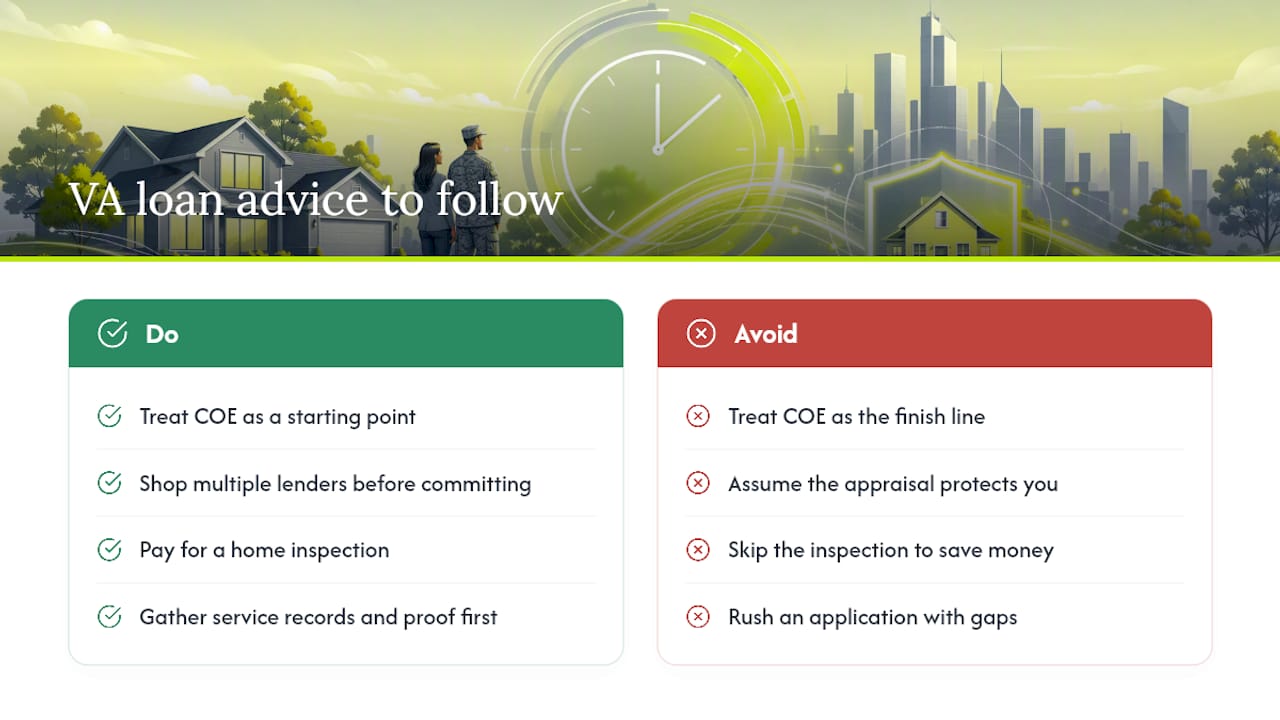
The second miscalculation is treating the appraisal as a safety net. It protects the VA’s guarantee, not your wallet, and it will not catch a failing water heater or a roof with five years left in it. Pay for the inspection. Every veteran I’ve seen skip it regretted it within the first year of owning the home.
Prioritize documentation readiness over speed. A veteran who spends a week gathering the right service records and funding-fee exemption proof will close faster than one who rushes an application with gaps in it.
— David Mordue
Ready to Move Forward With a VA Loan?
You can find mortgage brokers who offer a faster, fully online path to VA financing, with applications that can move to funding in under 21 days once your documents are in order.
Working with a knowledgeable team means you won’t be stuck untangling COE requests, entitlement math, or funding-fee exemptions on your own. Expert brokers can help pull your Certificate of Eligibility through Web LGY, calculate your remaining entitlement before you make an offer, confirm funding-fee exemption status early, and shop your Loan Estimate across lenders so you’re not guessing whether you got a fair rate. If you’re weighing a VA loan against other options, our VA loans page walks through eligibility and next steps in more depth, and if a down payment is unavoidable due to partial entitlement, our FHA loans page is worth a look for comparison. Visit Davidmordue to start your application or request a consultation today.
Sources
- VA Home Loans - Veterans Benefits Administration
- How to request a Certificate of Eligibility (COE) — VA
- Your home loan toolkit — CFPB
FAQ
What Disqualifies You From a VA Loan?
A dishonorable discharge typically disqualifies you, along with failing to meet minimum service-length requirements for your era of duty. On the lender side, unresolved bankruptcy, foreclosure within the required waiting period, or a debt-to-income ratio far outside a lender’s comfort zone can also lead to denial, even with a valid COE.
How Much Income Do You Need for a $500,000 VA Loan?
There’s no fixed VA income figure, since approval depends on your total debt load, residual income, and the specific lender’s underwriting standards. A lender calculates this using your monthly debts against your income, so getting preapproved is the only way to know your real number for a loan at this size.
What Is the “4% Rule” on a VA Loan?
There isn’t an official VA “4% rule.” If you’ve seen this term, it’s likely a misremembered reference to how sellers can contribute up to 4% of the sale price toward certain closing costs on a VA loan, separate from the funding fee.
Do You Have to Put 20% Down on a VA Loan?
No. Most VA-eligible borrowers with full entitlement can buy with no down payment at all, which is the program’s core benefit. A down payment becomes relevant only if you have partial entitlement from prior use or if your lender requires one for other underwriting reasons, according to VA’s guidance on loan limits.