
Most VA borrowers pay a one-time funding fee ranging from 0.5% to 3.3% of the loan amount, depending on your down payment and whether this is your first VA loan. You will not pay it if you receive VA disability compensation, are a qualifying surviving spouse, hold the Purple Heart, or carry certain pre-discharge disability ratings. Everything else, your exact rate, how it is calculated, and how to confirm your exemption before closing, is below.
TL;DR:
- The VA funding fee rate for first-time purchase loans with no down payment is 2.15%, but it drops to 1.5% with a 5% down payment and increases to 3.3% for subsequent loans.
- The fee is calculated as a percentage of the loan amount, not the home’s price, which means a larger down payment reduces the actual fee paid.
- Veterans with VA disability compensation, surviving spouses, Purple Heart recipients, or certain pre-discharge ratings are exempt from paying the funding fee.
- Most borrowers finance the fee into their loan, increasing monthly payments by roughly $30 to $35 per $5,700 added, depending on interest rates and loan terms.
- A VA funding fee refund is possible if the VA retroactively grants a disability rating before closing, typically processed within 10 business days.
Table of Contents
- What Is the VA Funding Fee and Why Does It Exist?
- What Are the 2026 VA Funding Fee Rates?
- How Do You Calculate the VA Funding Fee?
- Who Is Exempt From the VA Funding Fee?
- How Do You Pay the VA Funding Fee?
- Can You Get a VA Funding Fee Refund?
- How Can You Reduce or Avoid the VA Funding Fee?
- What Should You Ask Your Lender Before Closing?
- What a VA Loan Specialist Actually Adds to This Process
- Get Your VA Funding Fee Verified Before You Close
- Where to Verify VA Funding Fee Details Yourself
- Sources
What Is the VA Funding Fee and Why Does It Exist?
The VA funding fee is a one-time payment that helps keep the VA home loan program running without costing taxpayers money. It works differently from a typical mortgage insurance premium: you pay it once, usually at closing or financed into your loan, rather than monthly for the life of the loan. That single distinction is why VA loans often carry lower effective housing costs than conventional loans requiring private mortgage insurance, even when interest rates are similar.
The VA funding fee replaces the need for private mortgage insurance on VA-backed loans, and the fees collected from borrowers who use the benefit help offset losses on the small percentage of loans that default. It is the price of admission to a federal loan guaranty program that requires no down payment and no monthly mortgage insurance for the vast majority of borrowers.
The fee applies across nearly every VA loan product:
- Purchase loans, including zero-down purchases
- Cash-out refinances
- Interest Rate Reduction Refinance Loans (IRRRLs), also called VA streamline refinances
- Manufactured home loans
- Loan assumptions, where a new borrower takes over an existing VA loan
Native Americans using a VA direct loan on federal trust land and a few other narrow categories follow separate rules, but for the overwhelming majority of veterans and active-duty service members, one of the categories above will apply.
What Are the 2026 VA Funding Fee Rates?
Your VA funding fee rate depends on three variables: whether this is your first use of a VA loan, your down payment percentage, and the type of transaction. The official VA rate schedule breaks these out clearly, and the numbers have stayed stable since the last statutory update.
The most common bracket is 2.15% for a first-time purchase with no down payment, the scenario a large share of first-time VA borrowers fall into.
Notice how much a modest down payment changes your rate. Moving from 0% down to just 5% down on a first-use purchase cuts your funding fee percentage by roughly 30%, from 2.15% to 1.5%. On a $350,000 loan, that is the difference between paying $7,525 and $5,250 upfront, before you even factor in the reduced principal from the down payment itself.
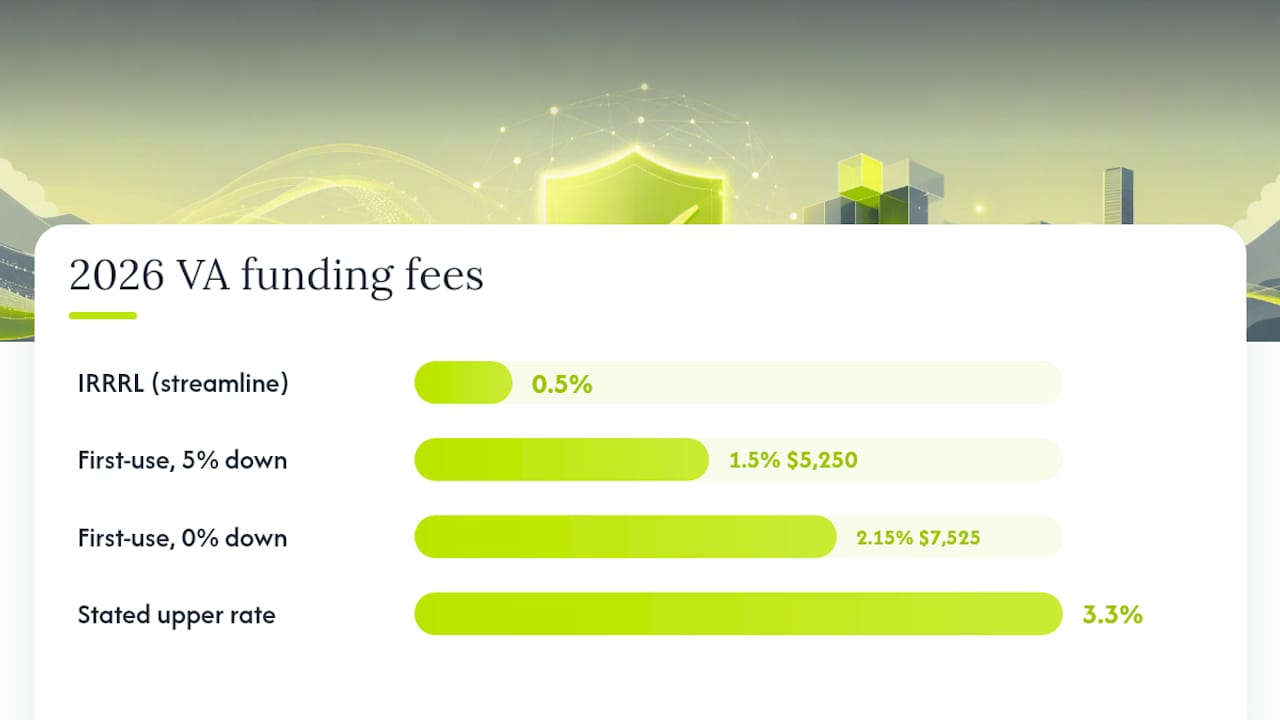
IRRRLs sit in their own category entirely. Because they carry a flat 0.5% funding fee regardless of prior use, streamline refinances are consistently the cheapest way to adjust a VA loan’s rate or term once you already have one.
How Do You Calculate the VA Funding Fee?
The funding fee is calculated as a percentage of your loan amount, not your home’s purchase price. That distinction matters when you make a down payment, because the fee only applies to the smaller amount you are actually financing.
The formula: Funding fee = Funding fee rate × Loan amount
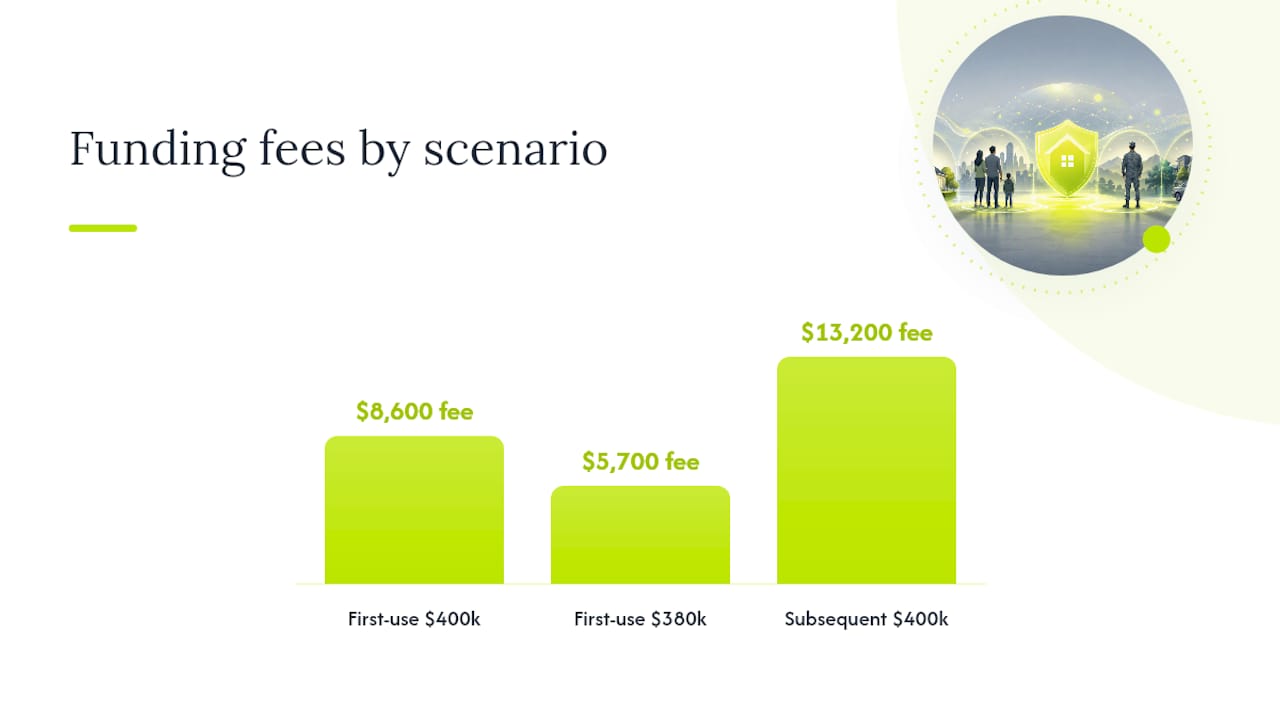
Here is how that plays out in three common situations:
- First-use purchase, no down payment. A veteran buying a $400,000 home with zero down finances the full $400,000. At the 2.15% first-use rate, the funding fee is $8,600.
- First-use purchase, 5% down. The same $400,000 home with 5% down ($20,000) leaves a loan amount of $380,000. At the reduced 1.5% rate for 5% down, the funding fee drops to $5,700, saving nearly $3,000 compared to the zero-down scenario above.
- Subsequent use, no down payment. A veteran who already used a VA loan once and is buying another $400,000 home with no down payment pays the 3.3% subsequent-use rate, bringing the funding fee to $13,200.
A few things worth keeping in mind when you run your own numbers:
- Most borrowers finance the funding fee into the loan rather than paying it in cash at closing.
- Rolling the fee in increases your loan balance and, in turn, your monthly principal and interest payment for the life of the loan.
- On a $380,000 loan at a fixed rate, adding $5,700 in financed fee typically adds somewhere in the range of $30 to $35 to the monthly payment, depending on your rate and term.
- The fee can be financed even if it pushes your loan slightly above your home’s appraised value, a flexibility unique to VA financing.
If you would rather see how a rolled-in fee affects your specific monthly payment, David Mordue - Forward Financial Group’s refinance calculator can model that scenario against your actual loan terms.
Who Is Exempt From the VA Funding Fee?
Certain veterans and surviving spouses pay nothing. The statutory exemptions cover:
- Veterans receiving VA disability compensation for a service-connected condition
- Veterans who would be entitled to disability compensation if they were not receiving retirement or active-duty pay instead
- Surviving spouses of veterans who died in service or from a service-connected disability, when the spouse qualifies for VA loan benefits
- Service members who received the Purple Heart
- Veterans with certain pre-discharge disability ratings issued by the VA or a service branch, even before their compensation claim is fully processed
Exemption status shows up directly on your Certificate of Eligibility (COE), the document your lender pulls to confirm your VA loan entitlement. If your COE does not reflect an exemption you believe you qualify for, particularly if you have a disability claim in progress, you need an updated COE before closing, not after.
This is where pre-discharge claims get complicated. When a veteran has a pending disability rating that has not yet been finalized, the lender is required to submit VA Form 26-8937 to request that the VA verify or correct the exemption status on record. Skipping this step is one of the most common reasons veterans get charged a fee they should never have paid.
Pro Tip: Ask your loan officer, by name, whether they have submitted Form 26-8937 if you have any pending VA disability claim, even a partial rating. Do not assume “pending” means “not yet relevant” to your closing.
COE processing is often close to instant through the VA’s automated systems, but cases involving a pending claim or manual review can take several business days. Build that time into your closing timeline rather than discovering it the week you are set to sign.
How Do You Pay the VA Funding Fee?
You have three practical ways to cover the funding fee, and the right choice depends on how much cash you have available versus how much you want to add to your loan balance.
- Pay in cash at closing. This keeps your loan amount lower and avoids paying interest on the fee over 15 or 30 years, but it requires more money upfront.
- Roll it into the loan. The VA explicitly allows financing the funding fee into your total loan balance, which is what most VA borrowers choose because it preserves cash for moving costs, furnishings, or a reserve fund.
- Have someone else pay it. A seller, family member, or another interested party can pay the funding fee on the veteran’s behalf as part of a negotiated seller concession or a gift.
The tradeoff is straightforward: cash now versus interest later. Financing $8,600 into a 30-year loan at a typical VA rate adds real cost over the life of the loan, likely more than $8,600 once you account for interest, but for a buyer stretched thin at closing, that tradeoff is often worth it. VA loans also cap how many other closing costs can be rolled in, so the funding fee’s flexibility here is somewhat unique among the fees you will encounter.
Can You Get a VA Funding Fee Refund?
Yes, and it happens more often than most borrowers expect. If the VA approves a disability compensation award with an effective date before your loan closed, you are entitled to a refund of the funding fee you paid, even though you paid it in good faith at the time.
Here is how the process typically unfolds:
- The VA issues a retroactive disability rating with an effective date that predates your closing.
- Your lender identifies the refund eligibility and documents the correction in the Funding Fee Payment System (FFPS), the system VA and lenders use to track fee payments and corrections.
- VA issues the refund, either as a cash payment to you if you paid the fee upfront, or as a credit applied to your loan principal if the fee was financed into your loan balance.
Refund processing after approval typically takes around 10 business days, though the disability claim itself, if not yet decided, can take considerably longer through VA’s standard claims process. Your lender does not control that claims timeline, only the correction and refund routing once the VA has made its decision.
The lender’s responsibility does not end at closing. If the fee was rolled into your loan and later refunded, the lender must apply that refund to your principal balance and document it properly in FFPS so the money lands in the right place.
How Can You Reduce or Avoid the VA Funding Fee?
A handful of legitimate strategies lower or eliminate your funding fee entirely, and most veterans never explore more than one of them.
- Increase your down payment. Reaching the 5% threshold cuts a first-use purchase rate from 2.15% to 1.5%; reaching 10% cuts it further to 1.25%.
- Use an IRRRL for a refinance. If you already have a VA loan and just want a lower rate or different term, the streamline refinance’s flat 0.5% rate almost always beats a cash-out refinance.
- Confirm your exemption status. If you have any service-connected disability rating, even 0%, get your COE checked before assuming you owe the fee at all.
- Negotiate seller concessions. In a buyer-favorable market, asking the seller to cover the funding fee as part of the purchase agreement is a legitimate and increasingly common negotiating point.
- Accept a gift toward closing costs. Family gift funds can be earmarked specifically to cover the funding fee, keeping your own cash reserves intact.
What Should You Ask Your Lender Before Closing?
A short conversation before closing day can save you thousands of dollars or weeks of refund paperwork later.
- Does my COE show an exemption, and does that match my actual disability status? If not, ask why before you sign anything.
- Have you submitted VA Form 26-8937 for my pending claim, if I have one? Get a direct yes or no, not a vague reassurance that “it will get sorted out.”
- How exactly will the funding fee be paid, cash or financed, and what does that do to my monthly payment? Confirm the number in writing.
- If my exemption is approved after closing, where does my refund go? Cash to me, or credit to my loan principal? Make sure the lender’s answer matches your preference.
Pro Tip: Never let a lender talk you into closing now and “fixing it with a refund later” if you have a pending disability claim. That approach shifts real risk and paperwork onto you, and VA guidance specifically cautions against treating refunds as a substitute for verifying exemption status upfront.
What a VA Loan Specialist Actually Adds to This Process
Most of the funding fee headaches I see trace back to timing: a pending claim not caught early enough, a Form 26-8937 filed late, a COE that never got corrected before closing. A broker who works VA loans regularly checks exemption status as a first step, not an afterthought, and knows exactly when a correction needs to happen versus when a post-closing refund is the only option left. That difference alone determines whether you pay a fee you never owed. Some brokers run fully online applications built for exactly this kind of coordination, moving files toward funding quickly without the exemption check getting lost in the shuffle.
— David Mordue
Get Your VA Funding Fee Verified Before You Close
Working with a broker who specializes in VA financing means someone is actually checking your exemption status against your COE before you sign anything, not after you have already paid a fee you did not owe. Some brokers handle VA loan applications entirely online, with funding often completed quickly, so verification happens early enough to matter instead of becoming a refund claim months later.

If you are weighing a VA purchase against your down payment options, the VA loans page walks through how financing choices affect your funding fee bracket. Already have a VA loan and considering an IRRRL to cut your rate? Run the numbers first on the refinance calculator to see how a 0.5% streamline fee compares to your current terms. When you are ready to move forward, start your application and get a straight answer on your exemption status and your rate before you commit to anything.
Where to Verify VA Funding Fee Details Yourself
Rates and exemption rules are set by federal statute and can be updated, so confirm current details directly from the VA before closing:
- VA funding fee and loan closing costs, the official rate schedule and payment rules
- VA Circular 26-23-19, covering exemption verification and refund procedures for lenders
- VA Home Loan Guaranty Buyer’s Guide, a plain-language overview of exemptions and payment options
This article is general information, not a substitute for advice from a qualified financial advisor. Consult a qualified financial professional about your own circumstances before acting on anything here.
Sources
- VA funding fee and loan closing costs — U.S. Department of Veterans Affairs
- VA Funding Fee Exemption and Refund Procedures for Lenders (Circular 26-23-19)
- VA Home Loan Guaranty Buyer’s Guide — U.S. Department of Veterans Affairs
- How To Get a VA Funding Fee Refund — MilitaryMoney