
A VA cash-out refinance lets you replace your current mortgage, VA or non-VA, with a new VA-backed loan and walk away with cash from your home’s equity, potentially up to 100% of its appraised value. If you’re a veteran, active-duty service member, or qualified surviving spouse with meaningful home equity and a clear reason to tap it, this loan type deserves a serious look.
Here’s what you need to know before you start comparing lenders:
- The Department of Veterans Affairs backs the loan, but private lenders fund and service it, and you’ll need a Certificate of Eligibility (COE) to prove your service qualifies you.
- Funding fee rates run 2.15% of the loan amount for first-time use and 3.3% for subsequent use, financed into the loan if you choose.
- Maximum loan-to-value is 100% of appraised value under VA rules, though many lenders cap actual cash-out lending closer to 90% for their own risk management.
This loan works best for homeowners who need real cash for a real purpose, home repairs, high-interest debt payoff, or converting an adjustable-rate or FHA loan into a fixed VA loan, not for anyone chasing a marginal rate drop. Once you’ve confirmed you’re eligible, the next move is comparing at least three lender offers side by side.
Key Takeaways
A VA cash-out refinance works because it lets eligible borrowers convert home equity into cash while meeting VA safeguards like Net Tangible Benefit and seasoning that protect against bad refinance deals.
| Point | Details |
|---|---|
| Verdict on cash-out access | Eligible veterans, active-duty members, and qualified spouses can borrow up to 100% of appraised value, though many lenders cap it near 90%. |
| Funding fee reminder | Expect 2.15% of the loan amount on first use and 3.3% on subsequent use, financeable into the loan. |
| NTB and seasoning matter | Every refinance needs a documented Net Tangible Benefit, and VA-to-VA loans must meet the 210-day or six-payment seasoning rule. |
| Compare before you commit | Get quotes from at least three lenders and request written NTB disclosures before applying anywhere. |
| Next step with David Mordue | David Mordue - Forward Financial Group offers a fully online application and personalized rate comparisons through its refinance calculator to help you estimate net cash-out before you apply. |
Table of Contents
- What Is a VA Cash-Out Refinance, and How Does It Differ From an IRRRL?
- Who Qualifies for a VA Cash-Out Refinance?
- The VA Rules That Actually Decide Whether Your Refinance Gets Approved
- How Much Cash Can You Actually Get, and What Will It Cost You?
- When a VA Cash-Out Refinance Actually Makes Sense
- The Step-by-Step Process, From Application to Closing
- How to Compare Lender Offers and Spot Predatory Marketing
- A Broker’s Take: Who Actually Benefits From This Loan
- How David Mordue - Forward Financial Group Can Help You Move Forward
- Sources
What Is a VA Cash-Out Refinance, and How Does It Differ From an IRRRL?
A VA cash-out refinance pays off your existing mortgage, whether it’s a VA loan, an FHA loan, a conventional loan, or even a loan with no VA backing at all, and replaces it with a new VA-guaranteed loan. The difference between your old balance and the new loan amount comes to you in cash at closing. That’s the entire point of the product: converting home equity into usable money without selling the house.
The VA splits these refinances into two categories, and the distinction matters more than most borrowers realize. Type 1 cash-out refinances happen when the new loan amount is equal to or less than the payoff amount of the loan being refinanced, essentially a limited cash-out. Type 2 refinances happen when the new loan exceeds that payoff amount, meaning you’re pulling out additional equity beyond what’s needed to satisfy the old loan. Both types must satisfy the VA’s Net Tangible Benefit requirement, but Type 1 VA-to-VA refinances carry an extra layer of scrutiny: lenders must certify that closing costs will be recouped within a set period, which shapes whether some lenders will even offer certain VA-to-VA deals.
A cash-out refinance is often confused with the VA’s other refinance product, the Interest Rate Reduction Refinance Loan, better known as the IRRRL or VA streamline refinance. They’re not interchangeable. An IRRRL cannot deliver cash to the borrower and exists purely to lower your rate or shift loan terms on an existing VA loan. It typically skips the appraisal and requires far less paperwork, which is why it closes faster.
| Feature | Type 1 Cash-Out | Type 2 Cash-Out | IRRRL |
|---|---|---|---|
| Cash to borrower | Limited (payoff only) | Yes, above payoff | None |
| Appraisal required | Yes | Yes | Usually no |
| Typical timeline | 40 to 55 days | 40 to 55 days | Often 2 to 4 weeks |
| Key compliance flag | Fee recoupment certification | NTB and seasoning checks | Net tangible benefit, no cash rule |
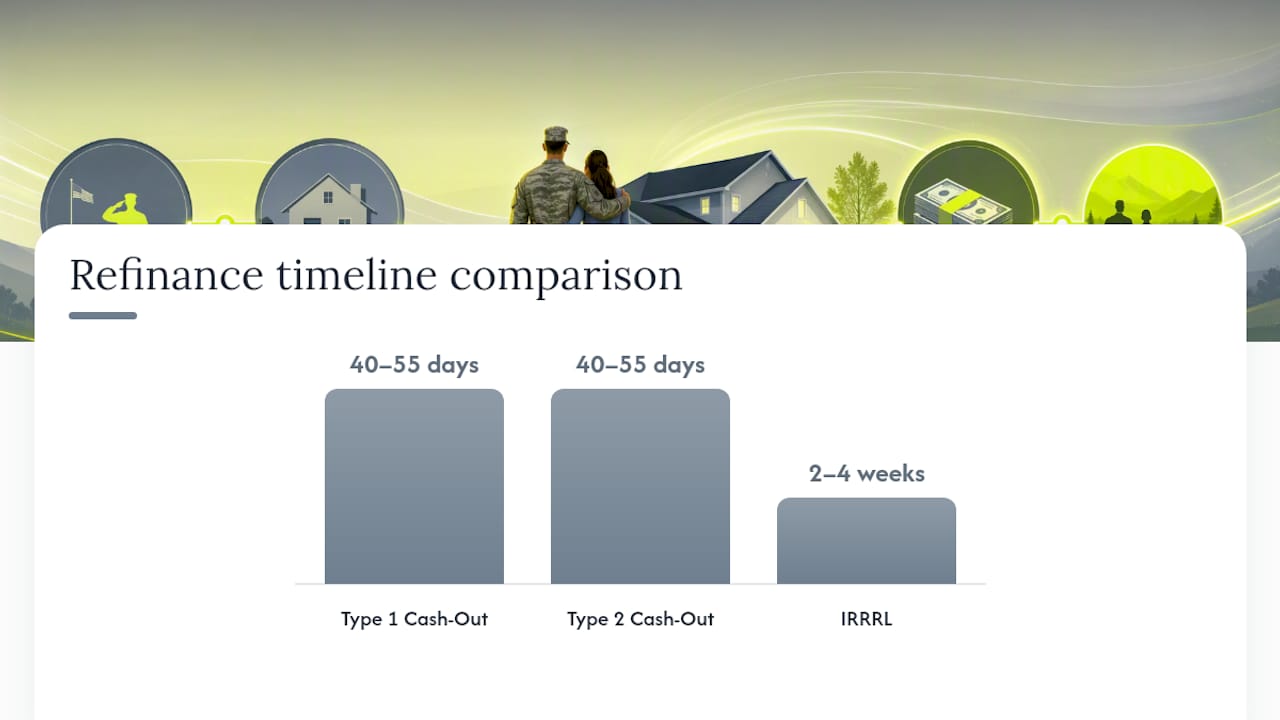
If you need money in hand, you’re in cash-out territory. If you just want a better rate on a loan you already have through the VA, the IRRRL is the simpler, cheaper path.
Who Qualifies for a VA Cash-Out Refinance?
Eligibility starts with your service record, not your credit score. Veterans, active-duty service members, and certain surviving spouses of service members who died in service or from a service-connected disability can all qualify, provided they meet the VA’s minimum service requirements. You’ll need to establish this through a Certificate of Eligibility, the document that proves to a lender that you have VA loan entitlement to use.
Beyond service eligibility, the home itself has to meet one core rule: it must be your primary residence. VA cash-out refinances aren’t available for investment properties or vacation homes. Past that, individual lenders layer on their own underwriting standards, and these vary more than borrowers expect.
- Most lenders look for a credit score around 620, though the VA itself sets no fixed minimum.
- A debt-to-income ratio near 41% or lower is the common benchmark, though some lenders will go higher with strong compensating factors.
- You’ll need documented income (pay stubs, W-2s, or tax returns if self-employed) and recent bank statements showing assets.
- An appraisal is mandatory since the new loan amount depends on the home’s current value.
Getting your COE is usually the first real step, and it’s simpler than people expect:
- Apply online through the VA’s eBenefits portal or directly through a VA-approved lender, who can often pull it electronically in minutes.
- Gather your service documentation, a DD-214 for veterans, or a statement of service for active-duty members.
- Surviving spouses will need additional documentation confirming marriage and the service member’s cause of death.
- Keep a copy on hand, lenders will ask for it early in the process, and delays here stall everything downstream.
A quick documents checklist lenders will want up front: COE, two years of tax returns or W-2s, thirty days of pay stubs, two months of bank statements, and a current mortgage statement on the loan you’re refinancing.
The VA Rules That Actually Decide Whether Your Refinance Gets Approved
This is where most of the confusion, and most of the denials, actually happen. The VA doesn’t just hand out cash-out refinances on request. It built specific safeguards into the program precisely because cash-out refinancing has a history of being misused to strip equity from vulnerable borrowers, veterans included.
The centerpiece safeguard is the Net Tangible Benefit, or NTB, test. Lenders are required to document that the refinance genuinely improves your financial position in at least one specific way, not just that it’s technically possible to close.
The NTB requirement exists to protect you from a refinance that sounds appealing on paper but leaves you worse off. Lenders must show the loan clears at least one of several defined benefits: a lower interest rate, a shorter loan term, a switch from an adjustable to a fixed rate, or cash proceeds that meaningfully address a documented financial need. If a lender can’t check one of those boxes, the VA guaranty won’t be issued.
Lenders must deliver the NTB disclosure to you within three business days of application, and again at closing. If that disclosure never shows up, or shows up vague and unsigned, that’s a red flag worth raising before you sign anything.
Seasoning is the second major guardrail, and it trips up more borrowers than the NTB rule does. For VA-to-VA refinances, your existing loan must be seasoned, meaning the later of 210 days after your first payment or six monthly payments must have passed before you can refinance again. This rule is enforced automatically in lender underwriting systems, so a borrower who refinanced five months ago will get an automatic rejection regardless of how strong their credit looks otherwise.
Then there’s fee recoupment. For Type 1 VA-to-VA transactions, lenders must certify that the fees and closing costs you’re paying will be recouped, through lower payments, within 36 months. This calculation protects you from refinancing into a deal that costs more upfront than it saves you over time.
A few technical references worth knowing if you want to read the source rules yourself: 38 CFR § 36.4306 governs cash-out refinance guaranty requirements, and VA Circular 26-18-30 along with Circular 26-19-05 lay out the Type 1/Type 2 framework and seasoning enforcement in detail.
How Much Cash Can You Actually Get, and What Will It Cost You?
The VA allows a maximum loan-to-value of 100% of your home’s appraised value, meaning in theory you could borrow against the full value of your home. In practice, plenty of lenders cap actual cash-out lending closer to 90% LTV, a self-imposed limit tied to their own risk tolerance rather than a VA requirement. That gap matters when you’re estimating how much cash you’ll actually walk away with.

Here’s a simplified version of the math. Say your home appraises at $400,000 and you owe $250,000 on your current mortgage. Subtract the $250,000 payoff, and you’re looking at roughly $150,000 in gross equity available, before the funding fee and closing costs eat into that number.
The VA funding fee is the biggest single cost most borrowers overlook when they’re mentally spending their cash-out proceeds. For a first-time cash-out refinance, the fee runs 2.15% of the loan amount; if you’ve used your VA loan benefit before, that jumps to 3.3%. On a $400,000 loan, that’s the difference between roughly $8,600 and $13,200, and most borrowers finance this fee into the loan rather than paying it out of pocket at closing.
Pro Tip: To estimate your real net cash-out, take your appraised value, subtract your current loan payoff, then subtract the funding fee amount plus roughly 2% to 3% of the new loan for closing costs. Run the real numbers with a refinance calculator before you assume a figure, because the gap between gross equity and net cash in your pocket is usually bigger than people expect.
When a VA Cash-Out Refinance Actually Makes Sense
The advantages are real, but they only pay off if you’re using the loan for the right reason. VA cash-out refinances give you access to home equity with terms that beat most alternatives available to civilian borrowers.
- No private mortgage insurance, even at high loan-to-value ratios, which is a meaningful savings compared to conventional cash-out loans above 80% LTV.
- Competitive interest rates, generally lower than conventional or FHA cash-out products for comparable credit profiles.
- Ability to convert a non-VA loan into a VA loan, useful if you’re currently in an FHA loan paying mortgage insurance or an adjustable-rate mortgage you want to lock into a fixed-rate structure.
- Flexible use of funds, with no restriction on what the cash gets spent on once it’s in your account.
The tradeoffs are just as real. The funding fee adds meaningful cost upfront. Underwriting takes longer than a streamline refinance because of the appraisal and full documentation review. And the NTB and seasoning rules mean not every borrower who wants this loan will qualify for it right now.
Common, legitimate use cases include major home renovations, paying off high-interest credit card or personal loan debt, funding education costs, or, for veterans building an accessory dwelling unit, covering construction costs that would otherwise require a separate construction loan.
Compared to a HELOC or a standalone home equity loan, a VA cash-out refinance replaces your entire mortgage rather than stacking a second lien on top of it. That’s an advantage if your current rate is higher than what’s available now, and a disadvantage if you’re sitting on a historically low rate you’d rather not disturb.
The Step-by-Step Process, From Application to Closing
Knowing the sequence in advance keeps you from getting blindsided by requests for documents you didn’t expect, or timelines that run longer than you budgeted for.
- Find and compare lenders. Get quotes from at least three lenders before committing, since VA cash-out rates and fees vary more between lenders than borrowers assume.
- Gather your documents. COE, two years of income documentation, recent bank statements, and your current mortgage statement.
- Submit your application. Most lenders, including David Mordue - Forward Financial Group, run this fully online now.
- Schedule the appraisal. This determines your home’s current value and directly caps how much you can borrow.
- Underwriting review. The lender verifies income, assets, credit, seasoning compliance, and documents your Net Tangible Benefit.
- Closing disclosure and signing. You’ll receive final numbers, review the NTB disclosure one more time, and sign.
- Funding. Cash proceeds typically arrive a few business days after closing.
Expect the whole process to take roughly 40 to 55 days from application to closing, noticeably longer than an IRRRL because the appraisal and full underwriting review add real time. What speeds things up: having your documents ready before you apply, responding quickly to underwriter requests, and choosing a lender with an efficient online process. What slows it down: appraisal delays, missing tax documents, or a seasoning issue discovered mid-process that forces the lender to push your closing date out.
- Keep digital copies of every financial document ready before you start; this is the single biggest speed factor within your control.
- Confirm your loan’s seasoning status with your lender before applying if you refinanced any VA loan within the past year.
How to Compare Lender Offers and Spot Predatory Marketing
Not every lender quote is telling you the same story, even when the headline rate looks identical. Comparing offers properly means looking past the advertised rate to the total cost structure underneath it.
- APR, not just the interest rate, since APR bakes in fees and gives you a truer cost comparison.
- Total closing costs, itemized line by line rather than bundled into one number.
- How the funding fee is handled, financed into the loan or paid upfront, since that changes your effective loan amount.
- Loan term and any prepayment penalties, though VA loans rarely carry the latter.
- Written NTB documentation, ask to see it before you commit, not after you’ve already signed disclosures.
The VA has directly warned veterans about aggressive marketing tactics targeting the cash-out refinance space, and the CFPB backs this up with its own consumer guidance on spotting predatory refinance offers. Watch for unsolicited mail designed to look like an official government notice, lenders who promise to “guarantee” VA approval before pulling your file, or repeated pressure to refinance without ever clearly explaining what tangible benefit you’re getting.
Pro Tip: Ask every lender for their NTB disclosure and closing cost estimate in writing, then plug the numbers into a refinance calculator side by side. If a lender resists giving you a written NTB before you apply, that hesitation alone tells you something about how they operate.
A Broker’s Take: Who Actually Benefits From This Loan
I see the same pattern repeat itself with clients who come in asking about VA cash-out refinances. The borrowers who benefit most have a specific, quantifiable reason for the cash, debt at a rate meaningfully higher than what the refinance offers, a renovation with a clear cost estimate, or a non-VA loan carrying insurance costs they’re ready to shed. The borrowers who end up disappointed are usually chasing a vague sense that “equity should be doing something,” without a plan for what that money accomplishes once it’s in the bank.
The red flags I watch for on behalf of clients are almost always about timing and disclosure, not the borrower’s qualifications. A recent VA loan that hasn’t hit its 210-day seasoning mark, a lender quote that’s vague about total fees, or an NTB explanation that sounds more like a sales pitch than a documented benefit. When those show up, I tell clients to slow down, not sign. A cash-out refinance is a long-term commitment, and the paperwork exists specifically to keep veterans from getting talked into a deal that doesn’t actually help them.
How David Mordue - Forward Financial Group Can Help You Move Forward
David Mordue - Forward Financial Group specializes in getting veterans through this exact process without the guesswork that comes from shopping lenders blindly. Instead of chasing quotes from multiple call centers, you get one point of contact who compares rates across lenders on your behalf and walks you through the NTB, seasoning, and funding fee math specific to your situation.

The process starts with a fully online application and moves toward funding in as little as 21 days for eligible files, faster than the industry average for cash-out refinances. If you’re ready to see real numbers instead of estimates, run your scenario through the refinance calculator to get a sense of your potential cash-out amount and monthly payment change. When you’re ready to talk specifics, start your application with David Mordue - Forward Financial Group and get a personalized consultation built around your service history and financial goals.
Sources
- Cash-Out Refinance Loan | Veterans Affairs
- Veterans Benefits Administration Circular 26-18-30
- Consumer Financial Protection Bureau: Owning a home
This article is general information, not a substitute for advice from a qualified financial advisor. Consult a qualified financial professional about your own circumstances before acting on anything here.