
A reverse mortgage is defined as a loan that lets homeowners aged 62 and older convert home equity into tax-free cash without making monthly payments. Downsizing is the process of selling your current home and moving to a smaller, less costly property to free up capital. The reverse mortgage vs downsizing comparison is one of the most consequential financial decisions seniors face, and the numbers behind each option are rarely what people expect. HUD's Home Equity Conversion Mortgage (HECM) program sets the standard for federally insured reverse mortgages, while downsizing operates through the traditional real estate market. Both paths unlock equity, but they differ sharply in how much cash you receive, what it costs you long term, and how each affects your daily life.
1. How much cash can you actually access?
Downsizing delivers significantly more liquid capital than a reverse mortgage on the same property. Downsizing can unlock 4 to 5 times more liquid cash than a reverse mortgage, depending on market conditions. That gap is large enough to change your entire retirement plan.
A concrete example makes this clear. On a comparable property, downsizing might net you $517,000 after paying off your existing mortgage, while a reverse mortgage on the same home might yield around $110,000 in accessible funds. The difference comes down to structure: downsizing captures the full sale price minus debts and transaction costs, while a reverse mortgage only advances a portion of your equity.

The timelines differ too. Downsizing typically takes 12–24 weeks from listing to closing, while a HECM reverse mortgage usually closes in 4–8 weeks. If you need cash quickly, a reverse mortgage moves faster. If you want maximum capital, downsizing wins by a wide margin.
Pro Tip: Use the rent vs buy calculator at David Mordue - Forward Financial Group to model your net proceeds under both scenarios before committing to either path.
2. What does each option actually cost upfront?
Reverse mortgage upfront costs typically run $8,000–$12,000, and most of those fees can be rolled into the loan balance so you pay nothing out of pocket at closing. That makes the entry point feel low. The real cost shows up later through compounding interest, which is discussed in the next section.
Downsizing carries heavier upfront friction. Transaction costs consume 8%–12% of your home's value, covering agent commissions, closing costs, and moving expenses. On a $700,000 home, that is $56,000–$84,000 leaving your pocket before you see a dollar of profit. In high-cost housing markets, these friction costs can consume a substantial portion of your home's value and reduce net proceeds significantly.
There is also a replacement housing problem. If smaller homes in your area cost nearly as much as your current home, the net gain shrinks fast. Financial advisors generally recommend you need at least $150,000–$200,000 in net equity release from downsizing to meaningfully improve your retirement cash flow.
3. Long-term financial impact: interest, equity erosion, and legacy
The long-term cost of a reverse mortgage is where most seniors get surprised. HECM interest compounds monthly, and the loan balance can more than double every decade if home appreciation does not keep pace. On a $400,000 loan at 7% interest, the debt grows by $28,000 in the first year alone.
Reverse mortgage interest represents the price of independence. Borrowers must weigh that compounding cost against the physical difficulty, stress, and financial friction of relocating to downsize. For many seniors, the math favors downsizing on paper, but the lived reality tips the decision the other way.
Downsizing avoids this trap entirely. You capture permanent equity through the sale, invest or spend the proceeds, and carry no compounding debt. Your net worth does not erode over time the way it can with a reverse mortgage.
Inheritance is another key difference. A reverse mortgage reduces the equity your heirs receive, sometimes dramatically, after a decade of compounding interest. Downsizing preserves more wealth for the next generation because you hold the sale proceeds as liquid assets rather than watching them shrink inside a growing loan balance.
4. The Medicaid trap: how each option affects benefits eligibility
Converting home equity to cash through a reverse mortgage creates a Medicaid risk that most seniors overlook. Unspent reverse mortgage funds are countable assets for Medicaid and SSI eligibility purposes. That means a large lump-sum draw could disqualify you or your spouse from Medicaid long-term care benefits.
Your primary residence, by contrast, is generally protected under a federal cap of approximately $730,000 in 2026. Converting that protected home equity to cash can expose a spouse to asset counting rules that would otherwise not apply.
Downsizing carries a similar risk if you hold the sale proceeds as cash. The key difference is control: with downsizing proceeds, you can direct funds into protected vehicles like annuities or irrevocable trusts with proper planning. With a reverse mortgage, the cash arrives as a lump sum or line of credit that sits in your account and counts against you.
The best sequence, according to retirement planning professionals, is to address long-term care risk first, then treat home equity tools as supplemental income rather than your primary retirement plan.
5. Lifestyle and emotional factors: staying put vs. moving
A reverse mortgage lets you stay in your home, your neighborhood, and your daily routine. That continuity has real value, especially for seniors with deep community ties, established medical relationships, or mobility limitations. Downsizing often fails emotionally for seniors attached to their communities, making a reverse mortgage the preferred choice despite its higher long-term cost.
Downsizing requires adjusting to a smaller space, a new neighborhood, and the physical and emotional labor of clearing decades of belongings. For seniors managing health issues, that process can be genuinely difficult. The financial benefit must be weighed honestly against the personal cost.
Key lifestyle questions to ask yourself:
Can you realistically manage a move given your current health and mobility?
Is your social network tied to your current location?
Does your home require significant maintenance that would be easier to leave behind?
Would a smaller home actually meet your daily needs?
Pro Tip: Talk to your doctor before committing to a move. Health changes during a 12–24 week downsizing process can complicate everything from packing to settlement timelines.
6. Eligibility rules and program requirements
The HECM program has clear eligibility requirements. You must be at least 62 years old, and the 2026 HECM maximum claim amount is $1,249,125. The home must be your primary residence, and you must maintain property taxes, homeowner's insurance, and basic upkeep. Failing any of these obligations puts you in default, even without monthly mortgage payments.
Downsizing has no age requirement, but it does require market timing, a functioning sales process, and a suitable replacement property. In tight housing markets, finding the right smaller home at the right price can take months.
Tax implications differ between the two paths:
Reverse mortgage proceeds are generally non-taxable and do not affect Social Security or Medicare benefits.
Downsizing proceeds may trigger capital gains tax, though IRS Section 121 allows a $250,000 exclusion for single filers and $500,000 for married couples on the sale of a primary residence.
Any gain above those thresholds is taxable at capital gains rates.
Reverse mortgage interest is not deductible until the loan is repaid.
Feature | Reverse mortgage | Downsizing |
|---|---|---|
Minimum age | 62 (HECM) | None |
2026 loan limit | $1,249,125 | Not applicable |
Monthly payments | None required | Not applicable |
Tax on proceeds | Non-taxable | Capital gains rules apply |
Processing timeline | 4–8 weeks | 12–24 weeks |
You can review current FHA loan program details at David Mordue - Forward Financial Group to understand HECM eligibility and borrower protections in more depth.
7. When a reverse mortgage works as a strategic tool
A reverse mortgage is not always a last resort. Reverse mortgages work best as a bridge during market downturns or unexpected expenses, helping you preserve investment portfolios by delaying asset sales at a loss. If your portfolio is down 20% and you need income, drawing from a reverse mortgage line of credit instead of selling stocks at a loss is a legitimate wealth-preservation strategy.
The HECM line of credit also grows over time if unused, which is a feature most seniors do not know about. The unused portion of your credit line increases at the same rate as the loan's interest rate, giving you more access to funds the longer you wait to draw on it.
This strategic use works best when you have substantial home equity, a strong reason to stay in your home, and a clear plan for managing the compounding interest over time. It works poorly as a primary retirement income source without those conditions in place.
Key Takeaways
Downsizing delivers 4 to 5 times more liquid capital than a reverse mortgage, making it the stronger choice for wealth maximization, while a HECM reverse mortgage offers flexibility and speed for seniors who need income without moving.
Point | Details |
|---|---|
Cash access gap | Downsizing can net $517,000 vs. roughly $110,000 from a reverse mortgage on a similar property. |
Upfront costs | Reverse mortgage costs $8,000–$12,000 at closing; downsizing consumes 8%–12% of the home's value. |
Compounding interest risk | HECM interest compounds monthly and can double the loan balance every decade. |
Medicaid exposure | Unspent reverse mortgage funds count as assets for Medicaid and SSI eligibility. |
Lifestyle fit | Reverse mortgages support aging in place; downsizing maximizes financial returns but demands a move. |
What I've learned advising seniors on this decision
I have worked with many senior homeowners who came to me convinced they already knew which option was right. Most of them changed their minds after running the actual numbers.
The pattern I see most often: seniors lean toward a reverse mortgage because it feels safe and familiar. Staying in your home is comfortable. But when we model the 10-year trajectory, the compounding interest often surprises people. A loan that starts at $110,000 can grow to well over $200,000 in a decade, and that debt comes directly out of whatever equity remains for heirs or future care needs.
My honest view is that downsizing is the better financial decision for most people who can physically and emotionally manage the move. The capital difference is simply too large to ignore. But I also recognize that financial utility and emotional utility are not the same thing. For a senior who is deeply rooted in a community, managing a health condition, or facing a housing market where smaller homes cost nearly as much as larger ones, a reverse mortgage can be the right call.
What I always recommend: address long-term care planning before you touch home equity. Home equity is often the largest asset a senior owns. Using it well means protecting it first, then deciding how to deploy it. A refinance calculator can help you model scenarios before you commit to any path.
— David Mordue
Your next step with David Mordue - Forward Financial Group
Choosing between a reverse mortgage and downsizing requires more than a general comparison. It requires modeling your specific equity, costs, and retirement timeline with accurate numbers.
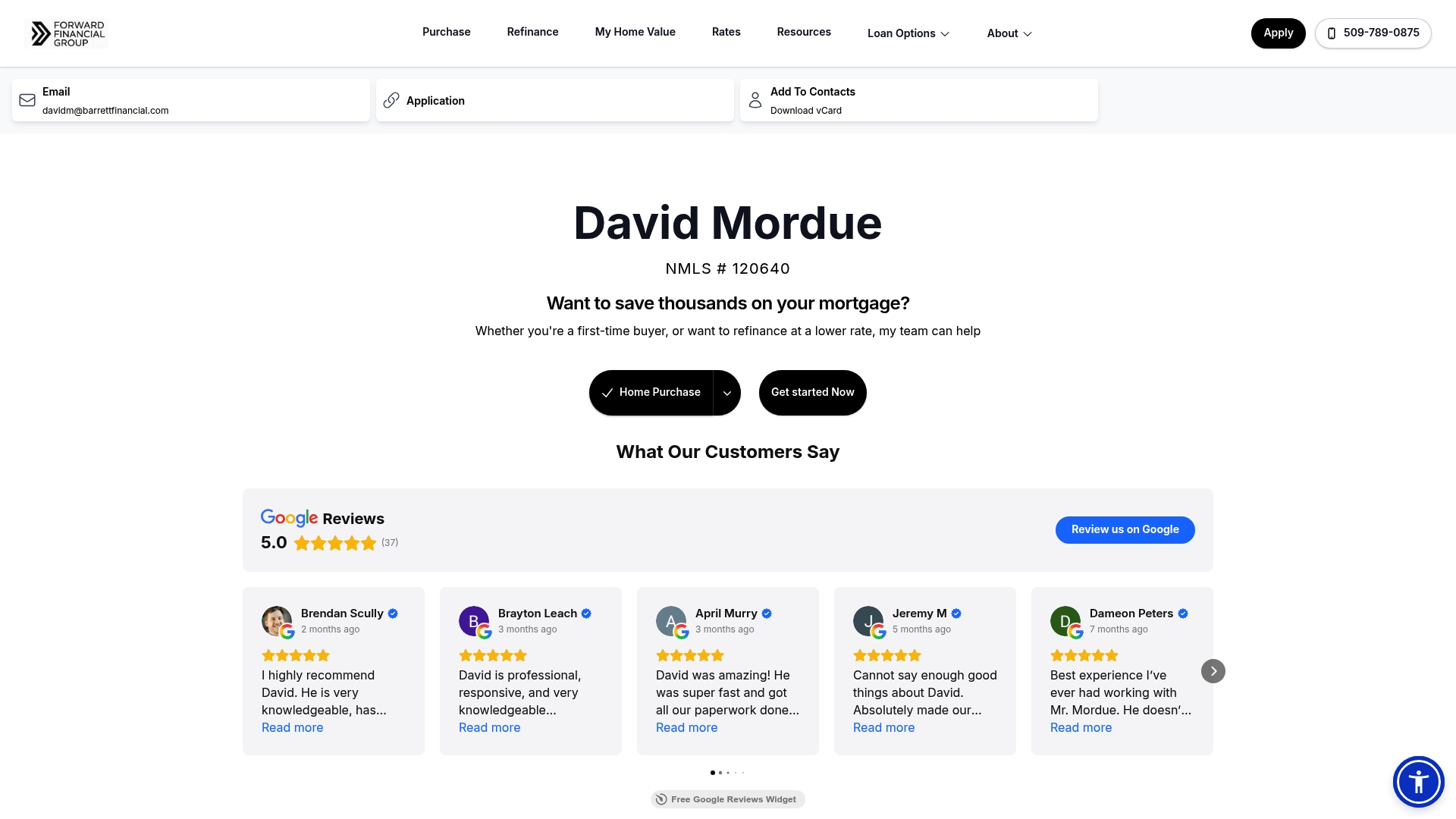
David Mordue - Forward Financial Group offers personalized mortgage consultations, expert rate comparisons, and a fully online application process that can move from inquiry to funding in under 21 days. Use the rent vs buy calculator to model your housing finance options, or visit davidmordue.com to connect with David directly and get a clear picture of what your home equity can do for your retirement.
FAQ
What is the main difference between a reverse mortgage and downsizing?
A reverse mortgage lets you access a portion of your home equity while staying in your home, while downsizing involves selling your home to capture the full equity minus transaction costs. Downsizing typically yields 4 to 5 times more liquid capital.
Does a reverse mortgage affect Medicaid eligibility?
Yes. Unspent reverse mortgage funds are countable assets for Medicaid and SSI purposes, which can affect eligibility for long-term care benefits. Your primary residence itself is generally protected up to approximately $730,000 in 2026.
What are the HECM eligibility requirements in 2026?
You must be at least 62 years old, live in the home as your primary residence, and maintain property taxes, insurance, and upkeep. The 2026 HECM maximum claim amount is $1,249,125.
How much does downsizing actually cost?
Transaction costs for downsizing typically run 8%–12% of your home's value, covering agent commissions, closing costs, and moving expenses. On a $700,000 home, that is $56,000–$84,000 in upfront costs before you see any proceeds.
When does a reverse mortgage make more sense than downsizing?
A reverse mortgage makes sense when moving is not practical due to health, community ties, or market conditions, or when used strategically as a bridge during a market downturn to avoid selling investments at a loss.