
No, reverse mortgage proceeds are not taxable income. The money you draw is a loan advance, not earnings, so the IRS never expects to see it on your Form 1040 and no lender sends you a 1099 for it. The one place this rule gets tricky is Medicaid, where cash sitting in your bank account at month’s end can count as a countable asset even though it was never income.
TL;DR:
- Reverse mortgage proceeds are loan advances, not taxable income, and are not reported on federal tax returns or form 1099s.
- Interest accrued on the loan is deductible only when paid, and only on the portion used for qualifying home improvements, making deductions rare for most borrowers.
- Cash from reverse mortgages does not affect Social Security or Medicare eligibility but can count as an asset for Medicaid and SSI if left in the account at month’s end.
- Most FHA-insured HECMs require HUD counseling, and borrowers must understand ongoing obligations like property taxes, insurance, and the risk of loan default.
- Proper planning with a CPA and elder law attorney can help optimize tax benefits and avoid default risks related to property tax or insurance lapses.
Table of Contents
- What “Not Taxable” Means for Your Reverse Mortgage Taxes and Benefits
- Are Reverse Mortgage Proceeds Taxable? (IRS and HUD Guidance You Can Verify)
- Interest Deductibility: When You Can Actually Deduct It
- How Proceeds Affect Social Security, Medicare, SSI, and Medicaid
- Borrower Obligations, LESA, and Default Risks
- Tax-Planning Moves Worth Discussing With Your CPA
- Reporting Requirements and Documentation for Your Tax Return
- Impact on Income Tax Credits and Deductions
- Capital Gains Tax on Sale or Inheritance
- HECM Eligibility Basics and the HUD Counseling Requirement
- Publisher Perspective: Coordinating Tax Rules With the Right Loan Structure
- Get Personalized Help Before You Draw
- Sources
What “Not Taxable” Means for Your Reverse Mortgage Taxes and Benefits
The logic behind reverse mortgage taxes is simpler than most people expect. Every draw you take creates a matching liability against your home equity, so you’re not gaining wealth in the eyes of the tax code. You’re converting one asset (equity) into another (cash) while a debt balance grows in the background. That offsetting structure is exactly why it never touches your adjusted gross income or modified adjusted gross income.
Here’s what that actually means for your paperwork and your benefits:
- No line on Form 1040 reports reverse mortgage draws, because they are not income.
- Your AGI and MAGI stay unaffected, which matters for Medicare premium calculations.
- Social Security and Medicare eligibility remain untouched.
- Medicaid and SSI are the exception, since these programs count assets, not just income.
If any of that touches your situation, the sections below unpack each piece, starting with the federal source language itself.
Are Reverse Mortgage Proceeds Taxable? (IRS and HUD Guidance You Can Verify)
You don’t have to take a broker’s word for this. The IRS’s own guidance for senior taxpayers confirms that reverse mortgage payments are loan proceeds, not taxable income, and they are never reported on your federal return. There’s no 1099 form involved because the IRS doesn’t classify this money as earnings, dividends, or any other category it taxes.
The Federal Trade Commission’s consumer guidance echoes this directly: reverse mortgage proceeds are loan advances, full stop, though state-level or single-purpose reverse mortgage programs occasionally carry different rules worth checking with a local agency. For the mechanics of the federal deduction rules that do apply, particularly around interest, the IRS outlines the framework in Publication 936. HUD’s HECM program pages cover the loan structure itself, which explains why the money behaves the way it does on your taxes.
Interest Deductibility: When You Can Actually Deduct It
This is where most homeowners get tripped up; understanding interest accrual and payment options is easier with IRS interest abatement help. Interest accrues on your reverse mortgage balance every month, but you cannot deduct a dollar of it until you actually pay it, which for most borrowers happens only at payoff, whether that’s from a home sale, refinance, or the loan being settled after death.
Even then, the deduction isn’t automatic for the full amount. Publication 936 limits the reverse mortgage interest deduction to the portion of proceeds you used to buy, build, or substantially improve your home. Draws you spent on medical bills, groceries, or a grandchild’s tuition don’t qualify, no matter how much interest accrued on them.
On top of that, you have to itemize deductions to claim it, and most seniors take the standard deduction instead. Nolo’s legal analysis notes this combination of timing and itemizing rules means many borrowers never actually see a deduction from their reverse mortgage interest, even after decades of accrual.
One advanced tactic some borrowers use is making voluntary partial interest payments in a given year specifically to create a deductible event. This only makes sense with a CPA’s input, since it affects your loan balance and potentially your itemizing math for that year.
How Proceeds Affect Social Security, Medicare, SSI, and Medicaid
Social Security and Medicare eligibility rest on income and work history, and reverse mortgage draws don’t touch either one, since the money isn’t income. You can draw as much as your line of credit allows without triggering a benefit reduction or a Medicare premium surcharge tied to income.
Medicaid and Supplemental Security Income work differently. Both are means-tested programs that count assets, not just income, and cash sitting in your checking account counts against you.
- Medicaid typically caps countable assets at a low threshold for an individual, though exact limits vary by state.
- The rule that catches people off guard is timing: Medicaid looks at your account balance on the last day of the month, not what you spent it on.
- A large reverse mortgage draw left sitting in your account at month’s end can push you over the asset limit, even if you spend it the following week.
The Consumer Financial Protection Bureau recommends working with an elder law attorney before taking large draws if you’re on Medicaid or anticipate needing it, since spend-down timing matters more than most homeowners realize.
Borrower Obligations, LESA, and Default Risks
Tax-free cash doesn’t erase your responsibilities as a homeowner. You still owe property taxes, homeowner’s insurance, routine maintenance, and any HOA fees, exactly as you did before the loan closed. Falling behind on these isn’t just a bill problem. It’s a loan default trigger.
Lenders assess your financial capacity during the application process, and if your income and credit history suggest a risk of falling behind, they may require a Life Expectancy Set Aside, or LESA. This set-aside mechanism earmarks part of your loan proceeds specifically to cover future property tax and insurance bills, protecting both you and the lender.
If taxes or insurance lapse and go uncorrected, the loan can become due and payable, which puts the home at risk of foreclosure. This is the real danger of a reverse mortgage, not tax exposure. When the loan does come due, whether through default, sale, or the borrower’s passing, the balance is typically settled from the home’s proceeds or the estate, and heirs are not personally liable beyond the home’s value on a HECM.
Tax-Planning Moves Worth Discussing With Your CPA
Reverse mortgage draws can actually work in your favor during specific tax years. Because the money doesn’t count as income, some retirees use it strategically to keep their modified adjusted gross income below the thresholds that trigger IRMAA surcharges on Medicare Part B and D premiums, rather than pulling from a taxable retirement account in a high-income year.
This coordination gets more powerful when paired with other planning tools. A few prompts worth raising with your accountant:
- Could a reverse mortgage draw cover living expenses in a year you’re also doing a Roth conversion, so the conversion doesn’t push you into a higher IRMAA bracket?
- Does the timing of your eventual payoff line up with a year where you’d benefit from an itemized interest deduction?
- Should you make voluntary interest payments now, only after your CPA confirms the math works in your favor?
None of these moves should happen without professional review, since they interact with your broader retirement income picture.
Reporting Requirements and Documentation for Your Tax Return
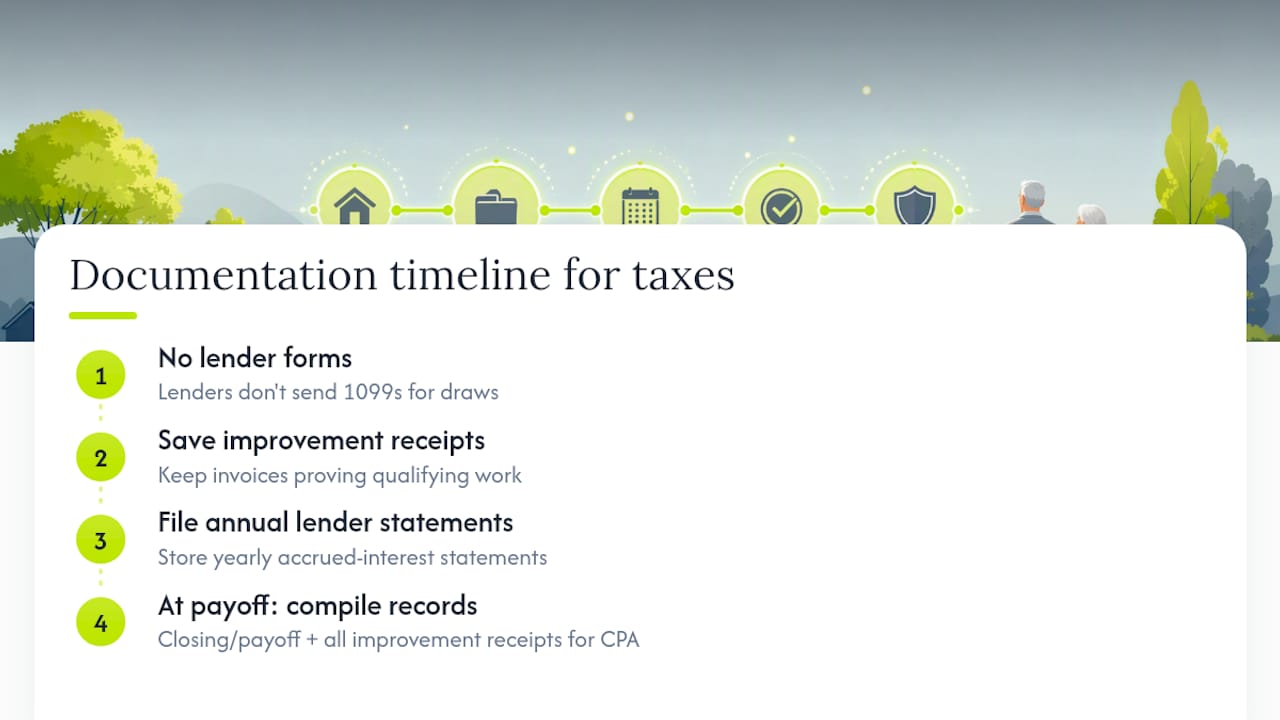
Here’s the good news: there’s remarkably little paperwork tied to reverse mortgage taxes themselves. Because your draws aren’t income, you won’t receive a 1099-MISC, 1099-INT, or any similar form from your lender reporting the amount you withdrew. Your federal return doesn’t have a line item for reverse mortgage proceeds because the tax code doesn’t treat this money as reportable.
What you do need to keep are your own records, particularly if you plan to claim an interest deduction someday. Save every receipt and invoice tied to home improvements funded by reverse mortgage draws, since the IRS will want documentation showing which portion of your loan balance was used for qualifying improvements versus general living expenses. Your lender’s annual statement showing accrued interest is also worth filing away each year, even though you can’t deduct that interest yet.
When the loan is eventually paid off, whether by you, a sale, or your estate, that’s the year interest deduction documentation matters most. Your closing statement or payoff letter will show the total interest paid, and your CPA will need your improvement records from the entire life of the loan to calculate what portion qualifies. Keep these documents in one folder from day one rather than trying to reconstruct them years later. If you’re weighing whether to pay off a reverse mortgage through a traditional refinance instead, running the numbers through a refinance calculator can help you see how payoff timing might align with a more favorable deduction year.
Impact on Income Tax Credits and Deductions
Because reverse mortgage proceeds don’t count as income, they generally don’t interfere with the income-based tests that determine eligibility for common tax credits. Credits like the Credit for the Elderly or the Disabled, or income-based phaseouts on other credits, are calculated using your AGI, and since draws never enter that calculation, taking a reverse mortgage doesn’t push you out of eligibility the way an equivalent amount of taxable retirement withdrawals might.
Where things shift is on the deduction side, and it’s a subtler effect than most people anticipate. If you were previously deducting mortgage interest on a traditional loan and you refinance into a reverse mortgage, that ongoing annual deduction disappears, since reverse mortgage interest isn’t deductible until paid at settlement. For homeowners who relied on that itemized interest deduction to stay above the standard deduction threshold, switching to a reverse mortgage can mean falling back to the standard deduction for the life of the loan.
Property tax deductions are unaffected either way, since you still pay those bills directly and can still deduct them if you itemize, subject to the state and local tax cap that applies to all homeowners. The bottom line: a reverse mortgage rarely disqualifies you from a credit, but it can quietly remove an interest deduction you were counting on, which is worth modeling with a tax professional before you close.
Capital Gains Tax on Sale or Inheritance
Selling a home with a reverse mortgage attached works the same way as selling a home with any other mortgage, from a capital gains standpoint. The loan balance, principal plus accrued interest, gets paid off from the sale proceeds at closing, and your capital gain is calculated the standard way: sale price minus your cost basis, not affected by how much you owe on the reverse mortgage itself. Most homeowners still qualify for the $250,000 single or $500,000 married exclusion on primary residence gains, assuming ownership and use tests are met, regardless of the reverse mortgage balance.
Inheritance is where the tax picture actually improves for most families. Heirs who inherit a home with a reverse mortgage receive a stepped-up cost basis equal to the home’s fair market value at the date of death. If they sell shortly after, there’s often little or no taxable gain, even though the original owner may have owned the home for decades. Heirs have options: pay off the loan balance and keep the home, sell it and use proceeds to satisfy the debt, or, since HECMs are non-recourse loans, walk away without owing more than the home is worth even if the loan balance exceeds the sale price.
The one thing families should not assume is that the reverse mortgage balance itself creates a tax event. It doesn’t. The loan repayment and any capital gains calculation are separate mechanics, and confusing the two is a common source of unnecessary worry during an already stressful time.
HECM Eligibility Basics and the HUD Counseling Requirement
Most reverse mortgages in the United States are Home Equity Conversion Mortgages, or HECMs, which are FHA-insured and carry federal eligibility rules. To qualify, you generally need to be at least 62 years old, own your home outright or have a low remaining mortgage balance you can pay off with loan proceeds at closing, and live in the home as your primary residence. The property itself has to meet FHA standards, and condos need to be on an approved list.

Before you can even apply, HUD requires every HECM applicant to complete a counseling session with a HUD-approved counselor, and this isn’t a sales formality. These sessions walk through the loan’s mechanics, your obligations as a borrower, and alternatives you might not have considered, precisely because HUD wants to make sure you understand both the tax treatment and the ongoing responsibilities before you sign anything. The counselor will also cover how a LESA might apply to your situation if your financial profile suggests you’d benefit from one.
This eligibility structure exists because a reverse mortgage is a significant, largely irreversible financial decision for someone often living on a fixed income. HUD’s counseling mandate is the government’s way of making sure the tax advantages don’t overshadow the real obligations, property taxes, insurance, and maintenance, that come with any home loan.
Publisher Perspective: Coordinating Tax Rules With the Right Loan Structure
The tax rules around reverse mortgages are genuinely favorable, but the real risk isn’t the IRS. It’s borrowers who understand the tax treatment perfectly and then miss the property tax deadline that puts the loan in default. David Mordue - Forward Financial Group builds tailored mortgage solutions for both first-time buyers and homeowners refinancing into or out of a reverse mortgage, with a fully online application that can fund in under 21 days. Before drawing large sums, especially if Medicaid is on your horizon, loop in a CPA and an elder law attorney. The loan structure matters as much as the tax rule.
— David Mordue
Get Personalized Help Before You Draw
Reading the rules is one thing. Applying them to your specific equity, income, and benefit situation is another, and that’s where a real conversation beats another article. Personalized consultations can help walk through how a reverse mortgage draw schedule interacts with property tax and insurance obligations, whether a LESA makes sense for your profile, and how payoff timing might affect an eventual interest deduction.

If you’re still deciding between a reverse mortgage and a more traditional path, running your numbers through the rent vs. buy calculator or the refinance calculator can clarify which route actually fits your retirement income picture. None of this replaces a CPA’s input on your specific tax return or an elder law attorney’s guidance on Medicaid planning, but it’s a solid starting point before you commit. Start your mortgage pre-approval or consultation today and get answers specific to your home and your numbers.