
A reverse mortgage works well for homeowners 62 or older who are house-rich and cash-poor and plan to stay in their home for the long term. If you expect to move within a few years, or if preserving home equity for your heirs is a priority, the costs typically outweigh the benefits.
The most common product is the Home Equity Conversion Mortgage (HECM), which is FHA-insured and regulated by HUD. That federal backing gives you meaningful consumer protections: mandatory HUD-approved counseling, a non-recourse guarantee, and a three-business-day right to rescind after closing. The GAO has documented that defaults rose sharply when borrowers could not keep up with property taxes, insurance, and occupancy requirements, so your ability to cover those ongoing costs matters as much as your equity. The CFPB and AARP both publish plain-language guides to help you compare options before you commit.
Pro Tip: Your planning horizon is the single most important factor. Most advisors recommend staying in the home several years to recoup upfront costs, which can total thousands to tens of thousands of dollars.
Key Takeaways
A reverse mortgage can strengthen retirement security for the right homeowner, but the ongoing property obligations and upfront costs make careful planning non-negotiable before you commit.
| Point | Details |
|---|---|
| Who benefits most | Homeowners 62+ with significant equity, long expected tenure, and reliable ability to pay taxes and insurance. |
| Primary pros | No required monthly mortgage payments, flexible payout options, non-recourse protection, and generally tax-free proceeds. |
| Primary cons | Loan balance grows over time, upfront costs are substantial, and property-charge failures are the leading cause of foreclosure. |
| HUD counseling is mandatory | Complete a session with a HUD-approved counselor before contacting any lender; it is your most important consumer protection. |
| David Mordue - Forward Financial Group | Offers free consultations and lender comparison support to help you evaluate reverse mortgages alongside refinancing and other alternatives. |
Table of Contents
- What Are the Main Reverse Mortgage Pros and Cons?
- What Are the Risks and Disadvantages You Should Weigh?
- How Do Reverse Mortgages Work, and What Types Are Available?
- What Do Reverse Mortgages Cost, and How Much Can You Borrow?
- How Does a Reverse Mortgage Affect Your Benefits, Taxes, and Heirs?
- When Does a Reverse Mortgage Make Sense, and What Are the Alternatives?
- What Should You Expect From HUD-Approved Counseling?
- What Do Government Reports and Research Say About Outcomes?
- What Are the Recommended Next Steps if You’re Considering a Reverse Mortgage?
- A Practical Perspective on Reverse Mortgages
- How David Mordue - Forward Financial Group Can Help You Evaluate Your Options
- Sources
What Are the Main Reverse Mortgage Pros and Cons?
The advantages worth knowing
A reverse mortgage’s most immediate benefit is the elimination of required monthly mortgage payments. You still own the home; the lender simply advances you money against your equity, and repayment is deferred until you sell, move out permanently, or pass away. For retirees on a fixed income, removing a mortgage payment can free up hundreds of dollars a month.
The ability to age in place is equally significant. NCOA research notes that roughly 60% of older Americans prefer to remain in their homes as they age, and a HECM makes that financially viable for many who would otherwise be forced to sell. The FHA-insured non-recourse protection means you will never owe more than the home is worth at the time of repayment, regardless of how long you live there or how the market moves.
Disbursement flexibility is another genuine advantage. You can choose from:
- Lump sum: A single payment, useful for paying off an existing mortgage or covering a large expense.
- Tenure payments: Equal monthly payments for as long as you live in the home, functioning like a private annuity.
- Term payments: Fixed monthly payments for a set number of years.
- Line of credit: Draw funds as needed; the unused portion grows over time, giving you more liquidity later.
The line of credit’s growth feature is particularly useful for retirement planning. Because unused credit increases at the same rate as the loan’s interest rate, delaying draws can meaningfully expand your available funds, providing a buffer against portfolio withdrawals during down markets.
Center for Retirement Research analysis shows that reverse mortgages are most effective when used strategically: bridging income while you delay Social Security to maximize your benefit, protecting your investment portfolio from sequence-of-returns risk in early retirement, or funding in-home care that would otherwise require a facility. Loan proceeds are generally not taxable and do not count as income for Social Security or Medicare purposes.
Pro Tip: If you have an existing mortgage balance, using a lump-sum HECM to pay it off first eliminates the monthly payment immediately and may free up more cash flow than drawing the same amount as monthly tenure payments.
What Are the Risks and Disadvantages You Should Weigh?
How the loan balance grows
Interest and fees accrue on the outstanding balance every month. Because you make no payments, the balance compounds over time, steadily reducing the equity in your home. After ten or fifteen years, a significant portion of your home’s value may belong to the lender rather than your estate.
Upfront costs are substantial. Origination fees, the FHA mortgage insurance premium (MIP), appraisal, title, and closing costs frequently total thousands to tens of thousands of dollars. As the FTC explains, these costs add to your loan balance and can deplete equity quickly, especially if you move or sell within a few years of closing.
Ongoing obligations and default risk
Owning the home is not enough. You must continue paying property taxes, homeowners insurance, and HOA fees, and keep the property in good repair. Failing any of these obligations can trigger foreclosure, even though you have no monthly mortgage payment.
The most common causes of reverse mortgage foreclosure are not missed mortgage payments. They are unpaid property taxes, lapsed homeowners insurance, and the borrower no longer living in the home as their primary residence. The GAO found that defaults rose notably as borrowers failed to meet payment and occupancy requirements over recent years, almost entirely because of these property-charge and occupancy failures.
Moving out for more than 12 consecutive months, even for a nursing home stay, triggers repayment. Eligible non-borrowing spouses have some protections under current HECM rules, but those protections have limits and depend on when the loan was originated.
Inheritance and estate impact
Your heirs will inherit a home with a loan balance attached. They can sell the property to repay the debt, refinance the loan to keep the home, or hand the property back to the lender. Because of the non-recourse clause, they will never owe more than the home’s appraised value at that time, but the equity available to them will be reduced.
Red flags to watch for:
- A salesperson who pressures you to sign quickly or discourages you from taking time to think.
- Any requirement to purchase an annuity, investment product, or other financial service as a condition of the loan.
- Fees that are not clearly itemized in writing.
- Anyone who claims to be a HUD-approved counselor but cannot provide their agency’s HUD approval number.
- Agents who push proprietary products without explaining how they compare to a standard HECM.
The HUD OIG fraud bulletin documents specific fraud patterns targeting older homeowners, including contractors who suggest a reverse mortgage to fund unnecessary repairs and family members who pressure seniors into loans for their own financial benefit.
Pro Tip: Never apply for a reverse mortgage without completing HUD-approved counseling first. Counselors are required to discuss alternatives, and many identify state or local programs that cost far less.
How Do Reverse Mortgages Work, and What Types Are Available?
The basic mechanics are straightforward. You borrow against the equity in your home, interest accrues on the outstanding balance, and repayment becomes due when you sell the home, move out permanently, or pass away. You retain title throughout.
Product types compared
| Product | Primary benefit | Best-fit borrower |
|---|---|---|
| HECM (FHA-insured) | Federal protections, flexible payout options, non-recourse guarantee | Most homeowners 62+; primary residence up to FHA lending limit |
| HECM for Purchase | Buy a new primary residence using reverse mortgage proceeds | Downsizers who want to move without a monthly mortgage payment |
| Proprietary (private) | Access equity above the FHA lending limit | Owners of high-value homes who need larger loan amounts |
HECMs account for the large majority of reverse mortgages originated in the United States. They are insured by the FHA, regulated by HUD, and carry the strongest consumer protections. Proprietary products are offered by private lenders, are not FHA-insured, and typically carry different cost structures and fewer standardized protections.
Eligibility checklist
- Age 62 or older (all borrowers on title must meet this requirement).
- The property must be your primary residence.
- You must complete a session with a HUD-approved counselor before applying.
- The home must meet FHA property standards and be appraised.
- You must demonstrate the financial capacity to pay ongoing property charges (taxes, insurance, maintenance).
Non-borrowing spouses who are under 62 may remain in the home after the borrowing spouse passes away under current HECM rules, but they cannot receive additional loan proceeds. The specifics depend on when the loan was originated and the lender’s terms.
The CFPB’s HECM guidance recommends comparing quotes from multiple lenders because interest rates, origination fees, and servicing fees vary meaningfully from one lender to the next.
What Do Reverse Mortgages Cost, and How Much Can You Borrow?
Upfront and ongoing costs
Typical upfront costs include:
- Origination fee: Capped by HUD for HECMs; varies by lender and home value.
- FHA mortgage insurance premium (MIP): An upfront MIP plus an annual ongoing MIP, both added to the loan balance.
- Appraisal fee: Required to establish the home’s current market value.
- Closing costs: Title insurance, recording fees, and other standard closing expenses.
- Servicing fee: Some lenders charge a monthly servicing fee that accrues into the balance.
Ongoing costs include the interest rate (fixed or adjustable depending on payout option), the annual MIP, and any servicing fees. All of these compound over time. The CFPB notes that HECMs include a non-recourse clause and a three-business-day right to rescind after closing.
How much you can borrow
The amount you can access, called the principal limit, depends on four factors: your age (older borrowers qualify for a higher percentage of home value), the appraised value of the home, current interest rates, and any existing mortgage balance that must be paid off at closing. HUD sets the maximum home value it will consider for HECM calculations; homes above that limit may benefit from a proprietary product.
Payout option implications
A fixed-rate lump sum gives you the highest immediate proceeds but starts accruing interest on the full balance from day one. An adjustable-rate line of credit starts smaller but grows over time if you leave it unused, making it a useful liquidity reserve. Tenure and term payments spread proceeds over time, reducing the rate at which the balance grows.
Pro Tip: Ask every lender for a Total Annual Loan Cost (TALC) disclosure, which expresses the full cost of the loan as an annual rate across different time horizons. It is the clearest apples-to-apples comparison tool when shopping lenders.
How Does a Reverse Mortgage Affect Your Benefits, Taxes, and Heirs?
Loan proceeds from a HECM are generally not taxable income and will not affect your Social Security or Medicare benefits. The FTC confirms that proceeds are typically tax-free, though you should verify your specific situation with a tax advisor.
Means-tested programs are a different matter. If you receive Medicaid or Supplemental Security Income (SSI), holding reverse mortgage proceeds in a bank account beyond the month they are received can push your liquid assets above the program’s eligibility threshold. Spending proceeds in the same month you receive them typically avoids this issue, but the rules are program-specific and state-specific.
What happens to your heirs
When the loan becomes due, your heirs generally have several options:
- Sell the home and use the proceeds to repay the loan balance; any remaining equity belongs to the estate.
- Refinance the loan into a conventional mortgage to keep the home.
- Hand the property back to the lender if the loan balance exceeds the home’s value (the non-recourse clause protects heirs from any shortfall).
The CFPB explains that heirs typically have up to 12 months to settle the loan after the borrower’s death, with extensions available in some circumstances. HECMs are FHA-insured and include mandatory disclosures and a rescission period, which gives borrowers and their families time to review the terms before the loan becomes final.
Pro Tip: Talk to your heirs before you close. Knowing their plans for the home helps you choose the right payout structure and avoids surprises when the loan eventually comes due.
When Does a Reverse Mortgage Make Sense, and What Are the Alternatives?
A reverse mortgage is likely a good fit when you have substantial home equity, plan to stay in the home for at least five to seven years, need to supplement retirement income or eliminate a mortgage payment, and can reliably cover property taxes, insurance, and maintenance. It tends to be a poor fit when you expect to move soon, when a less expensive alternative is available, or when leaving home equity to heirs is a primary goal.
Alternatives worth comparing
| Alternative | Primary trade-off vs. reverse mortgage | Best for |
|---|---|---|
| Downsizing / selling | Frees full equity but requires moving | Homeowners open to relocating |
| Conventional refinance | Lowers payment but requires monthly payments | Borrowers with income to qualify |
| HELOC / home equity loan | Lower cost but requires monthly payments and income qualification | Borrowers with steady income |
| Delay Social Security | No cost; increases lifetime benefit | Those who can bridge income another way |
| Tap retirement accounts | Flexible but may have tax consequences | Those with sufficient retirement savings |
The rent vs. buy calculator at David Mordue - Forward Financial Group can help you model the financial difference between staying in your current home and downsizing, which is often the most direct comparison to a reverse mortgage.
Decision checklist
Before proceeding, answer these questions honestly:
- How long do I realistically expect to stay in this home?
- Do I need a lump sum now, or would ongoing monthly income serve me better?
- Can I reliably pay property taxes, homeowners insurance, and maintenance costs for the foreseeable future?
- How important is it to leave home equity to my heirs?
- Have I explored whether a refinance, HELOC, or downsizing would meet the same need at lower cost?
Pro Tip: A HECM line of credit used as a liquidity reserve, rather than a primary income source, is one of the most strategically sound applications. Draw from it only when your portfolio is down, and let it grow unused in good years. This approach, supported by Center for Retirement Research findings, can reduce the risk of depleting retirement assets early.
For a broader view of reverse mortgage pros and cons for retirement planning, including how these loans interact with Social Security timing strategies, the partner resource linked here provides additional retirement-focused context.
What Should You Expect From HUD-Approved Counseling?
HUD-approved counseling is mandatory for every HECM applicant, and it is genuinely useful, not just a formality. Go to counseling before you choose a lender, not after. The session typically lasts 60 to 90 minutes and covers your specific financial situation, alternatives to a reverse mortgage, and the full cost breakdown of the loan you are considering.
Documents to bring
- Government-issued photo ID.
- Most recent mortgage statement (showing current balance and lender).
- Property tax bill and homeowners insurance declarations page.
- List of monthly income and expenses.
- Names and contact information for any heirs or family members involved in the decision.
Questions to ask your counselor
- What alternatives to a reverse mortgage should I consider given my situation?
- Can you walk me through the total cost of the loan over 5, 10, and 15 years?
- How do the payout options compare in terms of total interest accrued?
- What are the rescission rules, and how long do I have to cancel after closing?
- How will this loan affect my heirs and my estate?
The CFPB discussion guide used in counseling sessions covers these questions in detail and is worth reviewing before your appointment.
After counseling: next steps
- Obtain written loan quotes from at least two HUD-approved lenders.
- Compare origination fees, interest rates, MIP, and TALC disclosures side by side.
- Confirm the counselor’s notes and certificate of counseling completion.
- If you decide to proceed, review all closing documents carefully and remember your three-business-day right to rescind.
What Do Government Reports and Research Say About Outcomes?
The research picture on reverse mortgages is nuanced. These loans can work well for the right borrower, but the data also shows meaningful risks when borrowers are not financially prepared for the ongoing obligations.
The GAO’s analysis is the most cited government finding on this topic:
That shift is significant. It tells you that the risk of a reverse mortgage is not primarily about the loan balance growing too large. It is about whether you can sustain the property obligations over time. Borrowers who entered the program without a clear plan for covering taxes and insurance were the ones who faced foreclosure.
Center for Retirement Research surveys add important demographic context. Many HECM applicants have limited liquid assets and use proceeds for daily living expenses, debt repayment, home repairs, or health-related costs. This profile suggests that for many borrowers, a reverse mortgage is not a discretionary financial tool but a necessary one. That makes the decision more consequential, not less.
Key research takeaways:
- Default risk is operational, not financial: it stems from property-charge failures, not from the loan balance exceeding home value.
- Financially constrained borrowers are the most common users, which means the stakes of a poor decision are high.
- Strategic uses (Social Security bridge, portfolio buffer, in-home care funding) tend to produce better long-term outcomes than using proceeds for general spending.
- Planning horizon matters: short stays rarely recoup upfront costs.
What Are the Recommended Next Steps if You’re Considering a Reverse Mortgage?
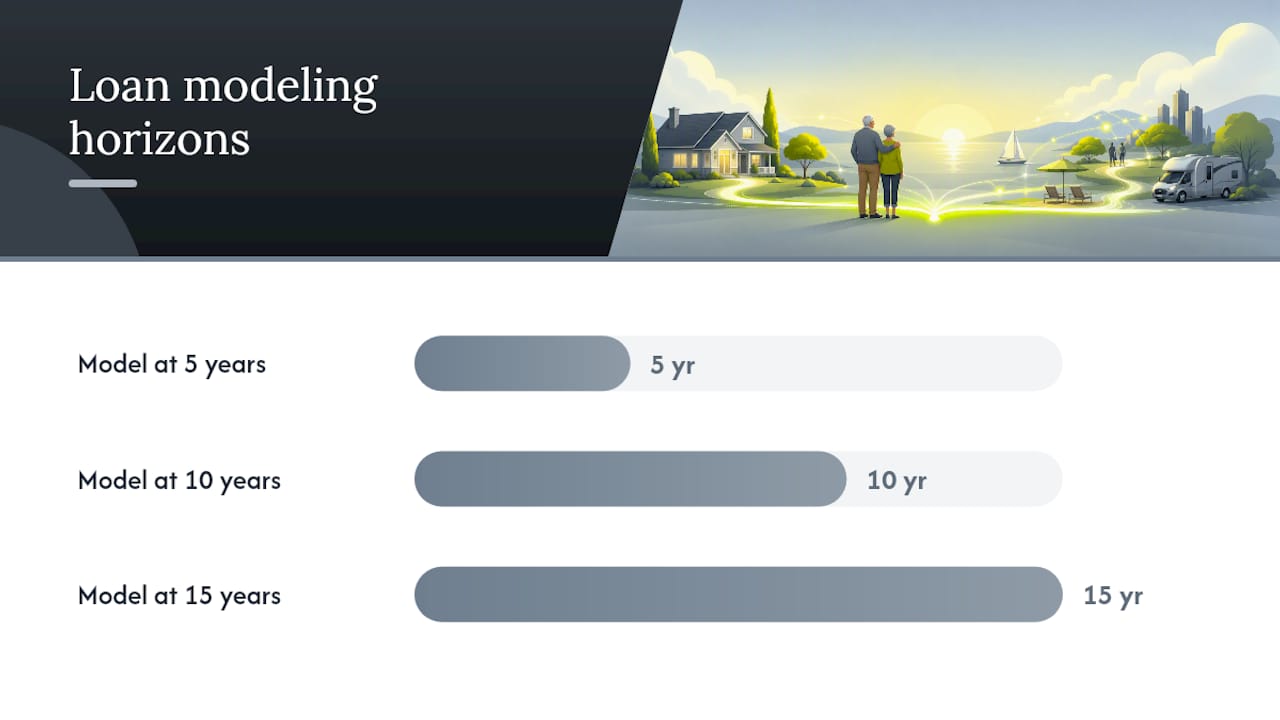
A reverse mortgage can be a sound retirement tool for house-rich, cash-poor homeowners 62 or older who plan to stay in their home long-term and can reliably cover ongoing property charges. Here is how to move forward safely.
Prioritized action plan:
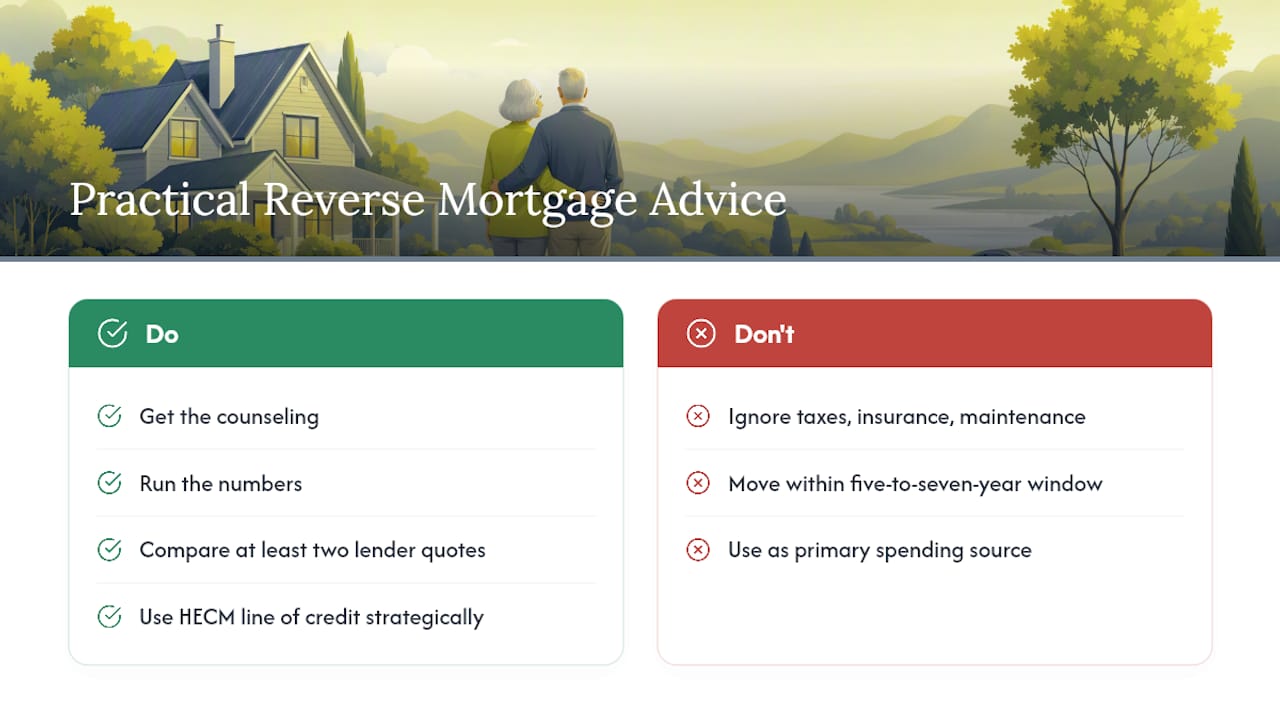
- Schedule HUD-approved counseling first. Find a counselor through the HUD website before contacting any lender. Counseling is free or low-cost and is your most important consumer protection.
- Run your numbers. Model your loan balance at 5, 10, and 15 years using the lender’s amortization schedule. Confirm the break-even point against your expected stay in the home.
- Verify your ability to cover property charges. Review your budget for property taxes, homeowners insurance, HOA fees, and maintenance. If these are already a stretch, a reverse mortgage may increase your foreclosure risk rather than reduce it.
- Get written quotes from at least two HUD-approved lenders. Compare origination fees, interest rates, MIP, and TALC disclosures. Rates and fees vary meaningfully.
- Consult a Medicaid or estate-planning professional if needed. If you receive means-tested benefits or have specific estate goals, get professional advice before closing.
Resources to consult:
- HUD HECM program information for official program rules and counselor locator.
- CFPB reverse mortgage guide for plain-language explanations and sample scenarios.
- GAO report on reverse mortgage risks for default statistics and policy context.
- NCOA aging-in-place guide for broader context on home equity and retirement.
- David Mordue - Forward Financial Group for personalized consultation and lender comparison support.
A Practical Perspective on Reverse Mortgages
The most important thing I see older homeowners overlook is not the loan balance or the fees. It is the operational obligations. A reverse mortgage does not end your financial responsibilities as a homeowner. It defers one of them, the monthly mortgage payment, while leaving all the others in place. Property taxes, insurance, and maintenance do not go away, and the GAO data shows clearly that these are where the real default risk lives.
The second thing worth saying plainly: the five-to-seven-year break-even threshold is not a guideline to dismiss. Upfront costs on a HECM are real and substantial. If there is any meaningful chance you will need to move within that window, for health reasons, family circumstances, or a change in your living situation, the math rarely works in your favor.
That said, for the right borrower in the right situation, a HECM line of credit used as a retirement liquidity buffer is genuinely one of the more elegant tools available. It grows when you do not use it, it protects you from having to sell investments at a loss in a down market, and it does not require monthly payments. Used strategically rather than as a primary spending source, it can extend the life of a retirement portfolio meaningfully.
The decision deserves careful analysis, not a quick yes or no. Get the counseling, run the numbers, and compare at least two lender quotes before you commit to anything.
How David Mordue - Forward Financial Group Can Help You Evaluate Your Options
Sorting through reverse mortgage options alongside refinancing, downsizing, and other alternatives takes more than a checklist. It takes someone who can model the numbers for your specific situation and give you an honest comparison.
David Mordue - Forward Financial Group works with older homeowners to evaluate whether a reverse mortgage, a conventional refinance, or another solution best fits their retirement goals. The process starts with a free personalized consultation, and the fully online application can move from inquiry to funding in under 21 days when you are ready to proceed. Use the refinance calculator to model a conventional refinance scenario, or contact David Mordue directly to discuss your situation and get a side-by-side comparison of your options. There is no obligation, and the goal is always to find the solution that genuinely serves your long-term financial security.
Sources
The following government, nonprofit, and research sources informed this guide and are worth consulting directly for official rules, statistics, and deeper analysis.
- Reverse Mortgages Present Benefits and Risks for Senior Homeowners | U.S. GAO
- Reverse Mortgages Explained (CFPB)
- Reverse Mortgages | Consumer Advice
- Reverse Mortgage: Yes or No? – Center for Retirement Research
This article is general information, not a substitute for advice from a qualified financial advisor. Consult a qualified financial professional about your own circumstances before acting on anything here.