
The Department of Housing and Urban Development set the 2026 Home Equity Conversion Mortgage maximum claim amount at $1,249,125, a ceiling that applies to loans with case numbers assigned on or after January 1, 2026. That number caps how much value HUD will count toward your loan, but it is not what lands in your pocket. Your actual proceeds depend on your age, the expected interest rate, your home’s appraised value, and the deductions taken at closing. Homes appraised well above that ceiling may qualify for a proprietary jumbo reverse mortgage instead.
TL;DR:
- The principal limit varies by age and interest rates, with older borrowers receiving a higher percentage of the lesser of appraised value or MCA, potentially up to about 62% at age 80.
- Deductions such as existing lien payoffs, insurance premiums, and closing costs significantly reduce net cash from the gross principal limit.
- Homes valued above the federal cap may qualify for proprietary jumbo reverse mortgages, which lack FHA insurance but can offer higher maximum amounts.
- Borrowers must meet age, residence, equity, and counseling requirements, and are responsible for ongoing property taxes, insurance, and home maintenance to avoid default.
Table of Contents
- What Is the HECM Maximum Claim Amount, and What Changed for 2026?
- How Is Your Personal Principal Limit Calculated?
- What Reduces Your Gross Principal Limit to Actual Cash?
- When Do Proprietary Jumbo Reverse Mortgages Make Sense?
- What Are Your Options for Receiving Reverse Mortgage Funds?
- Who Qualifies for a HECM, and What Ongoing Obligations Apply?
- What Do Realistic Reverse Mortgage Numbers Look Like?
- How We Help Seniors Make Sense of Reverse Mortgage Numbers
- Get a Personalized Reverse Mortgage Estimate
- Where to Verify These Reverse Mortgage Rules Yourself
- Sources
What Is the HECM Maximum Claim Amount, and What Changed for 2026?
The maximum claim amount, or MCA, is the dollar figure HUD uses as the outer boundary for every Home Equity Conversion Mortgage calculation nationwide. It works the same way in Cleveland as it does in Malibu, because HUD sets one national ceiling rather than adjusting it county by county the way it does with forward FHA loans.
HUD Mortgagee Letter 2025-22 fixed the 2026 MCA at $1,249,125, up from the prior year’s figure. That number is not arbitrary.
A few things to keep straight about the MCA:
- It’s a calculation ceiling, not a promised payout. HUD uses the lesser of your appraised value or the MCA in every principal limit formula.
- It applies to all HECM case numbers assigned on or after January 1, 2026, including special exception areas like Alaska, Hawaii, Guam, and the U.S. Virgin Islands.
- It resets annually based on conforming loan limit changes, so the figure you see this year won’t necessarily hold next year.
How Is Your Personal Principal Limit Calculated?
Your principal limit, the gross amount you can access before fees and payoffs, comes from a formula HUD has used for decades: multiply the lesser of your appraised value or the MCA by your Principal Limit Factor, or PLF. The HUD HECM program overview lays out the mechanics, and two inputs drive that factor more than anything else: the age of the youngest borrower on title and the expected interest rate at closing.
Older borrowers get a higher PLF because HUD expects the loan to accrue interest over a shorter timeframe. Rate movements cut the other way. Illustrative industry figures put PLFs at roughly 38% to 44% of the MCA around age 62, climbing to 56% to 62% around age 80, depending on where rates sit at the time.
Pro Tip: A one-point jump in expected interest rates can shave a few percentage points off your PLF, which on a $1 million home value can mean tens of thousands of dollars less in gross principal limit. Lock in a rate quote before you get attached to a number someone quoted you months ago.
- Gross principal limit = (lesser of appraised value or MCA) × PLF
- Younger borrowers (62 to 65) typically see the lowest PLFs in the range
- Borrowers in their late 70s and 80s see meaningfully higher factors
- HUD publishes official PLF tables that lenders use to run exact figures for your file
What Reduces Your Gross Principal Limit to Actual Cash?
The gross principal limit is the starting point, not the finish line. HUD and consumer resources outline a fairly predictable order of deductions before you see a dollar, and the CFPB’s reverse mortgage discussion guide walks through each one.
- Payoff of existing liens. Any current mortgage balance gets paid off first, straight out of your principal limit.
- FHA upfront mortgage insurance premium. This gets deducted before any cash disbursement.
- Origination fee. Capped by HUD regulation, but still comes off the top.
- Third-party closing costs. Appraisal, title work, recording fees, and similar charges.
- Life Expectancy Set-Aside (LESA), if required. Triggered by a financial assessment when HUD determines you need funds reserved for property taxes and insurance.
Budget conservatively. Net proceeds routinely land well below the headline appraisal number once these deductions run their course.
When Do Proprietary Jumbo Reverse Mortgages Make Sense?
If your home is appraised well above $1,249,125, a federally insured HECM caps your calculation at that ceiling regardless of what your home is actually worth. That’s where proprietary, or jumbo, reverse mortgages come in. These are private loan products, not FHA-insured, and industry coverage notes some programs advertise maximums approaching $4 million for qualifying high-value homes.
The trade-off matters:
- HECMs carry FHA mortgage insurance and non-recourse protection, meaning you or your heirs never owe more than the home’s value at repayment.
- Proprietary products set their own terms, and protections, fees, and eligibility rules vary by lender since there’s no uniform federal insurance backing them.
- Compare terms line by line rather than assuming a jumbo product simply mirrors HECM rules at a bigger scale. Our jumbo loan resources explain how private high-balance lending typically works, and a partner overview on jumbo loan products offers additional context on how these loans are structured.
What Are Your Options for Receiving Reverse Mortgage Funds?
HUD allows several payout structures, and choosing the right one shapes your retirement cash flow for years.
- Lump sum. Available up to the 60% first-year cap on fixed-rate HECMs, useful for paying off an existing mortgage or funding a major expense.
- Line of credit. The most popular choice for many borrowers because the unused portion grows over time at the loan’s effective rate, meaning your available credit can increase even if your home’s value doesn’t.
- Tenure payments. Fixed monthly payments for as long as you live in the home, functioning like a pension supplement.
- Modified tenure. A blend of a smaller line of credit paired with fixed monthly payments.
The line of credit’s growth feature surprises a lot of homeowners. It isn’t earning interest like a savings account. It’s simply that your borrowing capacity expands because you’re accessing less of your principal limit today, leaving more room to grow against later.
Who Qualifies for a HECM, and What Ongoing Obligations Apply?
Eligibility rules are straightforward, but they come with commitments that last for the life of the loan.
- At least one borrower must be age 62 or older.
- The home must be your principal residence, not a vacation property or rental.
- You need substantial equity, typically meaning you own the home outright or carry a low remaining balance.
- Completing HUD-approved counseling is mandatory before you can apply, a safeguard the CFPB points to repeatedly in its consumer guidance.
Once closed, you’re responsible for keeping property taxes, homeowners insurance, and any HOA dues current, plus maintaining the home in reasonable condition. Fall behind on these obligations, and you risk default, which the FTC’s consumer guidance flags as one of the more overlooked risks of reverse mortgages. You do retain a right of rescission for a short window after closing, giving you a chance to reconsider before the loan becomes final.
What Do Realistic Reverse Mortgage Numbers Look Like?
Numbers get concrete fast once you plug in actual ages and home values. These scenarios are illustrative, built on typical assumptions, not a quote for any specific homeowner.
After payoff of a modest existing mortgage, upfront MIP, origination fee, and closing costs, net proceeds might fall in the $350,000 to $400,000 range.
Scenario 2: Age 72, home valued around $800,000. A middle-range PLF for this age results in a gross principal limit that’s typically just under half the home value. After required deductions, net cash available is significantly less.
Scenario 3: Age 80, home valued about $1.1 million. Higher PLFs for older borrowers mean the gross principal limit might be over half the home’s value. After standard payoffs and fees, net proceeds are appreciably reduced.
- Assumptions used: current expected interest rates, standard closing costs, and typical LESA scenarios where financial assessment flags a need
- Every homeowner’s numbers shift based on actual appraisal, existing liens, and rate at closing
Treat these as planning benchmarks, not promises. A personalized calculation accounts for your specific mortgage balance, credit profile, and property.
How We Help Seniors Make Sense of Reverse Mortgage Numbers
When you come to us with a home value and an age, we run the actual PLF math instead of quoting a headline figure that doesn’t apply to your file. We estimate likely set-asides, walk through lump sum versus line of credit trade-offs, and compare HECM proceeds against proprietary jumbo options when your home value calls for it.
— David Mordue
Get a Personalized Reverse Mortgage Estimate
Generic PLF tables tell you what’s possible in theory. What you actually qualify for depends on your specific appraisal, your existing mortgage balance, and current rates, and that’s where a personalized run beats a rule of thumb. David Mordue - Forward Financial Group builds you a real principal limit estimate using your numbers, not a national average, then compares that against a proprietary jumbo option if your home value sits above the federal cap.

Our process starts with a conversation about your goals, whether that’s supplementing retirement income, paying off an existing mortgage, or setting up a growing line of credit for future needs. From there, we compare HECM and proprietary offers across multiple lenders, since we work as your broker rather than a single lender pushing one product. Most clients move from initial estimate to funded loan in a matter of weeks, not months. Ready to see your actual numbers? Visit our mortgage rates and consultation page to get started, or run your numbers first through our refinance calculator if you’re still weighing a reverse mortgage against other options.
Where to Verify These Reverse Mortgage Rules Yourself
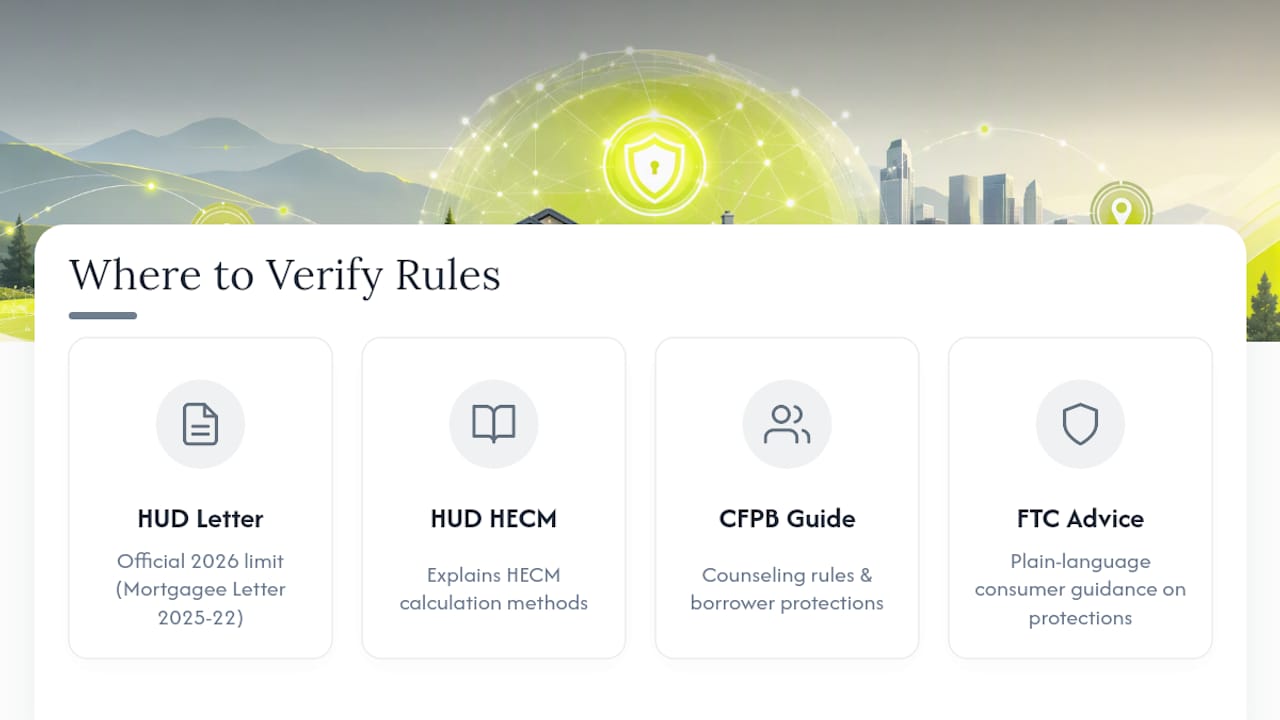
For the official 2026 limit, read HUD Mortgagee Letter 2025-22 directly. The HUD HECM program overview confirms calculation methods, while the CFPB’s reverse mortgage guide and FTC consumer advice cover counseling requirements and borrower protections in plain language.
This article is general information, not a substitute for advice from a qualified financial advisor. Consult a qualified financial professional about your own circumstances before acting on anything here.
Sources
- 2026 Home Equity Conversion Mortgage (HECM) Limits — HUD Mortgagee Letter (via NCLC)
- Consumer Financial Protection Bureau — Reverse mortgages
- Federal Trade Commission — Reverse mortgages consumer advice