
A HECM reverse mortgage line of credit gives homeowners 62 or older a tax-free, on-demand credit line secured by their home equity. Interest accrues only on the funds you actually withdraw, and the unused portion of the line grows over time at a guaranteed rate. The U.S. Department of Housing and Urban Development (HUD) backs this program through the Federal Housing Administration (FHA), with a lending limit capped at the FHA maximum as of 2026. If you want to know whether this tool fits your retirement plan, the fastest next step is scheduling a HUD-approved counseling session or requesting a broker consultation through David Mordue - Forward Financial Group.
Pro Tip: A HECM LOC is not a last resort. Many financial planners now treat it as a proactive retirement reserve, opened early so the unused line has years to compound.
Table of Contents
- How a HECM line of credit actually works
- Who qualifies and what the HUD counseling requirement means
- How much you can borrow and how the principal limit is calculated
- Costs, fees, and financial risks to understand first
- Pros and cons, and when alternatives make more sense
- How to apply and what to expect from start to funding
- Key Takeaways
- A broker’s perspective on timing and strategy
- How David Mordue - Forward Financial Group can help you move forward
- Authoritative resources and next reads
How a HECM line of credit actually works
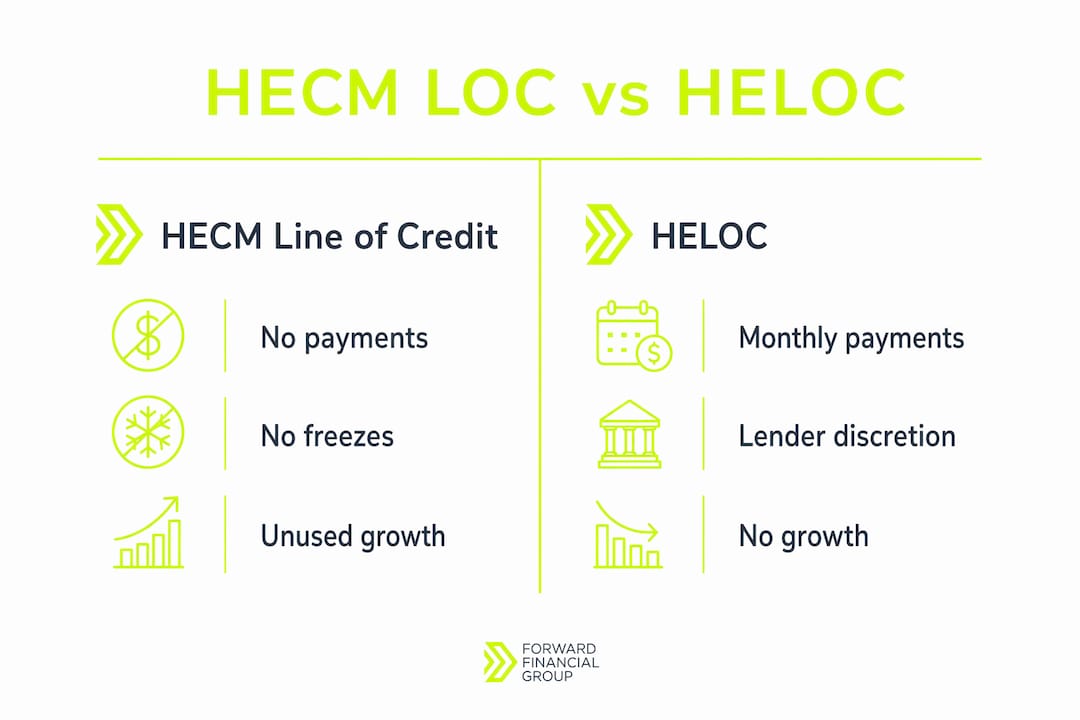
The HECM LOC behaves like a revolving credit line, but with one structural advantage no standard HELOC offers: no monthly mortgage payment is required while you live in the home as your primary residence and keep property charges current. You draw what you need, when you need it, and interest accrues only on withdrawn funds, not on the untouched balance.

The unused portion of your credit line grows at a guaranteed rate equal to the note interest rate plus 0.5% annual mortgage insurance premium (MIP), compounded monthly. That growth is not tied to your home’s market value. It is a contractual feature backed by FHA insurance, which means a lender cannot freeze or reduce your available credit because property values drop, the way a bank can with a HELOC.
This structural difference matters for retirement planning. A HELOC is subject to lender discretion; a HECM LOC is not. The FHA guarantee protects your available credit for the life of the loan, provided you meet your loan obligations.
Pro Tip: Open the line of credit before you need it. The longer the unused balance sits, the more it compounds. Many reverse mortgage advisers recommend establishing a HECM LOC early in retirement so the reserve becomes meaningfully larger by the time you draw from it.
| Feature | HECM Line of Credit | HELOC |
|---|---|---|
| Monthly payment required | No | Yes |
| Lender can freeze/reduce line | No (FHA-guaranteed) | Yes |
| Unused credit grows over time | Yes | No |
| Available for life of loan | Yes | Draw period only (typically 5 years) |
| Tied to home value changes | No | Yes |
Who qualifies and what the HUD counseling requirement means
Eligibility for a HECM in 2026 requires meeting all of the following:
- Age 62 or older (youngest borrower on the loan)
- Own the home outright or have substantial equity
- Occupy the home as your primary residence
- Complete a mandatory session with a HUD-approved counselor
- Satisfy any outstanding federal debt at or before closing
- Pass a financial assessment confirming you can cover ongoing property charges
The counseling session is not a formality. CFPB guidance makes clear that many loan defaults stem from borrowers misunderstanding their property-charge obligations, specifically property taxes, homeowner’s insurance, and HOA fees, not from confusion about repayment mechanics. The counselor will walk you through costs, alternatives, and the foreclosure risk that comes with missed property charges.
To find a HUD-approved counselor, visit the HUD counselor locator at HUD.gov. The National Council on Aging (NCOA) also provides guidance on evaluating reverse mortgages as part of a broader financial plan, not as a standalone fix.
Pro Tip: There is no minimum credit score for a HECM. The lender reviews your history of paying property taxes and insurance, not a credit number. If the assessment raises concerns, the lender may set aside part of your loan proceeds in a Life Expectancy Set-Aside (LESA) to cover those charges automatically.
How much you can borrow and how the principal limit is calculated
Your available credit line is determined by three inputs: the age of the youngest borrower (or eligible non-borrowing spouse), the current interest rate, and the lesser of your home’s appraised value or the FHA HECM lending limit of $1,249,125. Older borrowers and lower interest rates generally produce a higher principal limit.
Most borrowers qualify for a significant portion of their home’s value, varying with age and interest rates.
Sample calculation:
- Inputs: borrower age 70, appraised home value $600,000, current expected interest rate 6.5%
- Lesser of appraised value or FHA cap: $600,000 (below the $1,249,125 cap)
- Principal limit factor (age 70, 6.5% rate): approximately 43% (illustrative; actual factors come from HUD’s published tables)
- Initial principal limit: $600,000 × 0.43 = $258,000
- After mandatory first-year set-asides and fees, the available LOC at closing is typically somewhat lower than the gross principal limit
| Input | What it does |
|---|---|
| Youngest borrower’s age | Higher age = higher principal limit |
| Expected interest rate | Lower rate = higher principal limit |
| Appraised value (or FHA cap) | Sets the base; capped at $1,249,125 |
| Eligible non-borrowing spouse | Listed at origination; protects occupancy rights |
The “youngest borrower” rule carries a critical implication for married couples. If a younger spouse is not correctly listed as an eligible non-borrowing spouse at origination, they may lose the right to remain in the home after the borrowing spouse passes away or moves to a care facility.
Costs, fees, and financial risks to understand first
HECM LOCs carry real costs. Understanding them upfront prevents surprises later.
Typical fees:
- Origination fee: Capped by FHA; generally the greater of $2,500 or 2% of the first $200,000 of home value, plus 1% above that, up to a maximum of $6,000
- Initial MIP: 2% of the appraised value (or FHA lending limit, whichever is less), paid at closing
- Ongoing MIP: 0.5% of the outstanding loan balance annually
- Servicing fee: Set at origination; varies by lender
- Appraisal and closing costs: Comparable to a traditional mortgage
The loan balance grows over time because interest and MIP accrue on whatever you have withdrawn. That reduces the equity available to your heirs. The loan becomes due and payable when you sell, permanently move out, or pass away. Heirs can repay the balance and keep the home, sell the home and use proceeds to settle the loan, or walk away (the FHA non-recourse guarantee means they will never owe more than the home’s value at sale).
The most common default trigger is not repayment. Consumer protection guidance from the FTC and CFPB consistently points to unpaid property taxes, lapsed homeowner’s insurance, or failure to maintain the property as the reasons HECM loans go into default. Missing those obligations can trigger a due-and-payable notice regardless of how much credit remains in your line.
Pro Tip: If cash flow is tight, ask your lender about a LESA at origination. It reduces your available line but removes the risk of a property-charge default.
Pros and cons, and when alternatives make more sense
When a HECM LOC usually makes sense:
- You plan to stay in the home long-term and want a guaranteed liquidity reserve
- You want to avoid taxable investment withdrawals during market downturns (HECM proceeds are not considered taxable income and generally do not affect Social Security or Medicare benefits)
- You want protection against a lender cutting your available credit if home values fall
When it typically does not:
- You need short-term borrowing and can qualify for a HELOC with manageable payments
- Your equity is limited and fees would consume a large share of available proceeds
- Preserving maximum home equity for heirs is a primary goal
| HECM LOC | HELOC | Cash-out refinance | Downsizing | |
|---|---|---|---|---|
| Monthly payment required | No | Yes | Yes | N/A |
| Credit line guaranteed | Yes (FHA) | No | No | N/A |
| Affects Medicaid eligibility | Potentially if funds held in checking | Yes | Yes | Yes |
| Reduces home equity | Yes (gradually) | Yes | Yes (immediately) | Converts equity to cash |
The NCOA recommends treating a reverse mortgage as part of a comprehensive financial plan, not a crisis response. Use the HELOC payment calculator at Live Large to compare monthly payment obligations before deciding between a HECM LOC and a traditional HELOC.
Three decision questions:
- Can you reliably cover property taxes, insurance, and maintenance for the foreseeable future?
- Do you need guaranteed access to credit that cannot be frozen by a lender?
- Is your time horizon long enough for the unused line to grow meaningfully?
If you answered yes to all three, a HECM LOC deserves serious consideration.
How to apply and what to expect from start to funding
The process is more structured than a standard mortgage but straightforward when you know the steps.
- Complete HUD-approved counseling (required before any application): schedule through HUD.gov or NCOA; sessions typically last 60–90 minutes by phone or in person.
- Choose a HECM-approved lender and submit your application with supporting documents.
- Home appraisal: An FHA-approved appraiser determines the value used to calculate your principal limit.
- Underwriting: The lender reviews your financial assessment, title, and counseling certificate.
- Closing: You sign loan documents; a three-business-day right of rescission applies for refinances.
- Funding and line access: After rescission, your LOC is open. Draw funds by submitting a signed request to your loan servicer; disbursement is typically by check or direct deposit.
Documents to prepare:
- Government-issued photo ID and proof of age
- Proof of homeownership or current mortgage payoff statement
- Two years of property tax and homeowner’s insurance records
- Recent income documentation (Social Security award letter, pension statements)
- Any federal debt resolution documentation
Pro Tip: Working with a broker who knows HECM timelines can shorten the process. David Mordue - Forward Financial Group’s fully online application process targets funding in under 21 days, which matters when you are coordinating a HECM with other financial moves.
Key Takeaways
A HECM reverse mortgage line of credit is most valuable as a long-term retirement reserve opened early, funded by home equity, and protected by an FHA guarantee that no HELOC can match.
| Point | Details |
|---|---|
| Who it fits | Homeowners 62+, strong equity, long-term residence plans, and reliable property-charge capacity. |
| Growth feature | Unused credit grows at the note rate plus 0.5% MIP, compounded monthly, guaranteed by FHA. |
| Mandatory counseling | HUD-approved counseling is required before applying; it covers costs, risks, and property-charge obligations. |
| Alternatives to compare | HELOC, cash-out refinance, and downsizing each suit different timelines and payment-capacity profiles. |
| David Mordue - Forward Financial Group | Offers personalized HECM consultations and a fast online application process to help you compare options and move forward confidently. |
A broker’s perspective on timing and strategy
The most common mistake I see with HECM LOCs is waiting too long to open one. Homeowners often treat the line as a last resort, something to activate when savings run low. That approach costs real money, because the unused line’s growth compounds from the day it opens. A borrower who opens a HECM LOC at 65 and draws nothing for five years arrives at 70 with a meaningfully larger reserve than if they had waited until 70 to apply.
My recommendation: open the line while you still have other income sources, document your ability to cover property charges thoroughly at origination, and coordinate the timing with your estate plan. If you are married and your spouse is younger, make sure they are listed as an eligible non-borrowing spouse at closing. That single step protects their right to remain in the home and preserves the line for as long as they live there.
For homeowners with high-value properties, also consider whether the $1,249,125 FHA cap limits your available proceeds enough to make a proprietary reverse mortgage worth exploring alongside the HECM option.
How David Mordue - Forward Financial Group can help you move forward
Sorting through HECM rules, FHA limits, and alternative strategies on your own takes time. David Mordue - Forward Financial Group cuts through that complexity with personalized consultations, side-by-side comparisons of HECM LOC versus refinance options, and a fully online application process that can reach funding in under 21 days.

Start with the refinance calculator to see how a cash-out refinance stacks up against a HECM LOC for your specific numbers. If downsizing is on the table, the rent vs. buy calculator helps you weigh that decision with real figures. When you are ready to talk through your situation with a broker, visit davidmordue.com to request a consultation or start a pre-approval. David Mordue - Forward Financial Group works with HUD-compliant processes and can help you coordinate counseling, appraisal, and closing on a timeline that fits your retirement plan.
This article is general information, not professional financial or legal advice. Confirm current HECM rules, lending limits, and eligibility requirements with HUD or a qualified mortgage professional for your specific situation.
Authoritative resources and next reads
- HUD HECM program page: The primary source for eligibility rules, lending limits, and approved lender lists. Start here for official program details.
- HUD counselor locator (HUD.gov): Find a HUD-approved counselor near you. Required before any HECM application.
- CFPB reverse mortgage guidance: Plain-language explanation of who qualifies and what counseling covers. Best for understanding consumer protections.
- NCOA reverse mortgage resource: Expert perspective on using reverse mortgages within a financial plan and when alternatives are worth exploring first.
- FTC consumer guidance on reverse mortgages: Covers cost comparisons and red flags. Read before signing anything.
- ExitVest foreclosure resource: Practical guidance on property-charge default risks and options for staying in your home.
- David Mordue - Forward Financial Group tools: Refinance calculator, rent vs. buy calculator, and pre-approval application for homeowners comparing HECM LOC with other equity strategies.