
No, you are not personally responsible for a reverse mortgage balance beyond what the home is worth. Federal law makes reverse mortgages “non-recourse” debt, meaning the lender can only collect from the property itself, never from your other savings, income, or assets. That single fact should ease the panic most heirs feel when a servicer’s letter shows up in the mail.
You have three paths forward once you understand this responsibility of heirs: sell the home and keep any leftover equity, repay or refinance the loan to keep the property, or walk away and let the lender take it through a deed-in-lieu or foreclosure. Each option carries its own timeline and paperwork.
Your first moves matter more than which option you eventually choose:
- Contact the loan servicer immediately, even before you have a full plan.
- Request a current payoff statement and order an independent appraisal.
- Keep property taxes and homeowners insurance current while you decide.
Key Takeaways
Heirs are never personally liable for a reverse mortgage balance beyond the home’s value, and acting within the first 30 days of the due-and-payable notice preserves every option on the table.
| Point | Details |
|---|---|
| Non-recourse protection is real | You never owe more than the home’s value; FHA insurance covers any shortfall. |
| Three paths, one decision | Sell, keep by paying or refinancing, or walk away through deed-in-lieu. |
| Speed determines outcomes | Order a payoff statement and appraisal within the first weeks, not months. |
| The 95% rule caps your exposure | HUD limits payoff to 95% of appraised value when the loan exceeds home worth. |
| Refinancing requires your own qualification | David Mordue - Forward Financial Group helps heirs compare refinance options and check affordability before committing to keep the home. |
Table of Contents
- The Three Choices Heirs Actually Have
- What To Do First: Your 30 to 90 Day Checklist
- Refinancing Or Paying Off: How Heirs Keep The Home
- Selling The Home: Payoff, The 95% Rule, And Your Alternatives
- Protections And Pitfalls Every Heir Should Know
- When To Call A Counselor, Attorney, Or Broker
- How A Reverse Mortgage Affects The Estate’s Value
- Tax Implications After A Reverse Mortgage Payoff
- Common Disputes Heirs Run Into
- Authoritative Resources For Heirs
- What Heirs Should Actually Prioritize First
- Refinance Or Sell: Get A Clear Answer On Your Timeline
- Frequently Asked Questions
- Sources
The Three Choices Heirs Actually Have
Every reverse mortgage heirs responsibility situation boils down to one of three roads, and understanding the mechanics of each keeps you from making a rushed decision under pressure.
-
Sell the home. This is the most common path. You list the property, and at closing, the sale proceeds pay off the reverse mortgage balance first. Whatever remains after the loan, closing costs, and any liens goes to you or the estate. If the home has appreciated since your parent took out the loan, this can mean a meaningful inheritance. If it has not, you are protected: you never owe more than the sale generates.
-
Keep the home by paying it off or refinancing. If the property has sentimental value or you simply want to hold onto it, you can satisfy the loan in full using estate cash, personal savings, or new financing. Most heirs go the refinancing route, since a HECM payoff is often a six-figure sum most families do not have sitting in a checking account. Refinancing requires you to qualify on your own income and credit, the same as any other mortgage applicant, which trips up heirs who assume the loan simply transfers to them.
-
Walk away. When the home is worth less than the loan balance and you have no interest in keeping it, a deed-in-lieu of foreclosure lets you hand the property back to the lender without going through a drawn-out court process. This is a legitimate, sometimes smarter choice, not a failure. It closes the estate’s obligation cleanly and avoids the cost and time of foreclosure, though it does mean forfeiting the home entirely.
None of these choices requires you to write a personal check beyond the home’s value. That is the entire point of non-recourse protection built into every FHA-insured HECM.
What To Do First: Your 30 to 90 Day Checklist
The clock starts the moment the servicer learns of the borrower’s death, and how you respond in the first month shapes everything that follows.
Once the loan becomes “due and payable,” the servicer typically sends a formal notice, and you generally need to respond promptly with your intended plan. That does not mean you need to close a sale or finalize a refinance in 30 days. It means you need to communicate your intent and start acting on it.
Here is the practical order of operations:
- Notify the servicer of the borrower’s death and identify yourself as heir or executor.
- Request a written payoff statement showing the exact balance owed.
- Order a professional appraisal to establish current market value.
- Ask about an extension in writing if you need more time to sell or arrange financing.
Heirs typically get up to six months total to settle the loan, and servicers often grant extensions in three-month increments when you can show active progress, like a signed listing agreement or a refinance application in process.
Pro Tip: Order the appraisal before you decide anything. Heirs who wait to see “what the market feels like” often lose weeks they cannot get back, and that delay is the single biggest cause of avoidable foreclosure filings on reverse mortgage estates.
Refinancing Or Paying Off: How Heirs Keep The Home
Keeping the house sounds simple until you realize the loan does not just transfer into your name. You have to qualify for new financing on your own merits, and lenders will look at your income, credit score, and debt-to-income ratio exactly as they would for any first-time buyer.
Your realistic paths to retaining the property include:
- Cash payoff using estate funds, life insurance proceeds, or personal savings, if the balance is manageable.
- Traditional refinance into a conventional or FHA-insured fixed-rate loan once you qualify.
- HUD’s 95% rule, which caps what you owe at 95% of the home’s appraised value when the loan balance has grown larger than the home is worth.
That last point deserves emphasis. If your parent’s HECM balance ballooned past the home’s current value, you are not on the hook for the full amount. FHA mortgage insurance, which every HECM borrower pays into over the life of the loan, absorbs the difference so the lender collects no more than that 95% ceiling.
Before applying anywhere, run the numbers through a refinance calculator to see whether the new monthly payment fits your budget, since moving from an interest-accruing reverse mortgage into a fully amortizing loan changes the math considerably. Working with a mortgage broker rather than a single bank speeds this process up, because a broker can shop your file across multiple lenders at once instead of waiting on one underwriter’s timeline. That matters when you are racing a servicer’s deadline. If the numbers do not work at a fixed rate, ask about adjustable-rate options that lower the initial payment while you stabilize the estate’s finances.

Selling The Home: Payoff, The 95% Rule, And Your Alternatives
Selling remains the cleanest exit for most heirs, and the mechanics work almost exactly like selling any other home, with one extra step at closing.
When the sale closes, the title company pays the reverse mortgage balance directly from the proceeds before anything else gets distributed. Whatever is left after that payoff, plus any closing costs and outstanding taxes, comes to you or the estate. If your parent had substantial home equity, this can mean tens of thousands of dollars landing in the estate.
The 95% rule protects you when the math runs the other way. HUD caps the amount owed at 95% of the appraised value whenever the loan balance exceeds what the home is actually worth, and FHA mortgage insurance covers the rest directly to the lender. You never make up that gap out of pocket.
If a traditional listing feels like too much work, or the home needs repairs you cannot afford before selling, you have other exits:
- Short sale, where the lender agrees to accept less than the full balance if the home sells for less than owed.
- Deed-in-lieu of foreclosure, handing the keys back without a sale at all.
- Letting the lender foreclose, the slowest and least favorable option, though it still carries no personal liability beyond the property.
Comparing inherited-home selling paths side by side helps many heirs realize a quick cash sale, even below full market value, sometimes nets more than a drawn-out listing once carrying costs and repair bills are factored in.
Protections And Pitfalls Every Heir Should Know
Non-recourse protection is powerful, but it is not unlimited, and misunderstanding its edges causes real problems.
What it does: it guarantees the lender cannot pursue your personal bank account, wages, or other property to cover a shortfall. What it does not do: it does not stop the servicer from starting foreclosure if you simply ignore notices, and it does not cover unpaid property taxes or lapsed insurance, which remain your responsibility to maintain while you decide on a path forward.
Eligible non-borrowing spouses occupy a special category. If your stepparent or the deceased’s spouse was named on the loan documents as an eligible non-borrowing spouse, they may be able to remain in the home indefinitely under HUD rules, separate from the heir process entirely. These cases are fact-specific and often require a HUD-approved counselor or attorney to confirm eligibility.
The most common mistakes heirs make:
- Ignoring the due-and-payable notice, assuming it will resolve itself.
- Letting homeowners insurance lapse, which can trigger a servicer-placed policy at a much higher cost.
- Waiting months to start the appraisal or payoff request, burning through the response window.
Pro Tip: If you inherited the home alongside siblings or other heirs, get everyone’s decision in writing early. Servicers need a single point of contact, and disagreement among heirs is one of the fastest ways a manageable timeline turns into a foreclosure filing.
When To Call A Counselor, Attorney, Or Broker
Not every step in this process requires a lawyer, but knowing who handles what saves you time and money.
- HUD-approved housing counselor: best for understanding your options at no cost, especially with eligible non-borrowing spouse questions or general confusion about the process.
- Estate or probate attorney: needed when multiple heirs disagree, when the estate is going through probate, or when title issues complicate a sale.
- Mortgage broker: the fastest route if you have decided to keep the home and need to compare refinance rates across lenders quickly, rather than applying one bank at a time.
Heirs who move fastest are the ones who talk to a servicer, a counselor, and a broker in the same week rather than waiting for one conversation to lead to the next.
David Mordue - Forward Financial Group works with heirs specifically on the refinance side, helping you estimate what a new loan payment would look like and whether you qualify before you commit to keeping the property.
How A Reverse Mortgage Affects The Estate’s Value
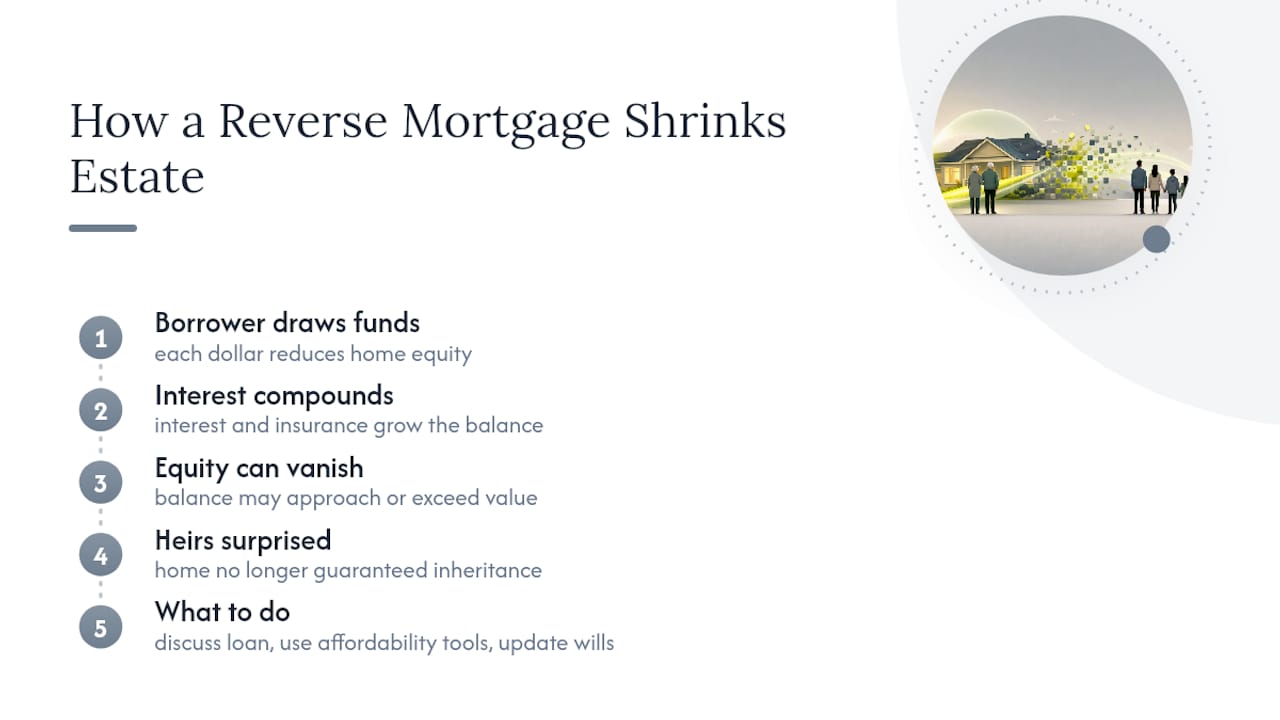
Every dollar drawn from a reverse mortgage during your parent’s lifetime is a dollar that will not pass to you as home equity. This is the trade-off inherent to the product: your parent gained income or a credit line in retirement, and the estate’s real estate value shrinks accordingly.
For inheritance planning purposes, this means the home can no longer be treated as a fixed asset in a will or trust. If your parent took a lump sum early in the loan’s life, interest and mortgage insurance premiums compound over years, sometimes decades, and the growing balance can eventually approach or exceed the home’s value. Families who assumed “the house” would be a guaranteed inheritance are often surprised to learn the equity has been substantially drawn down.
This does not mean a reverse mortgage is a poor estate planning choice for the borrower. It means heirs need realistic expectations set well before the borrower’s death, ideally through direct conversation about the loan balance, draw history, and anticipated home value. If you are still in the position of helping a parent plan ahead rather than settling an estate, that conversation, and a look at affordability tools, can prevent confusion later. Estates with a reverse mortgage in place should also be reviewed by whoever handles will or trust updates, since the eventual payoff obligation changes what other heirs might expect to receive.
Tax Implications After A Reverse Mortgage Payoff
Paying off a reverse mortgage, whether through sale or refinance, does not typically create taxable income for you as the heir. The loan proceeds your parent received during their lifetime were not taxable income to them either, since they represented borrowed funds against home equity rather than earnings.
Where taxes can enter the picture is capital gains on the sale itself. If the home sells for more than its stepped-up basis, generally the fair market value at the date of your parent’s death, that gain could be taxable to the estate or to you as heir, depending on how the property was titled and distributed. The stepped-up basis rule often minimizes this exposure significantly compared to what your parent’s original purchase price would have generated in gains.
Mortgage insurance premiums and any interest that accrued on the reverse mortgage are generally not deductible by heirs, since you did not pay them and did not benefit from the original loan. If the estate settles the debt for less than owed under a short sale arrangement, ask a tax professional whether any forgiven-debt reporting applies, since the specifics vary based on how the estate is structured and whether it falls under insolvency exceptions. This is one area where a CPA or estate attorney earns their fee, given how much these outcomes depend on individual circumstances.
Common Disputes Heirs Run Into
Multiple heirs rarely agree instantly on what to do with an inherited home, and reverse mortgages add a ticking clock that makes disagreement more expensive than it would be otherwise.
The most frequent friction points:
- Siblings split between selling and keeping. One heir wants to preserve the family home; another wants their share of equity now. Resolving this quickly usually means the heir who wants to keep it must buy out the others, which requires financing fast enough to meet the servicer’s timeline.
- Servicer communication delays. Large servicers handle enormous volumes of due-and-payable notices, and heirs sometimes wait weeks for a callback on a payoff statement. Persistence and written requests, not just phone calls, tend to get faster results.
- Appraisal disagreements. If you believe the servicer’s appraisal undervalued the home, you can request a second appraisal, though this adds time to an already tight window.
- Confusion over who has authority to act. Without a will naming an executor, or before probate grants that authority, servicers may be unable to discuss the loan with anyone, stalling the entire process.
None of these disputes change the underlying non-recourse protection. They simply slow down how quickly you reach a resolution, which is exactly why early, documented communication with the servicer matters more than most heirs expect.
Authoritative Resources For Heirs
- CFPB: Can my heirs keep or sell my home after I die?
- CFPB factsheet: Know your rights and responsibilities (PDF)
- HUD HECM program page
- HUD-approved counselor locator
- Usa for general federal resource navigation
What Heirs Should Actually Prioritize First
Most guides on reverse mortgage heirs responsibility bury the timeline under legal definitions before ever telling you what to do Monday morning. That order is backward. The single highest-leverage action is calling the servicer before you have a plan, not after, because the extension clock and your credibility with that servicer both start ticking from first contact.
The conventional advice to “consult an attorney” undersells how much a mortgage broker can resolve in a single week when refinancing is the goal. Attorneys matter for probate disputes and eligible non-borrowing spouse questions. For the far more common scenario, an heir who simply wants to know if they can afford to keep the house, a broker comparing rates across lenders moves faster than a law office billing by the hour.
*— David Mordue
Refinance Or Sell: Get A Clear Answer On Your Timeline
Most heirs facing a reverse mortgage deadline end up choosing between a rushed cash sale to an inherited-home buyer or a full traditional listing that takes months. David Mordue - Forward Financial Group gives you a third path: a fully online refinance application that can lead to funding in less than 21 days, fast enough to meet most servicer extension windows without settling for a below-market sale price just to beat the clock.

You get a personalized consultation and rate comparison across multiple lenders in one process, rather than applying separately to each bank while your response window shrinks. If you are still deciding whether keeping the home even makes financial sense, run your numbers through the rent versus buy calculator first. When you are ready to see real numbers against your income and credit, start a refinance pre-approval with David Mordue - Forward Financial Group today.
Frequently Asked Questions
Are heirs personally responsible for a reverse mortgage after the borrower dies? No. Reverse mortgages are non-recourse loans, so heirs’ financial and legal responsibility never extends beyond the home’s value, regardless of how large the loan balance has grown.
What happens to a reverse mortgage when you die and no one wants the house? Heirs can decline to keep the property and allow the lender to take it through a deed-in-lieu of foreclosure, closing the estate’s obligation without further cost to heirs.
Can heirs sell a home with a reverse mortgage still attached? Yes. Selling a home with a reverse mortgage works like any other sale, except the loan balance is paid directly from proceeds at closing before any remaining equity reaches the heirs.
How long do heirs have to settle a reverse mortgage after death? Heirs typically get about 30 days to respond to the due-and-payable notice and up to six months total to sell, refinance, or pay off the loan, often with extensions available.
What is the 95% rule in reverse mortgage estate obligations? HUD caps what heirs owe at 95% of the home’s appraised value whenever the loan balance exceeds the home’s worth, with FHA mortgage insurance covering the difference to the lender.
This article is general information, not a substitute for advice from a qualified financial advisor. Consult a qualified financial professional about your own circumstances before acting on anything here.
Sources
- With a reverse mortgage loan, can my heirs keep or sell my home after I die? | Consumer Financial Protection Bureau
- You have a reverse mortgage: Know your rights and responsibilities | CFPB (PDF)
- HECM: Home Equity Conversion Mortgage | HUD
- What Happens When You Die with a Reverse Mortgage: Rules for Heirs and Estates - SuperMoney