
Reverse mortgage counseling is a mandatory, one-on-one session with a HUD-approved counselor that you must complete before applying for a federally insured HECM. It’s independent of any lender, and it exists to walk you through costs, obligations, and alternatives so you decide with full information, not sales pressure. The counselor issues a certificate your lender needs to process your loan. Your next step: call HUD at 1-800-569-4287 or search HUD’s counselor roster online today.
TL;DR:
- Most counseling sessions last one to two hours and cost between $125 and $200, with some agencies offering payment deferrals or sliding scales.
- Prospective borrowers should bring proof of identity, current mortgage documents, recent tax and insurance bills, loan estimates, and their financial goals to maximize session value.
- Counselors clarify the full cost structure, including fees, TALC, and ongoing obligations like taxes and insurance, helping homeowners understand long-term impacts.
- It is crucial to confirm that the counselor is HUD-approved, independent of lenders, and to avoid agencies recommended solely by lenders for unbiased advice.
- The counseling certificate, valid for 180 days, is required to proceed with a HECM application, and homeowners should compare loan estimates to find the most cost-effective option.
Table of Contents
- Why HUD Requires Reverse Mortgage Counseling
- What Happens During Your Counseling Session
- What Counseling Costs and How to Pay
- Finding a HUD-Approved Counselor You Can Trust
- Preparing for Your Session: What to Bring
- Alternatives Counselors Review and Questions Worth Asking
- After Counseling: Your Certificate and What Comes Next
- Using Counseling to Shop Smarter for Your Loan
- What Counselors Wish Every Homeowner Knew Beforehand
- How David Mordue - Forward Financial Group Fits Into Your Plan
- Where to Verify Counseling Requirements and Find a Counselor
- Sources
- FAQ
Why HUD Requires Reverse Mortgage Counseling
You can’t apply for a Home Equity Conversion Mortgage without sitting down with a counselor who has no financial stake in whether you take the loan. HUD built this requirement into the HECM program because reverse mortgages carry long-term consequences that are easy to misjudge from a sales brochure. A HUD-approved counselor explains the loan’s mechanics, then reviews whether it actually fits your situation.
The CFPB describes counseling as a genuine safeguard: it gives you unbiased information and makes clear that a reverse mortgage is still a loan with real ongoing obligations, not free money against your house.
Three agencies anchor the system:
- HUD sets the counseling rules, approves counselors, and runs a hotline at 1-800-569-4287.
- The Consumer Financial Protection Bureau publishes discussion guides and consumer tools to help you evaluate the loan.
- The National Council on Aging (NCOA) connects older homeowners with vetted counseling resources and financial guidance beyond the loan itself.
What Happens During Your Counseling Session
Sessions run one to two hours and follow a structured protocol, whether you meet by phone, video, or in person. Expect the counselor to cover:
- How the loan works — payment plan options (lump sum, line of credit, monthly payments, or a combination), and how your available equity converts into cash.
- The full cost picture — origination fees, mortgage insurance premiums, servicing costs, and the Total Annual Loan Cost (TALC), which shows what the loan really costs over time.
- Non-recourse protection — why you or your heirs will never owe more than the home’s value at repayment.
- Effects on heirs and estate planning — what happens to the property after you move out or pass away.
- Your ongoing obligations — property taxes, homeowners insurance, and upkeep, all of which stay your responsibility.
Counselors often use structured intake tools, including a Financial Interview Tool and budget worksheets, to map your income and expenses against the loan’s realistic impact on your finances.
What Counseling Costs and How to Pay
Counseling fees vary by agency, though most sessions run in the range of $125 to $200, and some nonprofit counselors offer sliding scales based on income. Fees are usually collected up front, but that’s not an absolute rule.
Fee facts to know before you book:
- HUD’s counseling handbook allows agencies to offer hardship deferrals, letting qualifying homeowners pay the counseling fee at closing instead of before the session.
- HUD has lifted the counseling fee cap that used to limit what agencies could charge, so fees now vary more between providers than they once did.
- Ask directly, before scheduling, how the agency handles payment, deferral, and refunds if you don’t move forward.
- Keep a copy of your payment receipt along with the counseling certificate. Your lender will ask for both.
Pro Tip: If money is tight right now, say so when you call to schedule. Many agencies will defer the fee to closing rather than turn you away.
Finding a HUD-Approved Counselor You Can Trust
Start with HUD directly. Call the HUD hotline at 1-800-569-4287 or use HUD’s online counselor search tool to pull a list of approved agencies near you. The CFPB also hosts lookup tools that link back to the same HUD-approved roster.
National nonprofit intermediaries fill a real gap here. NCOA partners with agencies nationwide, and GreenPath Financial Wellness offers telephone counseling for homeowners who don’t have a convenient local office. Both are useful when face-to-face counseling isn’t practical in your area.
Before you book, confirm:
- The counselor appears on HUD’s active approved list.
- The agency has no financial relationship with any specific lender.
- Delivery format (phone, video, in person) fits your comfort and mobility.
- The agency discloses fees and hardship policies clearly before you commit.
- The organization is a registered nonprofit with a clean BBB record where one is listed.
Avoid any counselor recommended exclusively by your lender. It’s not automatically improper, but independence is the entire point of this requirement, and you want a counselor with no incentive either way.
Preparing for Your Session: What to Bring
You get one counseling session that counts toward your certificate, so arrive ready to use the full hour or two productively.
- Photo ID and proof of age for you and any co-borrowers.
- Current mortgage statement, if you still carry a balance.
- Recent property tax and homeowners insurance bills.
- A simple list of monthly income and expenses.
- Any loan estimates or quotes you’ve already gathered from lenders.
- A short list of your goals — staying in the home long-term, funding home repairs, supplementing retirement income, or something else entirely.
Pro Tip: Bring every lender quote you’ve collected, even rough ones. A counselor who can see actual numbers side by side will catch cost differences you’d otherwise miss entirely.
Alternatives Counselors Review and Questions Worth Asking
Part of every counseling session involves testing whether a reverse mortgage is even the right tool. Counselors typically walk through:
- Selling and downsizing to a smaller, less expensive home.
- A cash-out refinance or traditional home equity loan (HELOC), if you can still qualify for and manage monthly payments.
- Public benefits or local assistance programs for property tax relief or home repairs.
- Family arrangements, including intra-family loans or shared living costs.
Come with direct questions: How will this loan affect what my heirs inherit? What’s my actual TALC over five and ten years? Is this loan truly non-recourse? What specific events would trigger repayment?
Ask your counselor to run a direct comparison between any lender quotes you’ve collected. That side-by-side view of fee structures and TALC often reveals cost gaps between lenders that a single quote sheet won’t show you.
After Counseling: Your Certificate and What Comes Next
Once your session wraps up, the counselor issues a certificate of counseling, valid for 180 days. Your lender cannot process a HECM application without it, so this document is your ticket to move forward.
From here:
- Compare the TALC and terms across any lenders you’re considering, using what the counselor helped you understand.
- Submit your certificate along with your loan application.
- Confirm your lender’s expected timeline for underwriting and closing.
Remember that closing day isn’t the finish line. You still must keep up with property taxes, homeowners insurance, and basic home maintenance, and you must continue living in the home as your primary residence. Falling behind on any of these is the most common reason HECM loans go into default, so counselors spend real time making sure this part sinks in.
Using Counseling to Shop Smarter for Your Loan
Counseling works best when you treat it as a comparison tool, not a formality to clear before applying. Bring every lender quote you’ve gathered, and ask your counselor to walk through the TALC differences between them line by line.
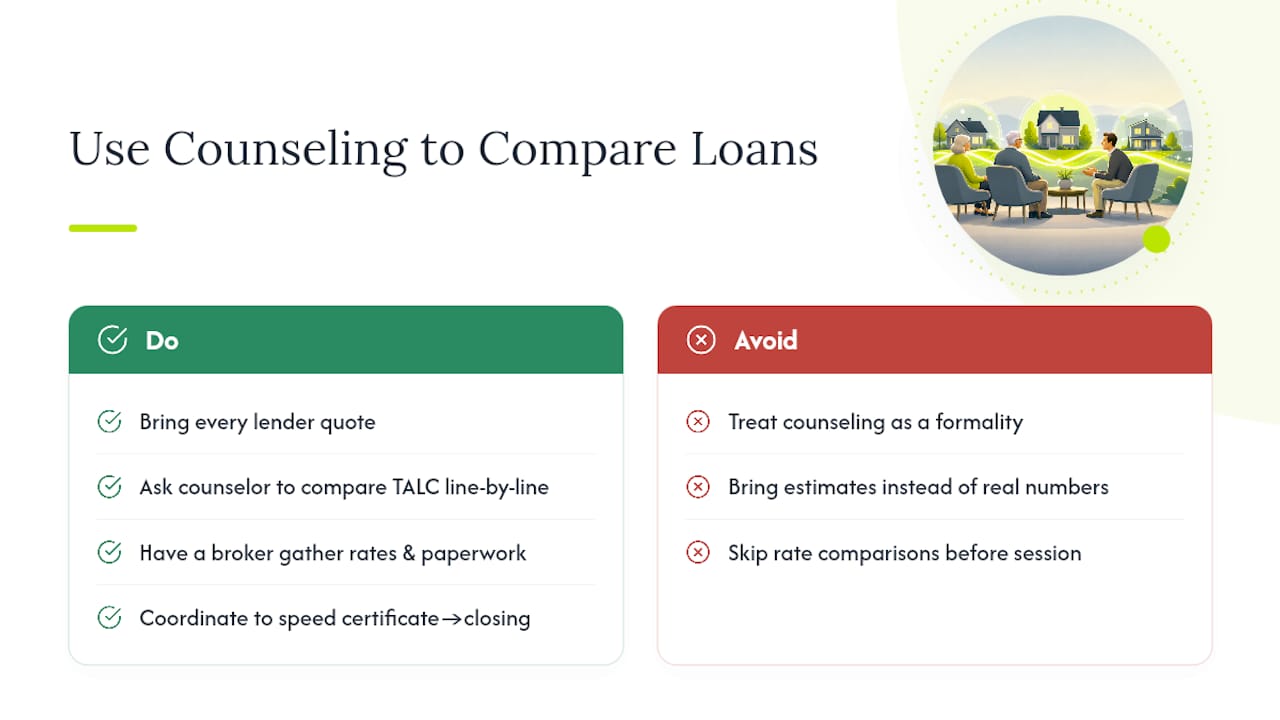
A mortgage broker can help you time this correctly, gathering rate comparisons and paperwork before your session so the counselor has real numbers to evaluate rather than estimates. That coordination often shortens the gap between certificate and closing.
What Counselors Wish Every Homeowner Knew Beforehand
Homeowners who come prepared tend to leave with better decisions, not just a signed certificate. Three habits make the difference: gather your paperwork before the call, bring actual lender quotes instead of rough guesses, and ask directly what could put your home at risk later. Always verify HUD approval yourself. Never let a lender pick your counselor for you.
— David Mordue
How David Mordue - Forward Financial Group Fits Into Your Plan
Once your counseling certificate is in hand, the next challenge is finding a loan that actually fits your numbers. Mortgage brokers run rate comparisons across multiple lenders through fully online applications, so you are not stuck taking whatever the first lender quotes you.
That matters most in the weeks around counseling, when you’re gathering the loan estimates a good counselor will compare side by side. A personalized consultation can help you pull those quotes together, understand where the fee structures actually differ, and figure out whether a reverse mortgage, a refinance, or another path fits your retirement plans best. If you’re still weighing whether to stay put or downsize, the rent versus buy calculator is worth running before your session, too. Reach out to a mortgage broker to get a personalized consultation and start comparing your options before you walk into counseling.
Where to Verify Counseling Requirements and Find a Counselor
- HUD’s HECM counseling handbook details session requirements and counselor protocols.
- CFPB’s discussion guide explains what to expect before applying.
- NCOA’s counseling overview lists nonprofit resources, including GreenPath.
- Bfil’s home-finance resources offer additional consumer background on housing finance decisions.
This article is general information, not a substitute for advice from a qualified financial advisor. Consult a qualified financial professional about your own circumstances before acting on anything here.
Sources
FAQ
Is reverse mortgage counseling legally required?
Yes. HUD requires every HECM applicant to complete counseling with a HUD-approved counselor before a lender can process the loan.
How long does a counseling session take?
Most sessions run one to two hours and can happen by phone, video, or in person.
How much does reverse mortgage counseling cost?
Counseling fees vary by agency, and some counselors offer hardship deferrals that let you pay at closing instead.
Where do I find a HUD-approved counselor?
Call HUD’s hotline at 1-800-569-4287 or use HUD’s online counselor search; NCOA and GreenPath Financial Wellness also offer nationwide telephone counseling.
What does the counseling certificate do?
It’s the document your lender needs to process your HECM application, and it stays valid for 180 days after your session.