
Reverse mortgage closing costs on a typical $500,000 home run $12,000 to $20,000, driven mostly by the upfront mortgage insurance premium and origination fee. Almost all of that total gets rolled into your loan balance rather than paid from your pocket, so your actual cash due at closing is often under $200. The bigger financial question isn’t the fee sheet, it’s how those financed costs compound against your equity over the years ahead.
TL;DR:
- The mortgage insurance premium for a typical $500,000 reverse mortgage can reach $10,000 upfront, accounting for a large portion of the total closing costs.
- Most closing fees, including the origination fee and third-party charges, are financed into the loan, leaving only about $200 to $300 due at closing.
- Ongoing costs such as annual mortgage insurance and interest accumulation can significantly reduce home equity over time, especially if the loan is held long-term.
- Borrowers should compare net proceeds after financing costs and pay close attention to interest rate choices, as they impact long-term equity and costs.
- Federal rules require HUD counseling, which must be completed before application, and some fees are non-negotiable, while others vary among lenders.
Table of Contents
- Understanding Reverse Mortgage Closing Costs Line by Line
- How Closing Costs Get Paid: Financed vs. Out-of-Pocket
- Ongoing Costs and What They Do to Your Home Equity
- The Closing Timeline From Counseling to Funding
- Shopping Lenders: What Varies and What Doesn’t
- What a Broker Actually Verifies Before You Sign
- When a Reverse Mortgage Actually Makes Sense
- How David Mordue Can Help You Move Forward
- Where to Verify the Rules Yourself
- Sources
- FAQ
Understanding Reverse Mortgage Closing Costs Line by Line
A Home Equity Conversion Mortgage, or HECM, is the FHA-insured reverse mortgage that accounts for the vast majority of these loans in the United States. Its closing costs look intimidating on paper because federal rules require specific insurance and fee structures that conventional mortgages don’t carry. Here’s what actually shows up on your itemization.
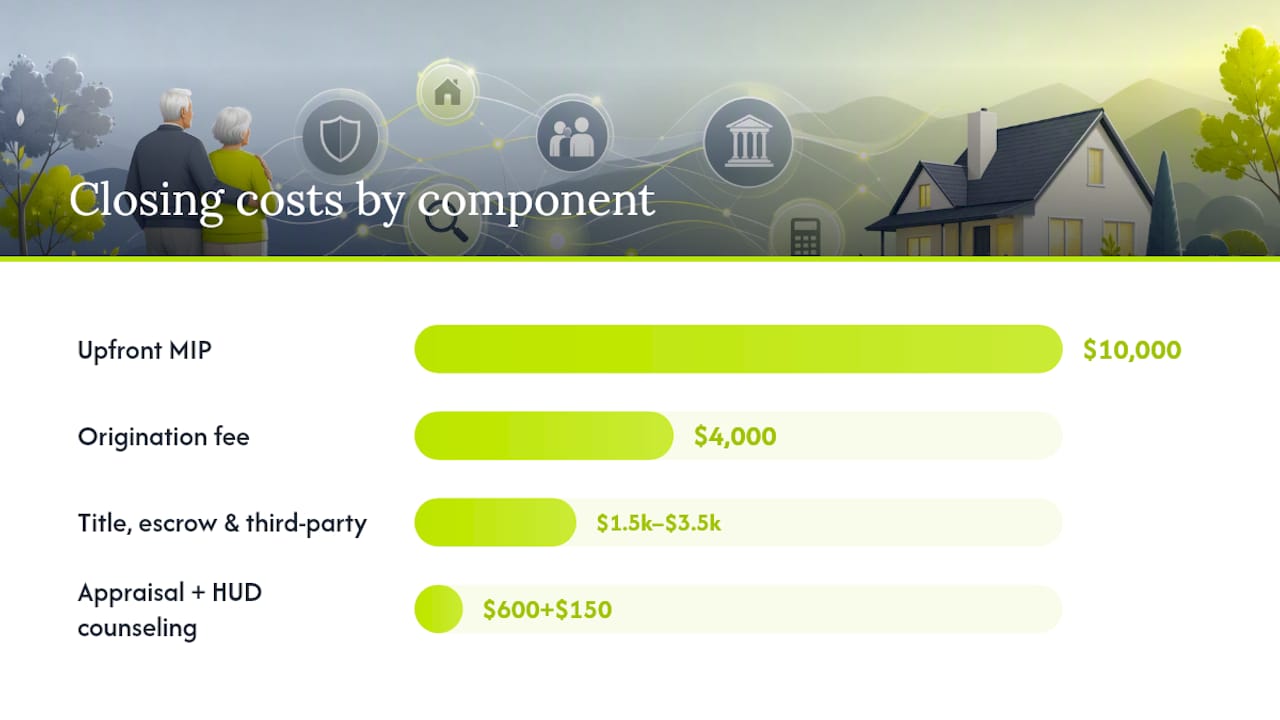
- Upfront FHA mortgage insurance premium (initial MIP): This is the single largest line item. HUD sets it at 2% of your home’s appraised value or the HECM lending limit, whichever is lower. On a $500,000 home, that’s $10,000 right there. This premium funds the FHA insurance pool that guarantees you’ll never owe more than your home is worth.
- Origination fee: The lender’s fee for processing your loan is capped by HUD at the greater of $2,500 or 2% of the first $200,000 of your home’s value plus 1% of anything above that, with an absolute ceiling of $6,000. A $500,000 home works out to $4,000 (2% of $200,000 plus 1% of $300,000), well under the cap.
- Appraisal fee: Expect $500 to $700 in most markets, though it can run higher for rural properties or homes needing a second appraisal because the first one raised red flags. You typically pay this one before closing, not at the table.
- Title, escrow, recording, and document preparation: These third-party charges vary by state and county and commonly total $1,000 to $3,000. A rural county in Ohio and a coastal county in California will not charge the same recording fees, so don’t assume a friend’s number applies to your closing.
- HUD counseling fee: Independent, HUD-approved counselors typically charge $125 to $200, paid directly by you before your application even moves forward. Counselors can waive the fee for borrowers who demonstrate financial hardship.
- Smaller items: Credit report pulls, flood zone certification, notary and courier fees each run $20 to $100, and they add up to a few hundred dollars combined.
Every one of these fees ties back to a HUD-regulated formula or a documented third-party charge. None of them should appear on your paperwork as a mystery number, and if one does, that’s your first red flag.
How Closing Costs Get Paid: Financed vs. Out-of-Pocket
Most reverse mortgage closing costs get added to your loan balance rather than paid in cash, which is why the sticker shock of a $12,000 to $20,000 total rarely translates into an actual check you have to write. The exceptions are the appraisal fee and the HUD counseling fee, both of which you typically pay upfront, out of pocket, before your loan even closes.
Here’s how the math plays out on that $500,000 home example:
- Upfront MIP ($10,000) and origination fee ($4,000) get added to your loan principal.
- Title, escrow, and smaller third-party charges (roughly $1,500 to $3,500) also get financed.
- Your appraisal ($600) and counseling fee ($150) were already paid before closing.
- Cash-to-close, the amount due at the closing table itself, ends up under $200 in most cases.
That’s the trade-off worth sitting with: financing your closing costs preserves your liquidity today, but every dollar rolled in starts accruing interest immediately, on top of the interest already accruing on your principal draw. Paying costs in cash, if you have the means, shrinks your loan balance and slows equity erosion, but it ties up money you might want available for other needs.
This is also where the distinction between gross and net proceeds matters. Your gross principal limit might sound generous, but subtract the financed closing costs and any existing mortgage payoff, and what’s left, your net proceeds, is what you can actually use. A homeowner comparing offers should always ask for the net figure, not the headline gross number lenders like to lead with.
Ongoing Costs and What They Do to Your Home Equity
Closing day isn’t the end of the cost conversation. A HECM carries an annual mortgage insurance premium of 0.50% of your outstanding loan balance, charged monthly and added directly to what you owe. Interest accrues on top of that, whether your rate is fixed or adjustable, and because you are not making monthly payments, both the interest and annual MIP compound against the growing balance over time.
- Annual mortgage insurance premiums add a small percentage of your balance every year, recalculated as the balance grows.
- Interest, fixed-rate loans lock in a rate for the life of the loan, while variable-rate HECMs track an index and can shift the balance’s growth trajectory. Check current mortgage rate trends before choosing between the two.
- Servicing fees are less common today than they once were, but some lenders still charge modest monthly amounts for statement processing and account management.
- The non-recourse rule protects you and your heirs from owing more than the home’s appraised value at repayment, even if the loan balance has grown larger than the sale price.
The financial commentators who warn about the “dark side” of reverse mortgages are usually pointing at exactly this mechanism: ongoing MIP and interest compounding steadily eat into the equity your heirs might otherwise inherit. That’s not a hidden trap, it’s simple math playing out over ten or twenty years, but too many borrowers focus only on the closing-cost sheet and never model the long-term picture.
Pro Tip: Run the numbers at your expected time horizon, not just today. A HECM held for three years and one held for fifteen years produce very different equity outcomes, and a broker or counselor can walk you through both scenarios before you sign anything.
The Closing Timeline From Counseling to Funding
Federal rules require every HECM borrower to complete HUD-approved counseling before a lender can process the loan application. That certificate remains valid for a limited period., so timing your counseling session against your homebuying or refinancing plans matters more than most borrowers realize.
- Application and appraisal: Your lender orders the appraisal and pulls your credit and financial assessment.
- Underwriting: The lender verifies title, confirms any existing mortgage payoff amount, and finalizes your Loan Estimate.
- Signing: A settlement agent or attorney conducts the closing. You’ll sign the note, the deed of trust, and the Closing Disclosure. Any existing mortgage gets paid off first, before you see a dime of remaining proceeds.
- Rescission period: Federal law gives you a mandatory 3-business-day right of rescission after signing, during which you can cancel with no penalty.
- Funding: Once the rescission period passes, your lender disburses funds according to your chosen payment plan.
California borrowers have a longer cooling-off period after counseling before the loan can close, beyond the federal standard. Always confirm your own state’s rules with your counselor.
Shopping Lenders: What Varies and What Doesn’t
Not every fee on a HECM Loan Estimate is negotiable, but several are, and knowing which ones separates a good deal from an expensive one. Upfront MIP is fixed by HUD formula and won’t change from lender to lender. The origination fee, interest rate or margin, and servicing structure can vary among lenders.
- Request Loan Estimates from at least two or three lenders and compare net proceeds, not just the headline fee totals.
- Ask each lender to walk you through their origination fee calculation and confirm it stays under the HUD cap.
- Ask your title or settlement agent for an itemized breakdown of recording and escrow charges rather than accepting a lump “closing costs” figure.
- Confirm whether the interest rate is fixed or adjustable, and if adjustable, which index it tracks.
Watch for red flags: an origination fee that exceeds the HUD cap, any lender who pressures you to skip or rush counseling, or vague third-party fees that never get itemized. Reputable lenders welcome the questions; the ones who get impatient with them are telling you something.
Pro Tip: Ask every lender the same exact questions in the same order. Side-by-side comparisons only work when you’re comparing apples to apples, not letting each lender frame their own pitch.
What a Broker Actually Verifies Before You Sign
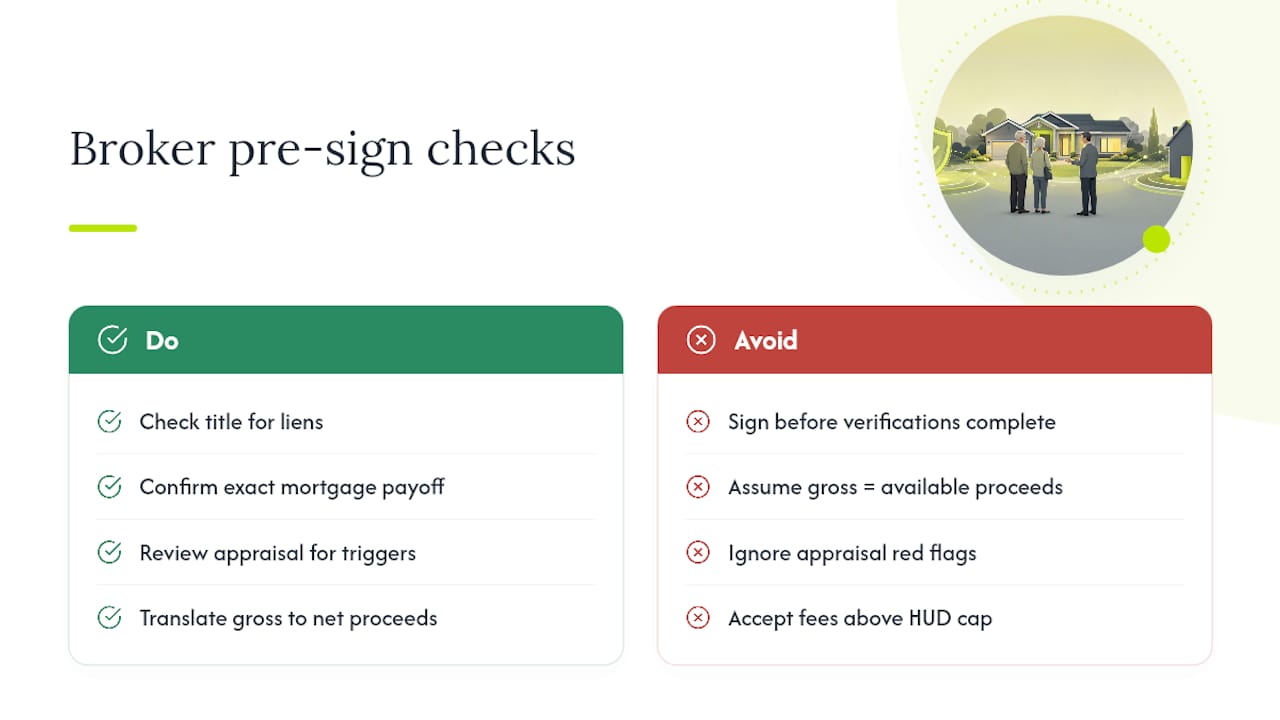
Before a Loan Estimate ever reaches your desk, a broker who knows this product checks the title for liens, confirms the exact payoff amount on any existing mortgage, and reviews the appraisal for anything that could trigger a second review or delay. That verification work is where a lot of last-minute closing surprises get caught early instead of at the signing table.
Mortgage brokers help clients weigh the real trade-off between paying costs in cash and financing them into the loan balance, translating gross principal limits into the net proceeds figure that actually matters for your plans, as explained in this income protection perspective. When an origination fee on a competing Loan Estimate creeps above the HUD cap, that’s exactly the kind of detail worth flagging before you sign anything.
If you’re at the stage of comparing numbers, David Mordue’s refinance calculator helps model how financed costs affect your balance over time, and a personalized consultation can walk through your specific home value and goals.
When a Reverse Mortgage Actually Makes Sense
A HECM tends to fit best when you plan to stay in your home for the long haul, your other liquid assets are thin, and you need supplemental income or a standby credit line more than you need to preserve maximum inheritance value. It fits less well for someone who expects to move within a few years or who has healthier alternatives, like a home equity line or downsizing, sitting on the table.
Your time horizon and estate goals should drive the decision more than the closing-cost sheet itself. A borrower planning to stay 15 years absorbs the upfront costs very differently than one planning to stay three. Use your HUD counseling session honestly, ask hard questions, and pull Loan Estimates from more than one lender before deciding. The costs are regulated and disclosed, but the right decision still depends entirely on your own situation.
— David Mordue
How David Mordue Can Help You Move Forward
Mortgage brokers can provide a faster, more transparent path to a reverse mortgage decision than shopping lender websites one at a time. Instead of chasing separate quotes from separate companies, you may get expert rate comparisons across multiple lenders in one consultation, plus a fully online application process designed to keep your timeline moving.

If you’re ready to see real numbers against your own home value, start with a personalized consultation where David Mordue reviews your goals, your existing mortgage payoff, and your estate priorities before recommending a path. You can also run your own projections first using the refinance calculator to see how financed costs would affect your balance over time. Once you’ve completed HUD counseling and gathered a couple of Loan Estimates, request your consultation and get a clear, net-proceeds comparison instead of a stack of confusing paperwork.
Where to Verify the Rules Yourself
Don’t take any lender’s word for the fee caps or program rules. HUD publishes the current HECM lending limits and maintains the counselor lookup tool every borrower is required to use. The CFPB breaks down cost disclosures in plain language, and the FTC publishes practical consumer warnings worth reading before you sign anything.
This article is general information, not a substitute for advice from a qualified financial advisor. Consult a qualified financial professional about your own circumstances before acting on anything here.
Sources
FAQ
What Is the “Dark Side” of a Reverse Mortgage?
The real risk isn’t the closing costs themselves, it’s underestimating how annual mortgage insurance and compounding interest shrink your home equity over a long loan term, leaving less for heirs than borrowers expect.
What Is the Lowest Closing Cost I Can Expect on a Reverse Mortgage?
Smaller homes with lower appraised values produce proportionally smaller upfront MIP and origination fees, but on a typical $500,000 home, total closing costs generally fall in the $12,000 to $20,000 range, with cash-to-close usually under $200.
What Is the “60% Rule” People Mention With Reverse Mortgages?
This refers to a HECM disbursement restriction in the loan’s first year, which generally limits how much of your available proceeds you can draw upfront to roughly 60% of the principal limit, with exceptions for paying off an existing mortgage. Specific limits can vary by case, so confirm the exact figure with your counselor or lender.
What Does Suze Orman Say About Reverse Mortgages?
Suze Orman has publicly cautioned that reverse mortgages carry real long-term costs and shouldn’t be treated as free money, urging homeowners to fully understand the fees and equity impact before signing. Her core caution lines up with the mainstream financial guidance from the CFPB and FTC: know your numbers first.
Can I Negotiate My Reverse Mortgage Origination Fee?
The origination fee is capped by HUD but not fixed at that cap, so it’s worth comparing Loan Estimates from multiple lenders since the fee itself, along with the interest rate, can vary between companies.