
The refinancing settlement process is the final phase where your new lender pays off your existing mortgage and registers a new loan in its place. Most homeowners understand that refinancing saves money, but few realize how much happens between signing and actual funding. The refinancing settlement process explained here covers every step: payoff demands, escrow coordination, federal disclosure rules, and closing costs ranging from 2% to 6% of your loan amount. Knowing these steps protects you from delays, surprise fees, and costly errors at the closing table.
What are the main steps in the refinancing settlement process?
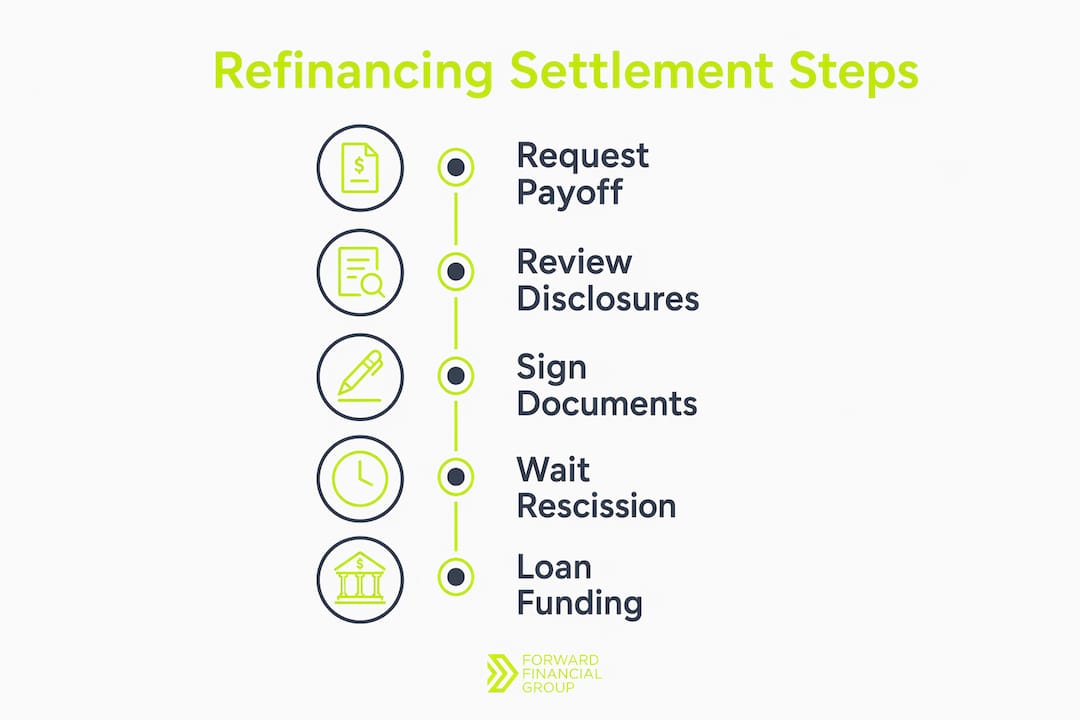
The refinancing settlement process follows a clear sequence, and knowing each step prevents confusion and delays.
Loan underwriting and clear-to-close. Your lender reviews your income, credit, and property documents before issuing a clear-to-close. Underwriting review often takes the longest in the refinance process because of document verifications and conditions. Respond to every document request the same day you receive it.
Closing Disclosure issuance. Your lender sends a five-page Closing Disclosure listing your final loan terms and all closing costs. Under federal TRID rules, you must receive this document at least three business days before closing. That waiting period is a legal protection, not a formality.
Payoff demand letter. Your escrow officer requests a payoff letter from your current lender. Payoff amounts include daily interest accrual up to the settlement date and any outstanding fees, not just your statement balance. A payoff letter is typically valid for 30 days, so timing matters.
Escrow coordination. The escrow officer collects your closing funds, organizes all documents, and prepares wiring instructions. Escrow officers coordinate payoff wiring, closing cost disbursals, and new mortgage registration through the county recorder. They are the central hub of the entire transaction.
Signing day. You sign the loan documents, but this does not mean your old loan is paid off immediately. Signing documents is not immediate funding. Actual disbursement follows after the rescission period and payoff instructions are confirmed.
Funding and recording. After the rescission period ends, your lender wires funds to escrow. The escrow officer pays off your old mortgage and sends the new deed of trust to the county recorder. Recording the new loan finalizes lien replacement and removes the old mortgage from public records.
Pro Tip: Request your payoff letter at least two weeks before your target closing date. Daily interest adds up fast, and a stale payoff letter can delay funding if it expires before closing.
How do federal regulations affect refinancing settlement timing?

Federal law controls the timeline of every refinancing settlement. Two rules matter most: the TRID disclosure requirement and the right of rescission.
The TRID rule, which stands for TILA-RESPA Integrated Disclosure, requires your lender to deliver the Closing Disclosure at least three business days before closing. This rule prevents lenders from rushing you through a closing without time to review your final numbers. The Closing Disclosure waiting period is a strong consumer protection that gives you time to compare final costs against your original Loan Estimate.
Business day counting under TRID is specific. Saturday counts as a business day for this purpose. Sundays and federal holidays do not count. That distinction matters when your closing falls near a weekend or a holiday, because the three-day clock may extend further than you expect.
The right of rescission adds another layer of timing. Most homeowners refinancing owner-occupied properties have a three-business-day right of rescission after signing, which delays actual funding. This right lets you cancel the loan without penalty within that window. Investment properties do not carry this right.
Certain changes to your loan terms reset the three-day waiting period entirely. Changes that increase your APR by more than 0.125%, a switch in loan product, or the addition of a prepayment penalty all trigger a new waiting period. If your lender makes any of these changes late in the process, your closing date will shift.
Key regulatory protections to track:
Confirm the date and method your Closing Disclosure was delivered, not just sent.
Count business days carefully, including Saturdays, when calculating your earliest legal closing date.
Review your APR on the Closing Disclosure against your Loan Estimate before signing.
Ask your lender directly whether any late changes will reset your waiting period.
What costs and fees should you expect at refinancing settlement?
Refinancing is not free. Refinance closing costs typically range from 2% to 6% of the loan amount, varying by lender and location. On a $400,000 loan, that means $8,000 to $24,000 in closing costs. Understanding what drives that range helps you negotiate and plan.
Your lender must provide a Loan Estimate within three business days of your application. That document lists every anticipated fee. The Closing Disclosure you receive before signing updates those numbers with final figures. Lenders must stay within legal tolerance limits between the two documents.
Fee type | Typical range | Notes |
|---|---|---|
Origination fee | 0.5%–1% of loan | Covers lender processing costs |
Appraisal fee | $300–$600 | Required to confirm property value |
Title insurance | $500–$1,500 | Protects lender against title defects |
Recording fees | $50–$200 | Paid to county to register new lien |
Prepaid interest | Varies | Covers interest from closing to first payment |
If fees on your Closing Disclosure exceed the Loan Estimate beyond legal limits, your lender must issue refund credits within 60 days. Catching discrepancies before signing is faster than waiting for a post-closing refund.
A no-closing-cost refinance rolls fees into your loan balance or accepts a higher interest rate in exchange for a lender credit. That option reduces your upfront cash need but increases your long-term cost. Use the refinance cost calculator at David Mordue - Forward Financial Group to compare both scenarios before deciding.
Pro Tip: Compare your Closing Disclosure line by line against your Loan Estimate before signing. Any fee increase beyond the tolerance limit is a violation you can flag before closing, not after.
How can you prepare for and reduce risks during settlement?
Preparation before settlement day eliminates most delays. The homeowners who close on time are the ones who treat document requests as urgent, not optional.
Request your payoff letter early. Ask your escrow officer to order the payoff demand as soon as your loan is in underwriting. Payoff letters have expiration dates, and a delay in receiving one can push your closing date back by days.
Respond to underwriting conditions immediately. A well-prepared borrower who responds quickly to document requests speeds loan clearance. Treat every condition as a same-day task.
Review your Closing Disclosure carefully. Compare every fee to your Loan Estimate. Look for new fees that did not appear on the original estimate, and question any increases above the tolerance limits.
Confirm wiring instructions directly with escrow. Wire fraud targeting real estate transactions is a real risk. Call your escrow officer directly to verify account details before sending any funds.
Track your disclosure receipt date. Write down the exact date you received your Closing Disclosure. Count three business days forward, including Saturdays, to confirm your earliest legal closing date.
Understanding your current mortgage rates before you lock also reduces risk. A rate lock that expires before closing can force you to accept a higher rate or pay a lock extension fee.
How does refinancing settlement differ from a purchase closing?
Refinancing settlement and purchase closing share the same basic structure, but several key differences affect your timeline and rights.
The most significant difference is the right of rescission. This right applies only to refinancing owner-occupied homes. A purchase closing has no rescission period, so funding happens the same day or the next business day after signing. A refinance closing adds three business days between signing and funding.
Other important differences include:
No buyer or seller parties. A refinance escrow handles only the payoff of your existing loan and the registration of the new one. There are no purchase proceeds to distribute.
Different documents. The HUD-1 settlement statement no longer applies to most transactions. The Loan Estimate and Closing Disclosure replaced it under TRID for loans originated after october 3, 2015.
Escrow account handling. Your existing escrow account for taxes and insurance may be closed and refunded, then a new one opened under your new loan. That refund can take several weeks to arrive.
Cash-out proceeds. If you are doing a cash-out refinance, those funds disburse after the rescission period ends, not at signing.
The practical result is that a refinance closing takes longer from signing to funded loan than a purchase closing. Plan for at least five business days between your signing appointment and the day your old loan is officially paid off.
Key Takeaways
The refinancing settlement process requires precise timing, careful document review, and proactive communication with your escrow officer and lender to close on time and without costly errors.
Point | Details |
|---|---|
Settlement pays off your old loan | Your new lender wires funds to escrow, which pays off your existing mortgage at closing. |
Three-day disclosure rule | You must receive the Closing Disclosure at least three business days before closing under TRID. |
Rescission period delays funding | Owner-occupied refinances include a three-business-day right of rescission after signing. |
Closing costs range 2%–6% | On a $400,000 loan, expect $8,000 to $24,000 in fees; compare Loan Estimate to Closing Disclosure. |
Payoff letters expire | Request your payoff demand early and confirm daily interest calculations to avoid closing delays. |
What I've learned from watching homeowners close refinances
Most homeowners arrive at the signing table expecting to be done. They sign the documents, hand over a check, and assume their old loan is paid off that afternoon. That assumption causes real problems.
The gap between signing and funding is the part of the refinancing settlement process that surprises people most. Clear-to-close approval, payoff demand confirmation, and settlement readiness must all align before your lender releases funds. If any one of those pieces is missing, disbursement waits. I have seen closings delayed by a single missing payoff confirmation, even after the borrower signed everything correctly.
Tracking your Closing Disclosure delivery date is the single most underrated task in the entire process. Precise tracking of delivery dates, including how Saturdays count as business days, prevents misunderstandings about when settlement can legally occur. Most borrowers do not know that Saturday counts. Their lender may not volunteer that information either.
My strongest advice is to build a relationship with your escrow officer before closing day. Call them. Ask questions. Confirm the wiring timeline. The escrow officer is the person who actually moves the money, and proactive communication with them resolves issues faster than any other step you can take.
— David Mordue
Ready to move forward with your refinance?
Refinancing is one of the most effective financial decisions a homeowner can make, and the settlement process does not have to feel complicated. David Mordue - Forward Financial Group offers a fully online refinance application that can lead to funding in less than 21 days, along with personalized guidance at every step from application to closing.

Use the refinance calculator to estimate your closing costs and compare loan scenarios before you apply. When you are ready to move forward, the mortgage refinance application at David Mordue - Forward Financial Group connects you with expert rate comparisons and a clear path to closing. Clients consistently report significant monthly savings, and the process is built to keep you informed from day one.
FAQ
What is the refinancing settlement process?
The refinancing settlement process is the final stage where your new lender pays off your existing mortgage and registers a new loan in its place. It includes escrow coordination, payoff wiring, document signing, and county recording of the new lien.
How long does refinancing settlement take after signing?
For owner-occupied refinances, funding takes at least three business days after signing due to the federal right of rescission. Total time from application to funded loan typically ranges from two to four weeks.
What fees are included in refinancing closing costs?
Refinancing closing costs typically range from 2% to 6% of the loan amount and include origination fees, appraisal fees, title insurance, recording fees, and prepaid interest. Your Loan Estimate lists these costs within three business days of application.
Can a lender change fees between the Loan Estimate and Closing Disclosure?
Lenders can adjust some fees within legal tolerance limits, but increases beyond those limits require a lender credit. If fees exceed tolerance, lenders must issue refund credits within 60 days of closing.
What triggers a new three-day waiting period before closing?
A new three-day waiting period is required if your APR increases by more than 0.125%, your loan product changes, or a prepayment penalty is added. Other fee changes do not reset the clock but must stay within tolerance limits.
Recommended
David Mordue - Get Your Mortgage Pre-Approval or Mortgage Refinance Today
David Mordue - Get Your Mortgage Pre-Approval or Mortgage Refinance Today