
A rate-lock float-down is a one-time option that lets you lower your locked mortgage rate if rates drop before you close, usually for an upfront fee. It’s worth paying for only when the monthly savings from the lower rate will recoup that fee well within the time you plan to keep the loan. If rates barely move or you’re closing fast, skip it.
TL;DR:
- Float-downs are most cost-effective when the expected rate drop surpasses the fee’s break-even point within your planned loan holding period.
- Fees vary from flat upfront payments to percentages of the loan, and a small fee may be worth it only if the monthly savings happen quickly within your expected timeframe.
- Borrowers should verify exact float-down terms in writing, monitor rates precisely against trigger thresholds, and avoid relying solely on verbal assurances.
- Shopping for the best baseline rate before locking remains the most effective way to minimize costs, making float-downs a secondary, backup option rather than the primary strategy.
Table of Contents
- What Is a Float-Down Option: What Borrowers Should Expect
- How Float-Downs Work: Triggers, Timing, and Lender Behavior
- Costs and Fee Structures: What a Float-Down Actually Costs You
- How to Decide: Break-Even Math and Worked Examples
- How to Get and Use a Float-Down: A Borrower’s Checklist
- Risks and Limitations Borrowers Often Misunderstand
- How Brokers Actually Advise Clients on Float-Downs
- The Bottom Line on Rate Lock Float Downs
- Why Most Float-Down Advice Misses the Point
- Get Your Float-Down Terms Reviewed Before You Lock
- Sources
- FAQ
What Is a Float-Down Option: What Borrowers Should Expect
A standard rate lock freezes your interest rate for a set period, protecting you if rates rise but leaving you stuck if they fall. Floating without a lock does the opposite: you keep flexibility but carry full exposure to rate swings until you close. A float-down splits the difference. You get the certainty of a locked rate with a one-time escape hatch if the market moves in your favor.
Most float-down programs share a few common traits, though the fine print varies by lender:
- Available only once per loan, not on a recurring basis.
- Usable only within a specific window during your lock period, often not immediately after locking.
- Contingent on your loan application staying unchanged (same program, same credit profile, same debt-to-income ratio).
- More commonly offered on longer locks, new construction loans, and in competitive purchase markets where builders or lenders use float-downs as a selling point.
Not every lender offers this feature, and some advertise it more prominently than others actually honor it in practice. The Federal Reserve notes that rate lock periods commonly run 30 to 60 days, though new construction and jumbo loans sometimes stretch that window to 90 days or longer, which gives a float-down more time to become relevant.
How Float-Downs Work: Triggers, Timing, and Lender Behavior
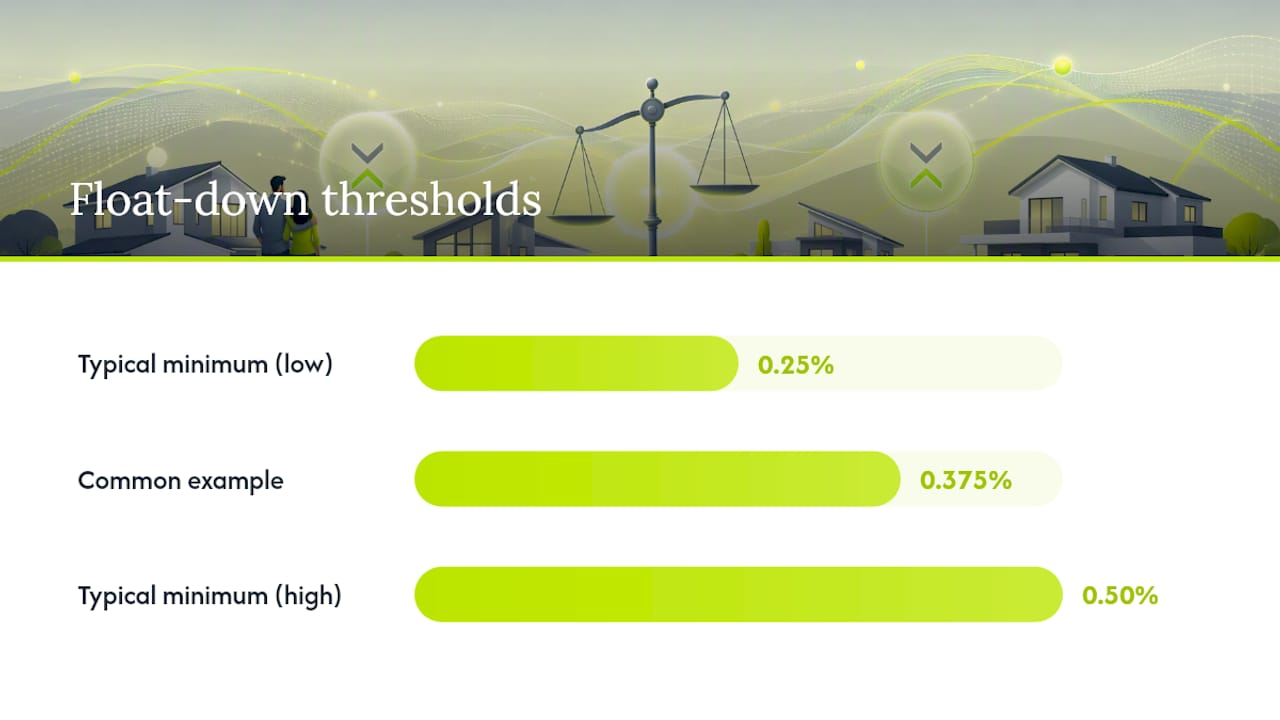
A float-down only kicks in once rates fall by a set amount from your locked rate. Many programs set a minimum drop threshold between a quarter and half a percentage point, and some lenders cap how far you can float down even if rates fall further than that.
Timing matters just as much as the trigger size. Lenders typically:
- Block float-down requests during the first several days after locking, to prevent borrowers from locking then immediately floating.
- Set a cutoff, often a specific number of days before closing, after which the option disappears entirely.
- Limit the request to a single use, so once you exercise it, you can’t come back for a second reduction if rates keep falling.
Here’s the trigger threshold in practice: if you locked at 6.75% and your lender requires a 0.375% minimum drop, the market rate for your loan profile has to fall to roughly 6.375% or lower before you qualify. It’s not enough to see headlines about falling rates. Lenders do not typically notify you automatically when you cross that threshold. The request has to come from you, and you need to know exactly when to make it.
Costs and Fee Structures: What a Float-Down Actually Costs You
Lenders charge for float-downs in a few different ways, and the format changes how much you end up paying:
- A flat upfront fee, sometimes a few hundred dollars, charged regardless of loan size.
- A percentage of the loan amount, often a fraction of a point up to a full point.
- A pricing adjustment baked into your rate, where you accept a slightly higher rate at lock time in exchange for float-down eligibility later.
Fee structures vary widely across lenders, and some price it near what a straight lock extension would cost, while others price it closer to buying discount points.
Here’s what a 0.25-point fee looks like on real numbers. On a $400,000 loan, 0.25 points comes to $1,000 paid upfront, nonrefundable in most cases, whether or not you ever end up exercising the option. Compare that to a lock-extension fee, which typically runs a similar range but buys you extra time rather than a lower rate. The two solve different problems, and confusing them is a common mistake among first-time borrowers evaluating their 30-year fixed-rate mortgage options.
How to Decide: Break-Even Math and Worked Examples
The math is simple once you have the numbers. Divide the float-down fee by your monthly payment reduction to get the number of months it takes to break even.
- $300,000 loan, rate drops 0.25% (from 6.75% to 6.50%): monthly savings run around $48. A $750 fee takes roughly 16 months to recoup.
- $400,000 loan, rate drops 0.375% (from 6.75% to 6.375%): monthly savings run around $96. A $1,000 fee breaks even in about 10 months.
- $500,000 loan, rate drops 0.50% (from 7.00% to 6.50%): monthly savings run around $165. A $1,500 fee breaks even in roughly 9 months.
Financial guidance consistently points to this same calculation: compare the fee against the monthly reduction, then weigh that against how long you expect to keep the loan. If you plan to sell or refinance within a year or two, a float-down with a long break-even period isn’t worth it. Run your own numbers with a refinance calculator before committing either way.
How to Get and Use a Float-Down: A Borrower’s Checklist
Get the terms in writing before you lock, not after. Ask your lender to spell out the minimum trigger threshold, the exact calculation method, the fee amount, whether that fee is refundable, any cap on the float-down amount, and how an application change would affect your eligibility.
Once locked, monitor rates against your specific threshold rather than general market headlines, and know the exact window during which you’re allowed to request the adjustment.
Watch for these red flags:
- Vague verbal promises about float-down availability with nothing in writing.
- No stated minimum trigger or cap, which leaves the lender full discretion.
- A large nonrefundable fee charged before you’ve confirmed the loan program is even eligible.
Pro Tip: Ask your lender for their float-down policy in the same conversation where you lock your rate, not after. Verbal assurances tend to soften considerably once you’re already committed to a lender.
Risks and Limitations Borrowers Often Misunderstand
Application changes are the most common way borrowers accidentally lose their float-down rights. A change in loan program, a dip in credit score, or a new debt showing up on your credit report can void both the lock and any attached float-down eligibility.
If your lock expires before closing, re-locking or extending is often more expensive than a float-down would have been, so don’t let the clock run out while you wait for a bigger rate drop.
Remember too that headline rate drops don’t guarantee you qualify. Lenders price loans off internal benchmarks that can lag or diverge from what the news reports, and most float-downs are strictly one-time, capped events, not an ongoing hedge against rate movement.
How Brokers Actually Advise Clients on Float-Downs
Brokers don’t automatically recommend paying for a float-down with your current lender. Sometimes shopping two or three lenders turns up a base rate already lower than what a float-down would get you after fees, which makes the float-down redundant before you even pay for it.
Part of the job is watching lender-side pricing shift day to day and running break-even scenarios against a client’s actual loan numbers rather than generic examples. That’s a different exercise for a $250,000 first-time purchase than for a $600,000 refinance with a shorter expected holding period.
A broker conversation typically covers:
- Whether current market conditions make a float-down likely to trigger before closing.
- How your specific loan program and lock length affect eligibility.
- Whether shopping lenders now beats paying a float-down fee later.
The Bottom Line on Rate Lock Float Downs
A float-down can save you real money, but only when the fee gets recouped well within your expected time in the loan. Get the exact terms in writing from your lender, then run the break-even math against your own loan amount before deciding.
Why Most Float-Down Advice Misses the Point
The conventional advice treats float-downs like a feature to shop for, similar to comparing lender fees or closing costs. That framing undersells the real decision. The number that matters isn’t whether a lender offers a float-down. It’s whether their current base rate, without any float-down at all, already beats what a competitor charges after tacking on the fee.
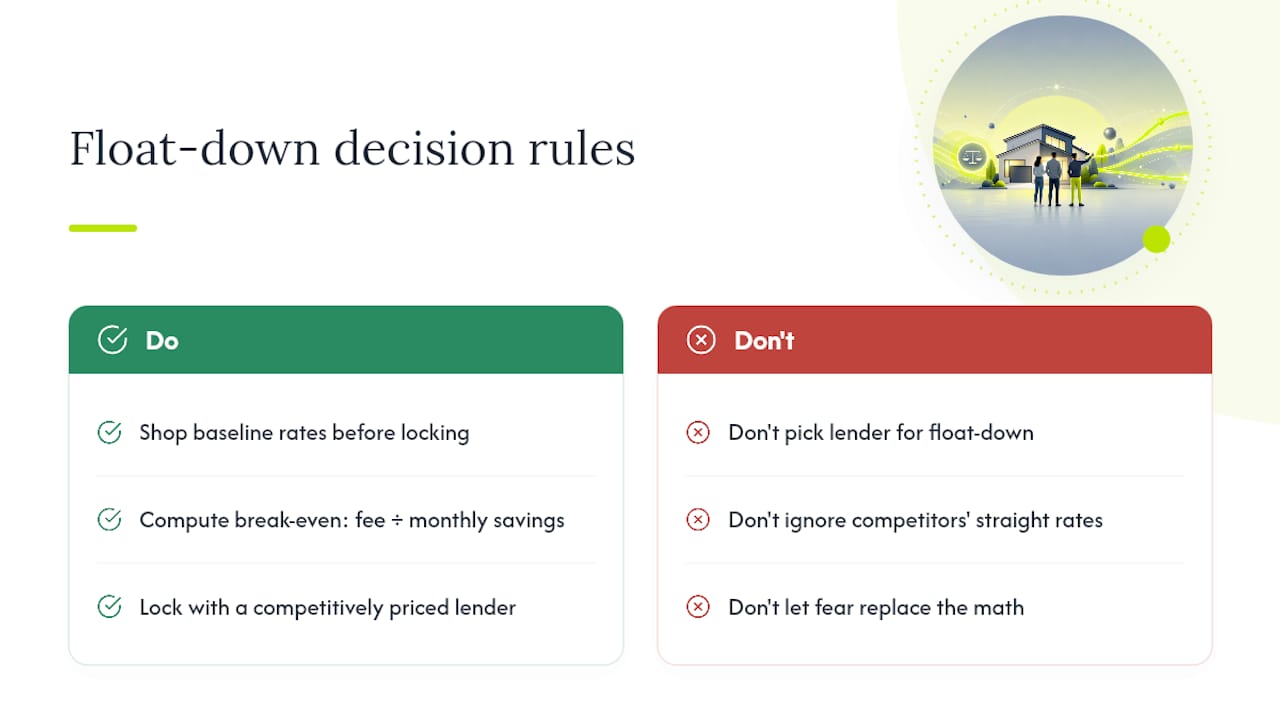
I’ve seen borrowers fixate on float-down terms while ignoring that a different lender’s straight rate would have made the whole question moot. Shopping rates before you lock does more heavy lifting than any float-down feature does after you’ve locked with the wrong lender.
Where the guidance holds up is the break-even discipline. Divide the fee by the monthly savings, compare that to how long you’ll hold the loan, and let the math decide instead of the fear of missing a rate drop. Where it falls short is treating the float-down as the primary lever. It’s a backstop, not a strategy. Shop first. Lock with the lender whose baseline pricing is already competitive. Then treat the float-down as a bonus, not the reason you chose them.
— David Mordue
Get Your Float-Down Terms Reviewed Before You Lock
A mortgage broker can help compare float-down terms across multiple lenders instead of asking you to accept whatever one lender offers, which matters since the strongest move is often shopping rates before you lock rather than paying a fee after. They can run the break-even math against your actual loan amount, check whether a competitor’s baseline rate already beats a float-down scenario, and assist with an online application process designed to help with faster funding.
If you’re weighing a purchase or refinance right now, start with a personalized rate comparison at Davidmordue or check current rates and preapproval options to see where you stand before you commit to any lender’s lock terms.
Sources
- What is a mortgage rate float down and is it worth it? - CBS News
- Mortgage Rate Lock Float Down: Overview, Examples - Investopedia
- Rate lock-ins discussion - Federal Reserve
- Mortgage rate lock — NerdWallet
This article is general information, not a substitute for advice from a qualified financial advisor. Consult a qualified financial professional about your own circumstances before acting on anything here.
FAQ
What happens if rates go down after I lock in?
Without a float-down, you keep your locked rate even if market rates fall further. With a float-down, you can request the lower rate one time if the drop meets your lender’s minimum threshold.
Will mortgage rates drop to 5% or lower in 2027?
No one can forecast rates with certainty, and any specific prediction should be treated skeptically. Base your float-down decision on your current locked rate and the break-even math, not on speculation about where rates might go.
Did mortgage rates go down today?
Rates change daily based on bond markets and lender-specific pricing, so check current listings directly with your lender rather than relying on general news coverage, since internal lender pricing can lag behind headline market rates.
Will mortgage rates ever return to 3%?
Rates near 3% were historically unusual, tied to specific economic conditions in recent years. Planning around a return to that level isn’t a sound strategy for deciding whether to lock, float, or use a float-down today.
Is a float-down better than refinancing later?
A float-down is typically cheaper and faster since it avoids new closing costs, but it’s capped and one-time. If rates fall significantly after your float-down window closes, refinancing becomes the only remaining option to capture further savings.