
A non-QM loan is a fully underwritten mortgage that uses alternative documentation to prove your ability to repay. If your income is real but doesn’t fit the W-2 template, this product was built for you.
You likely fit the non-QM profile if you:
- Are self-employed, a 1099 contractor, or a real estate investor whose tax returns understate your actual cash flow
- Have strong assets or rental income but limited documented W-2 earnings, or you’re a foreign national or ITIN borrower
Pause and reconsider if:
- You cannot comfortably afford the payment at the quoted rate; a non-QM loan doesn’t change affordability, it changes documentation
The Ability-to-Repay rule applies to every mortgage, QM or not. Non-QM is a documentation solution, not a way around underwriting.
Key Takeaways
Non-QM loans are a legitimate, fully underwritten mortgage option for creditworthy borrowers whose income or credit history doesn’t fit agency templates, but they cost more and require careful planning.
| Point | Details |
|---|---|
| Non-QM is fully underwritten | Alternative documentation replaces W-2s; the Ability-to-Repay rule still applies to every file. |
| Best-fit borrower profiles | Self-employed, real estate investors, ITIN borrowers, and 1099 earners with strong cash flow but non-traditional documentation. |
| Rate premium is real | Non-QM rates typically run roughly 1 percentage point above comparable conventional loans; get the APR and prepayment terms in writing. |
| Plan the refinance exit | Many borrowers move into conventional pricing after 12–36 months; model that path before you commit to the non-QM rate. |
| David Mordue - Forward Financial Group | The brokerage shops bank-statement, DSCR, and other non-QM programs across its lender network with a typical close time under 21 days. |
Table of Contents
- What are non-QM loans and how do they differ from a Qualified Mortgage?
- Who typically benefits from non-QM loans?
- What are the common non-QM program types?
- What do lenders require for non-QM eligibility?
- What do non-QM mortgage rates and costs look like?
- What are the pros, cons, and risks of non-QM loans?
- How do you apply for a non-QM loan, and how long does it take?
- How David Mordue - Forward Financial Group helps with non-QM loans
- How does a non-QM loan compare to hard money and portfolio loans?
- What David Mordue - Forward Financial Group offers for your non-QM needs
- The non-QM advice most borrowers don’t hear until it’s too late
- Sources
What are non-QM loans and how do they differ from a Qualified Mortgage?
A Qualified Mortgage, as defined by the CFPB, follows a specific documentation template: verified W-2 or tax-return income, a debt-to-income ratio at or below 43%, no risky loan features like negative amortization, and a maximum loan term of 30 years. Lenders who originate QM loans receive a legal “safe harbor,” meaning they’re presumed to have met the Ability-to-Repay standard.
A non-QM loan sits outside that template. It doesn’t skip underwriting; it replaces the agency checklist with alternative documentation, as HousingWire’s industry coverage confirms. The lender still verifies your ability to repay, just through bank statements, rental income, or asset statements rather than a W-2.
What non-QM does NOT mean:
- Automatically subprime or predatory
- No income verification (every file is underwritten)
- Negative amortization (largely prohibited under current rules)
- A product for borrowers who simply can’t afford the home
Key regulatory point: The CFPB’s Ability-to-Repay rule requires every mortgage lender to make a reasonable, good-faith determination that you can repay the loan. That obligation applies whether the loan is QM or non-QM.
The practical difference is risk pricing. Because non-QM loans don’t carry the QM safe harbor, lenders price the additional legal and credit risk into the rate. You pay more for the flexibility.
Who typically benefits from non-QM loans?
The common thread across non-QM borrowers is creditworthiness that doesn’t translate cleanly onto a tax return or pay stub. Experian’s consumer guidance identifies several profiles where these programs make practical sense.
- Self-employed business owners: Your Schedule C deductions reduce taxable income, which is great for taxes but damaging for a conventional mortgage application. Your actual cash flow may be two or three times what your return shows.
- Real estate investors: You own multiple properties, and your personal DTI looks stretched on paper. A DSCR loan qualifies you on the property’s rental income, not your personal earnings.
- High-net-worth borrowers with low reported income: Significant investment or retirement assets can serve as the qualifying basis through an asset-depletion calculation.
- 1099 contractors and gig workers: Irregular pay cycles and variable income make W-2 documentation impossible, but 12 or 24 months of bank statements can tell a clear story.
- Foreign nationals and ITIN borrowers: No Social Security number or U.S. credit history doesn’t automatically disqualify you; specialized programs exist for this profile.
- Borrowers after a credit event: Some non-QM programs shorten the waiting period after a bankruptcy or foreclosure compared to agency guidelines, per NerdWallet’s program overview.
What are the common non-QM program types?
Each program type solves a specific documentation problem. Matching your situation to the right program is the first step toward a successful application.
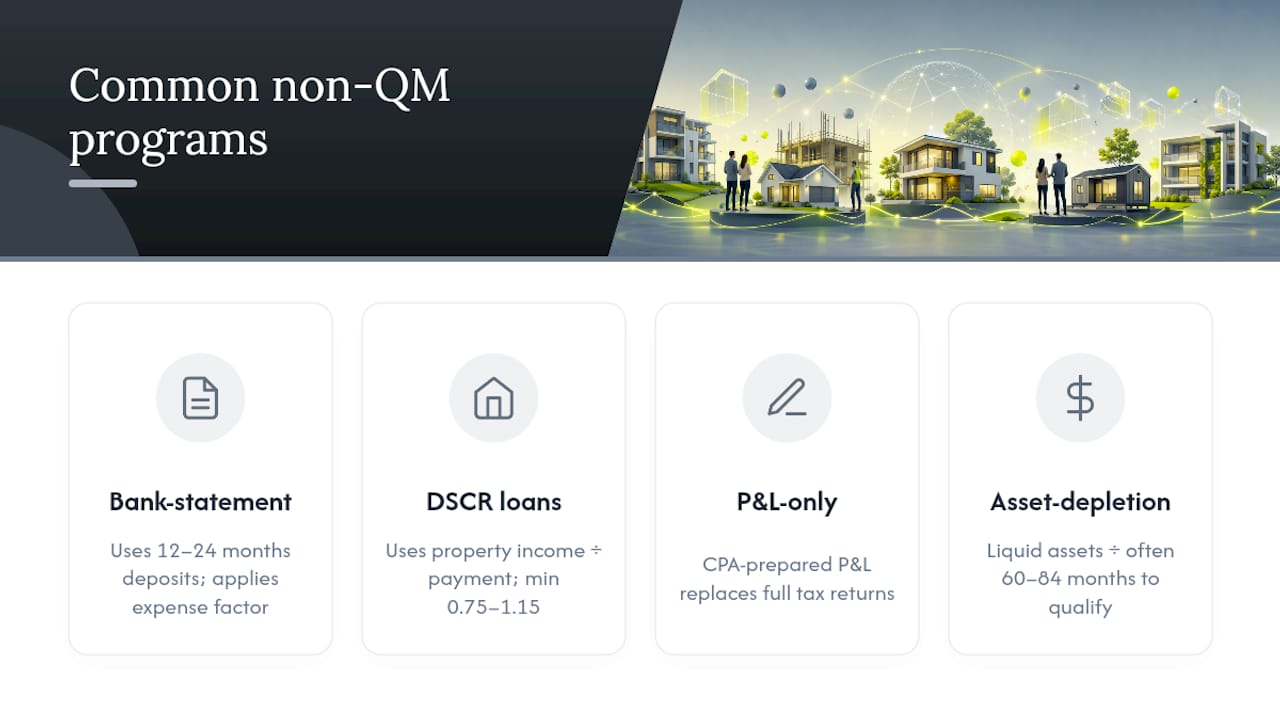
Bank-statement loans are built for self-employed borrowers. The lender reviews 12 or 24 months of personal or business bank statements, totals eligible deposits, and applies an expense factor to approximate qualifying income. A CPA-prepared profit and loss statement can support a lower expense assumption if your actual margins are better.
DSCR loans remove personal income from the equation entirely. The lender calculates your Debt Service Coverage Ratio by dividing the property’s gross rental income by its total monthly payment (principal, interest, taxes, and insurance). Many lenders set a minimum DSCR between 0.75 and 1.15, with the best pricing reserved for files above 1.20. These are the go-to product for real estate investors building or scaling a rental portfolio.
P&L-only loans use a CPA-prepared profit and loss statement as the primary income document, without requiring full tax returns. They suit business owners whose returns are complex or whose most recent year doesn’t reflect current earnings.
1099 loans average your 1099 income over 12 or 24 months. They work well for independent contractors, consultants, and commission-based earners whose income is consistent but never W-2.
Asset-depletion (asset-qualifier) loans divide your liquid assets by a set number of months (often 60 or 84) to create a monthly income figure. A borrower with $1.2 million in a brokerage account and minimal W-2 income can qualify on that calculation.
ITIN and foreign-national loans serve borrowers without a Social Security number. Documentation typically includes an ITIN, foreign credit references, a larger down payment, and proof of income from abroad.
WVOE (Written Verification of Employment) loans use a letter from an employer or CPA confirming income and employment status, useful for borrowers with variable compensation or non-standard employment arrangements.
Prime jumbo near-miss loans serve borrowers who exceed conforming loan limits but fall just outside agency guidelines on one factor, such as a slightly elevated DTI or a recent credit event.
What do lenders require for non-QM eligibility?
Non-QM underwriting is more file-specific than agency underwriting, but the core requirements follow recognizable patterns. Here’s what to prepare before you apply.
Documentation by program type
- Bank-statement: 12 or 24 months of personal or business bank statements; business license or CPA letter confirming self-employment; P&L if available
- DSCR: Executed lease agreement or market rent appraisal; property insurance quote; entity documents if purchasing in an LLC
- P&L: CPA-prepared profit and loss statement (typically covering 12 or 24 months); business bank statements to support figures
- 1099: 12 or 24 months of 1099 forms; bank statements confirming deposit patterns
- Asset depletion: Statements for all qualifying accounts (60 or 90 days); documentation that assets are liquid and accessible
- ITIN/foreign national: ITIN or passport; foreign credit references; proof of income from country of origin; larger down payment documentation
Common underwriting thresholds
Credit score expectations vary by lender and product, but most non-QM programs start at a minimum score in the mid-600s, with better pricing above 700. Some programs accept scores as low as 580 for specific products with compensating factors.
Reserve requirements typically range from 3 to 12 months of PITI, depending on the loan type, occupancy, and LTV. Investor DSCR loans often require more reserves than owner-occupied bank-statement files.
Pre-application checklist
- Pull your most recent 12 or 24 months of bank statements (personal and business)
- Gather 12 or 24 months of 1099s if applicable
- Request a CPA-prepared P&L if your business margins are better than a standard expense factor suggests
- Collect asset statements (retirement, brokerage, savings) dated within 60 days
- Obtain lease agreements or a rent schedule for any investment properties
- Check your credit report at AnnualCreditReport.com and address any errors before applying
- Confirm your entity documents if purchasing in an LLC or corporation
What do non-QM mortgage rates and costs look like?
Non-QM loans cost more than conventional loans. That’s the honest starting point. Because these loans are funded through private capital rather than agency channels, lenders price each file based on its specific risk profile rather than a standardized grid.
The rate premium over a comparable conventional loan is roughly 1 percentage point on many files, though the actual spread depends on several factors. DSCR and asset-depletion programs often price closest to conventional investor rates. Bank-statement and P&L programs typically carry a modest premium above that. Files with lower credit scores, higher LTVs, or thinner reserves price wider.
Primary rate drivers:
- Credit score (the single largest pricing lever)
- Loan-to-value ratio and down payment size
- Product type (DSCR vs. bank-statement vs. asset depletion)
- Reserve months after closing
- DSCR ratio for investment properties (above 1.20 earns better pricing)
- Occupancy type (owner-occupied vs. investment vs. second home)
Common term structures in non-QM:
- 30-year fixed (most common; compare to a conventional 30-year fixed for context)
- 40-year fixed with a 10-year interest-only period
- 5/1 or 7/1 adjustable-rate mortgages, which lower the initial rate but introduce repricing risk
- Interest-only periods (typically 5 or 10 years) that reduce initial payments but delay principal paydown
- Prepayment penalties on some investor loans, commonly structured as a 3-2-1 step-down over three years
Cost reality check: NerdWallet’s guidance notes that non-QM programs typically carry higher interest rates, larger down payment expectations, and alternative documentation requirements. Get the rate and prepayment terms in writing before you commit.
What are the pros, cons, and risks of non-QM loans?
| Factor | Pros | Cons / Risks |
|---|---|---|
| Documentation | Accepts bank statements, assets, rental income | More paperwork to organize; lender-specific requirements |
| Access | Opens homeownership for self-employed, investors, ITIN borrowers | Not a solution for borrowers who genuinely can’t afford the payment |
| Rates | Available when conventional isn’t | Typically 0.5–1.5 percentage points higher than comparable conventional rates |
| Loan features | Interest-only and 40-year options lower initial payments | Prepayment penalties on some investor loans; slower equity build with I/O |
| Consumer protections | ATR rule still applies | Fewer QM safe-harbor protections; secondary market can be less liquid |
| Refinance path | Many borrowers refinance into conventional after 12–36 months | Requires planning; don’t assume rates will drop enough to make it automatic |
Red flags to watch for:
- A lender who can’t explain how your income was calculated or what your qualifying income is
- Undisclosed fees or a rate that changes significantly at closing without a documented reason
- No discussion of a refinance path or exit strategy
- Pressure to close before you’ve reviewed the Loan Estimate carefully
- Any promise that ATR verification isn’t required
Pro Tip: Ask every lender for the Loan Estimate within three business days of application. Federal law requires it. Compare the APR, not just the rate, and confirm prepayment penalty terms in writing before you sign.
How do you apply for a non-QM loan, and how long does it take?
The application process mirrors a conventional mortgage in structure, but the documentation review is more intensive. Expect 14 to 35 days from application to closing with an experienced non-QM lender; less-experienced lenders or complex files can run longer.
Step-by-step application process
- Gather your documents using the checklist in the eligibility section above. Incomplete files are the most common cause of delays.
- Consult a broker who has access to multiple non-QM programs. A broker can match your profile to the right product and request pricing from several lenders simultaneously, which saves time and gives you a real comparison.
- Submit your application with the full document package. Non-QM underwriters review the file holistically; a strong credit score and solid reserves can offset a borderline income calculation.
- Underwriting review: The underwriter will verify your income calculation, review your credit history, confirm reserves, and assess the property. Expect questions and conditions; respond quickly to keep the file moving.
- Appraisal: The lender orders an appraisal to confirm the property’s value and ensure the LTV is within program guidelines.
- Clear to close: Once all conditions are satisfied, the lender issues a clear-to-close and schedules the closing date.
- Funding: Funds are disbursed at closing. For purchase transactions, the title company coordinates the transfer.
Common bottlenecks:
- Missing or inconsistent bank statements (gaps in deposit history slow the income calculation)
- LLC or entity documentation that doesn’t match the property vesting
- Appraisal delays in high-volume markets
- Lender-specific overlays that weren’t disclosed at the start
How David Mordue - Forward Financial Group helps with non-QM loans
Working with a broker on a non-QM file isn’t just convenient; it’s strategically important. Non-QM pricing and program guidelines vary significantly across lenders, and a single lender’s overlay can disqualify a file that another lender would approve without hesitation.
David Mordue is licensed through the Nationwide Multistate Licensing System (NMLS). You can verify any mortgage professional’s license at NMLS Consumer Access before you share financial documents or pay any fees.
What the broker relationship provides on a non-QM file:
- Access to multiple non-QM programs rather than a single lender’s menu
- Experience placing DSCR and bank-statement loans, including investor files in LLCs
- Transparent income calculation: you’ll know exactly how your qualifying income was derived
- A refinance plan: for borrowers who expect to qualify conventionally within 12–36 months, the broker can model the refinance path so you know what the exit looks like before you enter
Pro Tip: Before you sign with any lender or broker, ask: “How did you calculate my qualifying income, and what would I need to show to refinance into a conventional loan in two years?” A clear, specific answer is a strong trust signal. Vague answers are a reason to keep shopping.
As RefiGuide’s practitioner analysis notes, many non-QM borrowers refinance into conventional pricing after establishing two years of stable returns or payments. Planning for that exit from day one is what separates a smart non-QM decision from an expensive one.
How does a non-QM loan compare to hard money and portfolio loans?
Non-QM loans are often grouped with other alternative financing options, but the differences matter for your decision.
Hard money loans are short-term, asset-based loans typically used for fix-and-flip projects or bridge financing. They prioritize the property’s value over the borrower’s creditworthiness, carry very high rates (often in the double digits), and have terms of 6 to 24 months. They are not designed for long-term ownership or rental holds.

Portfolio loans are mortgages that a bank or credit union originates and holds on its own balance sheet rather than selling to the secondary market. Because the lender sets its own guidelines, portfolio loans can be flexible on income documentation, credit history, or property type. They often have competitive rates for borrowers with strong banking relationships, but availability is limited to the lender’s own product menu.
Non-QM loans sit between these two. They are fully amortizing, long-term mortgages (typically 30 years) with rates higher than conventional but far lower than hard money. They are funded through private capital and sold to non-agency investors, which gives them broader availability than a single bank’s portfolio program. For a self-employed borrower buying a primary residence or a rental investor building a portfolio, non-QM is usually the more practical long-term solution.
If you qualify for an agency product, such as an FHA loan or a VA loan, those programs will almost always offer better rates and terms than a non-QM alternative. Non-QM makes sense when agency options are genuinely unavailable, not as a default.
What David Mordue - Forward Financial Group offers for your non-QM needs
If you’ve read this far and recognized your situation in the borrower profiles above, the next step is a direct conversation about your specific documentation and the programs available to you.
David Mordue - Forward Financial Group is a mortgage brokerage built for borrowers whose financial lives don’t fit a W-2 template. Whether you’re self-employed with strong cash flow that your tax returns don’t reflect, an investor qualifying on rental income through a DSCR loan, or a foreign national navigating ITIN documentation, the brokerage’s lender network includes programs for each of those profiles. The fully online application process is designed to close in under 21 days, and every client receives a clear explanation of how their qualifying income was calculated and what a refinance path looks like. Start your application or request a rate comparison today to see which non-QM programs you qualify for and what they’ll cost.
The non-QM advice most borrowers don’t hear until it’s too late
Most articles about non-QM loans spend their energy explaining what these products are. That’s useful, but it misses the more important question: when is a non-QM loan the right move, and when is it a detour that costs you money?
The conventional advice treats non-QM as a last resort. That framing is wrong in one direction and dangerous in another. For a self-employed borrower with $15,000 in monthly deposits and a Schedule C that shows $40,000 in annual taxable income, a non-QM bank-statement loan isn’t a consolation prize. It’s the correct product. Waiting to qualify conventionally could mean waiting years while the property appreciates without you.
The danger runs the other way, too. Non-QM has become a category that attracts borrowers who want to stretch into a purchase they can’t actually afford. The documentation flexibility is real. The affordability requirement is also real. Those two facts coexist, and conflating them is where borrowers get hurt.
What most borrowers underestimate is the value of the refinance plan. Entering a non-QM loan without modeling the exit is like booking a flight without knowing where you’re landing. If your business is growing, two years of stronger tax returns may qualify you for a conventional rate that’s meaningfully lower. Use the refinance calculator before you close, not after.
The other thing the standard advice skips: broker selection matters more on a non-QM file than on a conventional one. Non-QM program guidelines and pricing vary far more across lenders than agency products do. A broker who places these loans regularly will know which lenders accept which documentation structures, which ones price DSCR files competitively, and which ones have overlays that will kill your file at underwriting. That knowledge is worth more than the rate difference between two lenders on a conventional loan.
This article is general information, not a substitute for advice from a qualified financial advisor. Consult a qualified financial professional about your own circumstances before acting on anything here.
Sources
- What are Non-QM loans and who are they for? — HousingWire
- Ability-to-Repay and Qualified Mortgage Rule — CFPB
- When Non‑QM Loans Are the Best Choice — RefiGuide
- What Are Non‑QM Loans? — NerdWallet
- What Is a Nonqualified Mortgage? — Experian