
A no closing-cost refinance lets you skip the upfront fees at closing, but those costs never actually disappear. Lenders either roll them into your loan balance or charge you a higher interest rate in exchange for a credit that covers the fees. Either way, you trade a smaller check today for higher payments over time, which is why the real question isn’t whether it’s free. It’s whether the tradeoff fits how long you’ll keep the loan.
TL;DR:
- A no closing-cost refinance either adds the fees to your loan balance or charges a higher interest rate that increases your monthly payments over time.
- The decision depends on how long you plan to keep the loan, with short-term stayers benefiting from skipping upfront costs, while long-term holders save by paying lower interest overall.
- Typically, closing costs range from 2% to 6% of the loan amount, and running the break-even analysis can reveal whether the higher monthly payments will surpass upfront savings within your desired timeframe.
- Borrowers with high credit scores and low loan-to-value ratios tend to have smaller rate increases with no-cost options, making them more favorable for short-term or cash-constrained situations.
- Calculating the exact break-even point involves comparing additional monthly payments to upfront costs, with staying in the home longer than the break-even period generally favoring a paid-cost refinance.
Table of Contents
- How a No Closing Cost Refinance Actually Works
- Pros and Cons of Skipping Upfront Fees
- When a No-Fee Mortgage Refinance Actually Makes Sense
- How to Calculate Your Break-Even Point
- Questions to Ask Before You Sign
- Perspective: Fast Funding, Careful Comparison
- What This Does to Your Total Interest Over Time
- No-Cost vs. Paid-Cost: A Side-by-Side Example
- Does a No Closing Cost Refinance Affect Your Taxes?
- The Real Question Isn’t Cost. It’s Timing
- Get a Break-Even Comparison Before You Choose Either Option
- Sources
How a No Closing Cost Refinance Actually Works
The phrase “no closing-cost” is a bit of a misnomer, and the Consumer Financial Protection Bureau says so plainly: there’s no such thing as a truly free refinance. Someone always pays the appraisal, title work, and origination fees. The only question is when and how.
Lenders structure a zero cost refinancing deal one of two ways:
- Capitalizing costs into the loan. Your closing costs get added to the principal balance instead of paid out of pocket. If you owed $300,000 and your costs run $9,000, your new loan balance becomes $309,000. You pay interest on that extra amount for the life of the loan, and your loan-to-value ratio ticks up slightly, which matters if you’re near a threshold for dropping mortgage insurance.
- Taking a higher rate for a lender credit. Instead of financing the fees, you accept a rate that’s typically 0.25% to 0.5% higher than the lowest available rate. The lender uses the extra revenue from that rate to issue a credit that offsets your closing costs. Your loan balance stays the same, but your monthly payment and your APR both climb.
Which option is available often depends on the loan program. Conventional loans generally allow either structure. FHA loans permit financed closing costs on streamline refinances, but HUD’s streamline refinance guidance sets specific limits on what can be rolled in. VA loans have their own wrinkle: Va explains how the funding fee interacts with other closing costs, and that fee itself can typically be financed. USDA refinances follow separate origination rules outlined in USDA’s loan origination guidance, which can affect how flexible a lender can be with credits on rural housing loans.
The CFPB’s consumer handout on refinancing makes the core point worth remembering: a no-fee refinance mortgage isn’t a discount. It’s a different payment schedule for the same set of costs.
Pros and Cons of Skipping Upfront Fees
The appeal is obvious: you keep cash in your pocket at closing instead of writing a check for thousands of dollars. That matters if your savings are tight, if you’re refinancing to free up cash for something else, or if you simply don’t want to drain your emergency fund to save on your rate.
The tradeoff is just as real. You’ll either carry a larger balance or pay a higher rate for as long as you hold the loan, and that adds up.
Refinance closing costs typically run 2% to 6% of the loan amount and include origination fees, appraisal costs, title insurance, and recording fees.
On a loan of substantial size, that’s thousands in fees you’d otherwise pay upfront. Say a no-cost structure adds a moderate amount to your monthly payment instead. Over several years, that can add up to an amount comparable to upfront fees, and by then you’ve likely paid more than you would have at closing, especially if you stay in the home long past the break-even point.
Here’s the short version:
- Pros: No upfront cash needed, faster path to a lower rate if you’re cash constrained, easier to refinance again later without stacking new fees on top of old ones.
- Cons: Higher lifetime interest cost, larger loan balance or higher APR, and the savings math only works if you sell or refinance again before the extra monthly cost catches up to what you saved upfront.
When a No-Fee Mortgage Refinance Actually Makes Sense
The math behind a no closing cost loan isn’t universal. It depends almost entirely on how long you plan to keep the mortgage and what else is competing for your cash.
- You expect to sell or refinance again within a few years. If you know you’re moving in 24 to 36 months, paying zero upfront and accepting a slightly higher rate almost always beats paying thousands out of pocket for a rate reduction you won’t hold long enough to recoup.
- Your cash reserves are thin. If covering closing costs would drain your emergency fund below a comfortable level, the no-cost route protects your liquidity even though it costs more over time.
- You need funds for something more urgent. Home repairs, medical bills, or a cash-flow gap can make preserving cash today worth more than saving money five years from now.
- Your credit score and loan-to-value ratio are strong enough to get a reasonable rate bump. Borrowers with higher credit scores and lower LTV ratios tend to get smaller rate penalties for no-cost structures, which narrows the gap between the two options.
- You’re staying long-term and have the cash on hand. If you plan to stay 10 years or more and can comfortably pay closing costs, a traditional refinance with a lower rate almost always wins on total cost.
Credit score and loan-to-value ratio change these numbers more than most homeowners realize.
How to Calculate Your Break-Even Point
Every no closing cost refinance decision comes down to one comparison: how many months of extra payment does it take to equal what you would have paid upfront. Once you cross that line, the paid-cost option becomes cheaper.
Start by pulling four numbers off each Loan Estimate you receive, side by side:
- Interest rate and resulting monthly principal and interest payment
- Total closing costs, itemized by category
- Any lender credits applied and what they offset
- APR, which reflects the true cost of credit including fees
The formula is simple: additional monthly cost ÷ upfront closing costs saved = months to break even.
Here’s how that plays out on a $300,000 loan. Say the paid-cost option comes with closing costs amounting to a typical percentage of the loan and a certain monthly payment. The no-cost version, using a higher rate, comes in at a somewhat higher monthly payment with zero due at closing. The break-even point is the number of months it takes for the higher monthly payments to equal the upfront fees, which can be several years.
If you plan to stay in the home fewer than 10 years in this example, the no-cost option wins. Longer than that, and the paid-cost refinance saves more over the life of the loan. Run your own numbers through David Mordue - Forward Financial Group’s refinance calculator using the actual figures from your Loan Estimates, and save every estimate you receive so you can compare them side by side rather than relying on memory or a lender’s verbal summary.
Questions to Ask Before You Sign
A no-fee mortgage refinance can turn into a bad deal if you don’t ask the right questions upfront. Request both a paid-cost quote and a no-cost quote from every lender you’re considering, and compare the APR and total interest paid over the loan term, not just the monthly payment.
Ask directly:
- What exactly does the lender credit cover, and is it itemized on the Loan Estimate?
- Does the rate come with any prepayment restrictions if you refinance again or sell early?
- Will escrow requirements change, and does that affect your monthly payment separately from the rate?
- What is the APR, and how does it compare to the paid-cost quote’s APR?
Watch for vague lender credits that don’t clearly map to specific fee categories. That’s a common way costs get obscured rather than eliminated. Also confirm the lender’s licensing through NMLS Consumer Access, which is the official record for verifying a loan originator’s registration in the United States.
Pro Tip: Ask your lender to email you both Loan Estimates as PDFs, not just a verbal comparison. Side-by-side documents make the APR and total-cost differences obvious in a way a phone call never will.
Perspective: Fast Funding, Careful Comparison
Every client who calls David Mordue - Forward Financial Group about refinancing gets the same starting point: we run both quotes, side by side, before recommending either one. Our fully online application process means we can produce funding in under 21 days once you’re ready to move, but speed never replaces the break-even math.
Our standard workflow includes:
- Pulling a paid-cost and no-cost Loan Estimate for direct comparison
- Calculating your specific break-even point using your loan balance and expected time in the home
- Reviewing whether your credit score or loan-to-value ratio changes the rate spread between the two options
- Walking through APR and total interest, not just the monthly payment
If you want to see these numbers for your own situation, request a Loan Estimate or run scenarios through our refinance calculator before committing to either structure.
What This Does to Your Total Interest Over Time
The monthly payment difference between a no-cost and paid-cost refinance looks small in isolation, but it compounds across the full loan term. Multiply that by 360 months and you’re looking at over $23,000 in additional interest paid over the life of the loan, even though nothing changed at the closing table.
The financed-costs version tells a similar story from a different angle. Adding $9,000 to your principal doesn’t just cost you $9,000. It costs you $9,000 plus every dollar of interest that would have accrued on that amount for as long as you hold the loan. On a 30-year term at a typical rate, that $9,000 addition can easily generate $10,000 to $12,000 in extra interest by the time the loan is paid off.
This is the part conventional advice tends to gloss over. A no closing cost refinance doesn’t just move numbers around on your Loan Estimate. It permanently changes your amortization schedule, shifting more of your future payments toward interest rather than principal in the early years. If you refinance again or sell before that shift matters, it’s a rounding error. If you hold the loan for the full term, it’s real money that never would have existed under a paid-cost structure.
No-Cost vs. Paid-Cost: A Side-by-Side Example
Picture two homeowners refinancing identical $300,000 balances at the same base rate environment. One pays $9,000 in closing costs upfront and locks a lower rate. The other takes the no-cost route through a rate bump and pays nothing at closing.
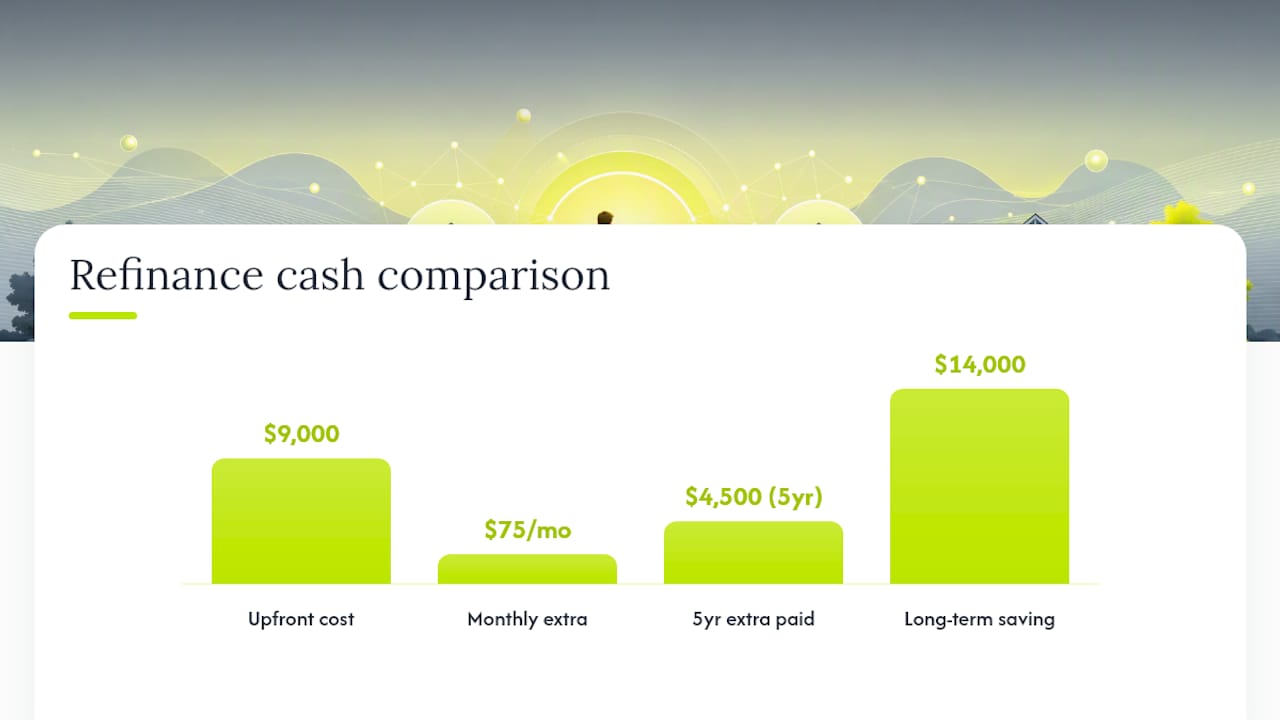
In year one, the paid-cost homeowner is $9,000 poorer in cash but paying less every month. The no-cost homeowner has full liquidity but a monthly bill that’s $75 higher. Five years in, the no-cost homeowner has paid an extra $4,500 in payments, still short of the $9,000 gap, so the no-cost choice remains ahead on total cash outlay.
By year ten, the math flips. The no-cost homeowner has now paid $9,000 more than the paid-cost homeowner spent upfront, and every month after that adds to a growing deficit. If both homeowners hold their loans for the full 30-year term, the paid-cost refinance ends up cheaper by roughly $13,000 to $15,000 in total interest, depending on the exact rate spread.
The lesson isn’t that one structure is universally better. It’s that the crossover point is calculable, specific to your loan size and rate spread, and worth running before you sign anything. A homeowner planning to move in three years and a homeowner planning to stay for fifteen are, financially speaking, answering two completely different questions even though they’re looking at the same rate sheet.
Does a No Closing Cost Refinance Affect Your Taxes?
The tax treatment of refinancing costs depends on which structure you choose, and it’s worth understanding before you file. When you pay closing costs out of pocket on a traditional refinance, most of those fees (appraisal, title, recording) aren’t tax deductible. Points paid to lower your rate typically have to be deducted gradually over the life of the loan rather than all at once, unlike points paid on a home purchase.
With a no-cost refinance, there’s usually nothing to deduct on the cost side because you didn’t pay anything upfront. If you rolled costs into your principal, you’re not creating a new deductible expense. You’re just borrowing more money, and the interest on that additional balance is potentially deductible under the same rules that apply to your regular mortgage interest, subject to the usual limits on mortgage interest deductions.
If you took the higher-rate, lender-credit route, the credit itself typically isn’t taxable income to you. It’s treated as an adjustment to your loan terms, not a payment received. The higher interest you pay as a result is subject to the same mortgage interest deduction rules as any other mortgage interest, again within IRS limits on deductible amounts.
None of this replaces guidance specific to your return. Refinance tax treatment can shift based on whether the loan is for your primary residence, whether you itemize, and how much total mortgage debt you’re carrying. A tax professional can confirm how your specific closing cost structure plays out on your return before you file.
The Real Question Isn’t Cost. It’s Timing
Most articles on this topic treat “no closing cost” like a trick question with a right answer. It isn’t. The conventional advice, always pay costs upfront if you can afford it, ignores that affordability and optimal financial strategy aren’t the same thing. A homeowner who can easily cover $9,000 in fees but plans to relocate for work in two years is better off keeping that cash liquid, even though they technically “could afford” the paid-cost route.
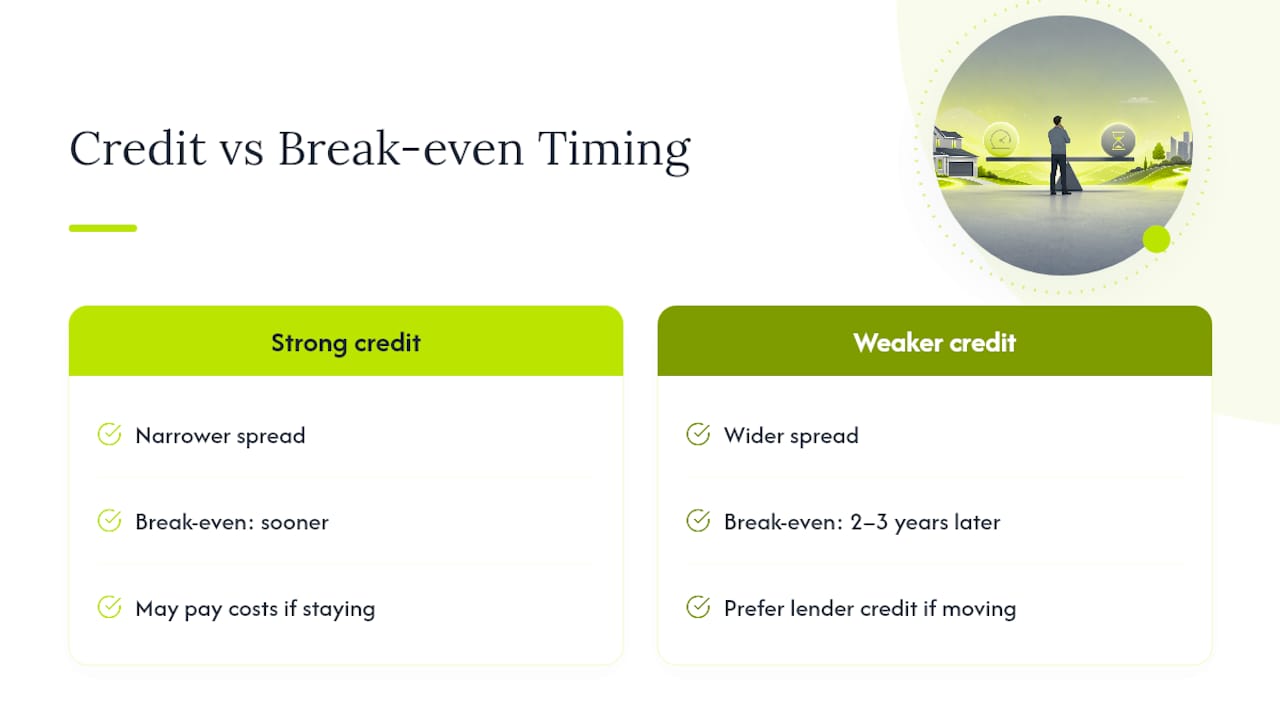
What gets underweighted in most guidance is how much the credit score and loan-to-value combination changes the rate spread, and therefore the entire break-even calculation. Two borrowers with identical loan balances can face break-even points that differ by two or three years simply because one has a stronger credit profile. That’s not a minor detail. It’s the variable that should drive the decision more than generic rules of thumb about “five years or less.”
Prioritize the math specific to your Loan Estimate over any blanket rule you read online. A resource like Jeff Sells San Diego’s breakdown of closing cost structures is a useful primer on how lender-paid credits get priced, but your actual numbers only come from quotes pulled for your loan.
— David Mordue
Get a Break-Even Comparison Before You Choose Either Option
If you’ve read this far, you already know the real decision isn’t “no cost or paid cost.” It’s how long you’ll hold the loan and what your specific rate spread looks like. That’s exactly the comparison David Mordue - Forward Financial Group runs for every refinance client, using a fully online application that can lead to funding in under 21 days once your numbers are locked in.
We pull both quote structures, calculate your break-even point using your actual loan balance and credit profile, and walk you through the APR difference in plain terms, not lender jargon. If you’re carrying a VA loan, an FHA balance, or an investment property loan through David Mordue - Forward Financial Group’s DSCR loan program, the comparison adjusts for your program’s specific rules automatically.
Start by requesting your current rate and Loan Estimate at Davidmordue, and we’ll run the numbers side by side so you can see exactly where your break-even point lands before you commit to either structure.
This article is general information, not a substitute for advice from a qualified financial advisor. Consult a qualified financial professional about your own circumstances before acting on anything here.
Sources
- Is there such a thing as a no-cost or no-closing cost loan or refinancing? | CFPB
- Should I refinance? (CFPB handout)