
Most one-unit primary residence purchases carry no mortgage reserve requirement at all. Fannie Mae sets the minimums most lenders build from. Here’s how to calculate yours and document it correctly.
TL;DR:
- No reserve requirement exists for most primary residence purchases, but actual reserves depend on loan type, often ranging from zero to over a year for jumbo loans.
- Reserves are calculated after closing as the remaining liquid assets, with specific assets like unvested retirement funds and lender-contributed money generally excluded.
- For multiple financed properties, lenders add reserves based on a percentage of the unpaid principal balance, from 2% for up to four properties to over 6% for larger portfolios.
- VA and FHA loans often waive reserve requirements, especially when strong borrower factors or rapid asset seasoning are present.
- Proper documentation of assets and early consultation with a broker can streamline reserve verification and prevent underwriting delays.
Table of Contents
- What Are Mortgage Reserves, Exactly?
- How Many Months of Reserves Do You Actually Need?
- Calculating Reserves When You Own Multiple Financed Properties
- What Lenders Ask You to Prove
- Which Borrowers Are Most Likely to Face Higher Reserve Demands?
- How to Calculate Your Own Reserve Number and Meet It
- When Lenders Waive or Reduce Reserve Requirements
- Getting Your Reserves Documented Without the Guesswork
- How David Mordue Helps You Clear the Reserves Bar Faster
- Sources
- FAQ
What Are Mortgage Reserves, Exactly?
Mortgage reserves are the liquid assets you’ll have left over after your down payment and closing costs clear. That “left over” part trips people up constantly. Borrowers look at their bank balance today and assume that’s their reserve amount, but lenders only count what remains after closing.
Reserves are measured in months of your PITIA: principal, interest, taxes, insurance, and association dues if you have them. If your total monthly housing payment is $2,400, two months of reserves means having $4,800 sitting in qualifying accounts after your closing check clears.
Not every dollar you own counts. Qualifying reserves generally include:
- Checking and savings account balances
- Stocks, bonds, and mutual fund holdings
- Vested retirement account balances (often discounted)
- Cash value of vested life insurance policies
- Certificates of deposit
Assets that typically don’t count: unvested retirement funds, money you can’t withdraw except at retirement or death, funds a lender or seller contributed on your behalf, and cash proceeds from a cash-out refinance on the home you’re buying, according to Fannie Mae’s asset guidelines.
How Many Months of Reserves Do You Actually Need?
The honest answer is “it depends on the loan,” but the guideline minimums give you a real starting point. Fannie Mae’s selling guide spells out the baseline numbers most conventional lenders build their own policies around.
| Loan or property type | Typical minimum reserves |
|---|---|
| One-unit primary residence purchase | None required |
| Second home | 2 months |
| Two to four-unit primary residence | 6 months |
| Investment property | 6 months |
| Cash-out refinance | 6 months |
| Jumbo loan (standard programs) | 6 to 12 months |
| Super-jumbo or investor-heavy jumbo programs | More than a year of reserves often required |
Jumbo lending is where reserve expectations climb fastest. Market guidance on jumbo mortgage requirements puts standard jumbo reserves in the 6 to 12 month range, with larger loan amounts pushing toward the higher end and stricter documentation across the board.
None of these numbers are fixed in stone. Desktop Underwriter and manual underwriting both weigh your full risk profile, so a lender can require more than the published minimum even when your loan type technically qualifies for less. Overlays vary from lender to lender, which is why the number you’re quoted can differ from what a friend was told for an apparently similar loan.
Calculating Reserves When You Own Multiple Financed Properties
Real estate investors run into an extra layer of math that first-time buyers never see. Once you own other financed properties beyond your primary residence, Fannie Mae adds reserves based on a percentage of the aggregate unpaid principal balance (UPB) across those other mortgages.
- Add up the UPB of your other financed properties. Skip the subject property, your principal residence, and anything sold or under a pending sale.
- Apply the applicable percentage tier. It’s 2% for one to four financed properties, 4% for five to six, and 6% for seven to ten when Desktop Underwriter applies.
- Convert the percentage into a dollar reserve requirement. Say you carry $600,000 in aggregate UPB across three rental properties. At 2%, that’s an additional $12,000 in reserves on top of whatever your new loan requires.
Accounts already being paid off at closing don’t factor into the calculation, and this method stacks on top of the standard PITIA reserve for the property you’re financing, not in place of it.
What Lenders Ask You to Prove
Lenders don’t take your word for reserve balances. They want paper trails, and the documentation checklist is fairly predictable once you know what to expect.
- Two to three months of recent bank statements for every account you’re claiming as reserves
- Investment or brokerage account statements showing current balance and vesting
- Proof of vested balance for retirement accounts, since unvested funds don’t count
- Cash value statements for life insurance policies
- Source documentation for any large, unexplained deposit that shows up in your statements
Statements usually need to fall within 60 to 90 days of your application, based on typical lender practice outlined in Fannie Mae’s guidance on reserve documentation. Funds you’re using for your down payment and closing costs get subtracted before your reserve balance is calculated, which is the “after-closing” rule in action. Desktop Underwriter can also flag a file for additional reserves beyond the stated minimum when your overall risk profile warrants it, so a clean application on paper doesn’t guarantee the lowest possible reserve ask.
Which Borrowers Are Most Likely to Face Higher Reserve Demands?
Certain profiles trigger reserve scrutiny more often than others, and it’s worth knowing where you stand before you apply.
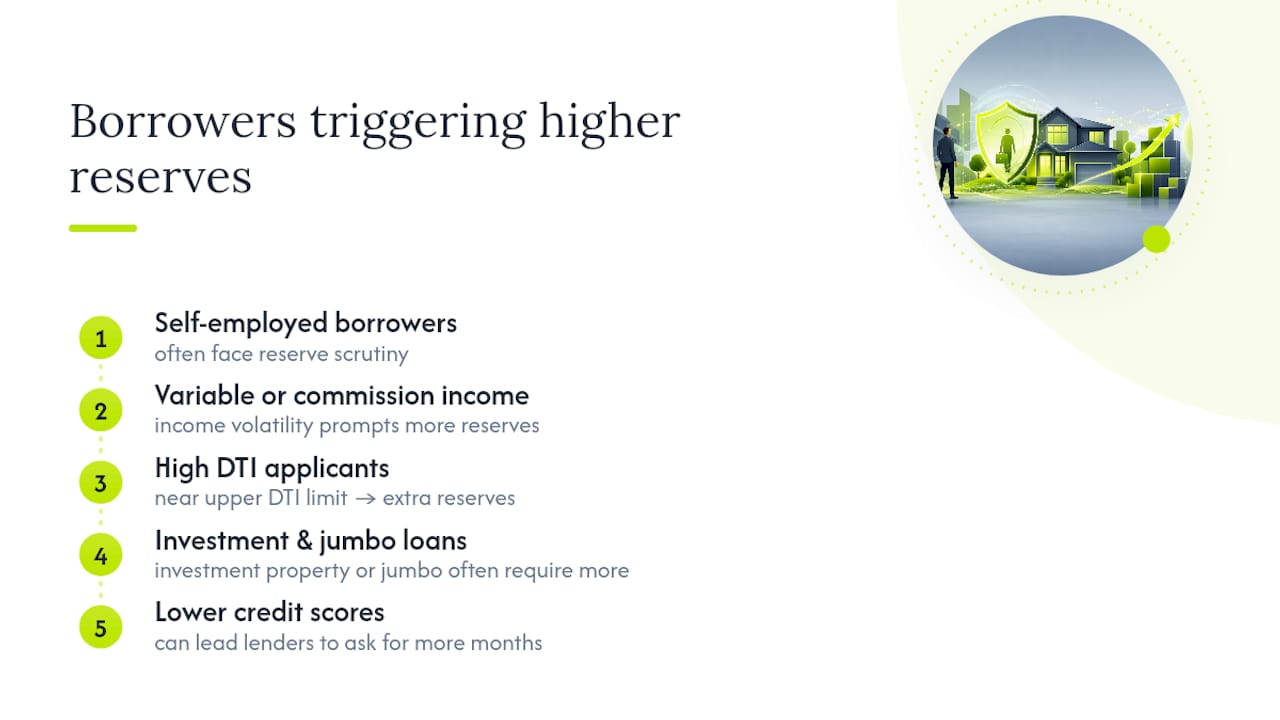
Self-employed borrowers, applicants with variable or commission income, and anyone carrying a debt-to-income ratio near the upper limit tend to see reserve requirements stack up. So do investment property buyers and jumbo loan applicants, almost as a matter of course. A lower credit score can also push a lender to ask for more months in the bank, even on a loan type that technically has a lower published minimum.
Reserves function as a risk offset. The more cushion you show, the less exposed the lender feels if your income dips or an unexpected expense hits right after closing. That’s why meeting the bare minimum and exceeding it aren’t the same conversation.
Meeting the minimum gets your loan approved. Showing six months of reserves when the guideline only asks for two can sometimes support better pricing or smooth over a borderline DTI, particularly with a jumbo lender or an investor-focused loan program. Bankrate’s research on mortgage reserves points to this as a common reason experienced buyers keep more liquidity on hand than the rules technically demand.
How to Calculate Your Own Reserve Number and Meet It
Running your own numbers before you talk to a lender saves you from surprises mid-application.
- Calculate your monthly PITIA for the home you want to buy, including any HOA dues.
- Match your loan and property type to the reserve months in the table above.
- Multiply PITIA by the required months to get your base reserve dollar figure.
- Add UPB-based reserves if you own other financed properties, using the calculation method above.
- Total your qualifying liquid assets and compare that figure against what you need after subtracting down payment and closing costs.
A few tactics help close the gap. Fully vested retirement accounts and brokerage balances document more cleanly than assets tied up in unvested stock grants. Adding a co-borrower with their own liquid assets can boost your combined reserve position. Investors sometimes choose a non-jumbo loan amount specifically to avoid the steeper reserve tiers that come with jumbo underwriting.
Pro Tip: Lenders often discount investment and retirement account balances before counting them toward reserves, since they build in a cushion for taxes or early withdrawal penalties. Document your vesting schedule clearly so the underwriter counts as much of that balance as possible.
When Lenders Waive or Reduce Reserve Requirements
Reserve minimums aren’t universal, and several categories of borrowers see them reduced or waived entirely.
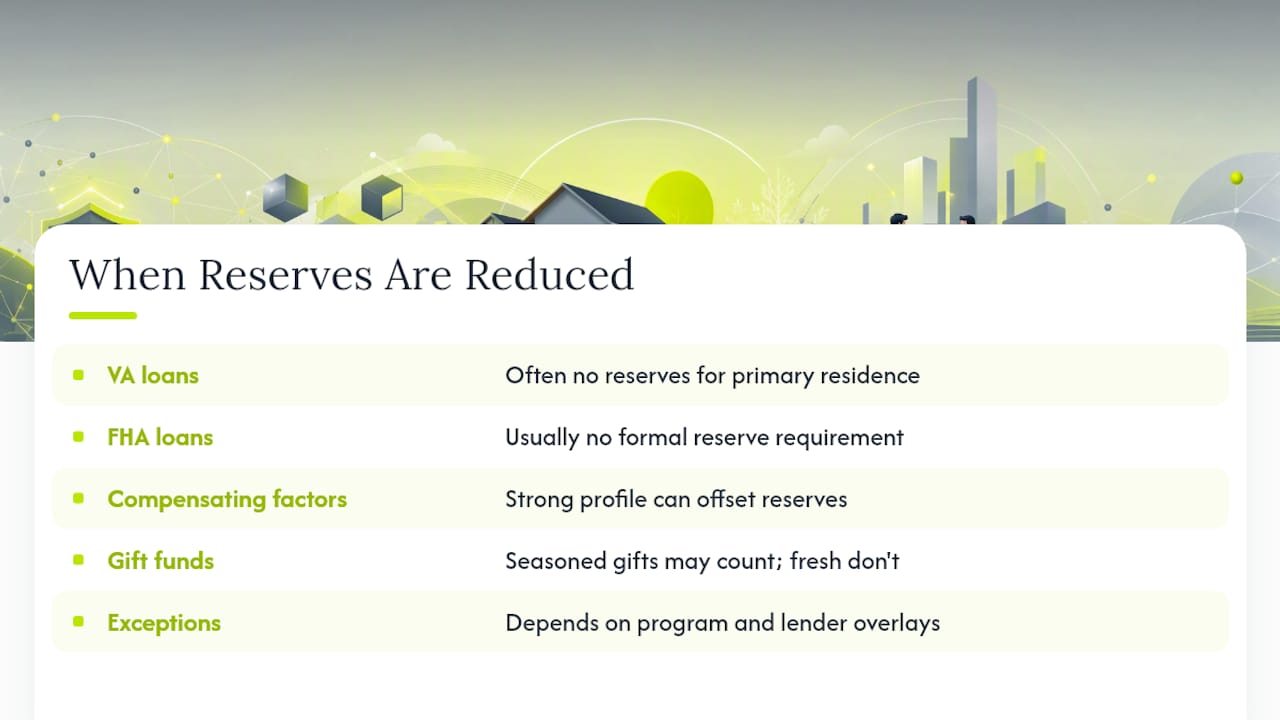
VA loans are the clearest example. Because the VA guarantee shifts risk away from the lender, many VA-backed purchases close with no reserve requirement at all for a primary residence, even though a conventional loan on a similar property might ask for some cushion depending on other risk factors. FHA loans follow a similar pattern for a standard primary residence purchase; reserves usually aren’t a formal requirement, though a lender can still ask for proof of some savings if other parts of the file look thin.
Strong compensating factors can also soften a reserve requirement that would otherwise apply. A borrower with an unusually low DTI, a high credit score, or a large down payment sometimes gets a break from a lender’s internal overlay, even when Fannie Mae’s published minimum technically calls for reserves. This is where automated underwriting through Desktop Underwriter matters: a strong overall risk profile can occasionally offset a thinner reserve position, since DU weighs the full file rather than reserves in isolation.
Gift funds complicate this picture. Gift money can sometimes count toward reserves once it’s seasoned in your account for the required time, but a fresh, undocumented deposit right before closing almost never qualifies. If you’re counting on family help to hit a reserve target, get that money into your account early and get a proper gift letter on file. None of these exceptions are guaranteed. They depend on the specific loan program, the lender’s overlays, and how the rest of your application looks, so the safest move is confirming your situation with a broker before you assume you’re exempt.
Getting Your Reserves Documented Without the Guesswork
Reserve calculations look straightforward on paper until you’re staring at your own bank statements wondering what actually counts. That’s the part where a broker earns their keep, sorting vested from unvested, matching your file to the right loan program, and catching a documentation gap before an underwriter does.
Using a mortgage broker’s online application can give you a clear picture of what your file needs early, rather than discovering a reserve shortfall midway through underwriting. Personalized consultations can help identify which accounts qualify and how to package statements to avoid flags for extra explanation. Getting that paperwork organized before submission is one of the best ways to avoid delays.
— David Mordue
How David Mordue Helps You Clear the Reserves Bar Faster
Mortgage brokers can provide clear answers on your reserve requirement without the back and forth of a traditional lender’s intake process. Some offer fully online loan applications that flag needed documentation up front, and personalized rate comparisons across lenders can help find programs with potentially lower reserve requirements.

If you’re buying a second home, an investment property, or working through a jumbo purchase where reserve months add up fast, a quick consultation can map out exactly which accounts qualify and how much cushion your specific loan needs. That clarity, paired with an online process built for speed, is how clients have moved from application to funding in under 21 days. Start your home purchase or refinance application today and get a straight answer on what your reserves actually need to look like.
This article is general information, not a substitute for advice from a qualified financial advisor. Consult a qualified financial professional about your own circumstances before acting on anything here.
Sources
- Minimum Reserve Requirements | Fannie Mae
- What Are Mortgage Reserves And Who Needs Them? | Bankrate
- Homebuyer
FAQ
Do all mortgage loans require reserves?
No. A one-unit primary residence purchase typically has no reserve requirement under Fannie Mae’s guidelines. Second homes, investment properties, multi-unit primary residences, and jumbo loans usually do.
How much reserve is needed for a jumbo loan?
Jumbo programs commonly require 6 to 12 months of PITIA in reserves, with larger loan amounts and super-jumbo programs sometimes requiring more, according to current jumbo mortgage guidance. Exact requirements vary by lender.
What counts as an acceptable mortgage reserve asset?
Checking and savings balances, brokerage accounts, vested retirement funds, and cash value life insurance policies generally qualify, per Bankrate’s breakdown of reserve assets. Unvested funds and lender-contributed money don’t count.
How are reserves calculated for investors with multiple properties?
Lenders apply a percentage to the aggregate unpaid principal balance of your other financed properties, ranging from 2% for one to four properties up to 6% for seven to ten, based on Fannie Mae’s UPB method. This adds to, rather than replaces, your standard PITIA reserve.
Can reserve requirements be waived?
Yes, in some cases. VA loans and standard FHA purchases often carry no formal reserve requirement for a primary residence, and strong compensating factors can sometimes reduce what a lender otherwise asks for.
Does David Mordue - Forward Financial Group help with reserve documentation?
Yes. Personalized consultations through David Mordue - Forward Financial Group help identify which of your assets qualify as reserves and how to organize statements before underwriting review.