
Get written Loan Estimates from three to five lenders before you decide on anything. Compare the APR and itemized fees, not just the headline interest rate. Then use those competing offers as leverage to negotiate a better deal, and lock the rate once you’re confident it’s the strongest one on the table. That’s the whole game, and everything below explains how to play it well.
TL;DR:
- Comparing interest rates, APR, fees, and loan features across multiple lenders reveals significant cost differences worth thousands over the loan life.
- Providing consistent loan amount, property, and financial details to each lender ensures that Loan Estimates are comparable and reliable for decision-making.
- Locking the rate should occur after choosing a suitable offer, with shorter locks preferred; float-down options can add flexibility if available.
- Shopping within a tight timeframe, ideally three days, minimizes market risk and leverages faster lenders or brokers to secure better rates.
- Negotiating with lenders using written competing offers can lead to fee reductions or better terms, as most will adjust to secure your business.
Table of Contents
- What Fields Should You Compare on Every Mortgage Rate Quote?
- How Do You Request Comparable Quotes, and What Does the Law Require?
- What Determines the Rate You’re Actually Offered?
- Interest Rate vs. APR: What Do These Numbers Actually Tell You?
- Step-by-Step: Shop Mortgage Rates in One to Three Days
- How Do You Negotiate a Better Mortgage Offer?
- When Should You Lock Your Rate, and How Do Float-Downs Work?
- What Do Small Rate Differences Actually Cost You Over Time?
- How David Mordue Helps You Execute This Workflow
- The One Rule I Give Every Client When Rates Are Moving
- Ready to Compare Your Own Mortgage Rate Offers?
- Where to Verify These Rules and Run Your Own Numbers
- Sources
What Fields Should You Compare on Every Mortgage Rate Quote?
Every Loan Estimate you receive should get measured against the same short list of fields. Skip this step and you’re comparing apples to oranges, which is exactly how borrowers end up choosing a worse loan because the marketing looked better.
Here’s what actually belongs on your comparison list:
- Interest rate, APR, loan term, and the monthly principal-and-interest payment. The rate alone tells you almost nothing without the other three numbers next to it.
- Whether the rate assumes discount points, and what those points cost. A “great” rate paired with two points can cost more upfront than a slightly higher rate with none.
- Itemized closing costs, origination fees, and third-party fees. Title insurance, appraisal costs, and recording fees vary by lender even when the rate looks identical.
- Mortgage insurance and how it changes your APR and monthly payment. Private mortgage insurance on a conventional loan and mortgage insurance premiums on an FHA loan affect your real cost differently.
- Risky loan features: prepayment penalties, balloon payments, and adjustable-rate caps. These rarely show up in casual rate-shopping conversations, but they can cost you tens of thousands of dollars if you don’t ask.
- Rate lock terms and float-down availability. Two lenders offering the “same” rate can lock it for wildly different windows and charge different fees if you want to float down later.
Pro Tip: Print or screenshot each Loan Estimate side by side in a spreadsheet. Lenders format disclosures a little differently, and it’s easy to lose track of which fee belongs where once you’re three quotes deep.
The FTC’s mortgage shopping guidance makes a point worth repeating: a low advertised rate can hide higher costs buried in points or fees. Reading the full Loan Estimate, not just the top line, is the only way to catch that.
How Do You Request Comparable Quotes, and What Does the Law Require?
Getting quotes you can actually compare takes a bit of discipline on your end. Giving consistent information to each lender ensures that the Loan Estimates you receive are comparable.
- Pull your credit report first so you know your real score range, not a guess. A 20-point swing can move your rate noticeably.
- Decide on your loan amount, down payment, and property type before you call anyone, and give every lender the identical numbers. Consistency here is what makes the comparison valid.
- Submit applications to three to five lenders within a tight window. Most credit scoring models treat multiple mortgage inquiries made within a 15 to 45 day span as a single inquiry, so shopping around doesn’t have to hurt your score the way people assume.
- Wait for the Loan Estimate. Federal rules require that a lender deliver a standardized Loan Estimate within three business days after receiving your application. If a lender is dragging past that window, that’s a signal worth noting.
- Line up all the Loan Estimates and compare them using the same checklist covered above, before you respond to any single lender.
Where you shop matters too. Banks tend to offer relationship discounts if you already hold accounts with them, but their rate flexibility can be limited by strict internal pricing grids. Credit unions often have competitive rates and lower fees since they’re member-owned, though their loan menu may be narrower. Online lenders move fast and are convenient for quick comparisons, but customer service can feel impersonal when something unusual comes up in underwriting. A mortgage broker, meanwhile, works across multiple lenders on your behalf, which can save you the legwork of contacting each one separately, though it’s worth understanding how that broker gets paid.
One thing federal regulators have been explicit about: neither a lender nor a broker is obligated to find you the best possible loan. The CFPB’s guidance on digital comparison platforms makes clear that the burden of shopping around falls on you, the borrower. Nobody else is doing this work for you by default.
What Determines the Rate You’re Actually Offered?
The rate you see advertised online is a benchmark, not a promise. Your personal quote depends on a stack of variables specific to you, your loan, and the lender you’re talking to.
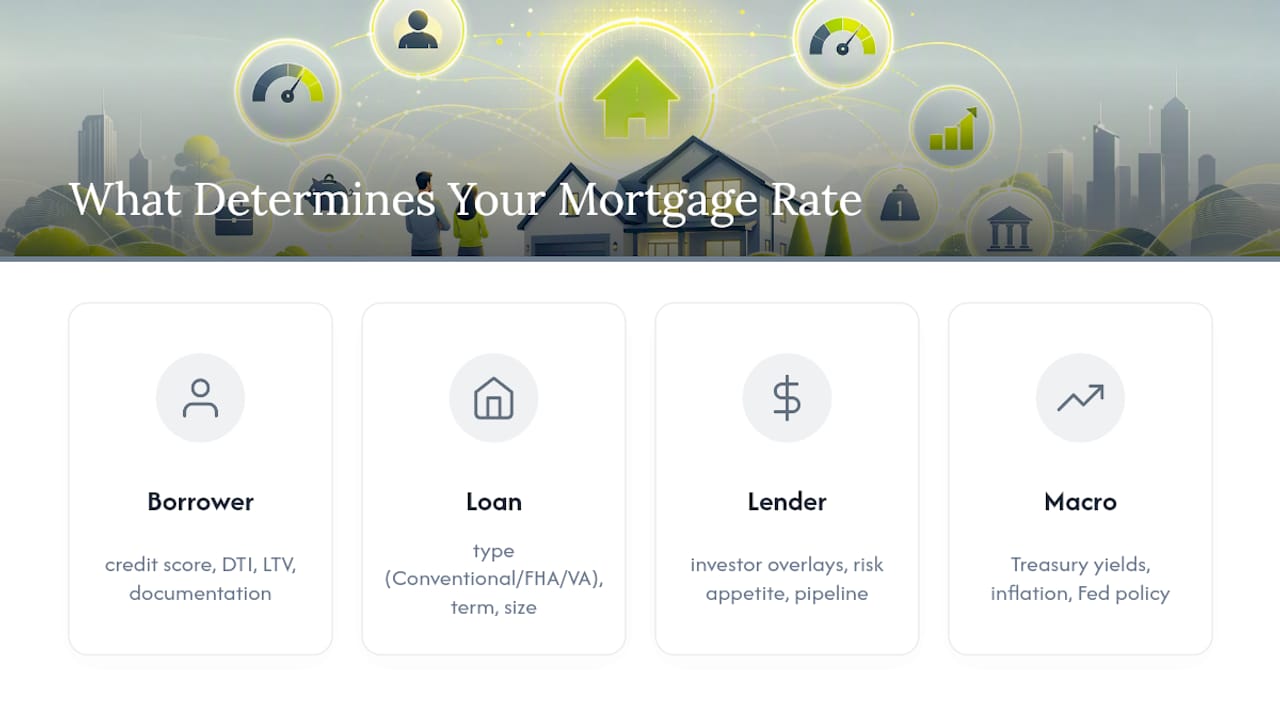
Borrower-level factors carry the most weight. Your credit score is the biggest lever, since lenders price risk in tiers, and even a jump from the high 600s to the mid 700s can shift your rate meaningfully. Your debt-to-income ratio (DTI) matters almost as much, because it tells the lender how much room you have if expenses rise. Your loan-to-value ratio (LTV), which reflects your down payment size relative to the purchase price, affects both your rate and whether you’ll pay mortgage insurance. Documentation type and how “seasoned” your assets are (meaning how long the money has sat in your account) round out the picture. The CFPB outlines these borrower-level drivers in detail, and it’s worth understanding each one before you apply.
Loan-level factors shift the math too. A conventional loan, an FHA loan, or a VA loan each come with different pricing structures and insurance requirements. Term length matters. A 15-year fixed loan typically carries a lower rate than a 30-year fixed loan because the lender’s risk window is shorter. Loan size plays a role as well. Conforming loans that fit within Federal Housing Finance Agency limits are usually priced more favorably than jumbo loans, which exceed those limits and carry more risk for the lender.
Lender-level pricing varies more than most people expect. Two lenders can look at the identical borrower profile and land on different rates because of their own investor overlays, their appetite for a particular loan type that week, or how full their production pipeline already is. This is precisely why shopping multiple lenders isn’t optional if you want the best price. It’s the only way to see that spread.
Macro drivers set the floor everyone is pricing against. Treasury yields, inflation expectations, and Federal Reserve policy move the broad direction of rates, and individual lenders adjust their own offers daily, sometimes multiple times a day, around that baseline. Advertised “as low as” rates you see in ads or on comparison sites reflect a best-case borrower profile under that day’s market conditions. They’re a useful starting reference, not a quote you should expect to receive yourself.
Interest Rate vs. APR: What Do These Numbers Actually Tell You?
The interest rate is the cost of borrowing the principal, expressed as a percentage. The APR (annual percentage rate) rolls that rate together with most upfront costs, including origination fees, discount points, and certain closing costs, then spreads them across the loan term to show you a more complete annual cost. When two loans have the same rate but different APRs, the one with the lower APR is generally cheaper once fees are factored in.
This distinction is exactly what the FTC recommends borrowers check first when comparing offers, because a lender advertising a low teaser rate can bury the real cost in points and fees that never show up in the headline number.
A few rules of thumb make this easier to apply:
- A lower rate with a higher APR usually means more upfront costs. Somebody is paying for that lower rate somewhere, and it’s usually you, at closing.
- Points buy down your rate, but only pay off over time. One point typically costs 1% of your loan amount and might lower your rate by roughly 0.25%, though the exact trade varies by lender.
- Break-even math tells you whether points are worth it. Divide the cost of the points by your monthly savings from the lower rate. If you plan to keep the loan (or stay in the house) past that break-even point, the points make sense. If not, skip them.
- APR isn’t perfect, but it’s the best single number for comparing structurally different offers. Use it alongside the itemized fee list, not instead of it.
Comparing multiple lenders isn’t just a nice-to-have step. Requesting even one additional quote can save an average of $1,500 over the life of the loan, and shopping five lenders can push that figure toward roughly $3,000. That’s real money sitting in the gap between the first offer you get and the fifth one.
Step-by-Step: Shop Mortgage Rates in One to Three Days
Mortgage rate shopping doesn’t need to drag out for weeks. Move with intention and you can gather, compare, and act on quotes within a few days, which also limits how long your credit inquiries stay clustered together.
-
Prepare your file before you contact a single lender. Pull your credit report, gather your last two pay stubs, your most recent W-2s or tax returns, and two months of bank statements. Decide roughly what loan type you’re targeting (conventional, FHA, VA) and how much you plan to put down. The rent vs. buy calculator is a useful gut-check here if you’re still weighing whether now’s the right time to buy at all.
-
Contact three to five lenders on the same day, or within 24 to 48 hours of each other. Give every one of them the exact same numbers: same credit score range, same down payment, same loan amount, same property type. This is non-negotiable if you want a fair comparison.
-
Wait for your Loan Estimates. Each lender has three business days to deliver one once you’ve submitted a completed application. Don’t accept a verbal quote as a substitute. Verbal numbers change; the Loan Estimate is the document that holds a lender accountable.
-
Lay every Loan Estimate side by side and run them through your checklist. Rate, APR, monthly payment, points, itemized fees, mortgage insurance, and lock terms. The lowest rate and the best overall deal aren’t always the same loan.
-
Take your strongest competing offer back to the lender you’d actually prefer to use, and ask them to match or beat it. This is the step most borrowers skip, and it’s the one that captures the bulk of the savings.
-
Choose the best overall package and confirm the lock details in writing. Note the lock length, the expiration date, and whether a float-down option is included before you sign anything.
Pro Tip: Do this during a week when your income and asset documentation are current. If your pay stubs or bank statements are more than 30 days old by the time you close, some lenders will require refreshed documents, which can quietly slow down your closing timeline.
Speed matters more than most first-time buyers realize. Rates can move meaningfully within a single week, so a workflow that takes three days instead of three weeks protects you from chasing a rate that’s already gone by the time you act on it. This is also where working with a broker who can turn applications around quickly, rather than one that takes a week just to get you a preliminary quote, makes a measurable difference in the rate you actually lock.
How Do You Negotiate a Better Mortgage Offer?
A written Loan Estimate is leverage. Once you have one in hand, you can go back to a competing lender and ask them directly to match it or explain why their offer is better despite the difference.
The CFPB’s own guidance on mortgage shopping confirms this works. Lenders regularly adjust fees, and sometimes rates, when a borrower shows up with a competing offer in writing rather than a vague claim that “someone else quoted me lower.”
A simple script works better than you’d expect: “I have a Loan Estimate from another lender showing a rate of X% and total closing costs of $Y. Can you match this, or come closer to it?” Lenders that want your business will often find room, particularly on fees they control directly.
Some fees may be negotiable, such as origination and processing fees, while third-party fees like appraisal costs and title insurance typically are fixed. Discount points may be adjusted depending on rate and upfront cost trade-offs.
If you’re working with a mortgage broker, ask directly how they’re compensated and whether that compensation changes based on which lender or loan product they place you with. A broker who aggregates offers across a wide lender network can genuinely save you time and money, but that value only holds up if they’re transparent about their own incentives.
Watch for red flags too: a lender who won’t put quoted numbers in writing, pressure to lock before you’ve seen a Loan Estimate, or fees that appear on your Closing Disclosure with no explanation you were given upfront. Any of those should slow you down, not speed you up.
When Should You Lock Your Rate, and How Do Float-Downs Work?
A rate lock freezes your interest rate for a set period, typically 30, 45, or 60 days, while your loan moves through underwriting. Shorter locks are usually free; longer ones, especially anything past 60 days, often carry a fee or a slightly higher rate to compensate the lender for the added risk.

A float-down option lets you capture a lower rate if the market improves after you’ve locked, usually for a fee or a slightly higher initial rate in exchange for that flexibility. Not every lender offers this, and it’s worth asking about explicitly, since it rarely gets mentioned unless you bring it up first.
Timing your lock is part instinct, part math. Lock too early and you’re stuck if rates drop before closing. Lock too late and you’re exposed if rates climb during underwriting. A reasonable approach: lock once you’ve compared offers, chosen your lender, and have a realistic closing date in view, then confirm the lock covers that date with a buffer for delays.
A typical mortgage timeline runs something like this: application and Loan Estimate delivery in the first few days, processing and documentation for one to three weeks, underwriting and conditions in another one to two weeks, then a closing disclosure at least three business days before signing. Appraisal delays and document requests are the most common things that push this out.
This is where processing speed genuinely protects you. A lender that can move from application to funding in under 21 days, which is the standard David Mordue’s team works toward, shortens the window where a rate swing can undo your careful shopping. The refinance calculator is a good way to see how that speed translates into real savings if you’re comparing a refi timeline specifically.
What Do Small Rate Differences Actually Cost You Over Time?
A quarter-point or half-point difference in your rate sounds small until you run the numbers across a 30-year loan. Here’s how it plays out on a $400,000 home purchase with a 10% down payment, meaning a $360,000 loan amount.
These figures assume a standard amortization schedule and don’t include property taxes, homeowners insurance, or mortgage insurance, all of which layer on top of the P&I figure and vary by lender and loan type.
A borrower with a stronger credit profile and a larger down payment typically lands toward the lower end of a lender’s pricing range, while a borrower with a thinner credit file or a smaller down payment lands toward the higher end. The CFPB’s rate exploration tool lets you plug in your own credit score, down payment, and loan type to see how those variables shift your realistic range, which is a far more useful exercise than staring at a national average rate that assumes a borrower profile that may not be yours.
The lesson buried in this table isn’t just “shop around.” It’s that the effort of collecting three to five Loan Estimates, which realistically takes an afternoon of phone calls and paperwork, can be worth tens of thousands of dollars over the life of a loan. Few other financial decisions offer that kind of return on a few hours of work.
How David Mordue Helps You Execute This Workflow
Everything in this guide comes down to speed, documentation, and having someone who can turn a competing offer into a stronger one. That’s the specific gap David Mordue’s process is built to close.
The application runs fully online, and funding often lands in under 21 days once your file is complete, which matters most when rates are moving and every extra week in processing is a week of exposure. Instead of guessing at how a lower rate with higher fees stacks up against a higher rate with fewer costs, the refinance calculator and rent vs. buy calculator let you model the trade-off with your own numbers before you commit to anything.
Personalized consultations walk through your specific credit profile, loan-type options, and current market pricing rather than handing you a generic rate sheet. Clients who’ve refinanced through David Mordue’s team have reported meaningful monthly savings by comparing their existing loan against current market offers, the same comparison exercise this article walks through step by step.
If you’re weighing an adjustable-rate structure against a fixed loan, the breakdown of ARM features and risk factors is worth reading before you request quotes, since it changes what “comparable” even means across your Loan Estimates.
The One Rule I Give Every Client When Rates Are Moving
Markets are unpredictable, and I’ve learned to stop pretending clients can time them perfectly. The rule I give people instead is simple: control what you can control, and move fast on the rest.
That means getting your documentation ready before you request a single quote, comparing Loan Estimates on APR and total fees rather than the rate alone, and using your strongest competing offer as leverage rather than sitting on it politely. Speed plus good paperwork consistently beats waiting around hoping the market improves in your favor. Rates are just as likely to move against you as they are to move in your favor, and hesitation rarely pays off either way.
The borrowers who end up with the best deals aren’t the ones who found some secret lender with impossibly low rates. They’re the ones who did the boring work of collecting real, written offers and then had the nerve to ask for better terms once they had them in hand. That’s not a complicated strategy. It’s just one most people skip.
— David Mordue
Ready to Compare Your Own Mortgage Rate Offers?
David Mordue - Forward Financial Group gives you a faster path to a real, personalized comparison than piecing together quotes from five separate call centers yourself. The application is entirely online, personalized consultations walk you through your actual numbers instead of a generic rate sheet, and funding can land in under 21 days once your file is complete, which matters if you’re trying to lock in a rate before the market shifts again.
Getting started takes less prep than you’d think. Before you reach out, gather your last two pay stubs, your most recent tax returns, and two months of bank statements, the same documents any lender will ask for. If you’re not sure where you stand yet, run your numbers through the refinance calculator or check your affordability with the conventional affordability calculator first. When you’re ready for a real quote instead of an estimate, start your preapproval or refinance consultation and see how your numbers compare against what you’ve already gathered.
Where to Verify These Rules and Run Your Own Numbers
The CFPB’s Loan Estimate guidance walks through exactly what belongs on the form and how to read it line by line. For a broader shopping perspective, Rate Grove’s overview of comparison shopping in banking is a useful outside read on how rate comparison works across financial products generally.
Beyond that, the FTC’s mortgage FAQ and Freddie Mac’s lender-shopping tips round out the official guidance worth bookmarking before you start requesting quotes.
This article is general information, not a substitute for advice from a qualified financial advisor. Consult a qualified financial professional about your own circumstances before acting on anything here.
Sources
- Request and review multiple Loan Estimates | Consumer Financial Protection Bureau
- TILA-RESPA integrated disclosure FAQs | CFPB
- Shopping for a mortgage: FAQs | FTC