
You’ll encounter two payment structures: borrower-paid, where you cover the fee upfront in exchange for a lower rate, or lender-paid, where the lender absorbs the cost and bakes it into a slightly higher rate. Either way, federal rules require these fees to appear on your Loan Estimate, and they’re almost always negotiable.
TL;DR:
- Mortgage broker fees typically range from 0.5% to 2.75% of the loan amount, translating to $1,250 to $13,750 depending on the loan size and fee structure.
- Borrower-paid fees cost upfront and lower monthly payments if holding the loan long-term, while lender-paid fees are built into a slightly higher interest rate and favor short-term or quick refinancing borrowers.
- Realistically comparing both options requires calculating the break-even point based on how long you plan to keep the loan, with longer terms favoring upfront fees and shorter terms favoring higher ongoing costs.
- Third-party closing costs like appraisal, title, and recording fees are pass-through charges and should be distinguished from broker compensation, which is subject to regulation and transparency requirements.
- Negotiating broker fees is common, especially when obtaining multiple offers, and copying offers from different brokers or lenders provides leverage to secure lower costs.
Table of Contents
- How Much Are Mortgage Broker Fees on a Typical Loan?
- Who Pays the Broker: You or the Lender?
- Where Do Broker Fees Show Up on Your Paperwork?
- Borrower-Paid or Lender-Paid: Running the Break-Even Math
- Beyond the Broker Fee: Other Charges to Watch
- How to Shop and Negotiate Broker Fees
- How David Mordue Handles Fee Disclosure
- Independent Brokers vs. Bank-Affiliated Brokers: Fee Differences
- Broker Fees vs. Direct Lender Fees: Which Costs Less?
- What Is a Yield Spread Premium, and Does It Affect You?
- When a Broker Makes Sense, and When It Doesn’t
- Get a Fee Breakdown Built Around Your Actual Numbers
- Where to Verify These Rules Yourself
- Sources
- FAQ
How Much Are Mortgage Broker Fees on a Typical Loan?
The percentage sounds abstract until you attach it to a real loan amount. Here’s what that 0.5% to 2.75% range actually means in dollars, using 1% as the common benchmark most brokers and market summaries cite.
- $250,000 loan: 1% equals $2,500; the full range spans $1,250 to $6,875
- $400,000 loan: 1% equals $4,000; the full range spans $2,000 to $11,000
- $500,000 loan: 1% equals $5,000; the full range spans $2,500 to $13,750
Some brokers charge a flat fee instead of a percentage, particularly on smaller loans where a percentage-based fee would round down to an unusually low number. You’ll also see fee amounts vary by state, since local competition among brokers and lenders shifts pricing more than any single rule.
Fee Fact: Federal law technically permits broker compensation up to 3% of the loan amount on Qualified Mortgages, but you’ll rarely see brokers charge the maximum. A 0.5% difference in fees on a $400,000 loan works out to $2,000, which is real money worth negotiating over rather than accepting at face value.
In practice, competitive pressure keeps most brokers well under that cap.
Who Pays the Broker: You or the Lender?
Every mortgage broker gets paid one of two ways, and federal rules prohibit collecting both on the same loan. Understanding which one you’re looking at changes how you should read your Loan Estimate.
- Borrower-paid compensation: You pay the fee directly at closing, either in cash or rolled into the loan balance, and in exchange you typically get a lower interest rate.
- Lender-paid compensation: The lender pays the broker, and that cost gets recovered through a slightly higher rate baked into your loan for its entire life.
The tradeoff comes down to timing. Borrower-paid fees cost you money now but save you money every month for as long as you hold the loan. Lender-paid compensation costs you nothing at closing but quietly taxes you every month through a higher rate, which adds up fast if you keep the loan for decades.
Pro Tip: If you’re short on cash for closing but plan to stay in the home long-term, ask your broker to model both scenarios side by side rather than assuming lender-paid is the “free” option. A rate that’s even a quarter point higher can cost more than the upfront fee within a few years.
Which one fits you depends heavily on how long you expect to keep the loan, a question the break-even math further down answers with real numbers. Borrowers who move or refinance within a few years often come out ahead with lender-paid compensation. Borrowers settling in for the long haul almost always save more paying the fee upfront.
Where Do Broker Fees Show Up on Your Paperwork?
Your Loan Estimate lists broker compensation under “Origination Charges” in Section A, with separate columns showing what you pay versus what gets paid by others (typically the lender). The Closing Disclosure repeats this breakdown with final, locked-in numbers once your loan is ready to fund.
- Check Section A of the Loan Estimate for the origination charge line item and its dollar amount.
- Compare the “Paid by Borrower” and “Paid by Others” columns to identify which compensation model applies to your loan.
- Confirm the numbers match between your Loan Estimate and Closing Disclosure; discrepancies should be questioned immediately.
Timing matters here. Lenders must deliver your Loan Estimate within three business days of your application, and your Closing Disclosure must arrive at least three business days before you sign. That window exists specifically so you have time to review, compare, and question the numbers before you’re locked in.
Regulation Z, the rule implementing the Truth in Lending Act, bans brokers from being compensated based on your loan’s terms (other than the loan amount itself), and it bars them from collecting compensation from both you and the lender on the same transaction. This is also where Qualified Mortgage points-and-fees caps kick in, setting tiered limits on total fees for loans that qualify for QM status. Together, these rules exist to stop brokers from steering you into a worse loan just because it pays them more.
Borrower-Paid or Lender-Paid: Running the Break-Even Math
The right choice hinges on one question: how long do you plan to keep this loan? Here’s a simple method to answer it yourself.
- Calculate your upfront cash difference between the borrower-paid and lender-paid options.
- Calculate your monthly payment difference between the two rate options.
- Divide the upfront difference by the monthly savings to find your break-even point in months.
- Compare that break-even point to how long you realistically expect to keep the loan.
A $400,000 loan illustrates how dramatically the right answer shifts with your timeline.
| Hold period | Best option | Why |
|---|---|---|
| 2 years (short) | Lender-paid | You avoid the upfront fee entirely and sell or refinance before the higher rate costs you more than you saved |
| 6 years (medium) | Depends on break-even point | If break-even lands under 6 years, borrower-paid usually wins; if it lands beyond, lender-paid may still be cheaper |
| long | Borrower-paid | The upfront fee gets recovered many times over through decades of lower monthly payments |
Run your own numbers rather than trusting a rule of thumb; a refinance calculator makes this comparison fast once you have both Loan Estimates in hand. And don’t stop at comparing the fee itself. Look at the APR on each option, since APR folds in the interest rate, points, and most fees into a single number that reflects your true annual cost, which the sticker rate alone never shows.
Beyond the Broker Fee: Other Charges to Watch
Your broker’s compensation is only one line item among several on your closing paperwork. Third-party costs like appraisal fees, credit report charges, title insurance, and recording fees get passed through to you regardless of who you work with, and they’re standard across nearly every mortgage.
- Appraisal, credit report, title, and recording fees are pass-throughs, not broker markup.
- Processing or administrative fees are separate from the broker’s compensation and should be itemized on their own.
- Ask directly what each fee covers if a line item looks vague or unexplained.
Pro Tip: Treat “no fee” marketing with suspicion. A broker or lender advertising zero upfront cost is almost always recovering that money through a higher rate. Always ask what the same loan would cost with the fee paid upfront versus rolled into the rate.
How to Shop and Negotiate Broker Fees
Getting a fair deal starts with volume: collect real numbers from multiple sources before you commit to anyone.
- Request at least three Loan Estimates, mixing independent brokers and a direct lender, so you’re comparing real offers rather than advertised rates.
- Ask each broker for a side-by-side breakdown of borrower-paid versus lender-paid scenarios on the same loan amount.
- Verify each broker’s license and disciplinary history through NMLS Consumer Access before you share sensitive financial information.
- Compare total cost and APR, not just the headline fee percentage.
Once you have competing offers, negotiate directly:
- “Is your fee negotiable, and what would it take to lower it?”
- “What exactly do your processing fees cover?”
- “Can any part of this fee be offset by a lender credit?”
Strong credit, a larger loan amount, and competing quotes in hand are your three biggest levers. Broker commission is more flexible than most first-time buyers assume, especially once a broker knows you’re comparing offers elsewhere.
How David Mordue Handles Fee Disclosure
Transparency around fees shouldn’t require you to decode paperwork on your own. Some mortgage brokerages use a fully online application process designed to move loans toward funding in under 21 days, a pace that matters when you’re racing a closing deadline or a rate lock.
- Personalized consultations may walk through borrower-paid versus lender-paid math using actual loan numbers, not generic examples.
- The rent vs. buy calculator helps you weigh how long you’ll likely hold a mortgage, which directly informs which fee structure saves you more.
- Rate comparisons from multiple lenders can show how broker access to wholesale pricing stacks up against a single bank’s offer.
Independent Brokers vs. Bank-Affiliated Brokers: Fee Differences
Not all brokers price the same way, and the distinction between independent and bank-affiliated matters more than most borrowers realize.
Bank-affiliated brokers, sometimes called loan officers working under a bank’s mortgage division, may have fee structures baked into the bank’s broader pricing rather than itemized as a separate line item you negotiate directly. Their compensation still shows up on your Loan Estimate, but the flexibility to shop it against competing offers is often narrower since you’re working within one institution’s rate sheet.
The practical difference shows up in your negotiating leverage. With an independent broker, you can point to a competing Loan Estimate from another wholesale lender and ask for a matching adjustment. With a bank-affiliated broker, that lever weakens because the bank isn’t necessarily competing against its own wholesale pricing.
Neither structure is inherently better for every borrower. A bank-affiliated broker can make sense if you already bank there and value bundled account relationships. An independent broker tends to win on pure price competition, since their entire value proposition rests on shopping your loan across a wider lender pool. Ask each type directly how their fee is calculated and whether it’s flexible, since the answer reveals more about your leverage than the label “independent” or “bank-affiliated” ever will.
Broker Fees vs. Direct Lender Fees: Which Costs Less?
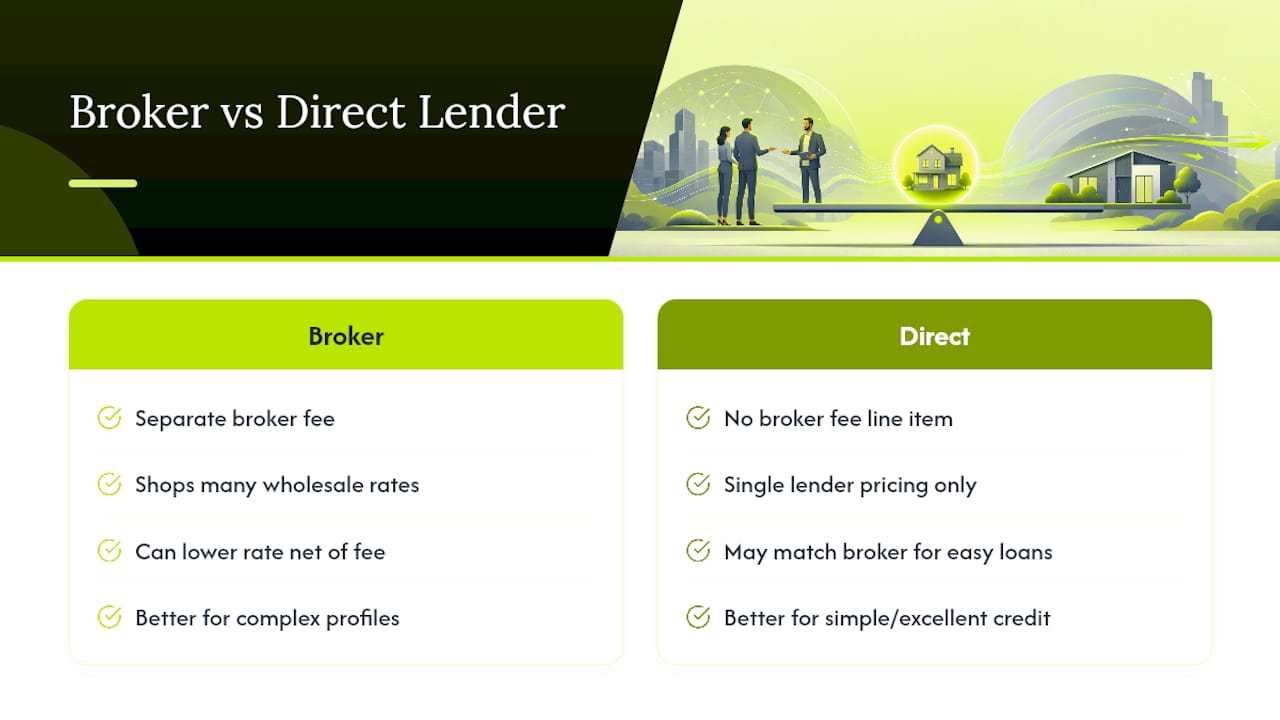
Going direct to a lender doesn’t automatically mean lower costs, even though it eliminates the broker’s line item entirely. Direct lenders still charge origination fees, underwriting fees, and processing fees that often add up to a similar percentage of your loan amount, just labeled differently on your disclosures.
The real comparison isn’t broker fee versus zero fee. It’s broker fee versus lender origination charges, and which path gets you the better overall rate. Brokers earn their value through access to multiple wholesale lenders simultaneously, which sometimes produces a lower rate that offsets their fee entirely. A single direct lender, by contrast, can only offer you their own pricing, which may or may not be competitive that week.
Savings potential runs both directions depending on your credit profile and loan type. Borrowers with excellent credit and straightforward income documentation sometimes get equally aggressive pricing direct from a large lender, since those lenders compete hard for easy-to-underwrite loans. Borrowers with more complex financial situations, self-employment income, or unusual property types often find brokers deliver meaningfully better pricing because brokers can shop that complexity across lenders built to handle it.
The only way to know which route wins for your situation is collecting real Loan Estimates from both and comparing APR side by side, exactly as outlined in the shopping checklist above.
What Is a Yield Spread Premium, and Does It Affect You?
A yield spread premium is compensation a lender pays a broker for delivering a loan at a rate higher than the lowest rate the borrower qualified for. It’s the mechanical engine behind lender-paid compensation: the lender profits from the higher rate over the life of the loan and shares part of that profit with the broker upfront in the form of the yield spread premium.
This is precisely why Regulation Z bans compensation tied to loan terms. Before current rules took effect, yield spread premiums created an incentive for brokers to push borrowers toward higher rates simply because it paid the broker more, regardless of whether the borrower qualified for something cheaper. Today, broker compensation can only vary based on loan amount, not on the interest rate or other terms, which closes that particular loophole.
You won’t see “yield spread premium” spelled out by name on your Loan Estimate, but its effect is baked into the rate you’re quoted under the lender-paid model. If your rate seems higher than what you’d expect for your credit profile, ask your broker directly whether lender-paid compensation is built into that number, and request the borrower-paid alternative for comparison. The rate difference between the two options is effectively the yield spread premium made visible.
When a Broker Makes Sense, and When It Doesn’t
Brokers earn their fee when your situation is complicated: self-employment income, an unusual property, credit that needs the right lender match, or a jumbo loan where wholesale access widens your options. If your file is simple and your credit is strong, a direct lender can sometimes match a broker’s pricing without the extra layer, so the fee buys you less.
Either way, demand full disclosure and run your own break-even numbers before you sign anything. A broker earns their keep specifically when access to multiple wholesale lenders produces a real, provable rate advantage over what one bank alone would offer you.
— David Mordue
Get a Fee Breakdown Built Around Your Actual Numbers
Most borrowers never see a true side-by-side of borrower-paid versus lender-paid costs until they’re already deep into a closing timeline. Some brokers provide the comparison first, built on your real loan amount and credit profile, before you commit to either path.
Some practices use fully online applications designed to move qualified borrowers toward funding in under 21 days, and consultations may include a direct walkthrough of how the origination charge on your Loan Estimate breaks down and why. This includes showing the borrower-paid number, the lender-paid number, and the break-even math between them, in plain language, before you decide anything.
If you’re ready to see what your own numbers look like, start with a personalized rate comparison or run your scenario through the refinance calculator first. Whether you’re buying your first home or refinancing an existing loan, David Mordue - Forward Financial Group will show you the fee breakdown in writing, not just in conversation.
Where to Verify These Rules Yourself
Every rule and figure in this guide traces back to a federal source you can check directly. The Consumer Financial Protection Bureau publishes plain-language guidance on Loan Estimates and broker pay structures, while the Federal Register carries the actual Qualified Mortgage rule text. HUD’s consumer booklet on closing costs breaks down the pass-through fees you’ll see alongside your broker charge.
This article is general information, not a substitute for advice from a qualified financial advisor. Consult a qualified financial professional about your own circumstances before acting on anything here.
Sources
- Ability to repay and qualified mortgage standards — Federal Register
- Settlement Costs and Who Pays What — HUD consumer booklet
FAQ
What Is a Reasonable Mortgage Broker Fee?
A reasonable fee typically falls between 0.5% and 2.75% of your loan amount, with 1% as the most common benchmark cited in market summaries. Anything approaching the federal 3% cap on Qualified Mortgages is unusually high and worth questioning.
How Much Does a Mortgage Broker Make on a $500,000 Mortgage?
The actual amount can range from $2,500 to $13,750 depending on where the fee falls within the typical 0.5% to 2.75% range, and whether it’s borrower-paid or lender-paid changes how visibly that cost shows up to you.
Is It Cheaper to Go Through a Mortgage Broker or a Bank?
Neither option is automatically cheaper; it depends on your credit profile, loan complexity, and how competitive that lender’s rates are that week. Brokers often win on complex loans by shopping multiple wholesale lenders, while direct lenders sometimes match pricing for simple, strong-credit borrowers, so comparing actual Loan Estimates from both is the only reliable way to know.
How Much Are Closing Costs on a $400,000 Loan?
Closing costs typically include the broker or origination fee plus third-party charges like appraisal, credit report, title insurance, and recording fees, which HUD’s consumer closing-cost guidance outlines in detail.
Are Mortgage Broker Fees Negotiable?
Yes, broker fees are generally negotiable, particularly for borrowers with strong credit, larger loan amounts, or competing quotes in hand. Asking directly whether the fee can be reduced, or offset with a lender credit, is a standard and expected part of shopping for a mortgage.