
Manual underwriting is likely relevant to you if your file was flagged as a “Refer” by the automated system, you have thin or non-traditional credit, or an underwriter downgraded an “Accept” result. The single most important thing you can do right now is start collecting detailed income, asset, and reserve documentation, because approval depends on meeting baseline debt ratios or proving strong compensating factors with paperwork that holds up under scrutiny.
TL;DR:
- Manual underwriting is triggered when the automated system returns a refer, or when you have limited or non-traditional credit, requiring thorough documentation of income, assets, and reserves.
- Borrowers with credit scores of 580 or higher can qualify for ratio stretch options, allowing ratios up to 37/47 with one verified compensating factor or 40/50 with two, while lower scores limit options.
- Reserves requirements vary: one month for 1-2 unit homes and three months for 3-4 unit properties, with liquid assets and proper documentation being essential.
- Strong compensating factors include verified cash reserves exceeding the minimum, residual income, and a clean 12-month housing payment history.
- The process generally takes one to three weeks longer than automated approvals, with delays often caused by appraisal wait times or supplemental documentation requests.
Table of Contents
- How Manual Underwriting Works Under FHA Policy
- FHA Rules You Need to Know: Ratios, Credit, and Reserves
- Compensating Factors That Actually Move the Needle
- Building Your Documentation Package for Non-Traditional Income
- Working With a Broker on a Manual-Underwrite File
- What to Expect: Timeline and Common Sticking Points
- How David Mordue Approaches Manual Underwriting Cases
- Get Help Packaging Your FHA Manual-Underwrite File
- Where to Verify These Rules Yourself
- Sources
- FAQ
How Manual Underwriting Works Under FHA Policy
FHA loans normally run through the Technical Overview of Total Loan Underwriting (TOTAL) scorecard, an automated system that scores your credit and finances in minutes. Manual underwriting kicks in when that system can’t give a clean answer, and it shifts the decision from software to a human being who has to justify every conclusion in writing.
You’ll land in manual underwriting for one of three reasons:
- TOTAL returns a “Refer” instead of an “Accept,” usually because of layered risk factors.
- You have non-traditional credit, meaning too few tradelines for a credit score.
- An underwriter downgrades an automated “Accept” after spotting something the system missed, like undisclosed debt or inconsistent income.
Under Handbook 4000.1, the lender carries direct responsibility for documenting your ability to repay and for justifying any compensating factors used to approve the loan. FHA leans on this process to protect the Mutual Mortgage Insurance Fund, since manually reviewed loans historically carry more variability than automated approvals.
FHA Rules You Need to Know: Ratios, Credit, and Reserves
The baseline FHA qualifying ratios for manual underwriting are 31% for housing expense (front-end) and 43% for total debt (back-end). Go above those numbers and your lender needs a documented reason, not just a hope that things work out.
Quick fact: the Federal Register’s 2013 final rule allows borrowers with credit scores of 580 or higher to stretch ratios to 37/47 with one verified compensating factor, or 40/50 with two.
Credit score matters more here than in automated underwriting:
- Scores below 580, or no credit score at all, sharply limit which compensating factors a lender can use.
- Scores of 580 and above open the door to the stretch ratios above, provided the factors are documented, not just claimed.
- Non-traditional credit histories (rent, utilities, insurance payments) can substitute for a score but require 12 months of verified, on-time payment history.
Reserve requirements scale with the property. On a 1 to 2 unit home, you need one full month of mortgage payment in reserves after closing. On a 3 to 4 unit property, that jumps to three months, according to HUD’s Mortgagee Letter 14-02. Reserves generally have to be liquid, and most retirement account balances don’t count unless you can actually withdraw the funds without penalty.
Compensating Factors That Actually Move the Needle
Not all compensating factors carry equal weight, and underwriters know the difference between a factor that’s real and one that’s cosmetic. Here’s what tends to work, ranked roughly by how convincing lenders find it:
- Verified cash reserves beyond the minimum. Three to six months of payments sitting untouched in a bank account speaks louder than almost anything else.
- Residual income. Money left over after all debts and living expenses, calculated against regional benchmarks, shows you can absorb a payment shock.
- A clean 12-month housing payment history. No late rent or mortgage payments in the past year, documented through a ledger or canceled checks, is one of the most commonly accepted factors.
- Stable additional income not counted in your DTI. Overtime, bonus income, or a side business that doesn’t quite meet FHA’s counting standards can still support your file as a secondary factor.
- Minimal increase in housing payment. If your new payment is close to what you’re already paying in rent, that’s documented with a lease and payment history.
One documented factor gets you to 37/47. Two gets you to 40/50, per Mortgagee Letter 14-02. The documentation has to be specific: bank statements showing the reserve balance over time, a signed lease with 12 months of proof of payment, or a profit-and-loss statement tied to actual deposits, not just a borrower’s assertion.
Building Your Documentation Package for Non-Traditional Income
Manual underwriting rewards preparation. Practitioners who work these files regularly agree that the borrowers who move fastest are the ones who hand over a complete, organized package on day one instead of trickling documents in over six weeks.
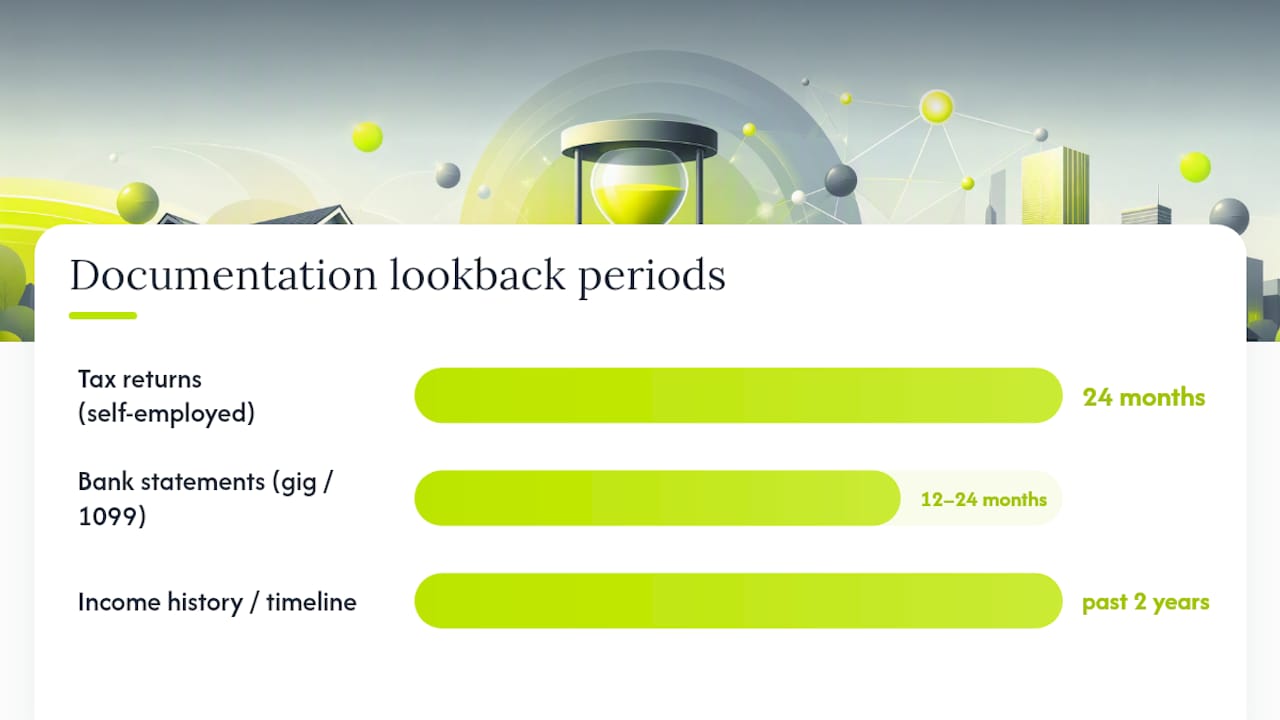
If you’re self-employed, plan to provide two years of tax returns, a year-to-date profit-and-loss statement, business bank statements, and copies of active contracts or invoices. Gig workers, 1099 contractors, and seasonal employees should gather 12 to 24 months of bank statements, signed client contracts, a history of repeat clients, and a short letter explaining any income gaps.
For assets and reserves, pull your most recent statements for every account you’re using, document the source of any large deposits, and include gift letters if part of your funds came from family. If you’re drawing on a retirement account, confirm with your lender whether that withdrawal is even eligible to count toward reserves before you rely on it.
- Write a one-page cover letter summarizing your income story and pointing to where each compensating factor is documented.
- Label folders (digital or physical) by category: income, assets, credit, reserves.
- Include a simple timeline if your income changed jobs, structure, or amount in the past two years.
Pro Tip: Reconcile your bank statements against your tax returns before you submit anything. Underwriters flag deposits that don’t match reported income faster than almost any other issue, and a short note explaining a mismatch upfront can save you a week of back-and-forth.
Working With a Broker on a Manual-Underwrite File
A broker who handles manual underwriting regularly will start with a pre-check: a review of your documentation against FHA’s baseline ratios and reserve rules to flag gaps before you ever submit to a lender. That early diagnostic is where most delays get prevented, not fixed later.
From there, the broker’s job is to organize your evidence into the story an underwriter needs to see, not just a stack of documents. That includes:
- Matching each compensating factor to specific paperwork instead of leaving the underwriter to hunt for it.
- Advising on which factors are strong enough to submit versus which will invite more questions than they answer.
- Managing communication with the lender so conditions come back to you as a clear, prioritized list.
- Tracking every outstanding condition and confirming it’s satisfied before resubmission, since a partial response often resets the review clock.
A fast, clear response to underwriter conditions, ideally within 24 to 48 hours, keeps momentum on your file and avoids the frustrating cycle where a loan sits untouched for a week between each request.
What to Expect: Timeline and Common Sticking Points
Manual underwriting typically adds one to three weeks compared to an automated approval, mostly because the underwriter is reading full documents rather than data fields. Appraisal turnaround and requests for supplemental income documentation are the two most common sources of delay.
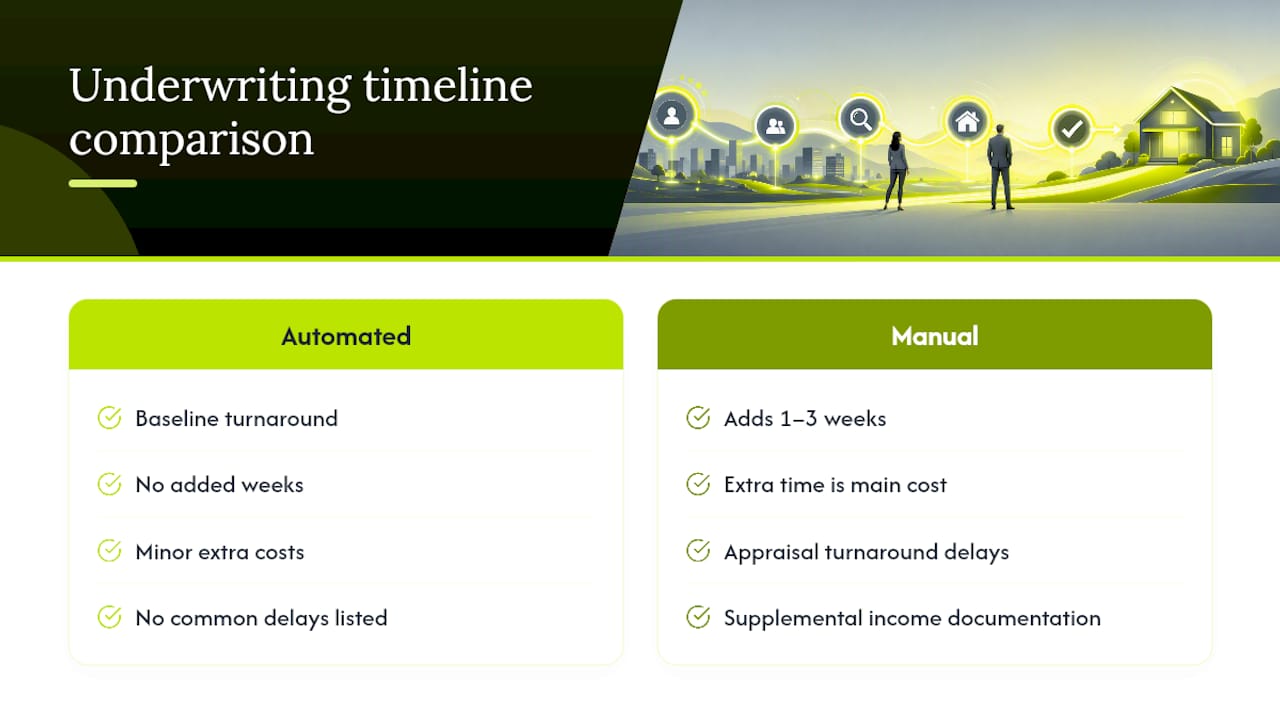
Extra costs are usually minor. The bigger cost is time, and thorough preparation is what shrinks it. A file is trending well when conditions come back specific and answerable. Red flags include vague or repeated requests for the same document, which often signal the underwriter isn’t convinced by what’s already been submitted, and a pattern worth addressing directly with your lender before it stalls the file further.
How David Mordue Approaches Manual Underwriting Cases
Every manual-underwrite file is a documentation problem before it’s a credit problem. My approach starts with a fully online intake that gets a clear picture of your income structure fast, then builds a targeted checklist based on exactly where your file will need compensating factors, not a generic list that wastes your time collecting paperwork you don’t need.
From there, I stay in direct contact with the underwriter throughout review. Borrowers can benefit from a fully online process built to move quickly, with funding achievable in under 21 days when documentation comes in complete and organized. The borrowers who close fastest are consistently the ones who treat the first documentation request as the only one they intend to get.
— David Mordue
Get Help Packaging Your FHA Manual-Underwrite File
If you’ve read this far, you already know manual underwriting isn’t about luck. It’s about whether your paperwork tells a complete, consistent story the first time an underwriter opens the file. David Mordue - Forward Financial Group builds that story with you: organizing income and asset documentation, identifying which compensating factors actually apply to your situation, and shopping rates across lenders so you’re not leaving savings on the table while you wait.

Start by reviewing the FHA loan program details and gathering two years of tax returns or pay history, your most recent bank statements, and any documentation of reserves or gift funds. A short consultation from there will tell you exactly what else your file needs and roughly how long your specific situation should take. Timelines vary with how complete your documentation is on day one, but the online application process is built to move as soon as you are ready.
Where to Verify These Rules Yourself
The policy details in this guide come directly from federal and HUD sources: the Federal Register’s 2013 final notice on manual underwriting, Mortgagee Letter 14-02 on ratios and reserves, and Handbook 4000.1, FHA’s consolidated policy manual, updated as recently as May 2024.
This article is general information, not a substitute for advice from a qualified financial advisor. Consult a qualified financial professional about your own circumstances before acting on anything here.
Sources
FAQ
What Triggers FHA Manual Underwriting?
Manual underwriting happens when TOTAL returns a “Refer” instead of an “Accept,” when you have non-traditional credit with no score, or when an underwriter downgrades an automated approval after finding something the system missed.
What Are the Baseline DTI Ratios for Manual Underwriting?
With one documented compensating factor those can stretch to 37/47, and with two factors to 40/50, according to federal guidance from 2013.
How Many Months of Reserves Do I Need?
A 1 to 2 unit property requires one month of mortgage payment in liquid reserves, while a 3 to 4 unit property requires three months, per HUD’s Mortgagee Letter 14-02.
Can I Get an FHA Loan With No Credit Score?
Yes, using non-traditional credit like documented rent, utility, and insurance payment history over 12 months, though scores below 580 or no score limit which compensating factors your lender can apply.
How Long Does Manual Underwriting Take Compared to Automated Approval?
Manual underwriting typically adds one to three weeks versus an automated approval, mostly due to document review time and appraisal scheduling. Working with a broker experienced in manual files can help keep that timeline as tight as possible through fast online intake and consistent underwriter communication.