
Yes, you can get a mortgage without a Social Security number. ITIN mortgage loans exist specifically for this purpose, usually structured as non-QM portfolio loans held directly by the lender. Expect a higher down payment, a modest rate premium, and more paperwork than a conventional loan requires. Your best first move is preapproval with a broker who specializes in this program.
TL;DR:
- ITIN mortgage loans are typically non-QM portfolio loans, with higher down payments (10-25%) and interest rate premiums of 0.5 to 2 percentage points over conventional mortgages.
- Lenders assess full financial documentation, including tax returns and bank statements, often building credit history from rent and utility payments, not just FICO scores.
- The loan limits vary widely by lender, generally ranging from mid-six-figure to low-seven-figure amounts, depending on the institution and borrower reserves.
- Access to ITIN loan programs is limited geographically, with regional credit unions, community lenders, and brokers most actively offering these products.
- Working with a specialized broker significantly improves approval chances, as they know which lenders are currently active and how to optimize your file.
Table of Contents
- What Is an ITIN Mortgage, and Why Does It Exist?
- Eligibility, Documentation, and Underwriting Expectations
- Rates, Fees, and Other Costs: What to Expect
- Where to Find Lenders That Offer ITIN Mortgages
- How to Apply: Checklist and Timeline
- Why Work With a Specialist ITIN Mortgage Broker
- Typical Loan Limits for ITIN Mortgages
- How ITIN Loans Affect Credit Building and Long-Term Finances
- ITIN Mortgages vs. Co-Signers and SBA Programs
- What the Research Actually Tells Borrowers to Prioritize
- How David Mordue Can Help You Move Forward
- Where to Verify the Details Yourself
- Sources
What Is an ITIN Mortgage, and Why Does It Exist?
An Individual Taxpayer Identification Number lets people who don’t qualify for a Social Security number file taxes and, in many cases, apply for a mortgage. The IRS issues ITINs through Form W-7, and lenders who offer ITIN mortgage loans accept that number in place of an SSN on the application.
These loans almost always fall into the non-QM category, meaning they don’t meet the standardized criteria that Fannie Mae and Freddie Mac require to buy a loan on the secondary market. Because there’s no ready buyer waiting to purchase these loans, most lenders keep them in their own portfolios rather than selling them off. That single fact shapes everything else about how ITIN loans work:
- Lenders set their own underwriting rules instead of following a rigid federal template.
- Approval can hinge on judgment and a full financial picture, not just a credit score.
- Pricing runs higher because the lender carries all the risk long-term.
The trade-off is straightforward: more flexibility on documentation, less flexibility on cost.
Eligibility, Documentation, and Underwriting Expectations
Lenders evaluating ITIN mortgage loan requirements want to see a full, honest financial story, not a perfect credit file. Most will ask for:
- A valid ITIN and government-issued photo identification.
- Two years of federal tax returns showing consistent income.
- Two to three months of bank statements demonstrating cash flow and savings.
- Proof of employment or self-employment income, including profit-and-loss statements if applicable.
- Documentation of on-time rent and utility payments if you lack a traditional credit history.
Down payments typically run 10% to 25%, and many lenders also want to see several months of reserves sitting in the bank after closing. Borrowers with thin credit files aren’t automatically disqualified. Some lenders will build a credit picture from rent payments, utility bills, and insurance premiums instead of relying on a FICO score.
Gaps in tax filing history, inconsistent bank deposits, or unexplained large cash transactions tend to slow things down the most.
Pro Tip: Open a dedicated checking account for your income at least six months before applying. Lenders read consistent, traceable deposits as a much stronger signal than a thick folder of receipts.
Rates, Fees, and Other Costs: What to Expect
Interest rates on ITIN mortgage loans generally run 0.5 to 2 percentage points higher than a comparable conventional mortgage. On a $350,000 loan, that gap can add well over $100 a month, so always compare offers using the annual percentage rate rather than the advertised note rate alone. APR wraps in fees and points, giving you a true side-by-side comparison.
Watch for these cost factors when reviewing a loan estimate:
- Origination fees, which can run higher on portfolio loans than on conventional ones.
- Discount points offered to buy down your rate.
- Private mortgage insurance, which may not follow standard PMI rules since these loans sit outside FHA and GSE backing.
- Lender-required reserve accounts held after closing.
A higher upfront cost can make sense if it locks in a meaningfully lower rate over a 30-year term. It doesn’t make sense if the “discount” barely moves your monthly payment. When two lenders quote similar rates, the one with lower fees usually wins over the life of the loan. Comparing current rate options side by side before committing is worth the extra half hour.
Where to Find Lenders That Offer ITIN Mortgages
Availability is not uniform across the country, and that’s the biggest practical hurdle for many borrowers. Because most ITIN loans stay in the originating lender’s portfolio, the market for them is small and localized, with program terms varying by state, county, and even individual branch.
The lenders most likely to offer these programs include:
- Local and regional credit unions, which originate a large share of ITIN loans nationwide.
- Community Development Financial Institutions built around underserved borrowers.
- Select regional banks with dedicated non-QM lending desks.
- Niche mortgage brokers who maintain relationships with multiple portfolio lenders.
If you’re starting your search, call credit unions in your area directly and ask whether they currently offer ITIN programs and under what terms. Then verify any lender or loan officer through NMLS Consumer Access before sharing financial documents. A broker who works with several portfolio lenders at once can save you from cold-calling a dozen institutions yourself, since they already know who’s actively lending in your market.
How to Apply: Checklist and Timeline
Applying for financing for undocumented immigrants and other ITIN holders follows a familiar mortgage rhythm, just with a different document set.
- Gather two years of tax returns, recent pay stubs or profit-and-loss statements, and two to three months of bank statements.
- Collect proof of identity and your ITIN letter from the IRS.
- If your credit file is thin, pull together twelve months of rent and utility payment records.
- Submit a preapproval application, either online or through a broker.
- Respond quickly to any underwriter requests for clarification or additional documents.
Preapproval often comes back within a few days once your file is complete. Full underwriting and closing typically take 30 to 60 days, though a specialist broker with strong lender relationships can sometimes move faster.
Pro Tip: Scan and label your documents before you start the application. Files named “Tax_Return_2024.pdf” instead of “Scan001.pdf” shave real time off underwriter review, since nobody has to guess what they’re looking at.
Why Work With a Specialist ITIN Mortgage Broker
Sourcing an ITIN mortgage loan on your own means calling lender after lender, hoping one of them still runs the program you need. A broker who specializes in this space already knows which portfolio lenders are active, what each one’s underwriting flexibility looks like, and how to position your file for approval.
David Mordue - Forward Financial Group built its process around exactly this kind of friction point:
- A fully online application designed to move fast, with funding possible in under 21 days.
- One-on-one consultations that help review documentation before submission.
- Free tools, including a rent-vs-buy calculator, to help you see the real numbers before you commit.
ITIN borrowers rarely lose approval because they’re unqualified. They lose it because they submitted to the wrong lender with the wrong document set. Matching the borrower to the right portfolio program is most of the job.
Always confirm any broker’s registration through NMLS Consumer Access before moving forward with an application.
Typical Loan Limits for ITIN Mortgages
There’s no single federal cap on ITIN mortgage loan amounts the way there is with FHA or conforming conventional loans. Since these are portfolio products, each lender sets its own maximum based on its risk appetite and balance sheet capacity.
In practice, most ITIN programs top out in the mid-six-figure to low-seven-figure range, with plenty of variation between institutions. A credit union working primarily with first-time buyers might cap loans around $400,000 to $500,000. A regional bank or niche non-QM lender with more capital flexibility might go considerably higher, especially for well-qualified borrowers with strong reserves and a sizable down payment.
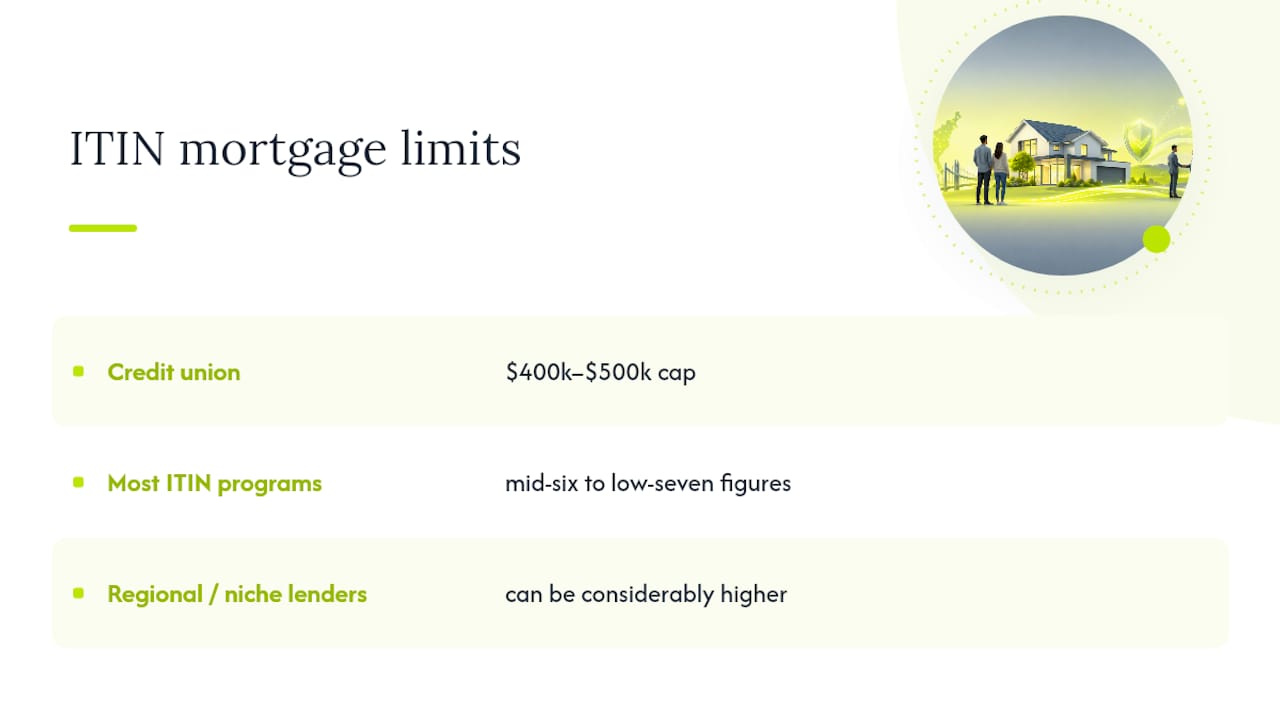
That means the maximum amount you personally qualify for is really a function of your down payment size as much as your income.
Because limits vary so widely by institution, the only reliable way to know your actual number is to request program guidelines directly from a lender, or work with a broker who can compare several portfolio caps against your financial profile at once.
How ITIN Loans Affect Credit Building and Long-Term Finances
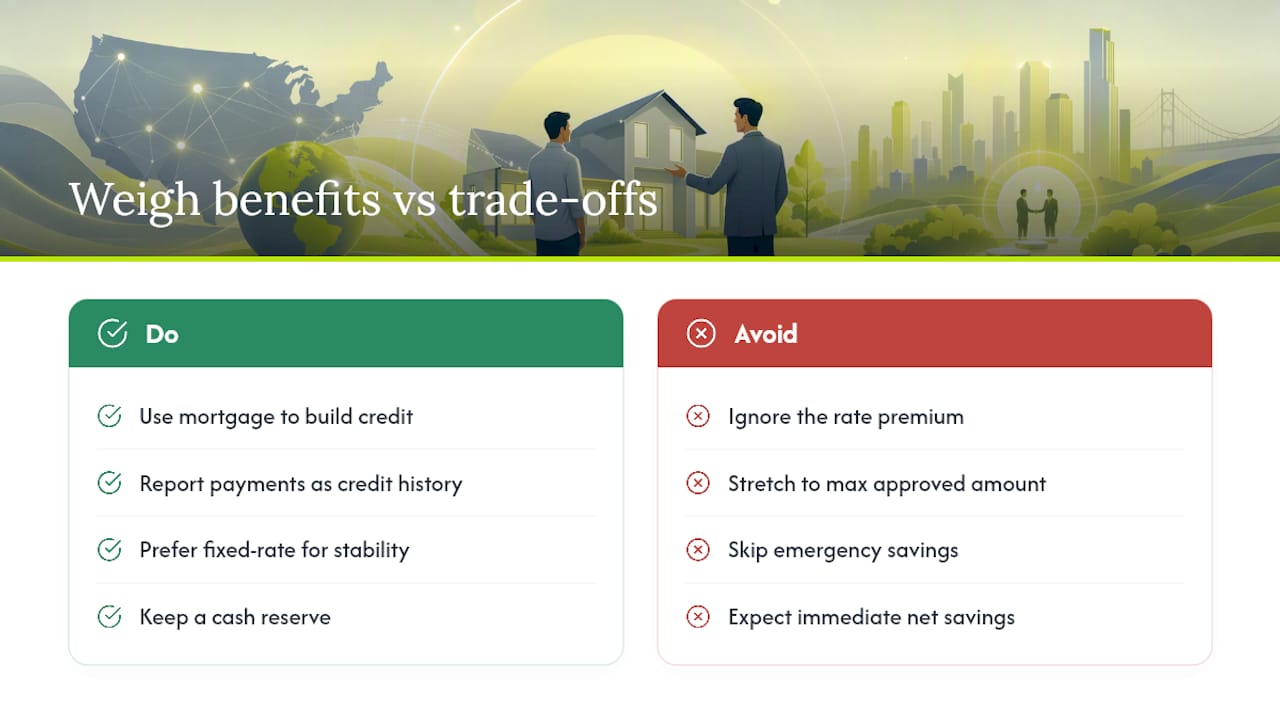
Making mortgage payments on time builds credit the same way it does for any borrower, once the loan is reported to the credit bureaus. Most ITIN mortgage lenders do report payment history, which means a consistently paid ITIN mortgage can meaningfully strengthen a thin credit file over time.
That matters more for ITIN holders than for the average borrower, since many arrive at the mortgage process with little or no traditional credit history to begin with. A mortgage becomes one of the few large, long-term credit obligations reporting month after month, which can gradually improve access to auto loans, credit cards, and better refinance terms down the road.
There’s a longer-term financial upside beyond the credit score itself. Homeownership converts a monthly housing payment into equity instead of rent, and fixed-rate ITIN loans lock in a housing cost that doesn’t rise with the local rental market. Over a decade or two, that stability can matter more to household wealth than the interest rate premium paid upfront.
The catch is that the rate premium and larger down payment reduce how much cash flow is available to build savings or pay down other debt early in the loan term. Borrowers should weigh the credit-building and equity benefits against the higher monthly obligation, and build in a cash reserve rather than stretching to the maximum approved amount.
ITIN Mortgages vs. Co-Signers and SBA Programs
An ITIN mortgage isn’t the only route to homeownership without a Social Security number, though it’s usually the most direct one for a primary residence. Two alternatives come up often, and each has real limits worth understanding.
Adding a co-signer with an SSN and established credit can sometimes unlock conventional or FHA financing at a lower rate than an ITIN program. The catch is that the co-signer takes on full legal liability for the loan, and many family members are understandably reluctant to do that for a house they won’t live in. It also means the loan appears on the co-signer’s credit report, affecting their own future borrowing capacity.
SBA loans are built for financing a business, not a personal residence, so they don’t substitute for a home mortgage in most cases. An SBA 504 loan can help an ITIN-holding business owner purchase commercial real estate, but it won’t get you a mortgage on the house you plan to live in.
Compared to both, an ITIN mortgage loan keeps the debt and the ownership in your name alone, with underwriting built specifically around your actual income and tax filings rather than someone else’s credit profile. It costs more per month than a co-signed conventional loan might, but it doesn’t ask anyone else to shoulder personal liability for your home.
What the Research Actually Tells Borrowers to Prioritize
The conventional advice on ITIN mortgage loans spends too much time on rate shopping and not enough on lender selection. Rate premiums matter, but the Urban Institute’s research makes clear the real constraint is supply: a small secondary market means only a limited number of institutions actively originate these loans in any given area. Chasing the lowest advertised rate across a handful of lenders who don’t even serve your county wastes time.
What actually moves the needle is documentation quality and lender fit. A borrower with an organized financial history and a lender whose underwriting team regularly handles ITIN files will close faster and cheaper than a borrower with perfect credit stuck with the wrong institution. That’s a case for working with someone who already knows which portfolio lenders are active right now, rather than starting from a blank search every time.
Prioritize this in order: confirm a lender or broker actually has a live ITIN program, build your alternative credit documentation early, then compare APR, not headline rate. Skip that order and you’ll waste weeks chasing lenders who quietly stopped offering the program months ago.
— David Mordue
How David Mordue Can Help You Move Forward
David Mordue - Forward Financial Group works as your direct alternative to cold-calling lenders one by one, hoping one still runs an active ITIN program. Instead of guessing which institution fits your file, you get one point of contact who already knows the portfolio lenders serving your situation and negotiates terms on your behalf.
Getting started is simple. Before your first call or online application, gather two years of tax returns, recent bank statements, and your ITIN documentation, the same file lenders will eventually request anyway. Run your numbers first through the rent vs. buy calculator to see what a realistic monthly payment looks like against your current rent. From there, start your preapproval application online, and expect a personalized consultation to walk through your specific ITIN mortgage options within days, not weeks.
Where to Verify the Details Yourself
Confirm program rules and lender credentials directly through official channels before signing anything:
- IRS: How to Apply for an ITIN for the official Form W-7 process.
- Urban Institute: ITIN Mortgages for market research and availability trends.
- NMLS Consumer Access to verify any lender or broker’s licensing status.
- U.S. Department of Housing and Urban Development for broader homeownership assistance programs.
Sources
- ITIN Loan: How to Get a Mortgage Without a Social Security Number - NerdWallet
- ITIN Mortgages - Urban Institute
- How do I apply for an ITIN? - IRS
- NMLS Consumer Access