
The home loan application process is a structured series of steps that takes you from initial preparation through to loan disbursement, and knowing each stage in advance is what separates smooth approvals from costly delays. Lenders assess your creditworthiness, income stability, and property value before committing funds. Credit scores of 700 or above meet minimum eligibility thresholds, while scores of 750 or higher typically unlock the best rates and terms. The entire process runs anywhere from 30 to 60 days, though some digital lenders complete it in as few as 15 business days. Preparation is the single biggest factor you control.
What documents do you need before applying for a home loan?
Your home loan application checklist starts with documentation, and incomplete files are the most common reason lenders slow down or reject applications. Lenders need a clear, verified picture of your identity, income, and financial history before they assess anything else. Gathering these documents before you submit saves days or even weeks.
Required documents typically include:
Proof of identity: Government-issued photo ID such as a driver's license or passport
Proof of income: Recent pay stubs, and 2 years w2's covering the last 30 days for salaried applicants
Bank statements: 1-2 months of statements showing consistent income and spending patterns
Tax returns: 1-2 years of filed returns for self-employed applicants
Property documents: Purchase agreement, title documents, or builder contract if already identified
Employment verification: A letter from your employer confirming your role, salary, and tenure
Lenders verify every document for completeness and recency. A bank statement from seven months ago will not satisfy a requirement for six months of history. Date-stamp your documents when you collect them and replace anything that expires during the process.
Your income documentation directly feeds this calculation, so accuracy matters more than presentation.

Pro Tip: Organize your documents into a single digital folder with clear file names before you contact any lender. Uploading a complete, labeled package on day one signals reliability and often accelerates the lender's review timeline.
How to apply for a home loan: step-by-step walkthrough
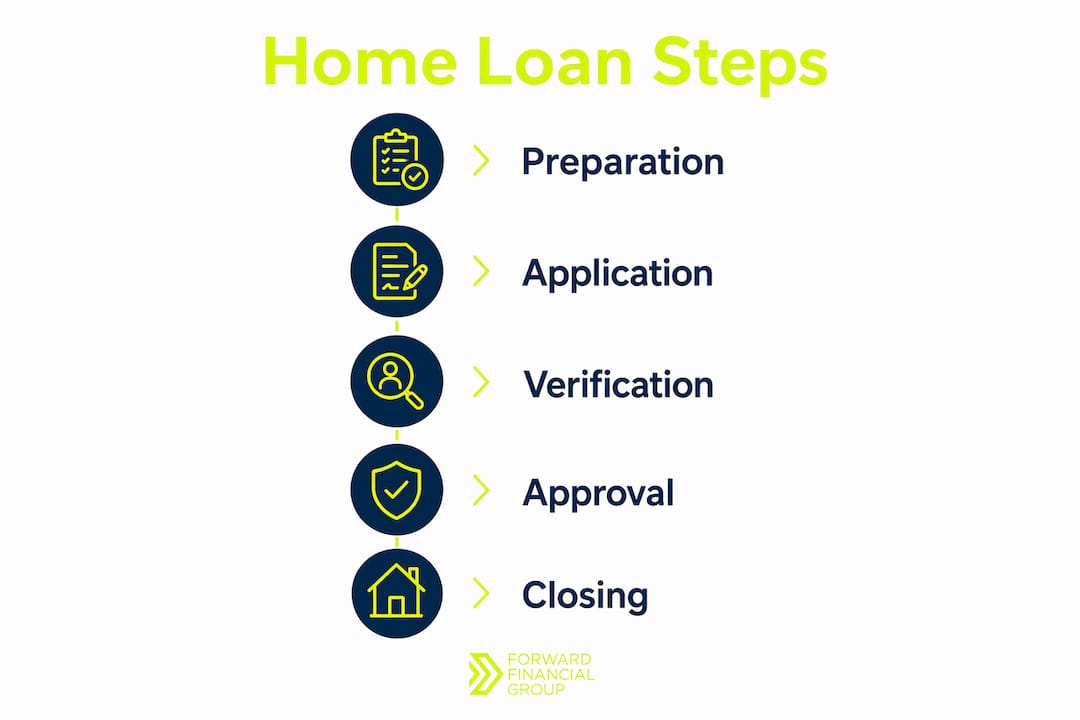
The mortgage application process moves through six distinct stages. Each stage builds on the last, and stalling at any point delays the entire timeline.
Complete the application form. Submit your personal details, employment information, income figures, and the loan amount you are requesting. Most lenders now offer fully online applications. David Mordue - Forward Financial Group, for example, runs a fully digital process that can reach funding in under 21 days.
Submit your documentation package. Upload or deliver every document from your checklist. The lender's processor reviews the file for completeness before passing it to underwriting. Missing a single item at this stage restarts the clock.
Credit check and financial verification. The lender pulls your credit report and verifies your income, employment, and debt obligations. Credit scores of 620 and up represent the minimum for most mortgage products, although some programs go as low as 580. Scores below that threshold typically trigger higher rates or manual underwriting.
Underwriting and property valuation. An underwriter reviews your full financial profile against the lender's lending criteria. Simultaneously, an independent appraiser values the property. This step is where most delays occur, because the appraiser's schedule and the underwriter's workload are outside your control.
Pre-approval or conditional approval letter. Once underwriting clears your file, the lender issues a pre-approval or "in-principle" letter. This document confirms your borrowing capacity and gives you buyer's authority during price negotiations with sellers or builders. Treat this letter as a tool, not a guarantee.
Final approval and loan sanction. After you identify a property and the lender completes legal and technical checks, the lender issues a formal loan sanction letter. This letter specifies the approved amount, interest rate, tenure, and repayment schedule. Review every figure before signing.
Pro Tip: Do not apply for new credit cards, auto loans, or any other debt between pre-approval and closing. New credit inquiries lower your score and trigger a full re-assessment of your financial profile, which can push your closing date back by weeks.
The mortgage application timeline runs 30–60 days for most borrowers. Digital lenders with automated underwriting can compress that to 15 business days. Your preparation and responsiveness determine where you land in that range.
You can use the affordability calculator at David Mordue - Forward Financial Group to estimate your borrowing capacity before you submit a single document. Knowing your number before you apply prevents you from targeting properties outside your approved range.
What mistakes slow down or kill a home loan application?
Most mortgage application delays trace back to borrower behavior, not lender inefficiency. Recognizing these patterns before you apply puts you ahead of the majority of first-time buyers.
Incomplete documentation. Submitting a partial file forces the lender to pause and request missing items. Each back-and-forth cycle adds three to five business days to your timeline.
Major financial changes after pre-approval. Changing jobs, taking on new debt, or making large cash withdrawals between pre-approval and closing triggers a full re-assessment and can result in denial at the final stage.
Underestimating the property valuation gap. If the appraiser values the property below your purchase price, the lender finances only the appraised value. You must cover the difference out of pocket. This gap can derail a purchase if you have not budgeted for it.
Slow responses to lender requests. Lenders work on tight processing windows. Waiting more than 48 hours to return a requested document pushes your file to the back of the queue.
Undisclosed liabilities. Failing to disclose existing debts, co-signed loans, or pending legal matters creates a discrepancy when the lender's verification checks surface them. Transparency from the start protects your application.
"Maintaining financial stability after you submit your application is as critical as the preparation before it. Last-minute underwriting rejections almost always trace back to a financial change the borrower made after receiving pre-approval, not to a problem that existed at the time of submission."
Credit score maintenance deserves specific attention. Pay every bill on time during the application period. Keep credit card balances below 30% of your available limit. These two habits protect the score the lender already approved you on.
How to prepare for closing: what to expect at the final stage
Closing is the final stage of the mortgage application steps, and it requires its own preparation. Most borrowers underestimate the paperwork and timing involved.
Closing step | What it involves | Typical timeline |
|---|---|---|
Loan agreement review | Read every term, rate, and repayment condition before signing | 1–3 days |
Mortgage document signing | Sign the loan contract, Memorandum of Entry, and related forms | Same day as agreement |
Original document submission | Property documents submitted physically to lender; held for loan tenure | At or before closing |
Legal and title check | Lender reviews decades of ownership history to confirm a clear title | 3–7 business days |
Loan disbursement | Funds released to seller or builder based on property completion stage | 1–5 days post-signing |
For ready properties, the lender disburses the full loan amount directly to the seller at closing. For under-construction properties, disbursement happens in stages tied to construction milestones. Confirm the disbursement schedule with your lender before signing so you can coordinate with the builder.
Original property documents stay with the lender for the full loan tenure. You receive certified copies. This is standard practice, not a red flag. Request a written acknowledgment from the lender listing every document they hold.
The lender's legal team reviews the property's ownership history to confirm a clear title. This check protects the lender's security interest and protects you from inheriting title disputes. Budget five to seven business days for this step and do not schedule your move-in date before it clears.
Key Takeaways
The home loan application process requires thorough preparation, financial stability throughout, and prompt responses to lender requests to reach closing without delays.
Point | Details |
|---|---|
Documentation completeness | Gather 3–6 months of bank statements, tax returns, and ID before applying. |
Credit score threshold | A score of 700 meets minimum eligibility; 750 or above secures the best rates. |
Serviceability buffer | Lenders test affordability at 3% above the current rate, so your income figures must be accurate. |
Pre-approval advantage | An in-principle letter gives you buyer's authority and strengthens your negotiating position. |
Financial stability post-approval | Avoid new debt, job changes, or large withdrawals between pre-approval and closing. |
What I have learned after years of guiding borrowers through this process
The pre-approval letter is the most underused tool in a buyer's kit. Most borrowers treat it as a formality. I treat it as a negotiating asset. Sellers and builders respond differently to a buyer who arrives with written confirmation of financing capacity. That letter signals seriousness in a way that verbal assurances never do.
The piece of advice I give most often is this: the application is not over when you submit it. The period between submission and closing is where most approvals fall apart. A borrower who changes jobs two weeks before closing, or opens a new credit account to buy furniture for the new home, can undo months of careful preparation in a single decision. Lenders re-verify your financial profile right before disbursement. What they find at that point must match what they approved.
I have also seen borrowers blindsided by the property valuation gap. They negotiate a purchase price, receive pre-approval based on that price, and then discover the appraiser values the property at a lower figure. The lender finances the appraised value, not the contract price. The borrower must cover the difference. Using an affordability stress test before you make an offer gives you a realistic ceiling and prevents this scenario from catching you off guard.
Digital tools have changed the timeline significantly. Borrowers who use online calculators to estimate their capacity before applying arrive with realistic expectations and cleaner files. That preparation shortens the lender's review time and reduces back-and-forth requests. The borrowers who struggle are the ones who treat the application as the starting point for their financial planning rather than the conclusion of it.
— David Mordue
How David Mordue - Forward Financial Group supports your mortgage application
Getting your documentation right and your finances stable before you apply is the work. Having the right guidance makes that work faster and less stressful.
David Mordue - Forward Financial Group runs a fully online mortgage process with funding possible in under 21 days. Whether you are applying for the first time or looking to refinance an existing loan, the team provides personalized rate comparisons and direct support at every stage. Start by checking your borrowing capacity with the rent vs. buy calculator, then connect with David Mordue - Forward Financial Group for a consultation tailored to your financial goals. When you are ready to move forward, get your pre-approval and put that buyer's authority to work.
FAQ
How long does the home loan application process take?
The typical mortgage timeline runs 30–60 days from application to closing. Digital lenders with automated underwriting can complete the process in as few as 15 business days.
What credit score do I need to apply for a home loan?
A credit score of 700 meets the minimum threshold for most mortgage products. Scores of 750 or above generally qualify for the best available rates and terms.
What happens if the property appraisal comes in below the purchase price?
The lender finances based on the lower of the appraised value or the contract price. You must cover the difference out of pocket, so budget for this possibility before making an offer.
Can I change jobs after receiving pre-approval?
Changing jobs after pre-approval triggers a re-assessment of your financial profile and can result in denial at the final stage. Hold off on any employment changes until after closing.
What documents does the lender keep after closing?
Any original property identity or financial documents are returned to you from the lender.