
To qualify for a home equity loan or HELOC, you generally need 10% to 20% or more equity in your home, a credit score in the mid-600s or higher, a debt-to-income ratio at or below roughly 45%, verifiable income, current homeowners insurance, and you may or may not need an appraisal. Your first move: pull your latest mortgage statement, estimate your CLTV, and check your credit report before you contact a lender.
TL;DR:
- Most borrowers can qualify if they have 15% to 20% home equity, a credit score in the mid-600s or higher, and a debt-to-income ratio at or below 43%.
- The maximum borrowable amount depends on your home’s value, CLTV caps (usually 80-85%), and outstanding mortgage balance, not on your full equity.
- Appraisals and seasoning rules can significantly impact your loan amount and timeline, especially if your home was recently purchased or appraises lower than expected.
- Credit score, DTI, and appraisal outcomes are the primary filters, with appraisals often being the most unpredictable factor affecting your approval.
- Using a broker can streamline the process, especially for borderline cases or nontraditional income, by comparing multiple lenders’ requirements and speeding up approval.
Table of Contents
- Home Equity Loan Requirements: Understanding Equity and CLTV Limits
- How Much You Can Borrow: The Math Behind HELOCs and Home Equity Loans
- Credit Score and Debt-to-Income: Where Most Applications Get Filtered
- Documents, Appraisals, Seasoning Rules, and Your Realistic Timeline
- What Lenders Must Disclose, and Your Right to Cancel
- Red Flags That Sink Applications, and How to Avoid Them
- How a Broker Fits Into Your Application
- How Long You Need to Own Your Home First
- Which Properties Qualify: Primary Residence vs. Second Home vs. Investment Property
- Age, Citizenship, and Residency Requirements
- Employment History and Income Stability
- What Sets Your Loan Amount Limits
- Why Home Equity Applications Get Denied
- The Truth About Qualifying for Home Equity Loans
- Ready to See What You Qualify For?
- Where to Verify These Rules Yourself
- Sources
- FAQ
Home Equity Loan Requirements: Understanding Equity and CLTV Limits
Home equity is the gap between what your house is worth and what you still owe on it. If your home appraises at $400,000 and your mortgage balance is $280,000, you’re sitting on $120,000 in equity, or 30%. That number sounds simple, but it is not the one lenders actually lend against.
What matters is combined loan-to-value, or CLTV: your current mortgage balance plus the new loan, divided by your home’s appraised value. Most lenders cap CLTV somewhere between 80% and 85%, and some require you to keep 15% to 20% of your equity untouched as a cushion against market swings.
- Maximum total debt allowed: $400,000 × 0.85 = $340,000
- Subtract your existing mortgage balance: $340,000 − $280,000 = $60,000
- That $60,000 is roughly your borrowing ceiling, before fees and lender-specific adjustments
Notice the gap between your raw equity ($120,000) and what you can actually borrow ($60,000). That difference trips up a lot of first-time applicants who assume “equity” and “available credit” mean the same thing. They don’t. A lender isn’t loaning against your full stake in the house. It’s loaning against the slice above its risk threshold, and that threshold moves depending on the lender, your credit profile, and even your state.
That’s worth checking before you spend time on documents.
How Much You Can Borrow: The Math Behind HELOCs and Home Equity Loans
Run this formula first: maximum borrowable amount = (home value × allowed CLTV) − current mortgage balance. Everything else, your rate, your term, your monthly payment, builds on that number.
Two quick examples show how the loan type changes what you actually experience month to month:
- Home equity loan (lump sum): On that same $60,000 approved amount, a fixed-rate loan gives you the full sum at closing, with one predictable monthly payment for the life of the loan, often 10 to 15 years.
- HELOC (revolving line): The same $60,000 becomes a credit line you draw from as needed, typically over a 10-year draw period, followed by a repayment period. Payments during the draw phase can be interest-only, which keeps costs low upfront but back-loads the principal.
Your appraisal has the final word. A number that looks solid on a home-value estimator can shift once a licensed appraiser walks the property, and that shift moves your borrowing ceiling up or down before the lender finalizes anything.
Credit Score and Debt-to-Income: Where Most Applications Get Filtered
Your credit score and DTI do more to shape your approval odds than almost any other factor on this list. Lenders sort applicants into rough bands: scores of 680 to 720 and above typically unlock the best pricing, mid-600s scores still get approved but at higher rates, and anything near 620 puts you in stricter-terms territory, if you qualify at all.
DTI works differently. Add up your current mortgage payment, the estimated new loan payment, and all other recurring debt, credit cards, auto loans, student loans, then divide by your gross monthly income. Most lenders want that number at 43% or below, though a handful will stretch to 50% for borrowers with strong compensating factors like a large down payment history or reserves.
- Pay down revolving balances before applying; it moves DTI faster than almost anything else
- Add a co-borrower with stronger income or credit if your numbers are borderline
- Consider a credit union or specialty lender if a big bank’s cutoffs are rigid
Pro Tip: Pull your credit report at least 60 days before applying. Disputing an error takes time, and a 20-point score bump can shift you into a better pricing tier.
Documents, Appraisals, Seasoning Rules, and Your Realistic Timeline
Have these ready before you apply, not after a loan officer asks for them twice:
- Government-issued photo ID
- Two most recent pay stubs and your last two W-2s
- Two years of tax returns (self-employed borrowers also need profit-and-loss statements and 1099s)
- Two to three months of bank statements
- Proof of current homeowners insurance
- Your most recent mortgage statement
Nearly every lender orders a fresh appraisal, and it typically costs several hundred dollars and takes 7 to 14 days to complete. That appraisal can move your available credit up or down independent of anything else in your file.
If you bought the home recently, check for a seasoning requirement. Many lenders impose a 30 to 90 day waiting period after purchase before they’ll even take an equity application. Factor that into your timeline. Most straightforward files close in two to six weeks from application to funding, assuming documentation comes in clean the first time.
What Lenders Must Disclose, and Your Right to Cancel
Before you sign anything, your lender has to hand you a clear breakdown of what the loan actually costs.
- Appraisal, title search, and closing costs, commonly 2% to 5% of the loan amount
- Full APR disclosure, not just the interest rate
- Payment terms, and for HELOCs, how the draw period differs from the repayment period
By federal rule, lenders must disclose APR, fees, and payment terms upfront, and if the loan is secured by your primary residence, you have a three-business-day right to cancel after closing, no penalty, no explanation required.
The CFPB’s HELOC brochure walks through these disclosures in plain language if you want to see exactly what your lender is legally required to hand you.
Red Flags That Sink Applications, and How to Avoid Them
Borrowing against your house means the house is the collateral. Miss payments and you risk losing it, which is why lenders scrutinize this file more closely than a typical personal loan. Letting your homeowners insurance lapse is its own hazard: lenders can force-place a policy on your behalf at a much higher cost, and that gets added straight to your loan.
Common reasons applications stall or get denied:
- A low appraisal that pushes your CLTV over the lender’s cap
- A recent missed mortgage or credit card payment showing up on your report
- DTI creeping past 43% once the new payment gets factored in
If any of these apply to you right now, waiting a few months to pay down debt, rebuild payment history, or clear a seasoning period usually beats applying and getting a denial on record.
Pro Tip: If one lender’s appraisal comes in low, that’s not always the final word. A second appraisal or a lender that accepts automated valuation models can sometimes recover borrowing power without touching your credit or income.
How a Broker Fits Into Your Application
A mortgage broker’s job on a home equity file is mostly logistics: packaging your documents correctly the first time, running your numbers against multiple lenders’ CLTV and DTI policies at once, ordering the appraisal, and keeping title, underwriting, and appraisal moving in parallel instead of in sequence.
Some mortgage brokers run their intake fully online, with calculators for refinancing and affordability built into the process, and may cite a funding timeline of under 21 days for qualifying files. For borrowers with VA eligibility or FHA history, the same team maintains dedicated resources on VA loan and FHA loan qualification.
Going direct to your current bank can work if your file is clean and your score is strong. A broker earns its place when your numbers are borderline, your income is nontraditional, or you want your file shopped across lenders with different CLTV appetites instead of accepting the first answer you get.
How Long You Need to Own Your Home First
There’s no universal waiting period written into federal law, but most lenders won’t touch an equity application on a home you bought within the last few months. Seasoning requirements of 30 to 90 days after purchase are common, and some lenders push that closer to six months to a year if your down payment was small or your appraisal shows minimal built-up equity.
The logic is straightforward. Equity takes time to build, either through principal payments or market appreciation, and lenders want proof that your ownership stake reflects something real, not a paper valuation that hasn’t been tested.
Homeowners who’ve owned for several years and made consistent payments rarely run into seasoning issues at all. The rule mostly targets recent purchases, cash-out refinances done shortly before applying again, or homes bought with minimal money down.
If you’re not sure whether you’ve cleared a seasoning window, check your closing date against your target lender’s policy before submitting an application. Some lenders will informally tell you over the phone whether your purchase date clears their internal threshold, which saves you from a wasted credit pull.
Which Properties Qualify: Primary Residence vs. Second Home vs. Investment Property
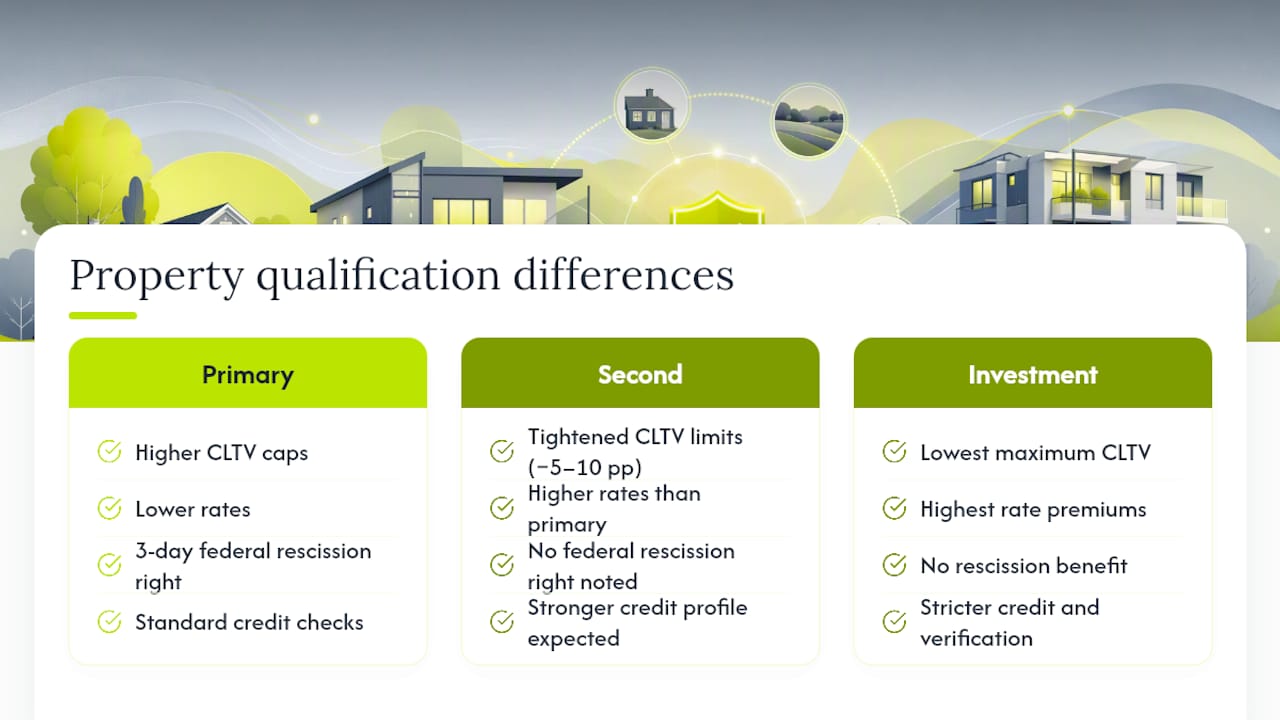
Your home equity loan requirements shift depending on what kind of property you’re borrowing against. Primary residences get the most favorable treatment across the board: higher CLTV caps, lower rates, and the federal three-day rescission right that applies specifically to loans secured by the home you live in.
Second homes and vacation properties usually qualify, but lenders tighten CLTV limits, often by five to ten percentage points, and expect a stronger credit profile to offset the added risk of a property that isn’t your primary residence.
Investment properties face the strictest standards. Expect lower maximum CLTV, higher rate premiums, and in many cases a requirement that you show cash reserves covering several months of payments on both properties. Some lenders decline to offer home equity products on investment properties altogether, preferring cash-out refinances or DSCR-based loan structures instead, which is worth exploring if a straight home equity loan isn’t available on that particular property.
Manufactured homes, homes on leased land, and properties held in certain trust structures can also run into eligibility limits that vary widely by lender. If your property doesn’t fit the standard single-family, owner-occupied mold, confirm eligibility before you invest time gathering documents.
Age, Citizenship, and Residency Requirements
You need to be at least 18 to sign a legally binding mortgage contract in the United States, which functions as the practical minimum age for any home equity product.
Citizenship isn’t a strict requirement the way some borrowers assume. U.S. citizens, permanent residents, and non-permanent residents with valid, verifiable documentation, work authorization, and a Social Security number or Individual Taxpayer Identification Number can typically qualify. What lenders actually care about is your ability to legally reside and work in the country long enough to make payments reliably, plus a documented income and credit history within the U.S. system.
Non-permanent residents sometimes face additional scrutiny, larger equity cushions, or slightly different documentation requests, since a shorter or less established U.S. credit history makes it harder for a lender to model risk the way they would for someone with a decade of domestic credit behavior. If that applies to you, expect your loan officer to ask for extra verification, not necessarily a denial.
Employment History and Income Stability
Lenders want to see steady, verifiable income, typically two years of consistent employment in the same field, or with the same employer, though switching jobs within your industry rarely raises a red flag on its own.
Gaps matter more than job changes. A six-month stretch of unemployment in the past two years invites more questions than three job changes at steadily increasing pay. Self-employed borrowers face a higher documentation bar: two years of tax returns plus profit-and-loss statements, since income can fluctuate more visibly year to year and lenders need a clearer average to underwrite against.
Commission income, bonus income, and freelance income are all usable, but lenders generally average them over 24 months rather than counting the most recent, possibly inflated, month. If you recently switched from salaried to self-employed work, expect lenders to want a full two-year self-employment history before they’ll count that income at full value. Some will consider a shorter track record case by case, particularly if you kept substantial cash reserves through the transition.
What Sets Your Loan Amount Limits
Four numbers interact to set your final loan amount: home value, current mortgage balance, allowed CLTV, and your qualifying income and credit profile. The CLTV formula sets your ceiling, but your DTI and credit score determine whether the lender will actually offer you that full ceiling or a smaller amount with tighter terms.
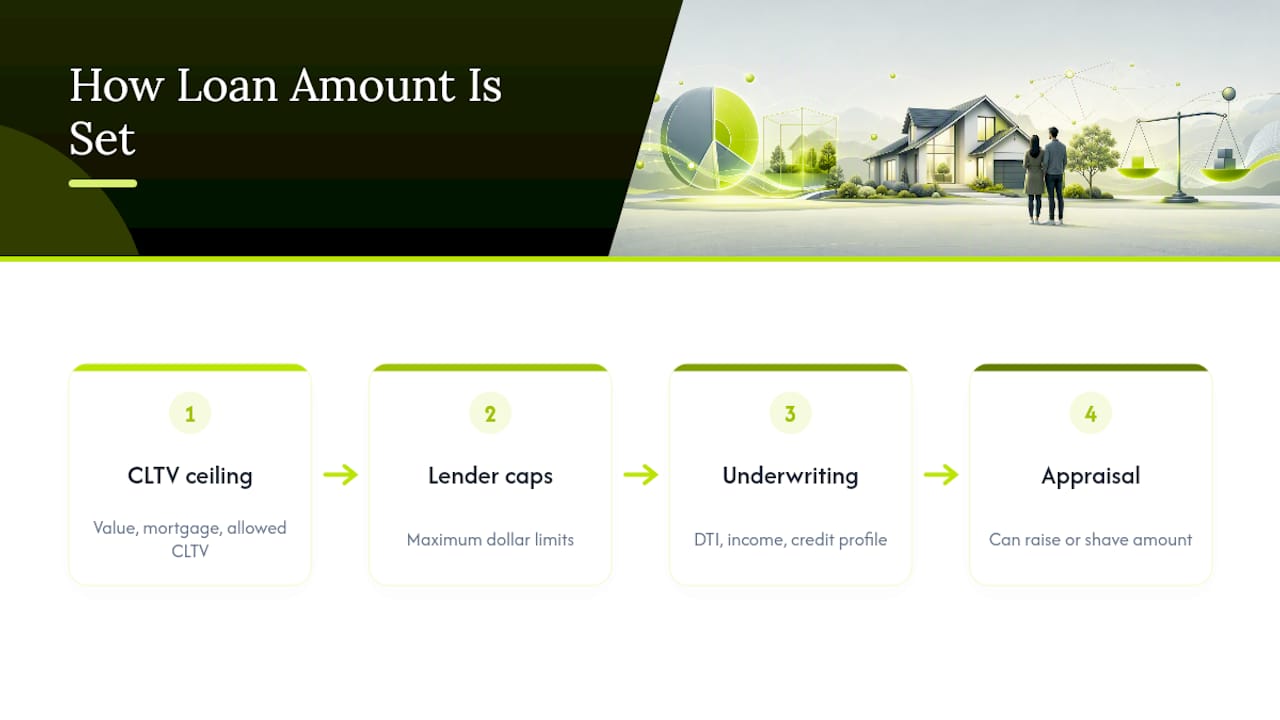
Some lenders also apply a maximum dollar cap regardless of your CLTV math, particularly on HELOCs, to limit their own exposure on any single file. High-value homes in strong markets sometimes bump into these caps before they bump into CLTV limits, which is worth knowing if you’re borrowing against a property well above your area’s median value.
Your appraisal is the variable most likely to move your final number after you’ve done your own math. A conservative appraisal can shave thousands off what you expected to qualify for, while a strong one can open room you didn’t think you had.
Why Home Equity Applications Get Denied
Denials rarely come from one single factor.
The most common denial triggers include a CLTV that exceeds the lender’s limit once the appraisal comes back, a DTI above the lender’s threshold once the new payment is factored in, recent late payments on the existing mortgage or major credit accounts, and unverifiable or inconsistent income, particularly common among recently self-employed applicants.
Insufficient homeowners insurance coverage, or a lapse discovered during underwriting, can also stall or kill a file even when every other number looks fine. Reviewing your policy status before applying costs nothing and removes one avoidable variable from the process.
The Truth About Qualifying for Home Equity Loans
Most guides treat home equity qualification like a single test you either pass or fail. It’s not. It’s four separate thresholds, equity, credit, DTI, and appraisal, and you can clear three of them easily while the fourth quietly disqualifies you. That’s the part conventional advice underplays: borrowers fixate on credit score because it’s the number most visible to them, while CLTV and appraisal outcomes, the two factors they can’t see coming, do more of the actual filtering.
The other overlooked piece is timing. Seasoning periods, appraisal turnaround, and documentation gaps stack up faster than people expect, and a file that looks ready on paper can still take six weeks to fund if the pieces move in sequence instead of in parallel. That’s where a broker’s real value shows up, not in finding some hidden loophole, but in running your file against multiple lenders’ CLTV and DTI tolerances simultaneously instead of applying once, waiting, and starting over if you’re denied.
If you take one thing from this: check your CLTV and pull your credit report before you do anything else. Everything downstream depends on those two numbers.
— David Mordue
Ready to See What You Qualify For?
Some lenders or brokers run home equity applications fully online, which can help skip branch visits and callback delays that slow down a traditional bank process, and may enable funding in as little as 21 days once a file is complete.
Start by running the numbers yourself. The refinance calculator gives you a realistic estimate of monthly payments before you commit to anything, and it’s a useful gut check against the CLTV math covered above. From there, gather your pay stubs, tax returns, and mortgage statement, and request a personalized consultation to walk through your specific equity position, credit profile, and timeline. If your situation involves rental property instead of a primary residence, the DSCR loan program may fit better than a standard home equity product. Visit David Mordue - Forward Financial Group to get started.
Where to Verify These Rules Yourself
- FTC: home equity loan and HELOC disclosures, for your three-day cancellation right
- CFPB HELOC brochure, for required lender disclosures
- Experian: home equity requirements, for credit and equity benchmarks
- Additional context via property value factors that can influence your appraisal
This article is general information, not a substitute for advice from a qualified financial advisor. Consult a qualified financial professional about your own circumstances before acting on anything here.
Sources
- Requirements for a Home Equity Loan or HELOC — Experian
- Home equity loans and home equity lines of credit — FTC
- CFPB HELOC brochure — Consumer Financial Protection Bureau
- HELOC requirements — LendingTree
- HELOC requirements — The Mortgage Reports
FAQ
How Much Would a $50,000 Home Equity Loan Cost Per Month?
It depends on your rate and term, but you can estimate it quickly using a refinance calculator; a fixed-rate 15-year term will carry a higher payment than a HELOC’s interest-only draw period, but builds equity faster.
Is It Difficult to Qualify for a Home Equity Loan?
It’s manageable if you meet the core benchmarks: 15% to 20% equity, a credit score in the mid-660 or better, and a DTI near 45% or below; most denials come from one of these numbers falling short, not from an overly complex process.
What Are the Three Types of Home Equity Loans?
The main options are a fixed-rate home equity loan (a lump sum with one payment), a HELOC (a revolving credit line with a draw and repayment period), and a cash-out refinance, which replaces your existing mortgage entirely while pulling out equity as cash.
What Is the Downside of a Home Equity Loan?
Your home secures the debt, so missed payments put the property at risk, and closing costs typically run 2% to 5% of the loan amount, which cuts into the funds you actually walk away with.