
A first-time homebuyer mortgage guide is a structured roadmap that walks you through loan options, eligibility requirements, and the full application process from credit check to closing. Regulatory bodies like the Consumer Financial Protection Bureau (CFPB) and the Department of Housing and Urban Development (HUD) set the standards that govern every mortgage you will encounter. Your credit score, down payment amount, and pre-approval status are the three factors that most directly determine what you qualify for and at what rate. Getting these right before you shop for a home puts you in a far stronger position than most first-time buyers realize.
What mortgage options are available for first-time homebuyers?
Four main loan types cover the majority of first-time buyers: conventional, FHA, VA, and USDA. Each serves a different financial profile, and choosing the wrong one can cost you thousands over the life of the loan.
Conventional loans are not government-backed. They require stronger credit but offer flexibility. Conventional loans can require as little as 3% down, and private mortgage insurance (PMI) is removable once you reach 20% equity. That removal option is a meaningful long-term advantage over FHA loans.

FHA loans are insured by the Federal Housing Administration and accept credit scores as low as 580 with 3.5% down. They are the most common choice for buyers with limited savings or imperfect credit. The tradeoff: if your down payment is below 10%, mortgage insurance stays on the loan for its entire life. Use the FHA affordability calculator to see what you qualify for before you apply.
VA loans are available to eligible veterans, active-duty service members, and surviving spouses. They require no down payment and no PMI, making them the most cost-effective option for those who qualify. Check your eligibility and run numbers with the VA affordability calculator.
USDA loans serve buyers in eligible rural and suburban areas. Like VA loans, they require no down payment. Income limits apply, so they are best suited to moderate-income buyers outside major metro areas.
- Conventional: 3% minimum down, PMI removable at 20% equity
- FHA: 3.5% down with a 580+ credit score, mortgage insurance may be permanent
- VA: 0% down for eligible military borrowers, no PMI
- USDA: 0% down for eligible rural buyers, income limits apply
Many states and localities also offer down payment assistance through grants or deferred loans. These programs are widely available but consistently underused by first-time buyers. Your state housing finance agency is the best place to start searching.
Pro Tip: Ask your mortgage broker about stacking a state assistance grant on top of an FHA loan. The combination can reduce your out-of-pocket costs at closing to near zero in some states.
What are the eligibility requirements and how do you prepare your finances?
Your credit score is the single most influential number in your mortgage application. Credit scores above 740 typically secure the best available rates. Scores below that threshold do not disqualify you, but they often mean a higher interest rate or a larger required down payment. Pull your credit report early and dispute any errors before you apply.
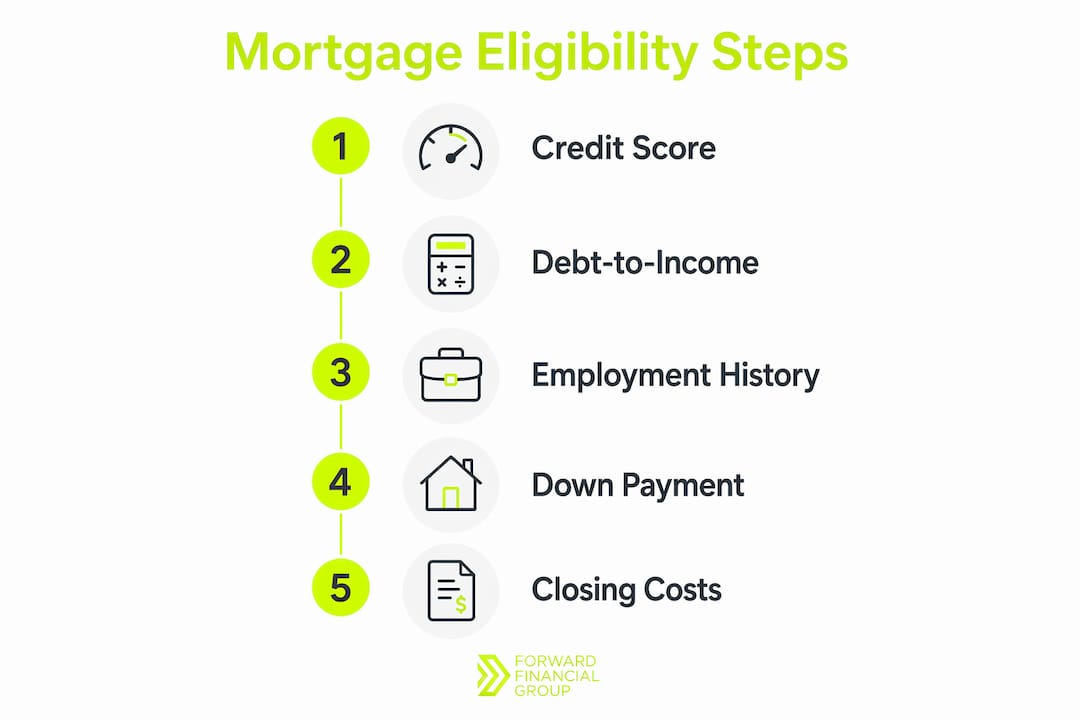
Your debt-to-income (DTI) ratio is the second major qualifier. Lenders prefer housing expenses that do not exceed 30% of your gross monthly income. Some programs allow total DTI up to 50%, and FHA loans can go as high as 57% in certain cases. That flexibility matters if you carry student loans or car payments alongside your housing costs.
Closing costs are a separate budget item that many first-time buyers underestimate. Closing costs typically range from 2% to 6% of the purchase price. Appraisal fees average $314–$424, and home inspection fees run $200–$500. On a $350,000 home, that means budgeting $7,000–$21,000 beyond your down payment.
Pro Tip: Request a Loan Estimate from each lender within three business days of applying. Federal law requires lenders to provide it, and it gives you a direct line-by-line comparison of fees.
| Eligibility checkpoint | What lenders look for |
|---|---|
| Credit score | 620+ for conventional; 580+ for FHA; 740+ for best rates |
| Debt-to-income ratio | Under 30% housing costs; total DTI up to 50%–57% for FHA |
| Down payment | 3%–3.5% minimum; 20% to avoid PMI on conventional loans |
| Employment history | Two years of steady employment or self-employment documentation |
| Closing cost reserves | Budget 2%–6% of purchase price beyond your down payment |
Employment history also matters. Most lenders want to see two consecutive years of income from the same employer or in the same field. Self-employed buyers need two years of tax returns showing consistent income.
How do you get pre-approved and apply for a first mortgage?
Pre-qualification and pre-approval are not the same thing. Pre-qualification is a simple estimate based on self-reported financial data. Pre-approval requires a lender to verify your income, assets, and credit through actual documentation. Sellers take pre-approval letters seriously. Pre-qualification letters carry little weight in a competitive market.
Follow these steps to move from preparation to a verified pre-approval:
- Pull your credit reports. Get reports from all three bureaus (Equifax, Experian, TransUnion) and correct any errors at least 60 days before applying.
- Gather your financial documents. You will need two years of W-2s or tax returns, 30 days of pay stubs, two to three months of bank statements, and photo ID.
- Calculate your budget. Use the conventional affordability calculator to set a realistic price range before you talk to lenders.
- Apply to multiple lenders. Getting three to five pre-approval letters lets you compare loan terms and choose the best offer. Multiple mortgage inquiries within a 45-day window count as a single credit pull under FICO scoring rules.
- Compare Loan Estimates side by side. Look at the annual percentage rate (APR), not just the interest rate. APR includes fees and gives you a true cost comparison.
- Choose your lender and lock your rate. Once you find a home, lock your rate in writing. Rate locks typically last 30–60 days.
A common mistake at this stage is changing jobs or making large purchases on credit while your application is active. Both actions can trigger a re-underwriting review and delay or kill your approval.
What should you expect during underwriting and closing?
Underwriting is the lender’s formal review of your financial profile and the property you want to buy. The underwriter verifies your documents, orders an appraisal, and checks the title. This phase is where most delays occur.
The closing process typically takes about a month from the time your offer is accepted. Common delays include appraisal gaps (when the home appraises below the purchase price), title issues, and last-minute changes to your financial profile. Respond to every underwriter request within 24 hours to keep things moving.
During closing, you will:
- Review and sign the Closing Disclosure at least three business days before your closing date
- Pay closing costs and your down payment via wire transfer or certified check
- Sign the final loan documents and receive the keys
Home inspections and appraisals are both required steps. The inspection protects you by identifying physical defects. The appraisal protects the lender by confirming the home’s market value supports the loan amount. Neither is optional in a standard mortgage transaction.
Closing scam warning: Wire fraud targeting homebuyers is a documented and growing threat. Always verify wire transfer instructions by calling your title company or closing attorney directly using a phone number you looked up independently. Never trust wiring instructions sent by email alone. One phone call can protect your entire down payment.
Key Takeaways
A first-time homebuyer’s success depends on choosing the right loan type, meeting credit and income thresholds, and completing pre-approval before making an offer.
| Point | Details |
|---|---|
| Match loan type to your profile | FHA suits lower credit scores; VA and USDA offer zero-down options for eligible buyers. |
| Credit score drives your rate | Scores above 740 secure the best rates; check and correct your report early. |
| Budget beyond the down payment | Closing costs add 2%–6% of the purchase price on top of your down payment. |
| Pre-approval beats pre-qualification | Only a verified pre-approval carries weight with sellers in a competitive market. |
| Apply to multiple lenders | Three to five pre-approval letters give you real leverage to compare and negotiate terms. |
What I have learned from working with first-time buyers
The biggest mistake I see first-time buyers make is waiting until they feel “ready” to start the process. By the time they feel confident, they have often missed rate windows or lost homes to buyers who prepared earlier. Financial readiness is built, not discovered.
The second pattern I notice is that buyers focus almost entirely on the interest rate and ignore the loan structure. A 30-year fixed rate at 6.8% with no PMI can cost less over time than a 6.5% FHA loan with permanent mortgage insurance. The math is not always obvious, and that is exactly where professional guidance pays for itself.
State and local assistance programs are the most underused resource in this entire process. I have worked with buyers who qualified for grants covering their full down payment and still did not know those programs existed. Ask about them at the start, not after you have already committed to a loan structure.
My honest advice: prepare your finances 6–12 months before you plan to buy. Pay down revolving debt, avoid new credit applications, and build your reserves. The buyers who do this consistently get better rates, smoother approvals, and fewer surprises at the closing table.
— David Mordue
Ready to move forward with your mortgage?
Knowing your options is the first step. Taking action is what turns a plan into a home.
David Mordue - Forward Financial Group offers a fully online mortgage application that can move from pre-approval to funding in less than 21 days. Whether you are weighing your options with the Rent vs Buy Calculator or ready to apply for mortgage pre-approval today, the process is built to be fast, clear, and personal. David Mordue - Forward Financial Group compares rates across lenders so you get a competitive offer without spending weeks doing it yourself. See what you qualify for and get your personalized rate comparison now.
FAQ
What credit score do I need for a first-time homebuyer mortgage?
Most conventional loans require a 620 or higher credit score, while FHA loans accept scores as low as 580. Scores above 740 typically qualify for the best available rates.
What is the difference between pre-qualification and pre-approval?
Pre-qualification is an estimate based on self-reported information, while pre-approval requires lenders to verify your actual financial documents. Sellers treat pre-approval as a credible commitment; pre-qualification carries little weight.
How much do I need for a down payment as a first-time buyer?
Conventional loans start at 3% down and FHA loans at 3.5%. VA and USDA loans require no down payment for eligible borrowers. Budget an additional 2%–6% of the purchase price for closing costs.
What are first-time buyer assistance programs?
State and local housing agencies offer grants and deferred loans to help cover down payments and closing costs. These programs are widely available but frequently overlooked. Contact your state housing finance agency to check eligibility.
How long does the mortgage closing process take?
The closing process typically takes about one month from accepted offer to final signing. Delays from appraisals, title issues, or document requests are common but manageable with prompt responses.