
An FHA Streamline Refinance replaces your existing FHA-insured mortgage with a new FHA loan, usually to lower your rate or monthly payment, with far less paperwork than a standard refinance. It keeps FHA mortgage insurance in place (and can reset it), and it forbids taking more than $500 cash back.
- Good fit: You’ve made your last six payments on time and closed your current FHA loan at least 210 days ago.
- Not a fit: You need cash out, or you’re behind on payments.
Pro Tip: If your loan is more than a few years old, ask your lender for a mortgage insurance premium comparison before you assume the streamline saves money.
Key Takeaways
An FHA Streamline Refinance lowers your rate with minimal paperwork, but resets to your mortgage insurance can cancel out the savings if you skip the breakeven math.
| Point | Details |
|---|---|
| Seasoning requirement | Wait at least 210 days and make six on-time payments before applying. |
| Net tangible benefit | Your combined P&I and annual MIP payment must drop, or you must convert from an ARM to fixed. |
| No cash-out | FHA caps cash back at $500, so this isn’t a way to access equity. |
| Watch your MIP reset | A new upfront and annual MIP schedule can offset a lower interest rate. |
| Compare before you commit | David Mordue - Forward Financial Group shops FHA-approved lenders and runs the net tangible benefit calculation for you. |
This article is general information, not a substitute for advice from a qualified financial advisor. Consult a qualified financial professional about your own circumstances before acting on anything here.
Table of Contents
- How FHA Streamline Refinancing Actually Works
- FHA Streamline Eligibility and Requirements
- Costs, MIP Changes, and Other Downsides
- How to Apply for an FHA Streamline Refinance
- Calculating Your True Breakeven Point
- Questions to Ask Lenders Before You Commit
- When a Streamline Refinance Actually Makes Sense
- Get Help Running the Numbers on Your Refinance
- Sources
How FHA Streamline Refinancing Actually Works
FHA splits streamlines into two types. A non-credit-qualifying streamline skips income verification and credit checks entirely, which is why it closes faster and works even for borrowers whose credit has slipped since their original loan. A credit-qualifying streamline requires a full credit and income review, typically because the new payment is going up or the borrower is being removed from the loan.
Appraisals work the same way. HUD does not require one for most streamlines, which is a real advantage if your home’s value has dropped and you’re underwater. But the lender gets to decide.
- HUD sets the floor: no appraisal requirement, no income check for non-credit-qualifying files.
- Lenders add overlays on top: some require an appraisal anyway, others run credit even when HUD doesn’t demand it.
- The result is that two lenders can offer very different paperwork loads for the same loan.
That gap is exactly why shopping FHA-approved lenders before committing to one matters more than the advertised rate.
FHA Streamline Eligibility and Requirements
Before you call a lender, run through the basics yourself. The mandatory rules come straight from HUD, not from any one bank’s preference:
- Your current mortgage must already be FHA-insured.
- The loan has to be current, with no recent delinquency.
- At least 210 days must have passed since your existing loan closed, and you need six payments on record.
- Your payment history over that window has to show on-time payments, not just six payments total.
Beyond timing, FHA requires a net tangible benefit. Usually that means your new combined principal, interest, and annual mortgage insurance payment drops by a meaningful margin, or you’re converting an adjustable-rate mortgage to a fixed rate.
| Requirement | What it means for you |
|---|---|
| FHA-insured loan | Only current FHA borrowers qualify; conventional loans need a different refinance path. |
| 210-day seasoning | You must wait at least 210 days after your original closing date. |
| Six-payment history | Six monthly payments made, with recent history showing on-time payments. |
| Net tangible benefit | Your P&I plus annual MIP payment must drop, or you’re moving from an ARM to fixed. |
Lenders will still ask for mortgage statements, a payoff quote, and proof you occupy the home as your primary residence, even on a paperwork-light streamline.
Costs, MIP Changes, and Other Downsides
Here’s what catches a lot of homeowners off guard: a lower interest rate doesn’t always mean a lower payment. Streamline refinances usually restart your upfront mortgage insurance premium and can shift the timing or rate of your annual MIP, and that reset can offset or even outweigh the savings from a better rate.

A homeowner who refinances from a rate a full point higher than today’s market might still see a similar or slightly higher payment once the new MIP schedule kicks in, especially on loans originated in the early years of a higher MIP era.
A few other things to check before you sign anything:
- No real cash-out. FHA caps cash back at $500; this program is not a way to tap equity.
- “No-cost” isn’t free. HUD doesn’t let lenders roll closing costs into the new loan balance, so a lender-paid “no-cost” refinance is actually funded by charging you a slightly higher rate.
- Appraisal risk. Even on files where FHA doesn’t require one, a lender-required appraisal can add real cost and time, particularly if your home’s value has dropped.
- Overlays vary. One lender’s “streamlined” process can still involve more underwriting than another’s.
How to Apply for an FHA Streamline Refinance
The process moves fast when your file is clean, but each step has a natural pace.
- Confirm your goal and eligibility. Check your loan’s seasoning date and payment history against HUD’s rules.
- Pull your current mortgage statement and payoff quote. Lenders need these on day one, even for streamlines.
- Shop two or three FHA-approved lenders, or get expert advice on affordable home financing in Ohio. Ask each one directly whether they require an appraisal or credit check for your file.
- Request written net tangible benefit calculations. Compare the real payment change, not just the advertised rate.
- Confirm appraisal requirements and lock your rate. This is where timelines diverge most between lenders.
- Close. Non-credit-qualifying files with no appraisal often close in two to three weeks; credit-qualifying files with an appraisal can take four to six.
Documents to have ready regardless of loan type:
- Recent mortgage statement and payoff quote
- Proof of homeowners insurance and escrow balance
- Evidence the home is your primary residence
Calculating Your True Breakeven Point
The math that actually matters is simple: total refinancing cost divided by your monthly savings (after accounting for any MIP change) tells you how many months until the refinance pays for itself.
Say your closing costs run $3,000 and your principal and interest payment drops by $120 a month, but your annual MIP adds $25 a month back. Your real monthly savings is $95, and $3,000 divided by $95 puts your breakeven around 32 months. If you’re planning to move or refinance again before then, the streamline may not be worth it.
- Always net out the MIP change, not just the rate change.
- If you’re offered a “no-cost” option, compare the higher rate’s lifetime cost against paying closing costs upfront.
- Run the numbers with a refinance calculator before committing to either path.
Questions to Ask Lenders Before You Commit
Not every FHA-approved lender treats streamlines the same way, so ask direct questions before you pick one:
- Will this loan require an appraisal, and if so, who pays for it?
- Is this credit-qualifying or non-credit-qualifying for me specifically?
- What does my new MIP schedule look like compared to my current one?
- If you’re offering a “no-cost” refinance, what rate am I giving up in exchange?
- What are my exact closing costs, itemized?
Red flags worth walking away from: a lender who won’t give you a written net tangible benefit calculation, vague answers about MIP treatment, or fees quietly bundled into the rate without explanation.
Pro Tip: Get at least two written estimates on the same day. Rates move daily, and comparing quotes from different afternoons will skew your decision.
When a Streamline Refinance Actually Makes Sense
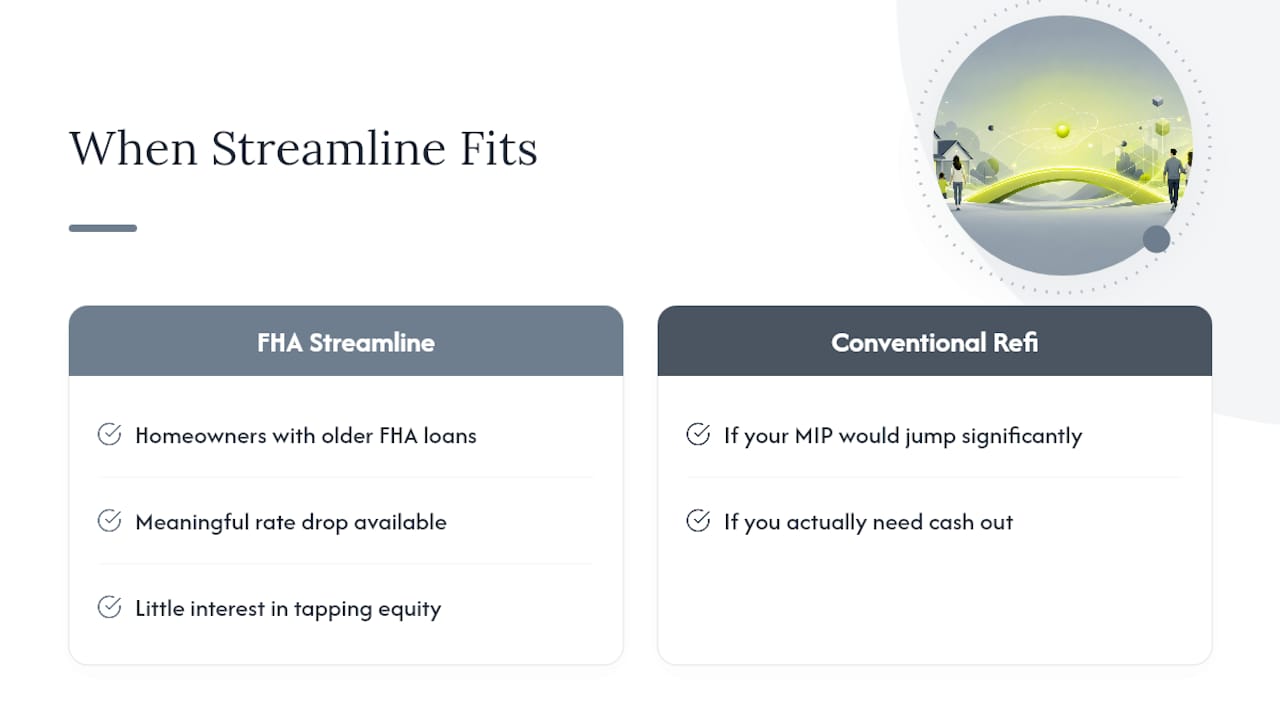
Streamlines tend to work best for homeowners with older FHA loans, a meaningful rate drop available, and little interest in tapping equity. If your MIP would jump significantly under the new schedule, or you actually need cash out, a conventional refinance deserves a serious look instead.
Get Help Running the Numbers on Your Refinance
Reading the HUD rules is one thing. Knowing whether your specific loan, MIP schedule, and rate actually produce real savings is another, and that’s where a broker earns their keep instead of a call center reading you a script. David Mordue - Forward Financial Group compares offers across FHA-approved lenders for you, checks whether you’d qualify for non-credit-qualifying treatment, and runs the net tangible benefit math before you ever lock a rate.

If you want a clear answer on whether your loan clears breakeven, start with the refinance calculator to model your MIP and rate change, then request a rate comparison at Davidmordue to see real offers side by side.
Sources
- Hud
- FHA Streamline Refinance | Rates & Requirements for 2026 — The Mortgage Reports
- FHA Streamline Refinance: What It Is, How It Works, and When It Makes Sense - SuperMoney