
A financed mortgage can realistically close in 10–21 days when you have a fully underwritten pre-approval, a lender with in-house underwriting, and every document ready before you make an offer. Cash buyers can close in as few as 7–14 days when contingencies are waived. For most financed buyers, the practical target is 21–30 days with the right lender and preparation.
Here are the realistic speed tiers to plan around:
- Cash purchase, no contingencies: 7–14 days
- Financed, fast-close lender, fully underwritten pre-approval: 10–21 days
- Financed, well-prepared buyer, standard lender: 25–35 days
- Financed, FHA or VA loan: 35–50+ days (government requirements add time)
- Typical financed purchase, no special preparation: 30–45 days
Federal rules create a hard floor for financed closings. After your lender issues the Closing Disclosure, you must wait three business days before signing. That single requirement alone makes sub-two-week financed closings extremely difficult to execute reliably.
Clear to close (CTC) means your lender has reviewed and approved every condition in your loan file. It is the final milestone before the Closing Disclosure is issued. Reaching CTC quickly is the single most controllable variable in your timeline — everything before it is where speed is won or lost.
Key Takeaways
A fast mortgage closing is achievable in 10–21 days for financed buyers who combine a fully underwritten pre-approval with a lender that has in-house underwriting and a dedicated processor.
| Point | Details |
|---|---|
| Realistic fast-close timeline | Financed buyers can target 10–21 days; cash buyers can close in 7–14 days with no contingencies. |
| Fully underwritten pre-approval | Verifying income, assets, and credit before offer acceptance removes weeks from post-offer underwriting. |
| Lender choice drives speed | In-house underwriting and a dedicated processor matter more than any advertised guarantee. |
| Rush appraisal cost | Expect $100–$300 extra to move an appraisal to the front of the queue when your timeline is tight. |
| David Mordue - Forward Financial Group | Offers a fully online process targeting closings under 21 days for eligible borrowers with dedicated processing and wholesale lender access. |
Table of Contents
- What “fast” actually means for mortgage timelines
- Programs and lender capabilities that actually shorten closing time
- Exact documents and actions that shave days off your closing
- How to choose the right lender when speed is the priority
- Common hold-ups that add weeks and how to fix them
- Money trade-offs for speed: fees, rate locks, and appraisal costs
- How Forward Financial Group helps borrowers close faster
- When you should — and shouldn’t — prioritize speed
- Forward Financial Group is ready when your timeline is tight
- Sources
What “fast” actually means for mortgage timelines
The industry benchmark for a financed purchase sits at roughly 44 days from accepted offer to closing, based on 2024 data. ICE Mortgage Technology data reported by Yahoo Finance places the average near 42 days, with VA loans averaging around 71 days and FHA loans trending similarly long due to stricter program requirements.
These averages mask a wide range. A well-prepared buyer with a strong lender can cut that timeline nearly in half. A disorganized buyer with a slow lender can stretch it past 60 days.
The milestones that consume the most time in a typical financed close are:
- Appraisal: scheduling and completing an appraisal usually takes about one to two weeks; rush appraisals can shorten this.
- Underwriting: initial underwriting review duration varies with lender volume and pre-approval status.
- Title work: title search, commitment, and defect resolution usually take multiple days.
- Closing Disclosure waiting period: mandatory three business day wait after disclosure issuance.
| Loan Type | Typical Timeline |
|---|---|
| Cash purchase | 7–14 days |
| Conventional (fast-close lender) | 10–21 days |
| Conventional (standard lender) | 30–45 days |
| FHA loan | 35–50 days |
| VA loan | 30–45 days |
Statistic: HUD guidance on government-insured loan programs confirms that FHA and VA loans carry additional disclosure and inspection requirements that extend timelines beyond what conventional loans require.
Programs and lender capabilities that actually shorten closing time
Not every lender who advertises a “fast close” can deliver one. The difference between a marketing claim and a real operational capability comes down to a few specific features.
Fully underwritten pre-approval is the single most powerful tool available to a financed buyer. A standard pre-approval letter is a credit check and a quick income estimate. A fully underwritten pre-approval means a lender has verified your income, assets, and credit in full before you make an offer. Once you go under contract, the lender skips the initial underwriting weeks entirely. Redfin’s reporting confirms this is the primary mechanism that allows post-offer timelines to compress to 10–21 days.
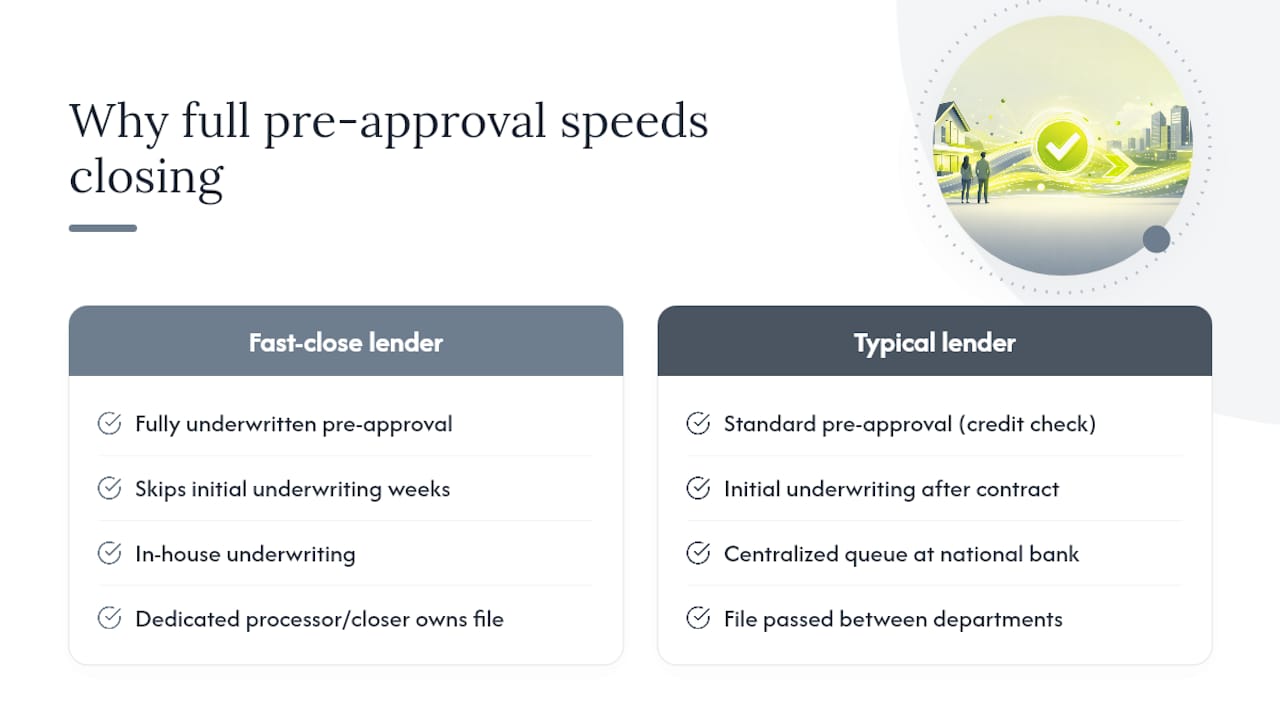
In-house underwriting means the lender’s underwriter sits in the same organization as your loan officer, not in a centralized queue at a national bank. Decisions happen faster, conditions get cleared faster, and you are not waiting on a third-party review team.
Dedicated processor or closer means one person owns your file from application through closing. You are not passed between departments. Questions get answered the same day.
Electronic document portals and e-signatures remove the physical courier and overnight mail delays that once added 2–5 days to a closing. Most competitive lenders now offer these, but verify before you commit.

Rush appraisal options allow you to pay a premium to move to the front of an appraiser’s queue. Typical extra cost is $100–$300 above the standard appraisal fee. Not every lender has appraiser relationships that support this, so ask directly.
Fast-close programs from some lenders advertise 10–14 business-day guarantees. These programs typically require a conventional loan, a clean borrower profile, and same-day document delivery. Eligibility is strict, and the guarantee usually applies only when the borrower meets every condition on time.
Pro Tip: Ask any lender two direct questions before you commit: “Do you underwrite in-house?” and “What was your average days-to-close for conventional purchases in the last 90 days?” A lender who cannot answer the second question with a specific number is telling you something important.
Exact documents and actions that shave days off your closing
Your lender can only move as fast as you do. Delays caused by missing documents are the most common and most preventable source of extended timelines.
Before you make an offer, gather:
- Two years of W-2s and federal tax returns (all pages, all schedules)
- 30 days of pay stubs from all employers
- 60 days of bank statements for every account (all pages, including blank ones)
- Documentation for any large deposits in the last 60 days
- Government-issued photo ID
- Proof of funds for down payment and closing costs
- Gift letters if any portion of funds is a gift
- Landlord contact information if you currently rent
Immediately after offer acceptance:
- Authorize your lender to order the appraisal and pay the rush fee if your timeline requires it
- Provide the title company’s contact information to your lender the same day
- Request the HOA resale certificate and condo questionnaire if applicable — these can take 5–15 days from HOA management companies
- Schedule your home inspection within 48 hours
- Respond to every lender document request within 24 hours, not 48
Pro Tip: Upload documents to your lender’s electronic portal rather than emailing them. Portals create a timestamped record, reduce the chance of files getting lost in an inbox, and allow your processor to see new documents immediately. Lock your interest rate as soon as your offer is accepted if you are confident in your timeline — waiting to lock while rates move adds uncertainty without benefit.
Compressing contingency windows is possible but carries real risk. Shortening an inspection contingency from 10 days to 5 days is reasonable if you have an experienced inspector available. Waiving it entirely is a financial risk that only makes sense in specific competitive situations with a property you have thoroughly assessed.
How to choose the right lender when speed is the priority
Lender choice is the single most significant factor in closing speed, according to real estate experts. The lender’s internal structure, not their marketing, determines how fast your file moves.
Local mortgage brokers with access to wholesale lenders often close faster than national banks because they are not constrained by a single lender’s underwriting queue. A broker with strong wholesale relationships can place your loan with the lender best suited to your profile and timeline. For broker selection guidance, the key attributes are in-house decisioning, dedicated staffing, and transparent communication.
Local credit unions sometimes offer competitive speed for members, but their underwriting capacity is limited and they may not offer fully underwritten pre-approvals.
National banks typically route files through centralized underwriting departments. This structure adds time, particularly during high-volume periods. Big-bank centralized underwriting often adds weeks compared to local decision-making, as industry reporting confirms.
Questions to ask any lender before committing:
- Do you underwrite in-house or through a third-party underwriter?
- Can you issue a fully underwritten pre-approval before I make an offer?
- Will I have a dedicated processor for my file?
- What is your average close time for a conventional purchase similar to mine?
- Can you accommodate a 21-day close if my file is complete?
Red flags that predict delays: a lender who cannot tell you their average close time, who routes all underwriting through a centralized team, who cannot offer e-signatures, or who cannot produce a fully underwritten pre-approval before offer acceptance.
David Mordue - Forward Financial Group operates as a mortgage broker with access to multiple wholesale lending channels, in-house processing, and a fully online application process designed to support closings under 21 days for eligible borrowers.
Common hold-ups that add weeks and how to fix them
Most closing delays trace back to a small set of recurring problems. Knowing them in advance lets you address them before they cost you time.
- Missing or incomplete documents: The fix is preemptive. Deliver every document your lender requests the same day you receive the request. Never assume a document is optional.
- Appraisal delays: If your appraiser is backlogged, ask your lender about a rush appraisal. The extra cost of $100–$300 is almost always worth it when your closing date is at risk.
- Low appraisal value: Request an appraisal review immediately. Your agent can provide comparable sales the appraiser may have missed. If the gap is small, gap funding or a price renegotiation with the seller are both viable paths.
- Title defects: Order the title search the day you go under contract. Common defects include old liens, estate issues, and boundary disputes. Most are resolvable, but they take time — time you do not have if you discover them in week three.
- HOA resale certificate delays: HOA management companies are notoriously slow. Request the resale certificate and condo questionnaire on the day of contract execution, not when your lender asks for it.
- Survey delays: In states where a survey is required, order it immediately after contract execution.
Pro Tip: Set up a group text or shared email thread with your loan officer, real estate agent, and title company contact from day one. A daily 60-second status check prevents the compounding effect where one person is waiting on another without realizing it. Proactive team communication is consistently cited by real estate professionals as the most reliable way to prevent minor delays from becoming major ones.
Contract amendments and contingency waivers can be used strategically when a specific delay is identified. If the appraisal is complete but the survey is running late, a short extension on the survey contingency is preferable to letting the contract lapse.
Money trade-offs for speed: fees, rate locks, and appraisal costs
Closing faster usually costs something. Understanding those costs upfront lets you decide whether the speed is worth it for your situation.
Rush appraisal: Typically adds $100–$300 to your standard appraisal fee. In most cases, the seller does not pay this — it comes out of your pocket at or before the appraisal is ordered.

Expedited title fees: Some title companies charge a premium for rush title searches or same-day commitment letters. These fees vary by market but are generally modest.
Courier and overnight fees: If any documents require physical delivery, overnight courier fees apply. Electronic portals and e-signatures eliminate most of these, but not all lenders or title companies are fully paperless.
Guarantee credits: Some fast-close programs include a credit to the borrower if the lender fails to close by the promised date. These credits are real but read the fine print — they typically apply only when the delay is the lender’s fault, not the borrower’s.
Rate lock timing matters. A 30-day rate lock is cheaper than a 45-day lock. If you are confident in a 21-day close, a 30-day lock protects you and costs less. If your timeline slips past the lock expiration, you face either a lock extension fee or re-locking at the current market rate — whichever is less favorable to you. Negotiate who pays for rush fees in your purchase contract when possible. In a buyer’s market, sellers sometimes absorb expedited title costs as a concession.
Example: A buyer using a rush appraisal ($200 extra), expedited title commitment ($150), and one overnight courier ($45) adds roughly $395 to their closing costs for a financed fast close. That figure is a reasonable estimate for planning purposes, not a guarantee — actual costs vary by market and lender.
How Forward Financial Group helps borrowers close faster
David Mordue - Forward Financial Group is built around a process that targets closings under 21 days for eligible borrowers. The approach is fully online, which removes the scheduling friction that slows traditional mortgage offices.
The fast-close process works as follows:
- Online application: Submit your full application through the digital portal in minutes, from any device.
- Fully underwritten pre-approval: Income, assets, and credit are verified before you make an offer, so post-offer underwriting is compressed significantly.
- Dedicated processor: One person manages your file from application through closing, providing direct communication and same-day responses.
- Electronic document portal: Upload documents securely, receive e-signature requests instantly, and track your file status without waiting for callbacks.
- Coordinated title contacts: Forward Financial Group works directly with title companies to keep the closing timeline on track from both sides.
- Rate comparison across lenders: As a broker, David Mordue accesses multiple wholesale lending channels to match your profile with the lender best suited to your timeline and loan type.
Eligibility for the under-21-day target generally requires a conventional loan, a clean credit and income profile, and full borrower responsiveness — meaning documents delivered within 24 hours of every request.
You can verify David Mordue’s licensing directly through NMLS Consumer Access, which lists state licenses and company registration for full transparency.
When you should — and shouldn’t — prioritize speed
Speed in a mortgage closing is a tool, not a goal. Used correctly, it protects you. Used carelessly, it can cost you more than the time you saved.
Speed is genuinely valuable when:
- You are relocating for a job and your start date is fixed
- Your lease expires and you need to avoid a month-to-month extension
- You are competing against other offers and a fast close is a meaningful differentiator for the seller
- You have a fully underwritten pre-approval and a clean property — the risk of moving fast is low
Speed is risky when:
- You are a first-time buyer who has not had time to fully understand the inspection results
- The property has title complexity or an HOA with a history of slow document delivery
- You are compressing contingencies on a property with deferred maintenance
- Your financial documents are not fully organized — a fast lender cannot save a disorganized borrower
The borrower checklist and lender-selection guidance covered earlier apply directly here. If your documents are ready and your lender has in-house underwriting, a 21-day close is a reasonable target with manageable risk. If either condition is missing, build in more time rather than hoping the process cooperates.
Forward Financial Group is ready when your timeline is tight
When your closing window is short, the difference between a lender who can deliver and one who cannot becomes very real, very fast. David Mordue - Forward Financial Group offers a fully online mortgage process with a target close time under 21 days for eligible borrowers — no branch visits, no paper chases, no waiting for a centralized underwriting queue to clear.
You can start your application today, request a fully underwritten pre-approval, and upload your documents directly to the secure portal. David Mordue compares rates across multiple wholesale lenders to find the option that fits both your financial profile and your timeline. Licensing is publicly verifiable through NMLS, and personalized consultations are available to walk you through your specific situation. If you are weighing your options before committing, the conventional affordability calculator gives you a clear picture of what you qualify for before you apply.
Sources
These sources back the timeline data, regulatory requirements, and program details referenced throughout this article.
- Can You Close On a House in 2 Weeks? Yes, Here’s How - LegalClarity
- How long it takes to close on a house — and how to speed up the process | Yahoo Finance
- Hud
This article provides general information about mortgage closing timelines and processes. It is not a substitute for advice from a licensed mortgage professional. Confirm current program rules and eligibility requirements with your lender or the relevant regulatory authority.