
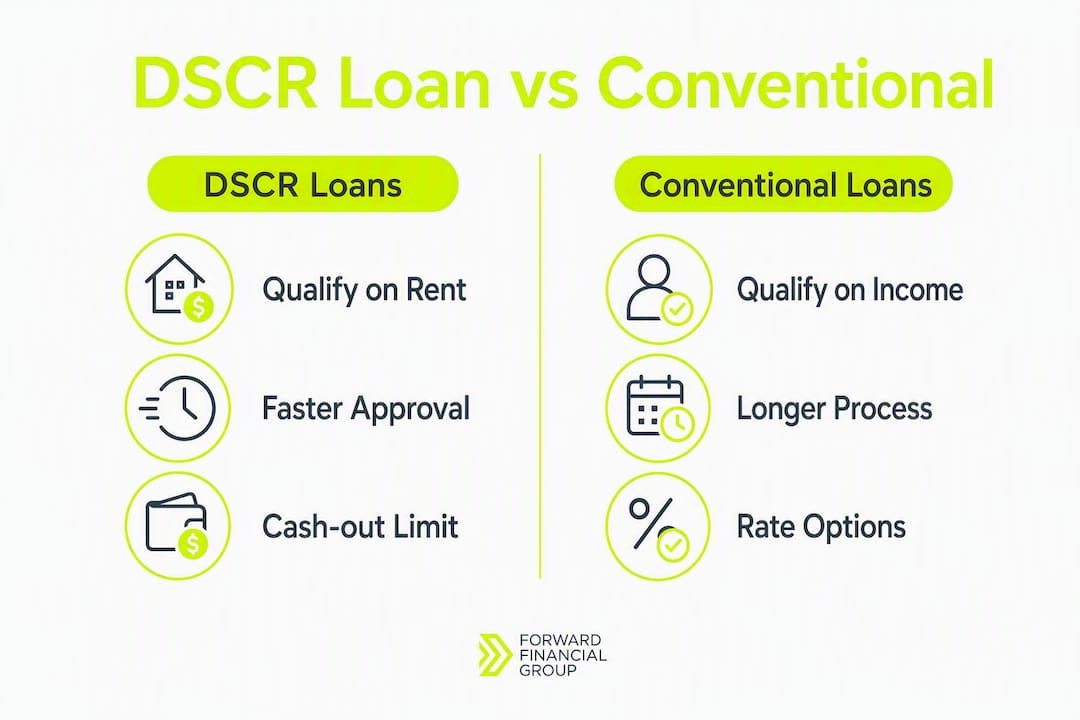
A DSCR loan lets an investment property qualify on its own rental income — not your W-2s — making it the fastest practical path for active investors to buy or refinance rentals when personal income documentation is limited or your portfolio has grown past conventional limits.
- Who it’s for: Self-employed investors with low reported income, buyers who need LLC vesting, and portfolio scalers who have hit Fannie Mae’s 10-property conventional cap.
- Main upside: Faster closes (typically 2–4 weeks vs. 4–6+ weeks for conventional), entity vesting in an LLC, and no W-2 or tax-return requirement.
- Main downside: Rates run roughly 100–150 basis points above conventional investment-property pricing, and reserve requirements are stricter than most borrowers expect.
Pro Tip: Before you run the numbers on a deal, run a quick pre-check with David Mordue - Forward Financial Group to see which DSCR program fits your property type and credit profile — it takes minutes and costs nothing.
Table of Contents
- What is the DSCR formula and how do you calculate it?
- How DSCR loans are underwritten differently from conventional mortgages
- Common investor scenarios where a DSCR loan makes sense
- Who qualifies and what documents lenders want
- What loan terms and costs should you expect?
- Benefits, downsides, and what happens with a sub-1.0 DSCR
- How to apply and what the timeline looks like
- Sample DSCR calculation and an anonymized case study
- Key Takeaways
- Why DSCR beats conventional for the right investor at the right time
- How David Mordue - Forward Financial Group gets your DSCR deal funded faster
- Useful sources and tools for further research
What is the DSCR formula and how do you calculate it?
The debt service coverage ratio measures whether a property’s rental income covers its monthly debt obligations. Lenders compute it as:
DSCR = Gross Monthly Rent ÷ Monthly PITIA

PITIA stands for principal, interest, taxes, insurance, and HOA dues (if applicable). Lenders do not subtract vacancy, management fees, or maintenance from the rent side of the equation — they use gross rent only.
What counts as “rent”? Lenders typically use the lower of the signed lease, the appraiser’s market rent schedule (Form 1007), or platform data for short-term rentals. For STR properties, AirDNA analytics or 12-month Airbnb/VRBO statements are commonly accepted, though lenders may cap LTV on those deals at 70–75%.
Worked example:
| Line item | Amount |
|---|---|
| Gross monthly rent (appraiser estimate) | $2,400 |
| Property taxes (monthly) | $220 |
| Homeowner’s insurance | $110 |
| HOA dues | $0 |
| DSCR | 1.04 |
A DSCR of 1.04 clears the standard 1.0 threshold most lenders require, though it leaves little margin. Pushing the loan amount down by $10,000–$15,000 or selecting an interest-only period would lift that ratio meaningfully.
Pro Tip: Switching from a 30-year amortizing structure to a 40-year or interest-only period reduces monthly P&I, which raises your DSCR without changing the rent. Model both scenarios before you lock a rate.
How DSCR loans are underwritten differently from conventional mortgages
Conventional underwriting starts with you: your W-2s, tax returns, debt-to-income ratio, and employment history. DSCR underwriting starts with the property. Your personal income never enters the calculation.
Here is the typical lender workflow from pre-qualification to closing:
- Pre-qualification. You provide the property address, estimated rent, and purchase price. The lender runs a quick DSCR estimate using AVM-based rent data to confirm the deal is in range.
- Application. You submit a credit authorization and proof of reserves. The lender pulls your credit score and verifies liquid assets.
- Appraisal order. The lender orders a full appraisal that includes a Form 1007 rent schedule, which establishes the appraiser’s opinion of market rent for the subject property.
- Underwriting. The underwriter calculates DSCR using the lower of the lease, Form 1007, or platform data. Overlays for property type, LTV, and credit score are applied here.
- Conditions and closing. You clear any outstanding conditions (updated insurance binder, entity documents for LLC vesting, final reserve verification) and proceed to closing.
Digital-first lenders can compress this to 10–21 days on a clean file. Complex structures — foreign nationals, multi-member LLCs, or properties with no rental history — typically run 28–60 days.
One important note: for vacant properties or new acquisitions with no lease history, lenders commonly accept the appraiser’s Form 1007 market rent estimate to underwrite projected income. You do not need an existing tenant to qualify.

Common investor scenarios where a DSCR loan makes sense
DSCR financing fits a specific set of situations well. Knowing where it excels helps you decide quickly whether to pursue it or stick with conventional options.
- Self-employed investors whose tax returns show low net income after deductions, making DTI-based underwriting difficult.
- Portfolio scalers who have reached or are approaching conventional financing caps.
- LLC buyers who want title vested in an entity for liability protection — DSCR lenders commonly allow LLC, trust, or other entity vesting with a personal guarantee from members.
- Short-term rental investors using Airbnb or VRBO income that conventional lenders will not count.
- Foreign nationals who lack U.S. tax history but own or are purchasing U.S. rental properties.
- Investors needing speed — when a seller wants a quick close, DSCR’s streamlined underwriting is a practical advantage.
When conventional is likely better: If you have strong W-2 income, fewer than four financed properties, and rate minimization is your top priority, conventional investment-property loans will typically price lower and carry fewer fees.
DSCR also supports rate-and-term refinances and cash-out refinances. Cash-out refis under DSCR are typically capped at 70–75% LTV and often require higher reserves, with pricing higher than purchase or rate-and-term transactions. Factor that into your exit math.
Who qualifies and what documents lenders want
Typical lender thresholds vary with standard programs generally requiring a minimum DSCR around 1.0. Some lenders accept a minimum DSCR as low as 0.75 on select sub-1.0 programs with stricter requirements. Credit score, down payment, reserves, and maximum LTV requirements depend on the lender and program specifics.
Document checklist
- Signed credit authorization
- Bank statements (2–3 months) to verify reserves
- Appraisal with Form 1007 rent schedule, or executed lease
- For STR properties: 12-month platform statements or AirDNA report
- Entity documents for LLC vesting: operating agreement, articles of organization, EIN letter
- Recent homeowner’s insurance quote (or binder)
- County tax records or current tax bill
Pro Tip: Season your reserve funds in one account for at least 30–60 days before application. Lenders want to see those funds sitting there, not freshly transferred. Getting an insurance binder and a tax estimate before you apply eliminates two of the most common closing delays.
What loan terms and costs should you expect?
DSCR pricing is highly individualized. Your DSCR band, credit score, LTV, property type, and loan purpose all affect the rate you receive. That said, published ranges give a useful baseline.
- Rate range for 30-year fixed DSCR loans for well-qualified borrowers generally runs 100–150 basis points above conventional investment-property pricing and commonly clusters in the 6.25%–7.875% range as of mid-2026.
- Origination fees are typically in the low single-digit percentage range.
- Closing costs are similar to those for conventional investment loans.
- Prepayment penalties are common and often structured to decrease over time; negotiating the prepayment terms is advisable if you plan to sell or refinance early.
Amortization options and their effect on DSCR:
A 30-year fixed mortgage produces the most predictable payment and is the most common structure. A 40-year amortization or an interest-only period reduces monthly P&I, which raises DSCR and can be the difference between qualifying and not qualifying on a tight deal. Adjustable-rate mortgages (5/6 or 7/6 ARMs) start lower, which also improves DSCR at origination, but introduce rate risk at adjustment — a meaningful consideration for long-hold investors.
Benefits, downsides, and what happens with a sub-1.0 DSCR
Pros
- No W-2s, tax returns, or DTI calculation required
- LLC and entity vesting available on most programs
- Faster closes than conventional underwriting
- Vacant properties can qualify using appraiser rent schedules
- Scales across multiple properties without a personal income ceiling
Cons
- Rates run 100–150 bps above conventional investment-property loans
- Reserve requirements are stricter — often 3–12 months PITIA post-close
- Down payments of 20–25% are standard; sub-1.0 deals may require 25–30%
- Prepayment penalties limit short-term exit flexibility
- STR programs carry lower max LTV (typically 70–75%)
Sub-1.0 DSCR deals
When a property’s rent does not fully cover its PITIA, lenders classify it as a sub-1.0 deal. These programs exist — some lenders accept DSCRs as low as 0.75 — but they come with a meaningful rate premium. Sub-1.0 deals typically carry an additional 50–100 basis points above standard DSCR pricing, higher reserve requirements (often 6–12 months), and lower maximum LTV. Lenders are compensating for the fact that the property cannot fully service its own debt. Investors who use sub-1.0 programs usually do so because they expect rent growth, plan a value-add renovation, or are buying in a high-appreciation market where cash flow is secondary.
DSCR loans close more quickly on clean files than conventional investment-property underwriting, which typically takes longer. On a competitive offer, that speed difference can be the deciding factor.
How to apply and what the timeline looks like
Step-by-step application process
- Run a DSCR pre-check. Estimate rent, PITIA, and your target loan amount. Confirm the deal clears 1.0 before investing time in a full application.
- Choose your lender and lock your rate. Compare programs across lenders — rate, points, prepayment penalty, and LTV all vary. Lock once you have a signed purchase agreement.
- Submit your application file. Credit authorization, reserve documentation, entity docs (if LLC), and insurance quote.
- Order the appraisal. The lender orders it; you pay the appraisal fee upfront. The Form 1007 rent schedule comes back with the full report.
- Underwriting review. The underwriter confirms DSCR, verifies reserves, and issues a conditional approval.
- Clear conditions. Respond to any outstanding items promptly — updated bank statements, final insurance binder, or entity document corrections are the most common.
- Close and fund. Sign closing documents and fund the loan.
Realistic timelines:
- Best-case digital lender, clean file: 10–21 days
- Typical complete file: 21–28 days
- Complex entity structure or foreign national: 28–60 days
David Mordue - Forward Financial Group’s fully online application process is built for speed. You can start a DSCR loan pre-check in minutes and get a same-day estimate on whether your deal qualifies.
Sample DSCR calculation and an anonymized case study
Two-scenario calculation: 30-year fixed vs. interest-only
Property: Single-family rental, purchase price $400,000, loan amount $320,000 Gross monthly rent (Form 1007): $2,400 Taxes: $220/month | Insurance: $110/month | HOA: $0
| Scenario | Monthly P&I | PITIA | DSCR | Lender implication |
|---|---|---|---|---|
| 30-year fixed | $2,220 | — | — | Sub-1.0; higher reserves, rate premium |
| Interest-only | — | — | — | Clears standard 1.0 threshold |
| 40-year amortization | — | — | 1.07 | Borderline; lender overlay may apply |
The interest-only structure clears the standard threshold that the 30-year fixed misses. That single structural choice changes the program available, the rate premium, and the reserve requirement.
Anonymized case study
An investor in the Southeast owned two long-term rentals in personal name and was self-employed with significant write-offs on Schedule C. When a third property came available, conventional underwriting rejected the application because reported net income was too low to support the DTI. The investor worked with David Mordue - Forward Financial Group to structure the purchase as a DSCR loan, vesting title in an existing LLC. The appraisal’s Form 1007 showed market rent of $2,200/month against a PITIA of $2,050 — a DSCR of 1.07. The file closed in 19 days. Two years later, after establishing a two-year rental history and improving reported income, the investor used a refinance calculator to model a conventional rate-and-term refi that reduced the rate by roughly 100 basis points.
- DSCR loan solved the immediate income-documentation barrier
- LLC vesting provided liability separation from the start
- The property’s own cash flow qualified the deal, not the investor’s tax returns
- A conventional refinance later captured a lower rate once documentation improved
Key Takeaways
A DSCR loan qualifies an investment property on its rental income alone, making it the most practical financing tool for self-employed investors, LLC buyers, and portfolio scalers who cannot or prefer not to document personal income.
| Point | Details |
|---|---|
| DSCR formula | Gross monthly rent ÷ monthly PITIA; most lenders require a minimum of 1.0. Some lenders allow a minimum DSCR of 0.75 on select programs. |
| Rate trade-off | Expect rates roughly 100–150 bps above conventional; sub-1.0 deals add another 50–100 bps. |
| Reserve requirement | Plan for 3–12 months of PITIA post-close, seasoned 30–60 days in your account. |
| Speed advantage | Clean DSCR files close in 2–4 weeks vs. 4–6+ weeks for conventional investment loans. |
| David Mordue - Forward Financial Group | Offers DSCR pre-checks online, LLC vesting support, and lender-matching for faster closes. |
Why DSCR beats conventional for the right investor at the right time
Most investors I work with ask the same question: “Should I use DSCR or just go conventional?” The honest answer depends entirely on where you are in your portfolio and how quickly you need to move.
For investors buying their first or second rental with strong W-2 income and a straightforward tax return, conventional financing usually wins on rate. The personal income documentation is easy to produce, and the lower rate compounds meaningfully over a 30-year hold. There is no reason to pay a rate premium you do not have to.
The calculus shifts once you are self-employed, past four financed properties, or buying in an LLC. At that point, DSCR removes the bottleneck entirely. The property qualifies itself. You can close in three weeks, vest in your entity, and move to the next deal without waiting for a conventional underwriter to reconcile two years of Schedule E income. One approach I find underused: buy with DSCR to win the deal and meet the timeline, then refinance to conventional once you have two years of rental history on the property and your income documentation is cleaner. You capture the speed now and the lower rate later.
The one thing investors consistently underestimate is reserves. DSCR headlines “no W-2s,” but lenders shift that scrutiny directly to your liquid assets. If your reserves are thin or unseasoned, that is where deals fall apart, not at the DSCR calculation itself.
How David Mordue - Forward Financial Group gets your DSCR deal funded faster
Investors who need to close quickly, buy in an LLC, or qualify on rental income rather than personal wages get a concrete advantage working with Reverse Mortgage North Lauderdale - Reverse Mortgage South Florida. The brokerage matches your deal to the right DSCR lender from the start, comparing rates, points, prepayment structures, and LTV limits across programs so you are not leaving money on the table.
The fully online application process means you can submit documents, track your file, and communicate with your broker without scheduling delays. David Mordue - Forward Financial Group has direct experience with LLC vesting, short-term rental underwriting, and complex entity structures, which shortens the back-and-forth that typically slows these files down. Whether you are purchasing, doing a rate-and-term refi, or pulling cash out of an existing rental, the process starts with a fast pre-check that costs you nothing.
Run your DSCR pre-check today, or start your online application to get a same-day estimate on your deal. Program specifics vary by lender and borrower profile; final terms are confirmed at underwriting.
This article is general information, not financial or legal advice. Confirm current program requirements with a qualified mortgage professional before making financing decisions.
Useful sources and tools for further research
- DSCR Loans for Investors — David Mordue: Program overview, eligibility details, and the online DSCR pre-check tool.
- Real Estate Financing Options Guide — Yellow Deed: Broader overview of financing options for real estate investors, including a quick DSCR and LTV check tool.
- Debt Service Coverage Ratio — Wikipedia: Foundational definition and financial ratio context.
- Refinance Calculator — David Mordue: Model cash-out and rate-and-term refinance scenarios on existing rentals.