
When those three conditions align, rolling high-interest balances into your mortgage can reduce your monthly obligations and simplify your finances considerably. When they don’t, you may be trading short-term relief for long-term risk.
Before going further, run these quick checks:
- Equity: After the refinance, will you retain at least 20% equity? If not, many programs won’t approve you, and private mortgage insurance may apply.
- Rate gap: Is the mortgage rate you qualify for substantially lower than your credit card or personal loan rates? A small gap rarely justifies the cost and risk.
- Break-even: Divide your total closing costs by your projected monthly savings. If that number is more months than you plan to stay in the home, the math doesn’t work in your favor.
Credible notes that U.S. household debt levels have pushed many homeowners to explore refinancing as a consolidation tool. The Consumer Financial Protection Bureau (CFPB) and NMLS Consumer Access are the two regulatory touchstones you should consult before signing anything. David Mordue, a licensed mortgage broker with Forward Financial Group, can help you run the numbers and compare programs before you commit.
Key Takeaways
A debt consolidation refinance is worth pursuing only when sufficient equity, a meaningful rate gap, and a clear break-even timeline all align in your favor.
| Point | Details |
|---|---|
| Equity threshold | Retain at least 20% equity after closing; dropping below this triggers added costs and limits program options. |
| Break-even math | Divide total closing costs (typically 2%–6% of loan amount) by monthly savings to confirm payback within your planned stay. |
| Foreclosure risk | Unsecured debt converted to mortgage debt puts your home at risk if payments are missed; confirm you can sustain the new payment. |
| Verify your lender | Check any lender on NMLS Consumer Access before sharing financial information or signing documents. |
| David Mordue - Forward Financial Group | Use the refinance calculator and speak with a licensed broker to compare programs and confirm the math before applying. |
Table of Contents
- How you can use home equity to consolidate debt
- Who qualifies for a debt consolidation refinance
- Pros and cons of refinancing to pay off unsecured debt
- What closing costs and timelines look like
- How to calculate whether a debt consolidation refinance saves you money
- When refinancing is not the best route
- Step-by-step: how to refinance to consolidate debt
- Key risks and red flags to watch for
- A broker’s perspective on when this strategy actually works
- How David Mordue - Forward Financial Group helps you refinance to consolidate debt
- Primary sources and further reading
- Sources
How you can use home equity to consolidate debt
Four main mortgage-based options exist for homeowners who want to consolidate debt. Each works differently, and the right one depends on your current rate, how much equity you have, and how much cash you need.

Cash-out refinance replaces your existing mortgage with a larger loan. The difference between the two loan amounts is paid to you in cash, which you use to pay off other debts. NerdWallet explains that lenders commonly require you to retain roughly 20% equity after the transaction, and that extending your mortgage term can increase total interest paid over time.
Rate-and-term refinance changes your interest rate, your loan term, or both, without pulling out cash. If your current mortgage rate is high, lowering it can free up monthly cash flow you redirect toward paying down other debts faster. This option works well when you don’t need a lump sum but want to reduce your overall payment burden.
Home equity loan (second mortgage) leaves your first mortgage untouched and adds a separate fixed-rate loan against your equity. You receive a lump sum and repay it on a set schedule. This is worth considering when your current mortgage rate is already low and you don’t want to reset it.
HELOC (Home Equity Line of Credit) is a revolving credit line secured by your home. You draw from it as needed, which makes it flexible but also variable-rate in most cases. It suits homeowners who need access to funds over time rather than all at once.
- Cash-out refinance: best when you need a large lump sum and your current rate is at or above today’s market rates.
- Rate-and-term refinance: best when your existing rate is high and monthly savings alone can fund debt payoff.
- Home equity loan: best when your first mortgage rate is already competitive and you want a predictable second payment.
- HELOC: best for phased debt payoff or when you’re unsure of the total amount you’ll need.
Dropping below that threshold triggers private mortgage insurance on a cash-out refinance and signals higher risk to lenders across all program types.
Who qualifies for a debt consolidation refinance
Lenders evaluate four main factors: equity, credit score, debt-to-income ratio (DTI), and documentation. Understanding where you stand on each before you apply saves time and prevents surprises.
Equity requirements vary by program. VA cash-out loans, available to eligible veterans, can allow higher loan-to-value ratios under certain conditions.
Credit score benchmarks for conventional programs typically start around 620, though a score of 680 or higher tends to unlock better rates. Credible’s qualification guidance confirms that credit score and DTI are the two most scrutinized factors in cash-out refinance approvals.
Documentation lenders typically request:
- Two years of federal tax returns and W-2s (or 1099s for self-employed borrowers)
- 30 days of recent pay stubs
- Two to three months of bank statements
- Your current mortgage statement
- A list of all debts to be paid off at closing
- A property appraisal (ordered by the lender)
FHA and VA programs have different credit and equity rules. FHA loans can be more accessible for borrowers with lower credit scores, while VA programs offer favorable terms for qualifying veterans. Checking program-specific rules before you apply is worth the time.
Pro Tip: Before submitting a full application, verify any prospective lender on NMLS Consumer Access. A licensed lender will appear in the registry. One that doesn’t is a red flag worth taking seriously.
Pros and cons of refinancing to pay off unsecured debt
The case for a debt consolidation refinance is real, but so are the risks. Both sides deserve a clear look.
Benefits:
- Lower interest rate. Credit card rates frequently exceed 20% APR. Mortgage rates, even in a higher-rate environment, are typically well below that. Rolling high-rate balances into a mortgage can reduce total interest cost substantially.
- Single monthly payment. One payment replaces multiple minimums, which reduces the administrative burden and the risk of missing a due date.
- Potential credit score improvement. Paying off revolving credit card balances reduces your credit utilization ratio, which is one of the most heavily weighted factors in your FICO score.
- Improved monthly cash flow. The combined new mortgage payment is often lower than the sum of the old mortgage plus all the minimum payments it replaces.
Drawbacks:
- Unsecured debt becomes secured. The FTC warns that consolidation loans requiring your home as collateral carry foreclosure risk if you miss payments. Credit card debt is unsecured; mortgage debt is not.
- Longer amortization increases total interest. Spreading a $20,000 credit card balance over 30 years at a lower rate can still cost more in total interest than paying it off aggressively in two or three years.
- Closing costs reduce or delay savings. LendingTree notes that a debt consolidation mortgage simplifies payments but increases total mortgage debt and can raise lifetime interest costs.
- Tax deduction limitations. Mortgage interest on cash-out proceeds used to pay off personal debt (not to buy, build, or improve the home) is generally not deductible under current IRS rules. Consult a tax professional for your specific situation.
- Risk of re-accumulating debt. Paying off credit cards through a refinance leaves those cards open. Without a clear plan to avoid new balances, you can end up with both a larger mortgage and new card debt.
The consolidation trade-off works best when the balances are large, the rate gap is wide, and you have a concrete plan to avoid rebuilding the debt you just paid off.
What closing costs and timelines look like
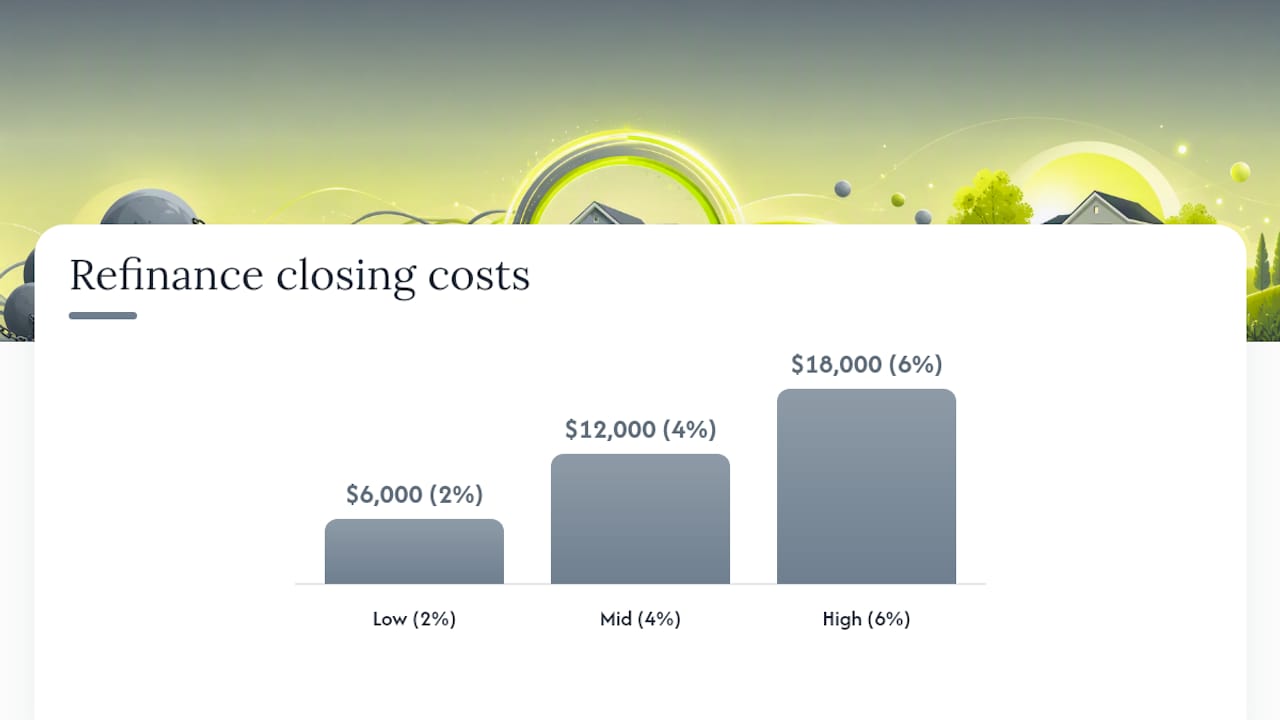
Closing costs on a refinance typically run 2%–6% of the loan amount. On a $300,000 refinance, that means $6,000–$18,000 in fees before you see a dollar of savings.
Common fees include:
- Origination fee (lender charge for processing the loan)
- Appraisal fee (typically $300–$600 depending on property and location)
- Title search and title insurance
- Recording fees and transfer taxes
- Prepaid interest and escrow setup
You can pay these costs at closing or roll them into the new loan balance. Rolling them in avoids an out-of-pocket expense but increases the loan amount and the total interest you pay over time. The better choice depends on how long you plan to stay in the home and how quickly you need cash flow relief.
Timeline from application to funding typically runs four to eight weeks for a mortgage refinance, depending on the lender, the complexity of your file, and how quickly you provide documentation. CBS News reports that personal loan lenders can fund within 1–3 business days, while mortgage-based solutions take longer but often carry lower interest rates.
Documents to have ready before you apply:
- Current mortgage statement and homeowner’s insurance declarations page
- Two years of tax returns and W-2s
- 30 days of pay stubs
- Two months of bank statements
- Statements for all debts you intend to pay off
Having these ready before your first lender conversation can shorten the timeline by one to two weeks.
How to calculate whether a debt consolidation refinance saves you money
The decision rule is straightforward: if the net present cost of refinancing (including closing costs) is lower than continuing your current payments, the refinance makes financial sense. The calculation has four steps.
Step 1: Add up your current monthly debt payments. Include the mortgage, credit cards, and any other balances you plan to consolidate.
Step 2: Estimate your new monthly payment. Use the Davidmordue to model the new loan amount (current mortgage balance plus cash-out) at today’s rates and your preferred term.
Step 3: Calculate monthly savings. Subtract the new payment from the total of your current payments.
Step 4: Calculate months to break even. Divide total closing costs by monthly savings.
Break-even formula: Total closing costs ÷ Monthly savings = Months to break even
Worked example:
In this scenario, a homeowner who rolls $50,000 in credit card debt into a cash-out refinance saves $320 per month. The $8,000 in closing costs are recovered in roughly 25 months. If you plan to stay in the home for three or more years, the math supports moving forward.
It’s a useful starting point, but it doesn’t account for closing costs, loan size, or how long you’ll stay in the home. The break-even calculation above is more reliable for a consolidation scenario. Check current mortgage rates to see where today’s market stands relative to your existing rate.
When refinancing is not the best route
A mortgage refinance is not always the right tool. For some borrowers, faster or lower-risk alternatives make more sense.
- Unsecured personal consolidation loan: No home collateral required. Rates are higher than mortgage rates but lower than most credit cards. Funding can happen in days. Best for borrowers with good credit and manageable balances who don’t want to put their home at risk.
- 0% balance-transfer credit card: Useful for short-term balances you can realistically pay off within the promotional period (typically 12–21 months). Transfer fees usually run 3%–5%, but the math often beats a refinance for small balances.
- Nonprofit credit counseling / debt management plan (DMP): A nonprofit credit counselor negotiates reduced interest rates with your creditors and consolidates payments into one monthly amount you send to the agency. No home collateral is involved. Best for borrowers with steady income who need structure but don’t qualify for a refinance.
- Creditor hardship programs: Many lenders offer temporary rate reductions or payment deferrals for borrowers facing financial difficulty. Worth a phone call before pursuing any consolidation route.
- Loan modification or forbearance: If your primary concern is keeping up with your mortgage rather than paying off other debts, a modification may be the right starting point.
CFPB warning: Debt-settlement companies that advise you to stop paying creditors can cause serious credit damage and expose you to lawsuits from creditors. The CFPB recommends nonprofit credit counseling as a safer alternative to for-profit debt-settlement services.
If your balances will be paid off within 12 months at your current pace, a refinance is rarely worth the closing costs and the added risk. Pause the application and explore the alternatives above first.
Step-by-step: how to refinance to consolidate debt
- Run the break-even worksheet. Use the formula above or the refinance calculator to confirm the math supports moving forward before spending time on applications.
- Check your equity and credit. Pull your credit report at AnnualCreditReport.com and get a rough home value estimate. Confirm you’ll retain at least 20% equity after the cash-out.
- Gather your documents. Assemble tax returns, pay stubs, bank statements, and debt statements before contacting lenders. This speeds underwriting by days.
- Request rate quotes from multiple lenders. Compare at least three loan estimates. Ask each lender about lender credits (a higher rate in exchange for reduced closing costs) versus paying points upfront to lower the rate.
- Order the appraisal and submit your full application. The lender orders the appraisal. Respond to underwriter requests within 24 hours to avoid delays.
- Review the Closing Disclosure carefully. You receive this document at least three business days before closing. Verify that the fees match what you were quoted and recalculate your break-even with the final numbers.
- Close and confirm debt payoffs. At closing, the lender typically pays off designated accounts directly. Confirm each payoff within one to two weeks and close or reduce credit limits strategically to protect your credit score.
Negotiation tips:
- Ask lenders to waive or reduce origination fees, especially if you have strong credit.
- Request a no-closing-cost option and compare it against paying costs upfront using your break-even timeline.
- Shop quotes within a 14-day window; multiple mortgage inquiries in that period count as a single hard pull on your credit report.
Key risks and red flags to watch for
Converting unsecured debt into mortgage debt is a serious financial decision. The risks are real and worth understanding clearly.
- Foreclosure exposure. Once credit card balances become part of your mortgage, missing payments puts your home at risk. A creditor can’t take your house over an unpaid credit card; your mortgage lender can.
- Bait-and-switch rate offers. Some lenders advertise rates that require perfect credit, maximum equity, and specific loan sizes. If the rate you’re quoted at application is materially different from what appears on the Closing Disclosure, ask for a written explanation.
- Pressure to sign quickly. A lender or broker who discourages you from shopping other quotes or rushes you through disclosures is a warning sign.
- Unlicensed lenders. Always verify any lender on NMLS Consumer Access before sharing personal financial information.
- Unclear fee disclosures. You are entitled to a Loan Estimate within three business days of application. If a lender delays or obscures this document, walk away.
FTC guidance: The FTC warns that consolidation loans secured by your home carry the risk of losing your house if you fall behind on payments, and that upfront costs (points and fees) must be factored into any net-savings calculation before you proceed.
Protective steps:
- Get all fee disclosures in writing before proceeding past the application stage.
- Compare net savings after closing costs, not just the monthly payment reduction.
- Verify that the debts paid off at closing are actually closed by the lender, not just paid down.
- If a deal sounds too good to be true, check the lender’s NMLS record and read recent reviews from independent sources.
A broker’s perspective on when this strategy actually works
Without that third element, the refinance solves a symptom rather than the underlying pattern.
The cases where I steer clients toward alternatives are equally clear. If the total balances are small enough to pay off within 12 months at the current pace, the closing costs of a refinance will exceed the interest savings. Borrowers with variable or recently interrupted income also face a harder qualification process and carry more risk if payments become difficult later. For those clients, a nonprofit debt management plan or an unsecured personal loan is a more proportionate tool.
One approach that often gets overlooked: a rate-and-term refinance combined with an accelerated payment plan. If your current mortgage rate is meaningfully above today’s market, lowering it through a rate-and-term refinance reduces your monthly payment without extending your debt or pulling cash out. The monthly savings can then be directed aggressively toward your highest-rate balances. This avoids resetting your mortgage term, keeps your home equity intact, and still delivers meaningful monthly relief. For borrowers who qualify, it’s worth modeling alongside a cash-out option before deciding.
How David Mordue - Forward Financial Group helps you refinance to consolidate debt
Fewer monthly payments and a lower interest rate are achievable goals, but the path there requires accurate numbers and the right loan program. David Mordue - Forward Financial Group gives you both. The refinance calculator lets you model your break-even timeline and compare payment scenarios before you speak with anyone. The affordability calculator shows how a new loan amount affects your monthly budget under conventional loan assumptions.
Beyond the tools, you get personalized lender shopping across multiple programs, including conventional, FHA, VA, and cash-out options, so you’re comparing real rates for your specific credit profile and equity position rather than advertised averages. The fully online application process is built for speed, with funding possible in under 21 days for qualified borrowers. That matters when you’re carrying high-interest balances every additional month.
To get started, request a no-obligation refinance quote or use the refinance calculator to run your own numbers first. A licensed broker will review your situation, compare programs, and help you decide whether a cash-out refinance, a rate-and-term refinance, or an alternative route gives you the best outcome.
Primary sources and further reading
These sources back the key claims in this article and are worth bookmarking for your own research:
- CFPB — Debt relief programs: What is a debt relief program and how do I know if I should use one? — Backs warnings about debt-settlement companies and the recommendation for nonprofit credit counseling.
- FTC — Getting out of debt: How to get out of debt — Covers collateral risk and the importance of calculating upfront costs before consolidating.
- NerdWallet — Refinancing to pay off debt: Refinancing your mortgage to pay off debt — Explains cash-out mechanics, the 20% equity rule, and closing-cost ranges.
- LendingTree — Debt consolidation mortgage: Debt consolidation mortgage: Should I get one? — Covers program types, pros, cons, and total interest considerations.
- Credible — Refinancing to pay off debt: Should you refinance your mortgage to pay off debt? — Summarizes qualification thresholds and household debt context.
- CBS News — Debt relief options: Debt relief that lowers monthly payments immediately — Compares funding timelines across consolidation options.
- NMLS Consumer Access — Lender verification: NMLS Consumer Access — The public registry for verifying mortgage lender licensing before you apply.
This article is for general informational purposes only and does not constitute financial, legal, or tax advice. Consult a qualified mortgage professional and tax advisor to evaluate your specific situation before making any refinancing decision.
This article is general information, not a substitute for advice from a qualified financial advisor. Consult a qualified financial professional about your own circumstances before acting on anything here.
Sources
- What is a debt relief program and how do I know if I should use one? | Consumer Financial Protection Bureau
- How to get out of debt | Federal Trade Commission (FTC)
- Refinancing your mortgage to pay off debt — NerdWallet
- Debt relief that lowers monthly payments immediately — CBS News
- Debt consolidation mortgage: Should I get one? — LendingTree
- Should you refinance your mortgage to pay off debt? — Credible