
Most conventional lenders set the floor at a 620 credit score for mortgage approval, though FHA loans open the door as low as 500 with a larger down payment. The best mortgage rates generally start showing up once you’re in the mid-to-high 700s. Lenders typically pull scores from all three credit bureaus and use the middle number, not your highest one, when they price your loan.
TL;DR:
- Loan approval often requires a middle credit score of at least 620 for conventional loans, though FHA loans can accept scores as low as 500 with larger down payments.
- A 60-point difference in credit score tiers can raise a borrower’s interest rate by over a percentage point, adding hundreds in monthly payments on a typical $400,000 loan.
- Lenders generally use FICO scores 2, 4, and 5 from all three bureaus, taking the middle score of those three, not the consumer-facing or highest scores.
- Borrowers with credit scores below 620 may improve their chances with larger down payments, stronger reserves, or adding a co-borrower, but improvement often reduces rates significantly.
- Checking and fixing credit errors, reducing revolving balances, and timing rapid rescore requests can help improve scores before applying for a mortgage.
Table of Contents
- How Mortgage Rates Change Across Credit Score Tiers
- Which Credit Scores Mortgage Lenders Actually Use
- Minimum Credit Scores by Loan Type
- How Your Score Drives Approval Odds and Payment Size
- How to Check and Prepare Your Credit Before You Apply
- If Your Score Is Low: What Actually Works
- A Broker’s View on Reading Credit the Right Way
- Start Your Pre-Approval With a Clear Rate Picture
- Where to Verify These Numbers Yourself
- Sources
- FAQ
How Mortgage Rates Change Across Credit Score Tiers
A 60-point swing in your credit score can cost you tens of thousands of dollars over the life of a loan, and most borrowers never see it coming until a lender pulls their file. Rate pricing on conventional mortgages runs in tiers, with each step down meaning a meaningfully higher APR.
Experian’s illustrative rate data shows the pattern clearly across common score bands:
- 620 to 639: the highest rates on the conventional scale, often a full percentage point or more above top-tier pricing
- 640 to 659: still elevated, though improving
- 660 to 699: a noticeable rate improvement over the low 600s
- 700 to 739: solidly competitive pricing for most lenders
- 740 and above: the tier where borrowers typically see the lowest available rates
On a $400,000, 30-year fixed loan, even a modest rate gap between tiers can add well over $100 to your monthly payment, and thousands more in interest paid over just the first five years. These bands are illustrative. Actual quotes shift with the bond market, your lender’s overlays, and the day you lock your rate, so treat them as a directional guide rather than a guaranteed number.
Which Credit Scores Mortgage Lenders Actually Use
The score in your banking app is almost never the score your underwriter sees. Mortgage lenders rely on older, mortgage-specific scoring models built for long-term repayment risk, not the newer consumer-facing versions banks show you for free.
Specifically, lenders typically pull three distinct scores:
- FICO® Score 2 from Experian
- FICO® Score 4 from TransUnion
- FICO® Score 5 from Equifax
For a single borrower, most lenders take the middle of those three numbers, not the average and not the highest. If you’re applying with a co-borrower, the math gets tighter: lenders generally calculate each person’s middle score, then use the lower of those two middle scores for pricing and eligibility. Your co-borrower’s credit history can end up being the number that actually decides your rate.
Minimum Credit Scores by Loan Type
Your minimum credit score to buy a house depends heavily on which loan program you use, and the gap between programs is bigger than most first-time buyers expect.
- Conventional loans: commonly require a 620 minimum, though the best conventional pricing starts well above that
- FHA loans: accept scores as low as 500 with a 10% down payment, or 580 with just 3.5% down, backed by the Federal Housing Administration
- VA loans: the Department of Veterans Affairs sets no official minimum score, but individual lenders typically require around 620 to 640
- USDA loans: the United States Department of Agriculture also skips a hard minimum, and lenders again tend to draw the line near 620 to 640
- Jumbo loans: generally require a higher credit score, typically in the upper range, since these loans exceed conventional limits set by Fannie Mae and Freddie Mac and carry more risk for the lender
A lower score doesn’t automatically disqualify you. Lenders often accept compensating factors like larger cash reserves or a bigger down payment in exchange for flexibility on the score requirement.
How Your Score Drives Approval Odds and Payment Size
Credit score doesn’t just move your rate. It changes how a loan gets underwritten in the first place. Lenders assign risk-based pricing tiers, and your score sits alongside debt-to-income ratio, cash reserves, and employment history as one of the core mortgage eligibility factors an underwriter weighs.
Two borrowers applying for the same $400,000 loan, with identical income and debt, can land on very different terms if one has a 640 and the other has a 760. The higher-score borrower typically gets a lower APR, smaller mortgage insurance requirement, and an easier path through underwriting conditions. The lower-score borrower may still get approved, just with a higher rate, stricter conditions, or a request for additional documentation.
- Debt-to-income ratio interacts with score: a strong score can sometimes offset a slightly higher DTI
- Cash reserves matter more as your score drops, since they signal repayment cushion
- Employment history stability can support an application when the score sits near a program’s minimum
Pro Tip: Ask your loan officer to run pricing at both your current score and a hypothetical 20 points higher. Seeing the exact dollar difference often makes the case for waiting 60 days to pay down a card before you lock a rate.
How to Check and Prepare Your Credit Before You Apply
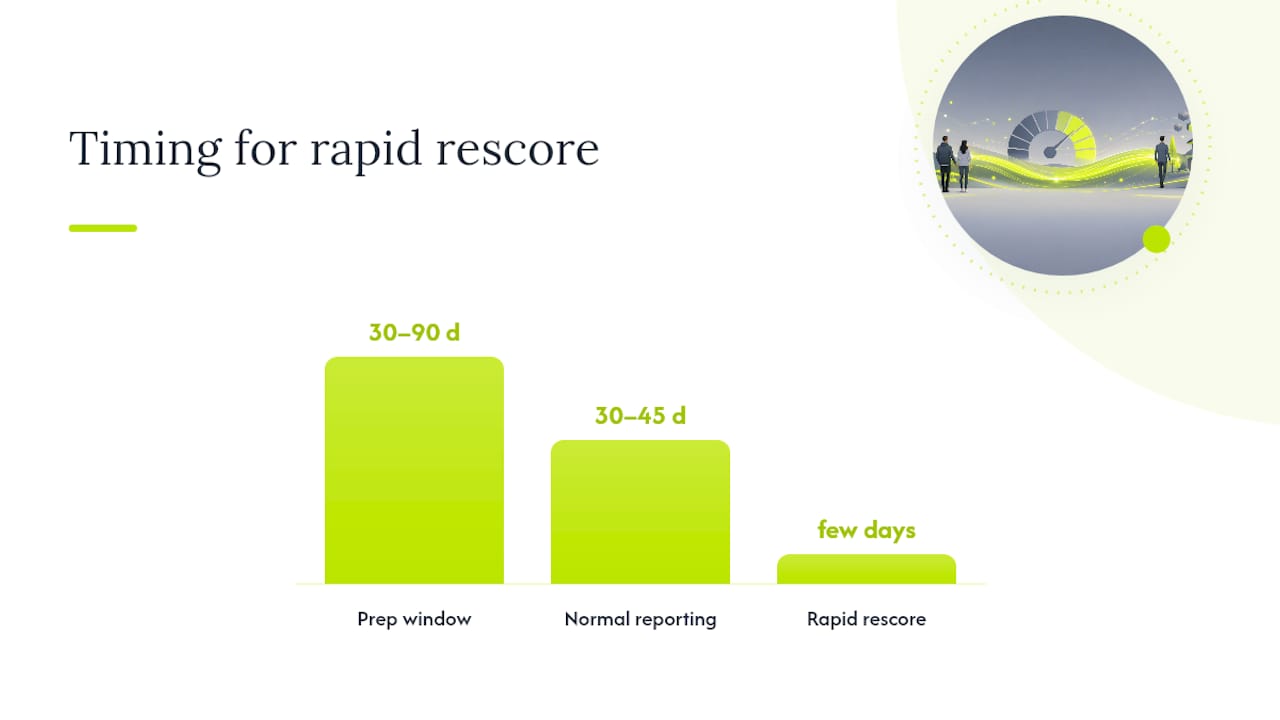
Give yourself a real runway before you apply. A 30 to 90 day prep window gives you enough time to fix errors, pay down balances, and let the improvement actually post to your report before a lender pulls your file.
- Pull your three-bureau report and check it against what your lender will see, since mortgage scoring can differ from your everyday credit app.
- Dispute any errors immediately. The CFPB outlines the formal dispute process, and the FTC’s credit resources cover monitoring tools you can use alongside it.
- Pay down revolving balances to lower your utilization ratio before you apply, not after.
- Avoid opening new credit or triggering hard inquiries in the months leading up to your application.
- Ask about a rapid rescore if you’ve recently paid off a balance or corrected an error close to closing.
A rapid rescore can update your report in a few business days instead of the usual 30 to 45 day reporting cycle, and rapid rescore cost typically runs as a small per-item lender fee rather than a large expense. It only works on verifiable, recent changes. A rapid rescore mortgage request won’t erase a bankruptcy or an old collection account.
Pro Tip: Coordinate the timing with your lender before you pay anything off. A rapid rescore only helps if the payoff and the request happen close enough together to matter before your rate lock expires.
If Your Score Is Low: What Actually Works
Raising your score before applying is often the better move, but it’s not the only one. If your score sits below 620, FHA financing is usually the most direct path, especially with 3.5% down at 580 or above. VA and USDA borrowers should expect lender overlays even though the agencies themselves set no hard floor.
- A larger down payment can offset a lower score on conventional loans
- Adding a co-borrower helps only if their score is comparable, since lenders use the lower middle score
- Cash reserves and stable employment history strengthen a borderline file
- Jumbo borrowers with sub-700 scores should expect a harder conversation and fewer lender options
If you’re 60 to 90 days from needing to move, a short pause to improve your score often pays for itself in rate savings.
A Broker’s View on Reading Credit the Right Way
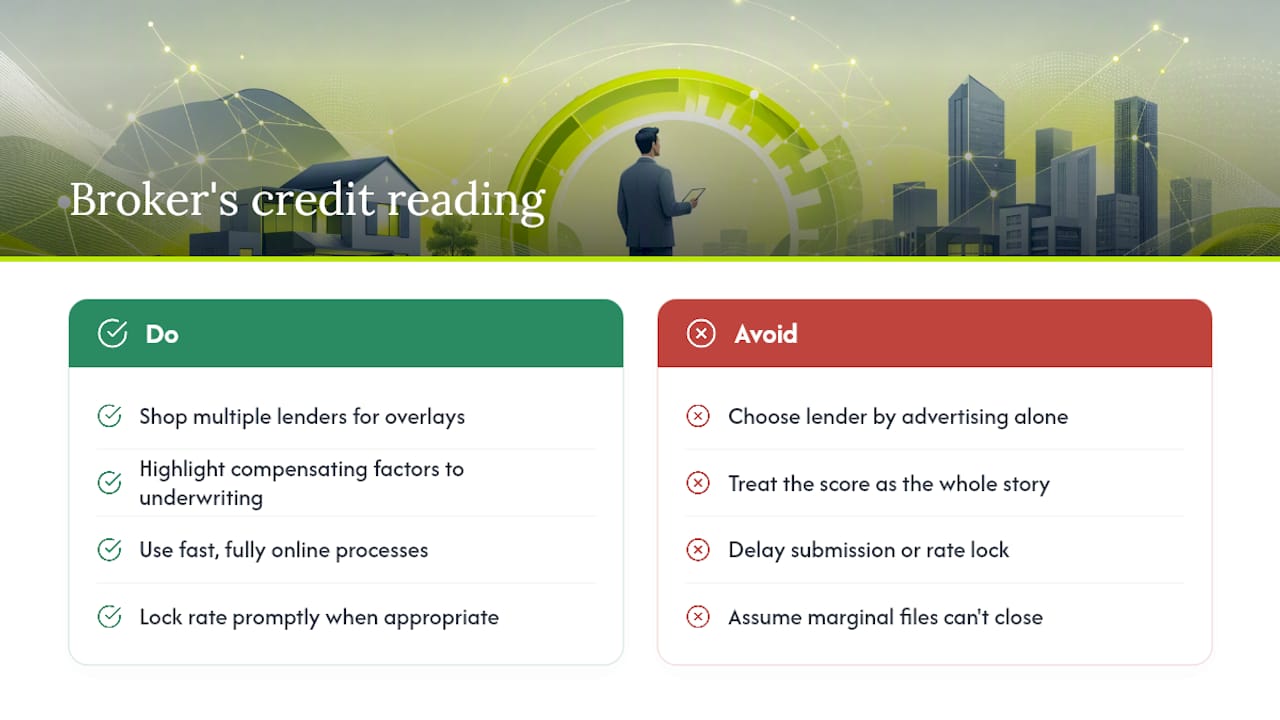
Underwriters see a number. A good broker sees a story, and that distinction is where real value gets created for borrowers sitting near a program threshold. Shopping multiple lenders means finding the one whose overlays fit your specific file, not the one with the loudest advertising.
Compensating factors like reserves, gift funds, or stable income can turn a marginal approval into a funded loan, but only if someone knows how to present them to underwriting. Speed matters too. A fast, fully online process can be the difference between locking a rate before it moves and missing the window entirely.
— David Mordue
Start Your Pre-Approval With a Clear Rate Picture
Once you know where your score lands, the next question is what rate you can actually get, and that’s where a broker earns their place instead of a single bank quote. David Mordue - Forward Financial Group shops your file across multiple lenders instead of pricing you against just one institution’s overlays, which matters most for borrowers sitting near a program’s minimum score.

Whether you’re a first-time buyer weighing FHA against conventional, or a homeowner watching your credit climb toward refinance territory, an online application process can move fast, with funding possible in under 21 days once your file is complete. If you’re carrying a VA entitlement, VA loan options skip the down payment requirement entirely regardless of where your score lands within lender overlays. Check current rate options and start pre-approval today, or explore FHA loan details if your score needs a lower entry point.
Where to Verify These Numbers Yourself
Confirm any rate or score threshold before you apply. The CFPB covers borrower rights and dispute steps, while Bankrate tracks current program minimums.
This article is general information, not a substitute for advice from a qualified financial advisor. Consult a qualified financial professional about your own circumstances before acting on anything here.
FAQ
What Credit Score Is Needed for a $400,000 Mortgage?
There’s no separate score requirement tied to loan size. A $400,000 conventional mortgage typically follows the same 620 minimum as any other conventional loan, though your rate and monthly payment improve significantly as your score climbs toward the mid-700s and beyond.
How Rare Is a 900 Credit Score?
Scores above 850 do not exist on the standard FICO scale. Very high scores are uncommon but achievable with years of on-time payments, low utilization, and a long credit history, and they typically qualify for a lender’s best available mortgage pricing.
Can I Get a $200,000 Loan With a 700 Credit Score?
Yes. A 700 score clears the conventional minimum of 620 with plenty of room and typically qualifies for competitive rate pricing. Your approval and exact rate will still depend on debt-to-income ratio, reserves, and the lender you choose.
What’s the Average Mortgage Rate for an 800 Credit Score?
Borrowers with very high scores consistently land in the lowest available pricing tier lenders offer, according to Experian’s rate data by credit score. Exact rates shift with market conditions, so a current quote from a broker gives the most accurate number for your situation.
What’s the Minimum Credit Score to Buy a House With an FHA Loan?
Individual lenders can set stricter overlays, so it’s worth checking FHA loan options directly.