
A Closing Disclosure is the final, legally binding summary of your mortgage terms, costs, and cash needed at closing. Your lender must give it to you at least three business days before your scheduled closing, and that window exists for one reason: so you can compare it, line by line, against your Loan Estimate before you sign anything.
TL;DR:
- Ensure the interest rate and loan product on page 1 match your expectations, especially if you locked in a fixed rate before closing.
- Compare the loan costs, fees, and cash-to-close calculations on page 2 against your original estimates, highlighting any increases beyond tolerances.
- Verify that seller credits and what you owe align with your contract terms, checking for missing credits or discrepancies on page 3.
- Review page 4 for escrow details, rate adjustments, and negative amortization risks, especially on adjustable-rate loans.
- Use the three-day review window to document, question, and request corrections for any changes outside tolerance limits before signing.
Table of Contents
- What Does a Five-Page Closing Disclosure Actually Show?
- How Do You Compare a Loan Estimate to a Closing Disclosure?
- What Red Flags Mean You Should Pause Before Signing?
- What Should You Do During the Three-Day Review Window?
- Who Sends the Closing Disclosure, and When Does the Clock Start?
- Where Can You Find Official Sample Closing Disclosure Forms?
- What Does a Broker Check First on a Closing Disclosure?
- How One Missed Seller Credit Almost Cost a Client Thousands
- How David Mordue Helps You Review Your Closing Disclosure
- Where to Verify These Rules Yourself
- Sources
What Does a Five-Page Closing Disclosure Actually Show?
The Closing Disclosure runs five pages, and each one answers a different question about your loan. Knowing what belongs where means you can go straight to the numbers that matter instead of reading the whole document cold at the closing table.
Page 1 covers your basic loan terms: the loan amount, interest rate, monthly principal and interest, and the loan term (15 years, 30 years, or something else). This page also flags whether your rate or payment can change later and whether the loan carries a prepayment penalty or a balloon payment. If you agreed to a fixed rate and see a variable one here, stop reading and start asking questions.
Page 2 breaks down your closing costs into two buckets. “Loan Costs” covers origination fees, application fees, and underwriting charges. “Other Costs” covers items like recording fees, transfer taxes, and prepaid items such as homeowners insurance and property taxes. This page also contains the “Calculating Cash to Close” table, which reconciles what you estimated against what you now owe at the table.
Page 3 shows the “Summaries of Transactions,” splitting out what the borrower owes against what the seller owes or contributes. If your purchase agreement included seller credits toward closing costs, this is where they should show up. Missing seller credits are one of the more common, and most expensive, errors on this document.
Page 4 holds the loan disclosures: whether your loan has an escrow account for taxes and insurance, whether negative amortization is possible, and, if you have an adjustable-rate mortgage, how and when your rate can adjust. Anyone with an adjustable-rate mortgage should read this page twice, since the adjustment caps and index here determine your future payment risk.
Page 5 contains the loan calculations (total of payments, finance charge, amount financed, and annual percentage rate), a confirmation that you received the disclosure, contact information for everyone involved, and the signature lines.
Here’s the shortlist of what to check on each page before you move on:
- Page 1: interest rate, loan product, monthly payment, and any prepayment or balloon flags
- Page 2: Loan Costs, Other Costs, and the Calculating Cash to Close table
- Page 3: what you owe versus what the seller is contributing
- Page 4: escrow setup, negative amortization, and adjustable-rate terms
- Page 5: APR, finance charge, and the signature and contact sections
The CFPB’s closing disclosure explainer walks through each of these tables in more depth, and it’s worth keeping open as a reference while you review your own copy.
How Do You Compare a Loan Estimate to a Closing Disclosure?
A Loan Estimate is a projection issued within three business days of your application. A Closing Disclosure is the final version of that same loan, generated once every fee is locked and every third-party charge is confirmed. The two documents share the same structure by design, which makes a side-by-side comparison the fastest way to catch a problem.
Federal rules don’t allow every number to move freely between those two documents. Charges fall into three tolerance categories, and knowing which bucket a fee sits in tells you whether an increase is normal or a red flag.
- Zero tolerance: lender origination charges, transfer taxes, and fees paid to the lender or an affiliate generally cannot increase at all.
- 10% cumulative tolerance: certain third-party fees, such as some recording fees, can rise, but the total increase across this category can’t exceed 10% of what the Loan Estimate quoted.
- No tolerance limit: fees for services you shopped for yourself, like a specific title company you chose outside the lender’s list, can change without a cap.
According to CFPB guidance on fee tolerances, a fee that exceeds its tolerance category gives you a regulatory basis to demand a correction or a refund, not just a polite explanation.
The most reliable method is a straight table comparison, not a scan. Line up your Loan Estimate and Closing Disclosure side by side and check: loan amount, interest rate, monthly principal and interest, APR, origination charges, third-party fees, lender credits, and the final cash-to-close figure. The CFPB’s guide to these forms confirms this table-by-table approach catches the errors that actually affect your bottom line, rather than cosmetic wording differences that don’t. If any number breaks its tolerance category, write down the specific line, the dollar difference, and the date, then bring that documentation to your lender before you sign.
What Red Flags Mean You Should Pause Before Signing?
Some differences between your Loan Estimate and Closing Disclosure are routine. Others mean something went wrong upstream, and signing without asking about them can cost you thousands over the life of the loan. Here’s what to look for, in order of how often they show up and how much damage they do:
- The interest rate or loan product changed. If you locked a 30-year fixed and the Closing Disclosure shows an adjustable rate, that’s not a rounding error. It means either a mistake or a lock that expired without your knowledge.
- Estimated Cash to Close jumped with no explanation. A few hundred dollars of shift from updated prepaids is normal. A jump of several thousand dollars with no line items to justify it is not.
- Origination or lender fees increased beyond the zero-tolerance rule. These fees are supposed to be locked once your Loan Estimate is issued. Any increase here is a compliance problem, not a market fluctuation.
- Your name, loan term, escrow setup, or seller credits are wrong. A misspelled name or missing escrow account is a paperwork error. A missing seller credit is money you were promised and are no longer getting.
- The numbers don’t reconcile against your own math. If your calculator says one thing and the Closing Disclosure says another, trust the math and ask why.
Any one of these is reason enough to request a corrected Closing Disclosure in writing before closing day. If the lender can’t explain the discrepancy or won’t issue a correction, delaying closing costs you far less than signing off on an error you’ll spend months trying to fix afterward.
Pro Tip: Screenshot the exact line item, the dollar amount, and the date you noticed it, then email that screenshot to your loan officer instead of calling. A written record moves faster through underwriting than a phone message, and it gives you a paper trail if the fee dispute needs to go further.
What Should You Do During the Three-Day Review Window?
Treat the three-business-day window as a checklist, not a countdown. Here’s the sequence that actually catches problems in time to fix them:
- Gather your documents. Pull your Loan Estimate, your signed purchase contract, and any recent emails from your lender about rate locks or fee changes.
- Compare pages 1 through 3 against your Loan Estimate. Check the loan terms, the cost tables, and the transaction summary for the seller-credit and cash-owed figures.
- Recheck the cash-to-close calculation. This single number determines how much you need to bring to closing, and it’s the figure most likely to contain a costly surprise.
- Contact your lender with specific, documented questions. Reference exact line numbers and dollar amounts rather than asking generally whether “everything looks right.”
- Request a revised Closing Disclosure if anything falls outside tolerance. Get the correction in writing before you agree to a new closing date.
Contact your loan officer first, since they can usually resolve most discrepancies within a day. If the issue involves the settlement or title company’s fees, loop in your closing or settlement agent directly. The Consumer Financial Protection Bureau is a last resort for unresolved disputes, but most fee corrections never need to go that far. If the lender can’t justify a material change, such as a rate increase or an unexplained jump in cash to close, it’s reasonable to delay closing rather than sign under pressure.
Who Sends the Closing Disclosure, and When Does the Clock Start?
Your lender, not the title company or your real estate agent, is legally responsible for delivering the Closing Disclosure. Delivery can happen by mail or electronically, but electronic delivery only counts once you’ve agreed to receive documents that way.
The three-business-day count excludes Sundays and federal holidays, so a Closing Disclosure delivered on a Friday typically pushes your earliest closing date to the following Wednesday. If your lender issues a revised Closing Disclosure because of a material change, the three-day waiting period restarts from the date you receive the new version, which is exactly why unresolved errors can delay a closing date you were counting on.
Not every loan uses this form. TRID rules generally exclude:
- Home equity lines of credit (HELOCs)
- Reverse mortgages
- Manufactured-home loans not secured by real property
Those loan types use different disclosure forms with their own timing rules, so if you’re financing through one of those structures, don’t expect the same five-page layout described above.
Where Can You Find Official Sample Closing Disclosure Forms?
The Consumer Financial Protection Bureau publishes both blank and fully completed sample Closing Disclosure PDFs, and pulling one up before your own closing gives you a template to mark up.
- The CFPB’s forms and samples library includes blank forms you can print and annotate.
- Completed example forms show what each field looks like when filled in correctly, which is useful for spotting a field that’s blank when it shouldn’t be.
- The CFPB’s guide to completing TILA-RESPA forms explains, table by table, what belongs in each section, including the rounding rules that govern how figures should appear.
Print a blank copy, highlight the eight or nine numbers from the comparison method above, and use it as your own checklist when your real Closing Disclosure arrives. It takes fifteen minutes and it’s the closest thing to a dry run you’ll get before the real document lands in your inbox.
What Does a Broker Check First on a Closing Disclosure?
When a client forwards a Closing Disclosure, the first three things checked are always the same: the interest rate, the monthly principal and interest payment, and the Estimated Cash to Close figure. Those three numbers reveal most problems within seconds, before digging into the smaller line items.
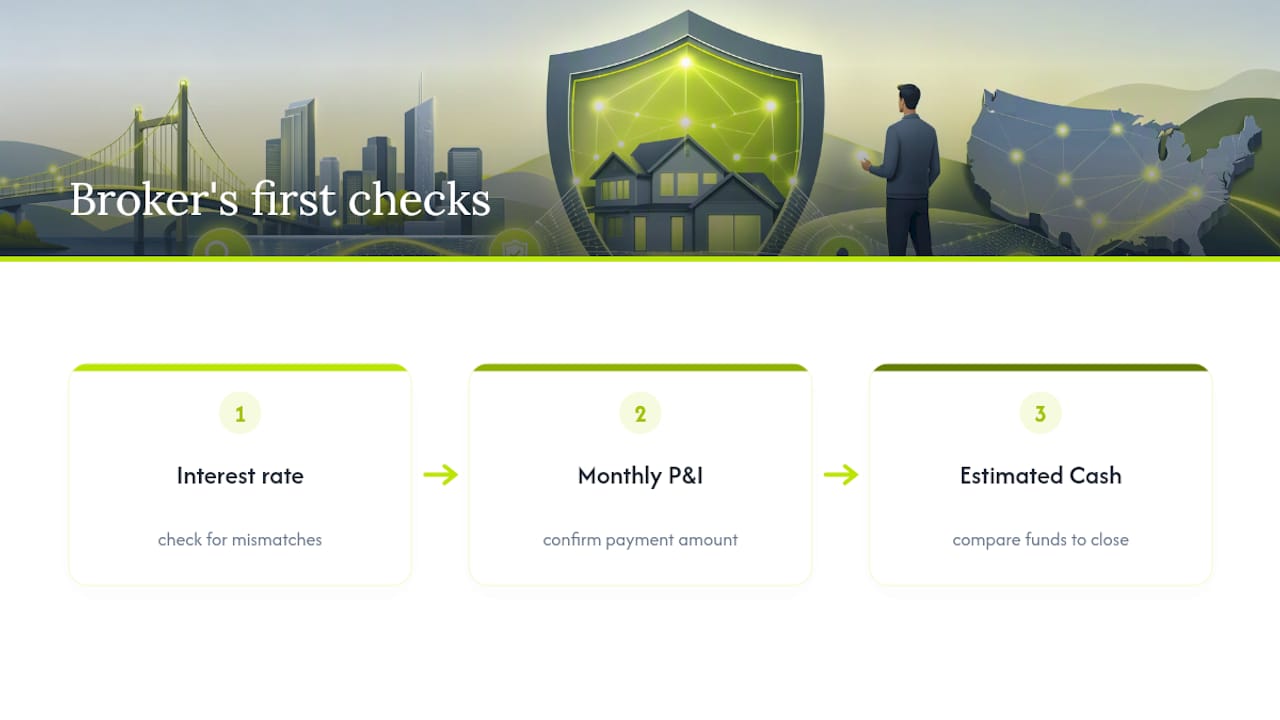
When something doesn’t match, the fix is documentation, not debate. That means screenshotting the discrepancy, emailing it to the lender in writing, and requesting a revised Closing Disclosure rather than a verbal promise to “fix it at the table.” If a fee dispute stalls or the lender pushes back on a clear tolerance violation, that’s the point to loop in your broker or, for a complex dispute, an attorney, rather than waiting until closing day to raise it.
How One Missed Seller Credit Almost Cost a Client Thousands
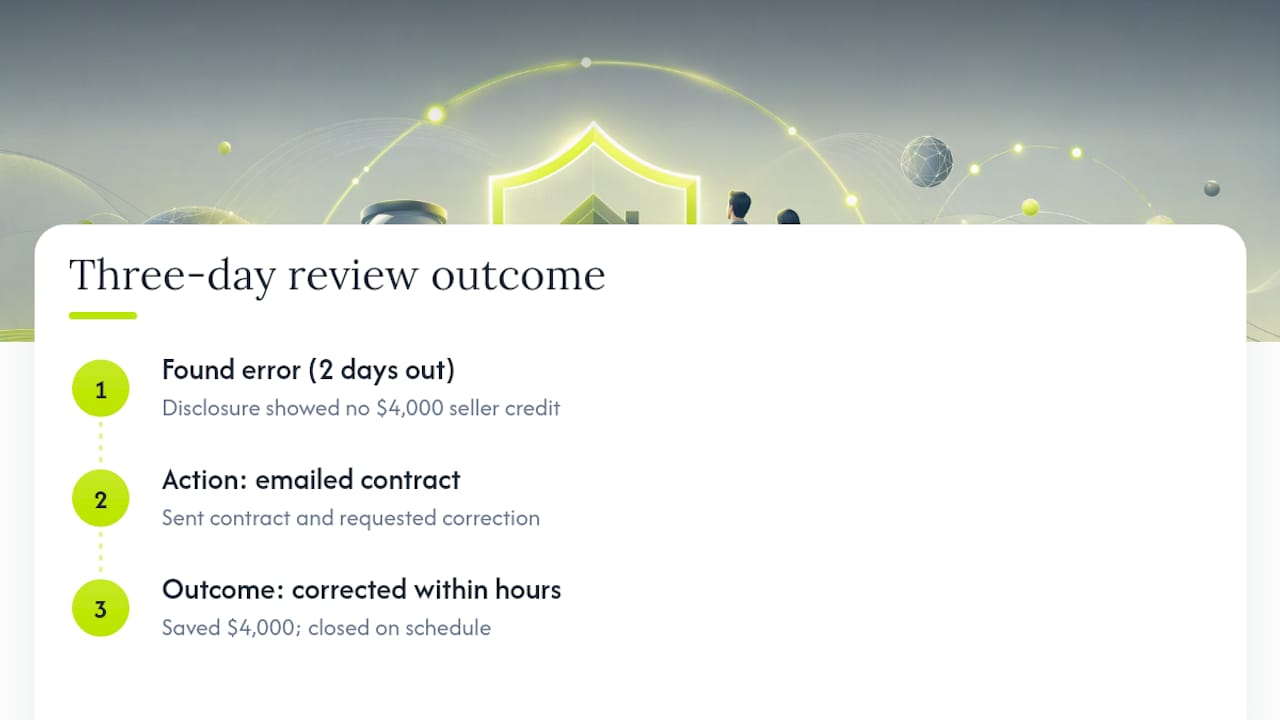
A client once forwarded a Closing Disclosure two days before closing showing no seller credit, despite a signed contract promising $4,000 toward closing costs. A quick email with the contract attached got a corrected Closing Disclosure back within hours. The client still closed on schedule.
That fifteen-minute review saved real money. It’s the entire argument for using your three-day window instead of skimming the document at the table.
— David Mordue
How David Mordue Helps You Review Your Closing Disclosure
Mortgage brokers who offer fully online application and document review processes can provide a second set of eyes on your Closing Disclosure without the wait typical of a traditional mortgage office. Questions about a fee discrepancy or a cash-to-close jump can get answered in hours, not days, and funding can still close quickly once everything checks out.
If your Closing Disclosure shows a payment that feels higher than expected, run it through the affordability calculators before you sign, or use the refinance calculator to see whether a corrected rate still meets your goals. Consulting a broker makes the most sense when a fee falls outside its tolerance category or when your lender can’t explain a change in writing. Start a pre-approval or refinance review with David Mordue - Forward Financial Group today, and get a second opinion on your Closing Disclosure before you sign anything.
Where to Verify These Rules Yourself
- CFPB Closing Disclosure explainer covers the full document structure and comparison guidance.
- CFPB Guide to the Loan Estimate and Closing Disclosure forms explains each required table in detail.
- 12 CFR § 1026.38 is the federal regulation text governing required content and formatting.
- Landlords preparing tenants for a move can also review this lease termination procedure guide for a related look at document review before a transaction closes.
Sources
- What is a Closing Disclosure? | Consumer Financial Protection Bureau
- Closing disclosure explainer | Consumer Financial Protection Bureau
- Guide to the Loan Estimate and Closing Disclosure forms (CFPB)
- 12 CFR § 1026.38 - Content of disclosures for certain mortgage transactions (Closing Disclosure) | LII / Cornell Law