
Clear to close means your lender has signed off that all underwriting conditions are met and the loan is ready to fund. It is not the same as holding signed closing documents in hand — the closing appointment itself still has to happen. In the rare event your finances or the property change materially before that appointment, the lender can revisit the file, so the days between clear to close and closing day still matter.
TL;DR:
- Appraisal delays, title issues, or high workload seasons can extend the time between clear to close and the final closing day.
- Meeting all lender conditions, such as verified repairs, clear title, updated insurance, and stable income, is necessary to reach clear to close smoothly.
- Most delays post-clear involve paperwork sitting in inboxes, which can be minimized through proactive document preparation and broker coordination.
- Final verification of employment, assets, and gift funds, along with timely review of the Closing Disclosure, are critical steps before closing.
- Changes in financial circumstances or property condition after clear to close can still prompt lender review or temporary denial before funding.
Table of Contents
- What Does “Clear to Close” Mean?
- Where Does Clear to Close Fit in the Mortgage Timeline?
- Common Conditions Lenders Require Before Clear to Close
- What Happens Right After You’re Cleared to Close?
- Can You Be Denied After Clear to Close?
- Your Checklist to Reach Clear to Close Without Delays
- How a Broker Speeds Up Your Path to Clear to Close
- Get to Clear to Close With Fewer Surprises
- Where to Verify the Rules Yourself
- Sources
What Does “Clear to Close” Mean?
Clear to close is the underwriter’s final determination that every condition on your loan has been satisfied and the file is ready to fund. You may hear it phrased as “cleared to close” or “final approval,” and all three point to the same milestone: underwriting is done, and your file moves to the closing team.
That is a different moment from the mortgage commitment letter you likely received earlier. A commitment letter is a conditional promise to lend, contingent on you clearing specific items like an appraisal or updated pay stubs. Clear to close confirms those conditions are actually satisfied, which makes it the more definitive of the two.
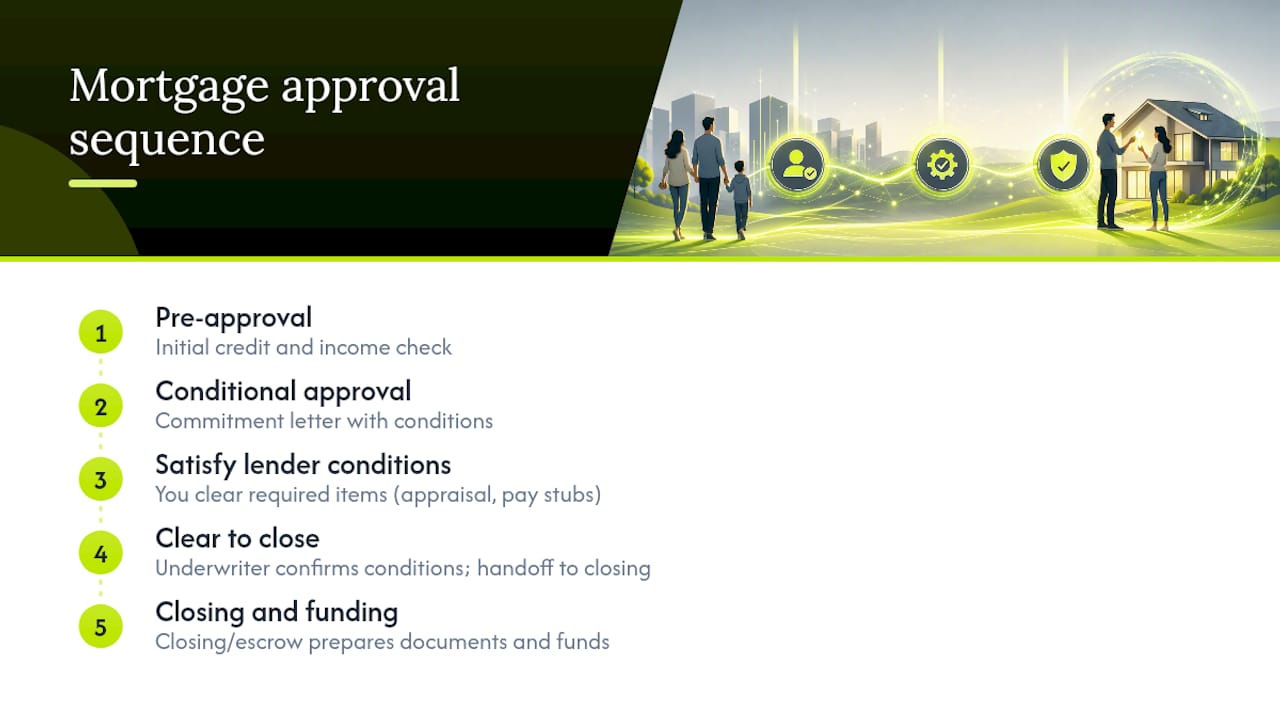
The full sequence usually runs like this: pre-approval, then conditional approval (the commitment letter stage), then you satisfy the lender’s conditions, then clear to close, then closing and funding. Once you’re cleared, the file typically moves from the underwriter to a closing or escrow agent, who prepares documents and coordinates the actual signing. Jessica Sanchez, a mortgage underwriter, describes this handoff as the point where attention shifts from internal underwriting to the external work of clearing title and coordinating funds.
Where Does Clear to Close Fit in the Mortgage Timeline?
Most borrowers reach clear to close within a few business days after underwriting signs off on the last outstanding condition, though the exact window depends on how quickly title work and any final verifications wrap up. From there, closing itself typically follows within about a week.
One federal rule anchors that final stretch: lenders must deliver your Closing Disclosure at least three business days before your scheduled closing. That three-day clock means your closing date is effectively locked in the moment the disclosure goes out, and any change to the loan terms significant enough to trigger a new disclosure can push closing back.
A few things routinely stretch this timeline. Appraisal delays are common, especially in rural areas or during high-volume seasons. Title issues, like an unresolved lien from a previous owner, can take days or weeks to clear. Bank holidays and the last two weeks of December also slow down title companies, insurers, and recording offices alike, so borrowers closing near a holiday should build in extra buffer.
Common Conditions Lenders Require Before Clear to Close
Underwriters don’t issue clear to close until a specific set of items clears their desk. Knowing what they’re checking lets you get ahead of each one instead of reacting to it.
- Appraisal completion and repair sign-off. The property has to appraise at or above the purchase price, and if the appraiser flagged repairs (a common issue on FHA and VA loans), those fixes usually need verified completion before funding.
- Clean title and title insurance. The title company has to confirm there are no competing claims, unpaid liens, or ownership disputes on the property, and issue title insurance protecting both you and the lender.
- Homeowners insurance, and flood insurance where applicable. Your policy has to be active by closing, and if the property sits in a flood zone, you’ll likely need separate flood coverage. Checking FEMA’s flood maps early can save you from a last-minute insurance scramble.
- Final verification of income, employment, and assets. Lenders re-verify employment and account balances close to closing to confirm nothing changed since your application, which is why a new job or a big purchase in this window raises flags.
- Loan-type-specific checks. VA loans carry additional entitlement and appraisal verifications, while FHA loans have their own property-condition standards that can add a step to this list.
Each item exists because it protects against a specific risk, whether that’s a title dispute surfacing after you’ve moved in or an uninsured loss in a flood zone. Handling them proactively, rather than waiting for a request, is usually what separates a smooth closing from a delayed one.
What Happens Right After You’re Cleared to Close?
Clear to close starts a short, specific sequence. Here’s what to expect and what’s expected of you.
- Review your Closing Disclosure. Compare it line by line against your original Loan Estimate, checking the interest rate, monthly payment, and closing costs for any unexplained changes. You have at least three business days to do this before signing.
- Schedule and complete your final walkthrough. This happens shortly before closing, not at closing, and confirms the property is in the agreed condition with nothing new broken or missing.
- Attend closing with the right paperwork. You’ll need government-issued photo ID, and typically your spouse if they’re on the loan. Bring certified funds or confirm your wire has gone through, not a personal check.
- Sign, then wait for funding and recording. Funding is when the lender releases money; recording is when the deed transfers officially at the county level. Ownership doesn’t finalize until recording happens, which is usually the same day or the next business day.
Each step is short on its own, but skipping the review step is where most last-minute stress happens.
Can You Be Denied After Clear to Close?
Denial after clear to close is exceptionally rare, but it isn’t impossible. Lenders can revisit a file if your financial situation or the property’s condition changes materially before signing and funding.
The common triggers are predictable: a large unexplained deposit in your bank account, a new credit card or auto loan, a job change, or damage to the property between the appraisal and closing (a burst pipe or storm damage, for example). Title problems that surface late, like a newly discovered lien, and any sign of documentation fraud can also stop a file cold, even after it was cleared.
Underwriters sometimes run a final pre-funding audit that samples files for compliance, even after the clear to close flag is set. If that audit flags something, you may get a request for missing paperwork with very little notice.
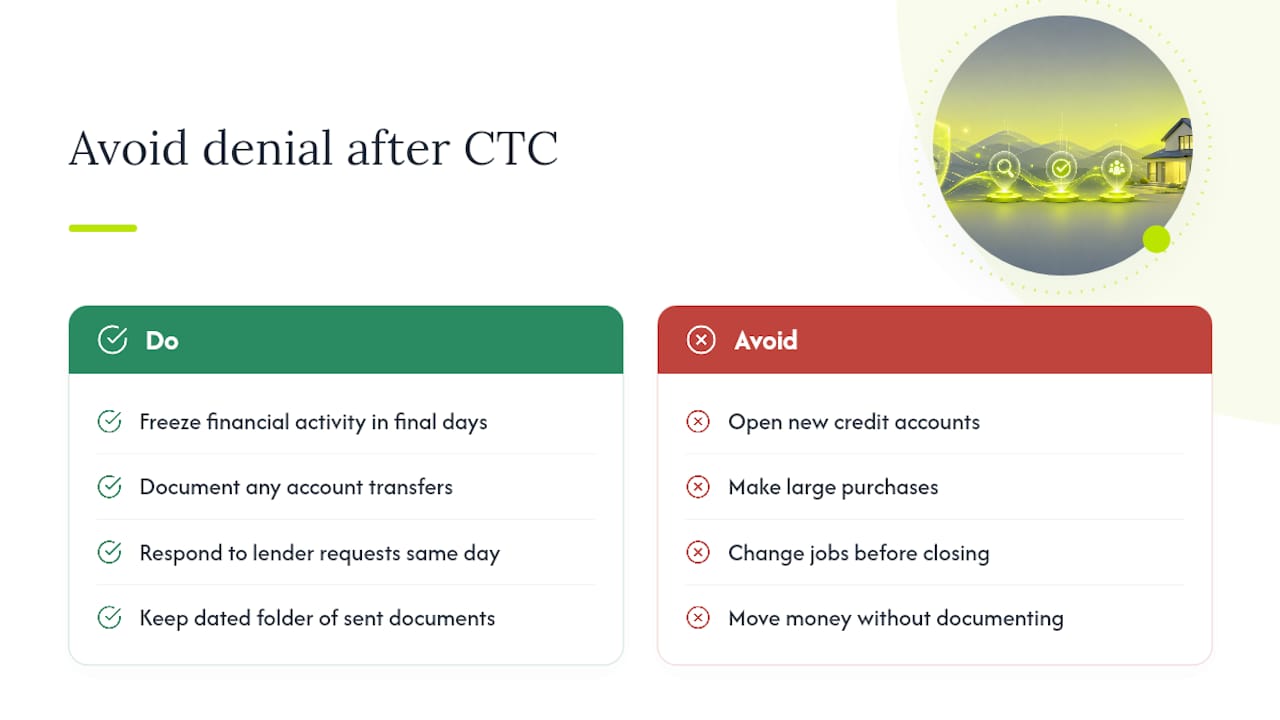
The fix is simple: freeze your financial life for these final days. Don’t open new credit, make large purchases, change jobs, or move money between accounts without documenting it. Do respond to any lender request the same day you get it.
Pro Tip: Keep a folder of every document you’ve already sent your lender, labeled by date. If underwriting asks for something “again,” you can often resend it in minutes instead of hunting for it under pressure.
Your Checklist to Reach Clear to Close Without Delays
Reaching clear to close faster comes down to having the right paperwork ready before your lender asks twice. Prioritize these in order:
- Income documents. Recent pay stubs, two years of W-2s, and a Verification of Employment your employer completes, usually by phone or a short form, close to closing.
- Asset statements. Bank and investment statements covering the past two months, with any large deposit already documented in writing.
- Gift fund paperwork, if part of your down payment is a gift. This means a signed gift letter and a paper trail showing the money left the giver’s account and landed in yours.
- Signed purchase agreement and identification. Your government-issued ID and the fully executed purchase contract need to be on file.
- Homeowners insurance binder, and an HOA form if the property belongs to an association.
- Wire instructions confirmed by phone, never by email alone. Wire fraud targeting home closings is a well-documented risk, and the CFPB’s Know Before You Owe initiative exists partly to help borrowers verify legitimate closing communications before moving money.
Working through this list before your lender even asks is usually the single biggest lever you have over your own timeline.
How a Broker Speeds Up Your Path to Clear to Close
A broker’s real value in this stretch is coordination, not paperwork. Mortgage brokers work document requests, appraisal scheduling, and title questions in parallel instead of in sequence, which is often where DIY borrowers lose days waiting on one party before contacting the next.
That means catching a flagged appraisal or a title question early, while there’s still time to fix it before it threatens your closing date. Pairing that coordination with a fully online application process is part of why some mortgage services structure their workflow around funding in under 21 days, rather than leaving borrowers to manage lenders, title companies, and insurers on their own.
Get to Clear to Close With Fewer Surprises
Most delays between final approval and clear to close come from paperwork sitting in someone’s inbox, not from an actual problem with your loan. Some mortgage brokers close that gap by handling document collection and lender communication directly, so you’re not the one chasing three different parties in the final week before closing.

That coordination is also why the online application process is built to move fast from the start. If you’re not yet under contract, running the numbers first through the affordability calculator for conventional loans or comparing options with the FHA affordability calculator gives you a realistic budget before you start shopping. If you’re refinancing and want to see what a clear-to-close timeline looks like for your situation, the refinance calculator is a useful starting point. When you’re ready to move, start your pre-approval with David Mordue - Forward Financial Group and get a rate comparison and a personalized consultation before your first document request even goes out.
Where to Verify the Rules Yourself
A few official sources are worth bookmarking as you approach closing. The CFPB’s Know Before You Owe page explains your rights around the Closing Disclosure, and NMLS Consumer Access lets you confirm your lender or loan officer is properly licensed. If flood insurance comes up, FEMA’s flood maps show whether your property sits in a designated zone. VA borrowers can check VA lender resources for loan-specific closing steps.
This article is general information, not a substitute for advice from a qualified financial advisor. Consult a qualified financial professional about your own circumstances before acting on anything here.
Sources
- Mortgage Commitment Letter vs Clear to Close: What’s the Difference? — Investopedia
- Clear to Close Timeline Explained — Forbes Advisor
- What should I do if I do not get a Closing Disclosure three days before my mortgage closing? — CFPB
- What does clear to close mean? — HomeLight