
Cash to close is the total dollar amount you must bring to the closing table to finalize a home purchase. It equals your down payment plus closing costs, prepaid items, and initial escrow deposits, minus any credits or deposits already applied. You’ll find the final figure on your Closing Disclosure, and it’s typically paid by wire transfer or cashier’s check. As a starting benchmark, closing costs alone usually run 2% to 5% of your loan amount.
TL;DR:
- Closing costs typically account for 2% to 5% of the loan amount, but total cash to close can range significantly based on prepaid items, credits, and escrow deposits.
- The final cash-to-close amount appears on the Closing Disclosure, which must be reviewed three days before closing for any discrepancies or unexpected charges.
- Payments at closing are accepted only via wire transfer or cashier’s check, with verified wiring instructions and early scheduling recommended to prevent wire fraud.
- Negative cash to close occurs when credits exceed charges, while rolling costs into the mortgage raises overall interest costs over the loan’s life.
- Negotiating seller concessions or lender credits can reduce the upfront cash needed but may involve trade-offs like higher interest rates or delayed closing.
Table of Contents
- What Cash to Close Includes (and What It Doesn’t)
- Where to Find Your Official Cash-to-Close Numbers
- How to Calculate Your Cash to Close
- How You Actually Pay It
- When Cash to Close Gets Complicated
- Ways to Lower What You Need at the Table
- How Preparing Early Changes Closing Day
- Get a Clear Number Before You Commit to Anything
- Sources
What Cash to Close Includes (and What It Doesn’t)
Cash to close is not the same thing as closing costs, and mixing up the two is where most confusion starts. Closing costs are just one ingredient in a bigger total. Closing costs are a subset of cash to close, covering fees like origination, appraisal, title work, and recording. Cash to close stacks several categories on top of that.
Here’s what actually goes into the number:
- Down payment: the equity you’re putting in upfront, based on your loan type and lender terms.
- Closing costs: lender fees, title insurance, appraisal charges, attorney fees, and recording costs.
- Prepaid items: homeowners insurance premiums and property taxes paid in advance.
- Initial escrow deposits: the cushion your lender collects to start your escrow account for future tax and insurance bills.
- Subtractions: your earnest money deposit and any seller or lender credits get subtracted from the total.
So the difference is straightforward once you see it laid out: closing costs are the fees, the down payment is your equity contribution, escrow deposits fund your future tax and insurance payments, and cash to close is everything combined, minus credits already accounted for. You need the full picture.
The good news is you don’t have to guess at any of this. Every dollar amount is itemized. Your Loan Estimate and Closing Disclosure both break out these categories line by line, so you can trace exactly where each dollar is going before you sign anything.
Where to Find Your Official Cash-to-Close Numbers
Two documents carry the numbers that matter, and they arrive at different points in your loan process.
The Loan Estimate shows up early, usually within three business days of applying. It gives you a preliminary cash-to-close figure based on the loan terms and rate you’re being quoted at that moment. Treat it as a working number, not a final one.
The Closing Disclosure is the document that counts. Federal rules require lenders to deliver it at least three business days before your scheduled closing. Page 3 of that form contains a dedicated cash-to-close line, along with a comparison table showing exactly which charges went up or down since your Loan Estimate.
When you get your Closing Disclosure, check these three things right away:
- The cash-to-close figure itself, compared against what you were originally quoted.
- The comparison table showing what changed and by how much.
- Any new fee or line item you don’t recognize.
Pro Tip: If your numbers shifted between the Loan Estimate and the Closing Disclosure, ask your lender to walk through each change before closing day. Discrepancies happen, and catching a mistakenly added fee three days out is a lot easier than catching it at the table.
How to Calculate Your Cash to Close
The formula behind cash to close is simpler than most buyers expect:
Cash to close = Down payment + Closing costs + Prepaids + Initial escrow deposits − Earnest money − Seller/lender credits
Run it against a real number. Using the standard 2% to 5% closing-cost range, your fees alone would land somewhere between $7,000 and $17,500.
Notice how wide that range gets even with the same down payment. Points you buy to lower your rate, prepaid interest for the days between closing and your first payment, and how much your lender collects for escrow all shift the final number. Every one of those line items shows up individually on your Closing Disclosure, so nothing here is a mystery once the document lands in your hands.

How You Actually Pay It
Personal checks and cash in hand aren’t accepted at closing. Settlement agents require certified funds, which means your options come down to two:
- Wire transfer — the most common method, sent directly from your bank to the title company’s escrow account.
- Cashier’s or certified check — an option some title companies still accept, though many now prefer wires exclusively.
Beyond picking a method, a few steps protect your timeline and your money:
- Confirm wiring instructions directly with your title company by phone, using a number you look up independently rather than one from an email.
- Schedule your wire a day or two early so it clears before your closing appointment, not during it.
- Bring photo ID and documentation showing the source of your funds, since settlement agents are required to verify this.
Wire fraud targeting home buyers is common enough that title companies and lenders consistently warn against trusting emailed wiring instructions. A five-minute phone call to a verified number is the cheapest insurance you’ll buy during this entire process.
When Cash to Close Gets Complicated
Not every closing follows the standard script. A few scenarios come up often enough to plan for.
Negative cash to close happens when your credits, like earnest money or seller concessions, exceed your total charges. Instead of bringing money to closing, you get money back, typically through a refund processed after the transaction closes.
Rolling costs into your mortgage is another common move. Instead of paying closing costs upfront, you accept a lender credit in exchange for a slightly higher interest rate. This lowers what you need on closing day but raises what you pay over the life of the loan. It’s a real trade, not a discount.
If you come up short on funds, your options narrow fast. Lenders and title companies can sometimes push the closing date, but a shortfall that isn’t resolved quickly can put the whole transaction at risk.
Pro Tip: Before agreeing to a lender credit to shrink your cash to close, run the math on total interest over five or ten years. A small rate bump can quietly cost more than the cash you saved upfront.
Ways to Lower What You Need at the Table
A few tactics can meaningfully shrink your cash-to-close number, though each comes with a trade-off worth weighing.
- Negotiate seller concessions, especially in a slower market where sellers are motivated to close.
- Ask for lender credits in exchange for a modestly higher rate.
- Shop around for title insurance and settlement services, since these fees vary by provider and aren’t always locked to your lender’s recommendation.
- Time your closing date near the end of the month to reduce prepaid interest charges.
- Look into state or local down-payment assistance programs, particularly if you qualify for an FHA loan.
Every one of these lowers your upfront number in exchange for something else, whether that’s a higher rate, a later closing date, or extra paperwork. Running your numbers through a rent vs buy calculator before you commit gives you a clearer sense of which trade-off actually makes sense for your budget.
How Preparing Early Changes Closing Day
Most surprises at closing trace back to numbers nobody checked early enough. An approach starting with fast online pre-approval and transparent estimates from day one ensures your cash-to-close figure isn’t a mystery that shows up three days before you sign.
Before closing, run through a short checklist: confirm any seller credits made it into the final paperwork, verify your wiring instructions directly with the title company, have your funds ready to clear ahead of time, and compare your Closing Disclosure line by line against what you were originally quoted. Catching a discrepancy on day one beats catching it at the table.
— David Mordue
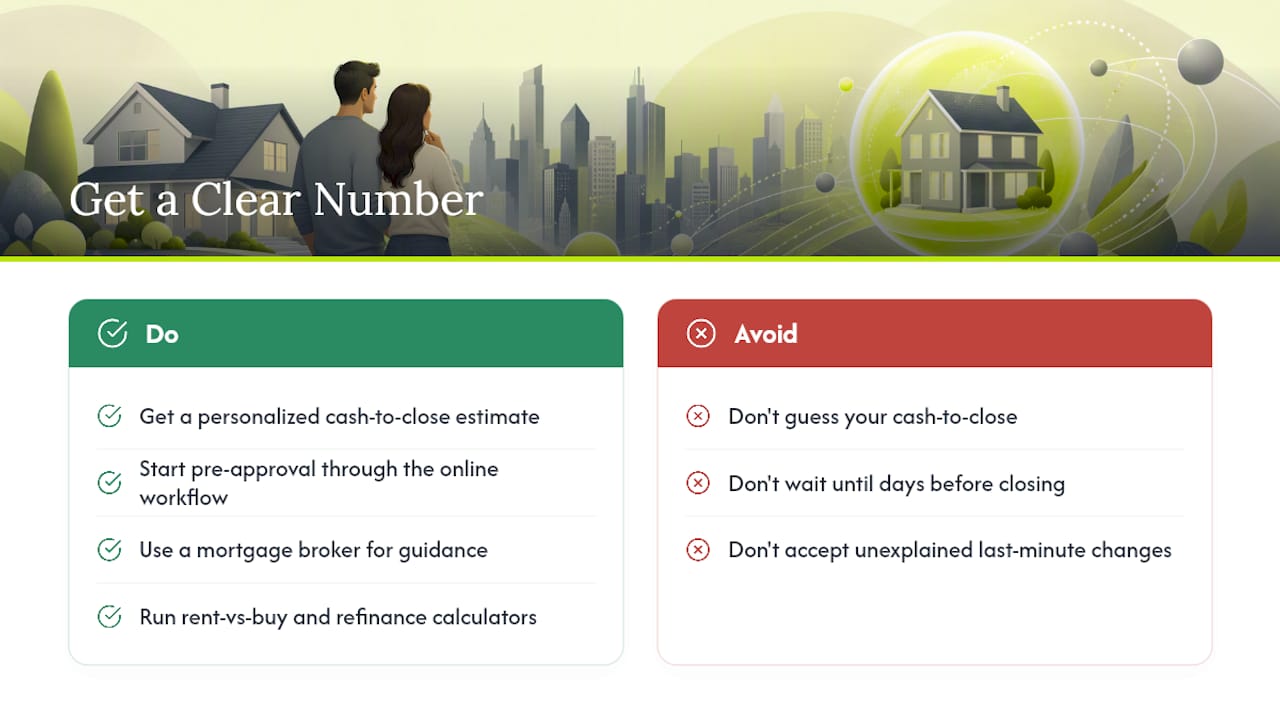
Get a Clear Number Before You Commit to Anything
Guessing at your cash-to-close number is how buyers end up scrambling for funds days before closing. Transparent estimates are built into the process from your first application, with a fully online workflow that can move you toward funding in under 21 days instead of the weeks a traditional lender often takes.

Whether you’re buying your first home, refinancing, or financing an investment property, the tools matter as much as the speed — learn more about the role of a mortgage broker to guide you through the process. Run your numbers through the rent vs buy calculator to see how your upfront cash stacks up against renting, or check the refinance calculator if you’re weighing whether rolling costs into a new loan makes sense for your situation. David Mordue’s team also verifies your Closing Disclosure figures directly with you, so nothing changes at the last minute without an explanation.
Ready to see your actual numbers? Start your pre-approval with David Mordue and get a clear, personalized cash-to-close estimate before you make an offer.
This article is general information, not a substitute for advice from a qualified financial advisor. Consult a qualified financial professional about your own circumstances before acting on anything here.