
Your interest rate is the base annual cost of borrowing and it’s what drives your monthly payment. Your APR is the interest rate plus most of the lender’s upfront fees, folded into a single annualized number to compare total cost. Here’s the rule of thumb:
- Use the interest rate to estimate your monthly payment.
- Use the APR to compare total cost between two similar loans, same loan type, same term.
- If those two numbers are far apart on one quote, that gap usually means points, origination charges, or mortgage insurance are baked into the deal.
TL;DR:
- The interest rate determines your monthly principal and interest payments, while APR includes upfront lender fees and charges.
- Comparing APRs is most accurate when loan types, terms, and holding periods are identical, but it can mislead if you plan to refinance or sell early.
- For a typical $300,000 30-year fixed mortgage, a 6.51% APR adds about $49 to your monthly payment compared to a lower rate, but costs $3,500 more upfront.
- Calculating your break-even point by dividing upfront fees by monthly savings helps determine whether to choose a higher-APR or lower-rate loan.
- Always compare loans with the same term, verify the actual fees per lender, and use tools or professional help to model your specific long-term and short-term costs.
Table of Contents
- APR vs Interest Rate: Why the Numbers Almost Never Match
- What APR Includes That Your Rate Doesn’t
- Turning APR vs Rate Into Real Dollars
- When APR Helps and When It Can Steer You Wrong
- Your Step-By-Step Process for Comparing Two Loan Offers
- How a Broker Actually Weighs Rate vs. APR
- Get a Real Comparison, Not Just Two Numbers Side by Side
- Key Takeaways
- Sources
APR vs Interest Rate: Why the Numbers Almost Never Match
Your interest rate is the percentage the lender charges annually on your outstanding principal. It’s the number your monthly payment is built from, and it shows up first on your Loan Estimate, on the Loan Terms page. A fixed rate stays the same for the life of the loan, so your principal and interest payment never moves. An adjustable rate (ARM) starts lower, then resets on a schedule tied to a market index, which makes your payment less predictable after the initial period ends.
Lenders don’t pull your rate out of thin air. They price it based on:
- Your credit score
- Your debt-to-income ratio (DTI)
- Your loan-to-value ratio (LTV), meaning your down payment size
- Where broader market rates sit that week
Two borrowers applying for the same $300,000 mortgage on the same day can get different rates purely because one has a 760 credit score and 20% down, and the other has a 680 and 5% down. That’s before fees ever enter the conversation.
What APR Includes That Your Rate Doesn’t
APR is an annualized percentage that wraps your interest rate together with many of the costs required to get the loan in the first place. That’s why APR is almost always higher than the base interest rate on a mortgage. On a typical home loan, APR usually rolls in:
- Origination fees the lender charges to process the loan
- Discount points you pay upfront to buy down the rate
- Broker fees, when a loan is arranged through a third party
- Mortgage insurance, in cases where it’s required at closing
It generally leaves out costs like the appraisal fee, credit report fee, and title charges, since those aren’t lender pricing decisions. There’s one notable exception to “APR is always higher”: credit cards. Card APRs typically equal the stated interest rate because there’s no origination fee to annualize into the number.
None of this is optional disclosure. The Truth in Lending Act requires every lender to show both figures, and on a mortgage, APR lives in the Comparisons section of your Loan Estimate, distinct from the rate on page one.
Turning APR vs Rate Into Real Dollars
Numbers make this click faster than definitions do. Say you’re financing $300,000 on a 30-year fixed mortgage and you get two offers; you might want to use a mortgage calculator to help compare the costs.
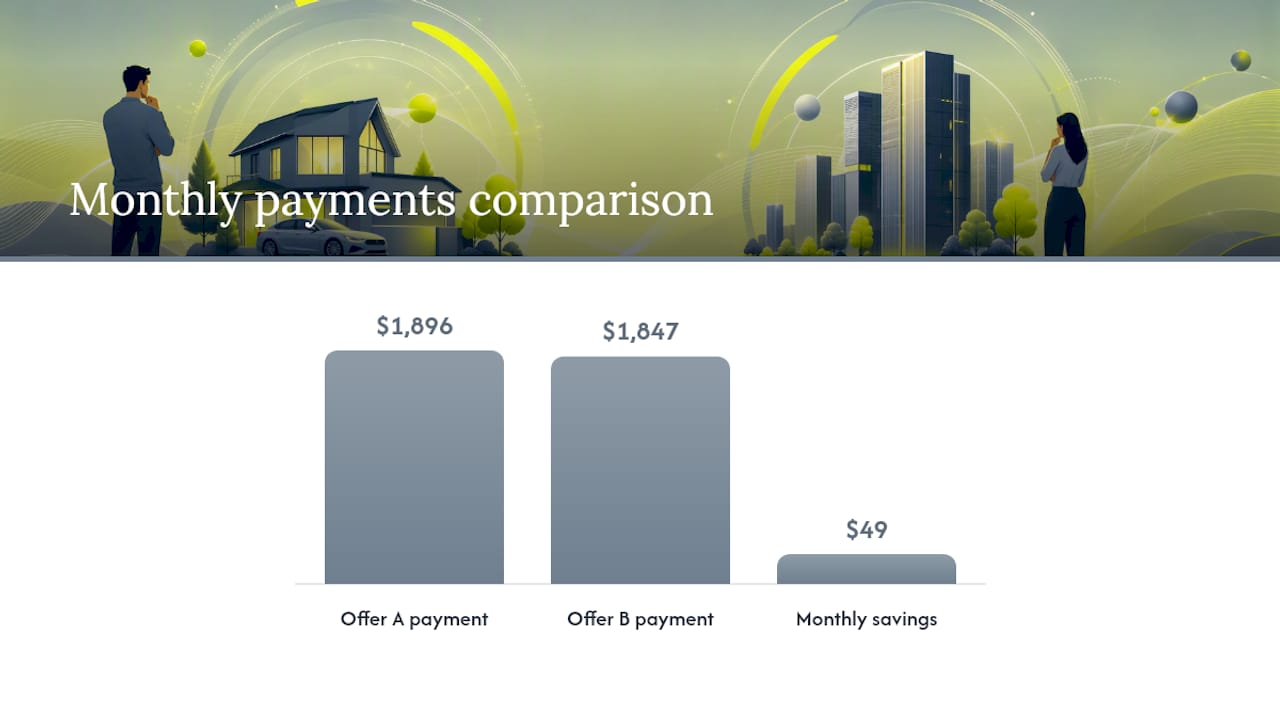
Monthly principal and interest: about $1,896.
Monthly principal and interest: about $1,847. APR: roughly 6.51%.
- Offer B has the lower rate, the lower APR, and the lower payment. Looks like the clear winner.
- But Offer B also costs $3,500 more upfront in points and fees.
This is exactly where the Loan Estimate’s five-year cost snapshot earns its keep. It totals your principal, interest, mortgage insurance, and loan costs over five years, so you can see which offer actually costs less if you don’t keep the loan for all 30 years. If you’re planning to sell or refinance within five to seven years, the lower-APR loan isn’t automatically the cheaper one for you.
Pro Tip: Divide the extra upfront cost by your monthly savings to get your break-even point in months. In the example above, $3,500 divided by roughly $49 in monthly savings comes to about 71 months, just under six years, before Offer B actually pulls ahead.
When APR Helps and When It Can Steer You Wrong
APR does real work: it exposes a loan that looks cheap on rate alone but loads on fees to make up the difference. That’s the entire point of the disclosure. But APR runs on one big assumption that doesn’t hold for every borrower: it assumes you keep the loan for its full term, spreading those upfront fees over 30 years of payments.
Three situations where that assumption breaks down:
- You expect to move or refinance soon. If you’ll hold the loan five years instead of thirty, calculate your actual break-even in dollars rather than trusting the annualized APR figure.
- You’re comparing ARMs. APR on an adjustable-rate mortgage is calculated off the introductory rate and doesn’t account for where your rate could reset once the fixed period ends. Never compare an ARM’s APR directly against a fixed-rate loan’s APR and assume it’s apples to apples.
- You’re comparing different loan structures. A HELOC’s APR calculation and a closed-end mortgage’s APR calculation aren’t built the same way. Comparing APRs across fundamentally different products tells you less than it looks like it does.
Your Step-By-Step Process for Comparing Two Loan Offers
Run every offer through the same sequence, in the same order, every time:
- Confirm the basics match. Same loan type, same term length, fixed against fixed or ARM against ARM. Comparing a 15-year fixed to a 30-year ARM tells you nothing useful.
- Compare rate to rate, then APR to APR. Line up the base interest rates for your monthly payment estimate, then line up the APRs separately for total cost.
- Pull the right numbers off the Loan Estimate. Your rate sits under Loan Terms on page one. APR and the five-year cost total sit in the Comparisons section on page three.
- Calculate your break-even on points. Upfront cost divided by monthly savings equals the number of months before paying points actually pays off.
- Ask the lender what’s in their APR. Not every lender bundles fees identically, so request a line-item breakdown rather than assuming two APRs were calculated the same way.
A refinance calculator or an affordability calculator can run steps two through four for you in minutes instead of a spreadsheet.
How a Broker Actually Weighs Rate vs. APR
When I sit down with a borrower, the math changes depending on one question: how long do you plan to keep this loan? Someone refinancing to lower a payment for the next three years needs a different answer than someone locking in a forever home. I use the refinance calculator and affordability tools to run both scenarios side by side, because the “right” answer between rate and APR depends entirely on your timeline, not on which number is smaller.
— David Mordue
Get a Real Comparison, Not Just Two Numbers Side by Side
Reading a Loan Estimate is one thing. Knowing whether paying points actually pays off for your specific timeline is another. David Mordue - Forward Financial Group runs your numbers through a fully online application, with rate comparisons across multiple lenders and a broker who can tell you in one conversation whether that lower APR is worth the upfront cost for how long you’re actually keeping the loan.

Test your own break-even math with the refinance calculator, or start your application now at Davidmordue and get a pre-approval decision fast, often with funding in less than 21 days.
Key Takeaways
Interest rate sets your monthly payment while APR annualizes your total borrowing cost, and comparing them correctly means matching loan type, term, and expected holding period before trusting either number alone.
| Point | Details |
|---|---|
| Rate drives payment | Your monthly principal and interest payment comes from the interest rate, not the APR. |
| APR reflects total cost | APR adds origination fees, points, and sometimes mortgage insurance to the interest rate. |
| Check the Loan Estimate | Rate appears on page one under Loan Terms; APR and five-year costs appear on page three. |
| Calculate your break-even | Divide upfront point or fee costs by monthly savings to find your true payoff timeline. |
| Don’t trust APR on ARMs | Adjustable-rate mortgage APRs reflect only the introductory rate, not future resets. |
| Get help running the numbers | David Mordue - Forward Financial Group compares rates across lenders and models break-even scenarios for your specific timeline. |
This article is general information, not a substitute for advice from a qualified financial advisor. Consult a qualified financial professional about your own circumstances before acting on anything here.
Sources
- What is the difference between a loan interest rate and the APR? | Consumer Financial Protection Bureau
- What Is APR and How Does It Affect Your Mortgage? - NerdWallet